"College Student Tourism and Community Development Contest": Bridging Communities and Students
The “University Student Tourism and Community Development Contest”* is a competition in which university students form teams to create “tourism and community development plans” aimed at revitalizing local areas. Organized by the JTB Tourism Research & Consulting Institute, the contest has been held annually since 2011. It is often said that interaction among people is essential for revitalizing a region. However, it is not only about visible movement of people; it is also important to increase the number of people who develop a deep attachment to the region—a “movement of the heart” that is not easily seen. In this column, I will examine how relationships with local communities are built through the “University Student Tourism and Community Development Contest.”
1. “University Student Tourism and Community Development Contest”
Now in its eighth year, the “University Student Tourism and Community Development Contest” was held across four regions (Ibaraki, Hokuriku, Nagasaki’s remote islands, and the Tama River), with 234 teams from 90 universities and 1,225 students participating. While the contest is expected to provide students with practical educational opportunities and contribute to the discovery of local resources and the promotion of regional tourism, another aspect became apparent on the ground.
At a social gathering with the students after the event, a representative from one of the universities told me, “Some of the students who didn’t win were so disappointed that they skipped the gathering.” In preparation for the contest, students spend about two months—from the June orientation to the mid-August plan submission deadline—gathering information, formulating hypotheses, conducting market research, and performing fieldwork.Through this fieldwork, they experience days spent seeing the local area with their own eyes, listening to the stories of local residents, gaining a real sense of the challenges, and pondering what they can do to solve them. Some teams even revisit the region to refine their plans and improve their feasibility. In this way, by engaging closely with the challenges of a region they previously had no connection to and continuing to think about them, the students come to deeply “engage with” a specific region and develop a genuine connection to it.
2. Changes in the Students’ Mindsets Following Contest Participation
We conducted a survey to assess the educational impact of participating in the contest and the changes observed in the students. Comparing their responses before and after participation, we noted significant educational benefits, such as the enhancement of foundational professional skills including “1. Action,” “2. Thinking,” and “3. Teamwork.” Notably, there was a particularly marked increase in “4. Attachment to the Community” and “6. Awareness of Contributing to the Community. ”We also heard comments from students that clearly demonstrated the cultivation of a new attachment to the region, such as, “Through this contest, I feel as though I’ve gained a third home—my hometown of Ehime—in addition to my university in Tokyo.”
Participation in the University Student Tourism and Community Development Contest allowed students to confront challenges in regions with which they had previously had no connection. This heightened their interest in the region and, as a result, deepened their attachment to it, revealing how the contest “touched their hearts” (Figure 1).
N=453
- Left scale: Self-assessment on a 7-point scale (pre/post—before and after contest participation)
- Right scale: Difference between pre- and post-assessments
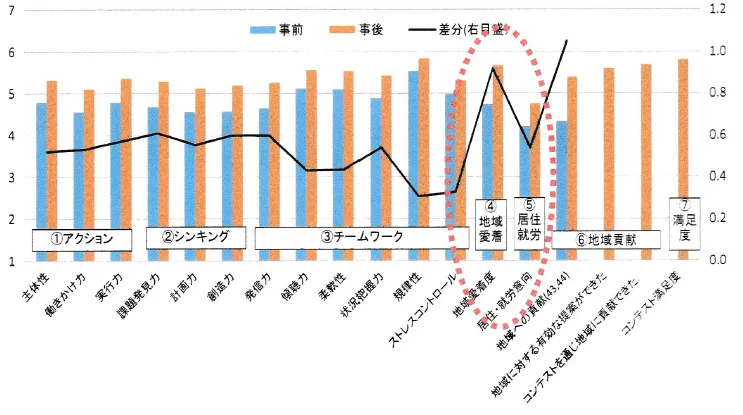
Contest Participation Source: Materials from the University Student Tourism and
Community Development Contest 2017 Steering Committee *Survey conducted during the 5th Contest (2015)
3. Fostering a Sense of Attachment to the Community Through Learning
So, does attachment to one’s “hometown”—a place with which one has had a deep connection since birth—naturally develop even without any special events?
Figure 2 shows that the deeper a student’s understanding of their hometown municipality by the time they finish high school (for example, being familiar with local businesses), the more likely they are to retain an attachment to their hometown even after moving outside the prefecture. While feelings toward one’s “hometown”—the region where one was born and raised—were once often spoken of emotionally as a matter of course, there is now a growing need to consciously nurture them.
In June of this year, the “Basic Policy on Revitalizing Towns, People, and Jobs 2018” and the “Basic Policy on Economic and Fiscal Management and Reform 2018” were approved by the Cabinet. These documents include provisions such as “promoting high school reforms that contribute to regional revitalization” and “strengthening the role of high schools as the core of regional development. ”When we look at the content—such as “promoting initiatives in which high schools, in collaboration with local municipalities and businesses, develop curricula that provide high school students with inquiry-based learning through activities like solving regional issues”—it becomes clear that this vision is similar to the “University Student Tourism Town Development Contest.”
Until now, we have focused our tourism education efforts primarily on university students, as seen in the “University Student Tourism Town Development Contest.” However, now that a sense of attachment to one’s “hometown” is no longer a given, there is a growing need for educational approaches that can help retain the emotional ties of children—who often leave their hometowns for higher education or employment—to the communities where they were born and raised. Going forward, we aim to develop and provide practical educational methods for high school students and even younger children.
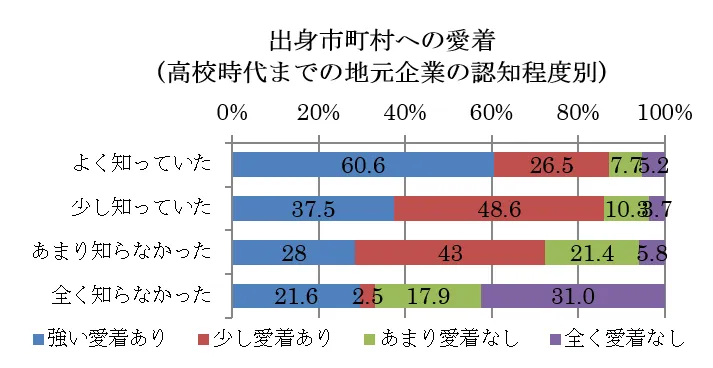
: Materials published on the Ministry of Education, Culture, Sports, Science and Technology (MEXT) website
, “Promotion of High School Education Reform through Collaboration with Local Communities” *“Exploring the Potential for Job Creation and the Return of Human Resources to Regional Areas (National Institute for Labour Policy and Training)”
*Target group: Residents living outside their home prefecture
<Source>
University Student Tourism and Community Development Contest Steering Committee, “University Student Tourism and Community Development Contest 2018”
著者