Toward Becoming a Nation Based on Inclusive Tourism
This year, one in five Japanese citizens will reach the age of 75 or older, and creating opportunities for them to go out and travel is considered crucial for extending healthy life expectancy and boosting economic benefits. Furthermore, as inbound tourism demand recovers, it has become clear that foreign travelers with disabilities are highly motivated to visit Japan. In this article, we will examine the necessity of universal tourism based on the results of our survey.
1. The 2025 Problem and the Need for Universal Tourism
Have you heard of the term “2025 Problem”? By 2025, the so-called “Baby Boom Generation”—those born during the first post-war baby boom—will turn 75 or older, meaning that approximately one in five Japanese citizens will be classified as “elderly aged 75 and over.” This situation is expected to highlight various social challenges, including economic issues such as pensions and medical expenses, as well as employment-related problems like the need for long-term care and a shortage of successors.
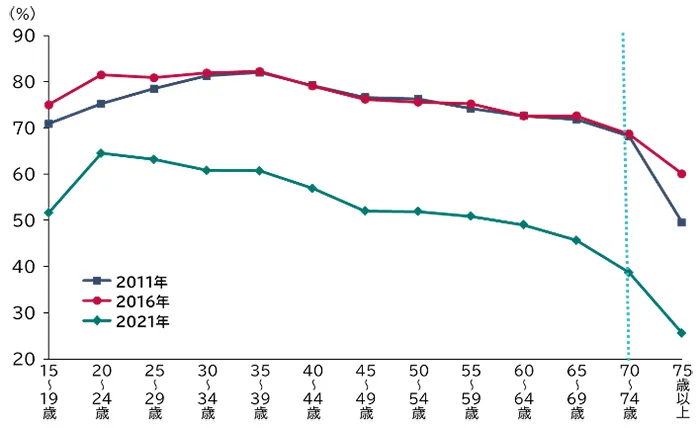
Data shows that people aged 70 and older tend to travel less frequently due to health concerns (Figure 1). Consequently, the number of Japanese travelers is expected to decline further in the future. Furthermore, with the elderly population projected to grow worldwide, the need for universal tourism is increasing globally as a step toward realizing an inclusive society.
The promotion of universal tourism has the potential to encourage social participation among the elderly and contribute to extending healthy life expectancy. Furthermore, it is considered an important measure for addressing the “2025 Problem,” including the creation of new markets targeting the elderly and people with disabilities, and the revitalization of local communities through the barrier-free development of tourist destinations.
The issue of an aging population is becoming increasingly severe not only in Japan but also in Europe and Asia, and from the perspective of inbound tourism, universal tourism is likely to play an increasingly important role in the future.
Therefore, in October 2024, our company conducted a survey on the travel needs of older adults in Japan and on travel to Japan by people with disabilities from overseas. We also visited leading destinations abroad and conducted interviews with UN World Tourism Organization (UNWTO) and other organizations. Through this research, we aimed to clarify what kind of reception environment should be established and to contribute to discussions on the future of the tourism industry, including the “2025 Problem.” In this column, we will present our analysis based on these survey results.
2. Japanese Seniors’ Desire to Travel Abroad
First, we will examine the findings of a survey (*1) that explored the desire among Japanese seniors to travel abroad.
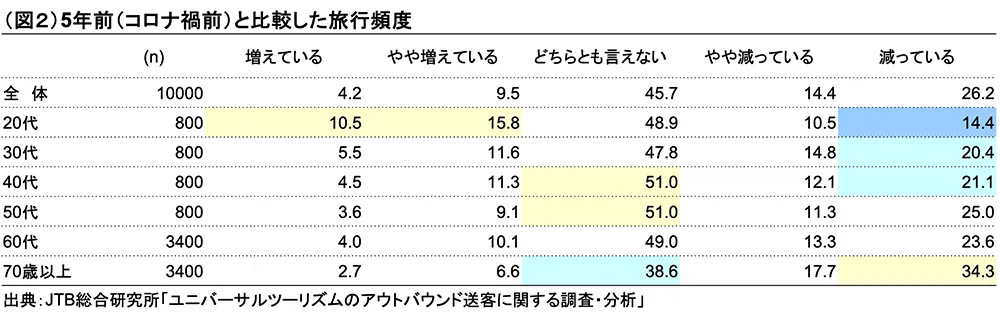
Although the number of Japanese travelers abroad is showing signs of recovery compared to pre-pandemic levels, it has not yet reached 2019 levels. According to the survey results, while more than 25% of those in their 20s reported that their travel frequency had “increased” compared to before the pandemic, more than 50% of those aged 70 and older responded that it had “decreased slightly” or “decreased” (Figure 2).
When asked why they do not travel, over 50% of seniors cited “lack of confidence in their energy or physical strength,” while nearly 40% stated that “their desire to travel has waned due to the COVID-19 pandemic,” indicating that the pandemic has significantly impacted seniors’ willingness to travel (Figure 3).
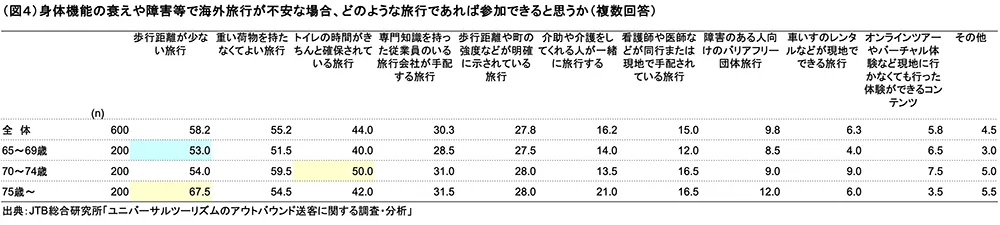
Furthermore, while many older adults wish to travel to Europe, some express hesitation due to reasons such as “cobblestone streets make walking difficult,” “old towns require a lot of walking,” and “poor restroom facilities.” In response to the question “What kind of trip would you be able to participate in?” over 50% cited “trips with minimal walking” and “trips where they don’t have to carry heavy luggage,” while over 40% cited “trips where restroom breaks are guaranteed” (Figure 4).Furthermore, regarding “factors prioritized when choosing an overseas trip,” over 85% cited “good public safety,” and more than 50% of those aged 75 and older stated that they prefer “a tour guide accompanying them from Japan” (Figure 5).
These survey results indicate that to create travel products that make it easier for older adults to travel abroad, it is necessary to prioritize safety and peace of mind—specifically, “good public safety,” “walking distances that are not burdensome,” “ensuring time for restroom breaks,” and “having a tour guide.”
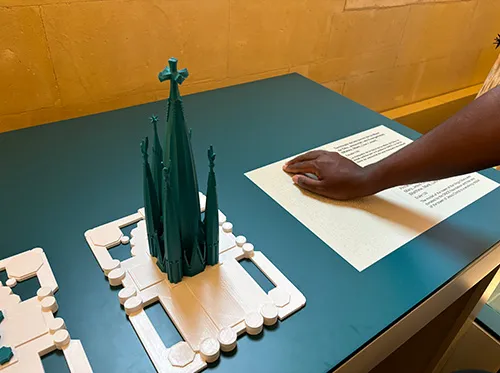
Furthermore, in recent years, the global promotion of universal tourism has led to an increase in the number of tourist destinations becoming barrier-free. Utilizing photos and videos of barrier-free tourist destinations overseas is expected to alleviate the anxieties of older adults and boost their motivation to travel abroad.
(*1) 2024 JTB Tourism Research & Consulting Independent Study: “Survey and Analysis of Outbound Travel Promotion for Universal Tourism.” After collecting questionnaires from 10,000 people using a research firm’s panel, 600 travel enthusiasts aged 65 and older were selected for analysis of the survey results.


3. Challenges Facing Foreign Tourists with Disabilities Visiting Japan
The Japan Tourism Agency has been promoting universal tourism since around 2011. In particular, following the hosting of the Tokyo 2020 Olympic and Paralympic Games, the number of local governments and businesses promoting universal tourism within Japan has increased, and the term has become widely recognized. However, the reality is that it is currently often perceived as “travel for the elderly or people with disabilities.”
Think of “Universal Studios.” It is by no means a theme park exclusively for the elderly or people with disabilities; rather, its purpose is to be “enjoyable for everyone.” Similarly, universal tourism is not limited to specific groups of people but refers to an environment where everyone can travel comfortably.
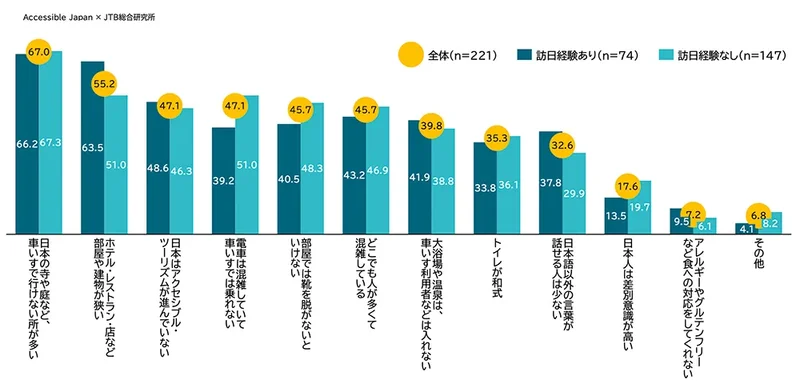
In fact, the terms “universal tourism” and “universal room” are Japanese-coined English terms; overseas, they are expressed as “accessible tourism” and “accessible room.” For this reason, when people with disabilities from overseas search for barrier-free information in Japan using keywords like “#Japan accessible,” they may have difficulty finding relevant information. As a result, there is a risk that they may misunderstand that “accessible tourism is not well-developed in Japan” (*2).
When foreigners who have visited Japan were asked about difficulties they encountered during their trips, 50% responded that “there are few or no accessible rooms at accommodation facilities.” Because Japan has a deep-rooted bathing culture, universal rooms often include bathtubs, whereas facilities with showers only are common overseas. Consequently, many respondents pointed out inconveniences, such as the bathtub making it difficult to use the shower and making the bathroom feel cramped.
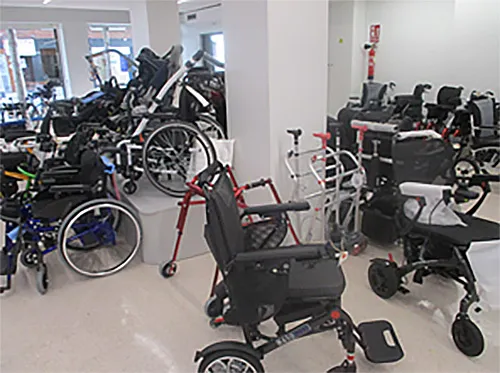
Furthermore, this survey revealed that there is a significant number of electric wheelchair users (*2). Responses indicated that electric wheelchairs are used at a rate comparable to manual wheelchairs (*2). In Spain, where accessible tourism is well-developed, there are stores near major hospitals that sell a wide variety of wheelchairs and assistive devices, displayed in a showroom-like setting. As a result, it is common to see elderly people and people with disabilities using electric wheelchairs on a daily basis.
Around the world, mobility aids such as wheelchairs—which serve as means of transportation—are evolving significantly, leading to improved convenience. However, in Japan, the level of support for electric wheelchairs at tourist destinations and on public transportation remains insufficient.
Looking ahead, as we prepare to welcome visitors with disabilities from overseas, key challenges will include the proper application of the term “universal design,” bathroom facilities in accommodations, and accessibility for electric wheelchairs.

(*2) Joint survey by Accessible Japan and JTB Tourism Research & Consulting: “Survey on the Perceptions of Accessible Tourism in Japan Among People with Disabilities Living Abroad”
4. The Concept of Universal Tourism Needed in Japan
How is Japan’s universal tourism perceived from overseas?
A representative from the United Nations World Tourism Organization (UNWTO) made the following observations: “While Japan is recognized as a leading nation in the Asia-Pacific region, the focus has been on accommodating the elderly. Consequently, consideration for younger people with disabilities and those with invisible disabilities (such as hearing impairments, intellectual and developmental disabilities, mental health conditions, internal disabilities, and intractable diseases) cannot be said to be sufficient.Another challenge is the significant disparity in the progress of barrier-free initiatives between major cities and regional cities.”
We also learned that the perspective on accessible tourism in Europe and the United States differs from that in Japan. Specifically, the following three points can be cited:
- Guarantee of Human Rights: Tourism is viewed as an important part of activities that improve quality of life. Ensuring equal access to these activities is a fundamental guarantee of human rights.
- Sustainable Tourism: Enabling more people to participate in tourism increases revenue for tourist destinations. Furthermore, creating an environment that makes travel easier for people with disabilities and the elderly ultimately leads to a more comfortable environment for all travelers.
- Social Inclusion: By providing opportunities for people with disabilities to actively participate in society, the inclusivity of the local community as a whole improves, and the reputation of the destination also rises.
These perspectives differ significantly from the common Japanese mindset that “we must do something for the elderly and people with disabilities,” and instead view universal tourism in a broader sense.
Compared to a few years ago, barrier-free access to public facilities in urban areas of Japan has improved; however, as noted earlier, there is a tendency to place particular emphasis on accommodating wheelchair users and people with physical disabilities. Furthermore, moving forward, it is necessary to consider universal design with the premise that it will be used by a more diverse range of people, not just wheelchair users. Limiting the scope of accessibility could lead to a situation in the future where renovations become necessary to accommodate people with disabilities that were not anticipated at the time.
In an aging Japan, the promotion of universal tourism plays a vital role in both addressing social challenges and fostering the development of the tourism industry. For Japan to become a truly inclusive tourism nation, it is essential to shift mindsets and disseminate information emphasizing that, in addition to physical accessibility improvements, creating an environment where everyone—not just the elderly and people with disabilities—can travel comfortably contributes to the protection of human rights, sustainable tourism, and social inclusion.We must reexamine the essence of universal tourism and work to build a future where people of all backgrounds can freely enjoy travel.
著者