Kansai, Japan’s tourism capital. ―Kansai’s pivotal role in Japan’s future as a tourism-oriented nation―
Japan’s tourism industry is undergoing a transition from quantity to quality. The 2025 World Expo not only demonstrated its success in attracting visitors but also highlighted structural challenges. Now, in the “post-Expo” era, the path charted by the Kansai region—with its diverse resources—will serve as a litmus test for the future of Japanese tourism. In this article, we view Kansai as the “tourism capital of Japan” and examine the pivotal role it will play in the nation’s future as a tourism-oriented country.
1. From “Quantity” to “Structure”: The Current State of Japan as a Tourism-Oriented Nation—From Expanding Volume to Structural Reforms Focused on Quality
Japan’s tourism industry is currently passing a clear turning point. The number of international visitors to Japan is recovering rapidly, and the goal of “60 million” has come within realistic reach. However, the focus is no longer on the numbers themselves. The questions now are: where do visitors enter, how do they travel, and in which regions do they leave a lasting impact?Having overcome challenges such as “concentration in specific regions” and “disparities between regions” faced during the expansion period of the 2010s, tourism is shifting from quantitative growth to a stage of structural design. This change aligns with the very nature of Japan as a nation. Amid a declining population, tourism has become a theme related to the “structure of the nation”—one that influences regional sustainability and the very use of the land—rather than merely a means of earning foreign currency. By nature, the Japanese archipelago—stretching 3,200 kilometers from north to south—possesses diverse climates and historical and cultural assets scattered across the country, creating a structure where profound experiences can only be gained through “itinerary-based travel.” However, in reality, tourism has remained limited to “point-based” visits prioritizing efficiency, failing to fully leverage this potential. What is needed now is a structural shift that reconnects these abundant resources from “points” to “areas.” The question is where to develop a model that transforms travel itself into value and distributes benefits across a wide region, rather than limiting them to specific cities. Geographical conditions, resource density, and the proximity of urban and rural areas—the “Kansai” region, the subject of this article, is the very stage that possesses all these elements and can implement the next model for a tourism-driven nation.
2. Kansai is a region where “Japan’s diversity can be experienced all at once” — Structural Advantages as a Comprehensive Destination —
Kansai’s tourism value does not stem from a single iconic resource. Rather, its essence lies in the fact that diverse elements—such as nature, culture, faith, and urban life—coexist in a multi-layered manner within a single living and travel sphere. This is not merely a matter of “having many famous tourist spots”; it is an extremely important characteristic in the sense that the region possesses a structure allowing visitors to experience the diversity of Japan in a three-dimensional way within a relatively short time and distance. Data also supports Kansai’s importance.
Looking at the figures for 2024, Kansai accounted for approximately 28.2% of the nation’s total overnight stays by foreign visitors and approximately 27.1% of inbound tourism spending. Considering that Kansai’s share of the nation’s total GDP is only about 15–16%, it becomes clear just how prominent Kansai’s presence is in the tourism sector.Kansai International Airport also accounts for approximately 25.7% of the nation’s total foreign arrivals, clearly establishing Kansai as Japan’s most critical hub for inbound tourism.
Turning to the natural environment, Kansai is home to three national parks, each with its own distinct character.Yoshino-Kumano National Park, where mountain worship and pristine nature still thrive; San’in Kaigan National Park, where the dynamism of topography and geology stands out; and Setonaikai National Park, where the landscape of the archipelago intertwines with human activity. These are not merely scenic spots, but spaces that embody the Japanese view of nature and the history of daily life, and they are highly compatible with adventure tourism and spiritual travel, which have garnered attention in recent years.
The concentration of cultural and historical assets is another major feature of the Kansai region. From castle architecture represented by Himeji Castle, to the cultural properties of the ancient capitals of Kyoto and Nara, to the origins of Buddhist architecture symbolized by Horyuji Temple, to the fusion of faith and nature demonstrated by the sacred sites and pilgrimage routes of the Kii Mountains, and even to the traces of ancient state formation seen in the Mozu-Furuichi Tumulus Cluster, one can trace the history of Japan chronologically.It is rare even on a global scale to find such a continuous concentration of values spanning such diverse eras within a single region.
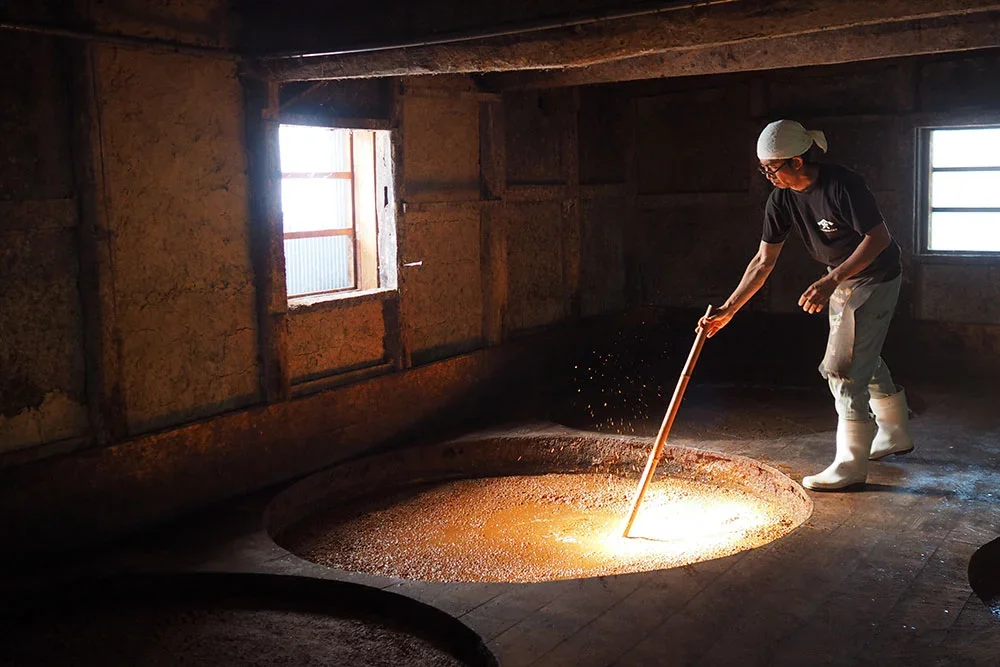
Furthermore, the Kansai region possesses a rich cultural heritage centered on food. Starting with sake, as represented by the Nada, Fushimi, and Omi regions, a culture of fermentation has become deeply rooted in the local way of life and industry.Food is not only a highly effective tourism resource, but because it is directly linked to the region’s daily life and industries, it is also likely to lead to increased value of stay and higher spending per visitor. This aligns strongly with current tourism policies aimed at creating high added value. Furthermore, Kansai excels in balancing urban functions with local culture.
While encompassing the major metropolitan area of Osaka, the region is surrounded by a continuous landscape of mountains, sea, and countryside, creating a seamless connection between the city and nature. This sense of scale provides the flexibility to accommodate both short-term and long-term stays, offering a significant advantage in designing itineraries for both sightseeing and extended stays. Thus, Kansai is not merely a collection of resources.It is one of the few comprehensive destinations in Japan where nature and culture, the past and the present, and the extraordinary and the ordinary overlap without being severed. This is precisely why Kansai can serve as a “testing ground” and “implementation hub” as Japanese tourism moves into its next phase.
3. Why Has “Circuit Tourism” Failed to Gain Traction? — The Distortions in the Tourism Structure Reflected by Kyoto’s Crowding —
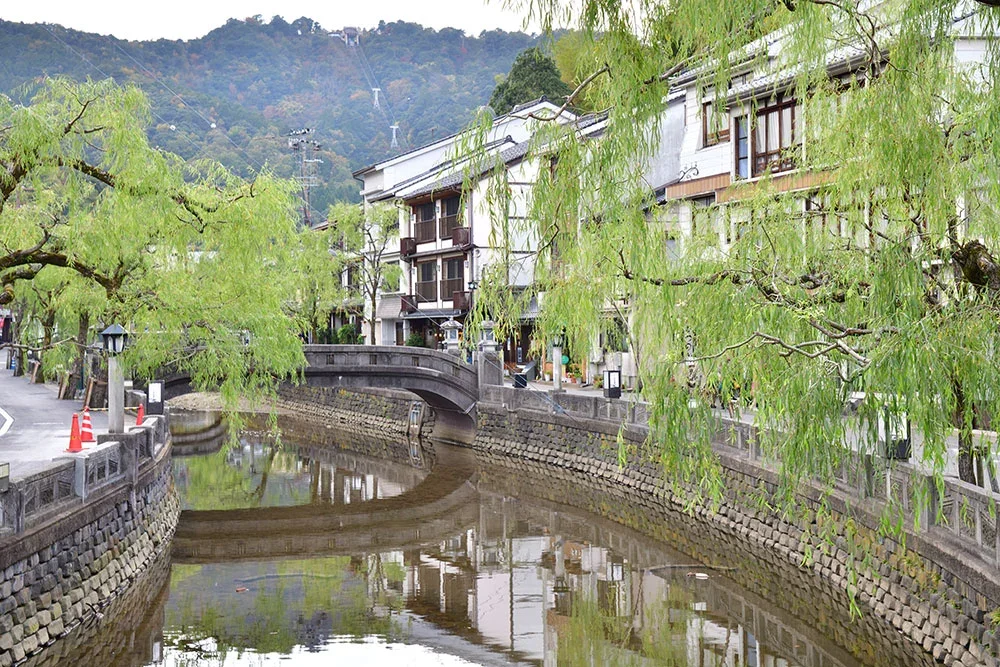
When discussing tourism in Kansai, one cannot avoid the issue of localized tourist concentration—so-called “overconcentration”—occurring in certain areas of Kyoto City. Issues such as overcrowding, poor etiquette, and the impact on residents’ daily lives have already been widely covered by the media. However, simply dismissing this phenomenon as “inevitable because Kyoto is popular” misses the essence of the problem. Kyoto’s congestion is not the result of a lack of appeal in the Kansai region as a whole. Quite the opposite: Kansai possesses a diverse array of natural and cultural resources beyond Kyoto. Nevertheless, the fact that tourist flows have concentrated in specific areas is due solely to the fact that the “structure” of tourism has been designed to work this way.
A look at the actual figures clearly reveals this “structural distortion.” Examining the breakdown of inbound tourism spending in the Kansai region for 2024, Osaka Prefecture (68%) and Kyoto Prefecture (27%) alone account for 95% of the total, while other areas—including Hyogo, Nara, Wakayama, and Shiga—account for a mere 5%.While the proportion of foreign visitors among all lodging guests in Kansai stands at 38.0%—significantly higher than the national average (23.0%)—the benefits of this are extremely unevenly distributed. There are several clear bottlenecks underlying this situation.
First, there are the barriers created by administrative boundaries. In the Kansai region in particular, the powerful cities of Osaka, Kyoto, and Kobe are in close proximity, and because each had the ability to attract visitors on its own, there was little incentive to collaborate across a wider area. However, tourists do not pay attention to prefectural borders. Optimization based on administrative units often conflicts with the perspective of wide-area travel. Second is the complexity of the transportation network. While Kansai, often called the “Kingdom of Private Railways,” boasts a well-developed rail network, this also makes transfers between operators and fare structures prone to complexity, leaving challenges—particularly regarding connections to secondary transportation. The hassle of getting around is a major factor that discourages travelers from exploring the region. Third is the fragmentation of data. Because data on passenger flow and congestion has not been sufficiently shared across regions and operators, efforts to avoid congestion and propose travel itineraries have not been effective. As a result, people have continued to concentrate in places that are “easy to understand and easy to get to” for travelers, while other areas have struggled to become viable options.
This is not a problem with the travelers themselves, but rather a problem with how options are presented—that is, a structural design issue. This structural distortion represents a lost opportunity for the Kansai region as a whole. While congestion lowers the quality of the tourism experience and creates friction with local residents, it also prevents sufficient economic benefits from spreading to surrounding areas. If we aim to “improve quality” as a tourism-oriented nation, we cannot allow this situation to continue. The key is not to make reducing congestion in Kyoto an end in itself.
What is needed is a perspective that views the entire Kansai region as a single “area” and intentionally reworks the flow of people. This requires data sharing across prefectural borders, the redesign of secondary transportation networks, and the integration of information dissemination. Only with these measures in place can the concept of “itinerary-based travel” become a reality. The congestion in Kyoto is not a sign of the limits of Kansai tourism. Rather, it is a signal indicating that there is significant room to enhance the value of the entire Kansai region by changing the underlying structure.
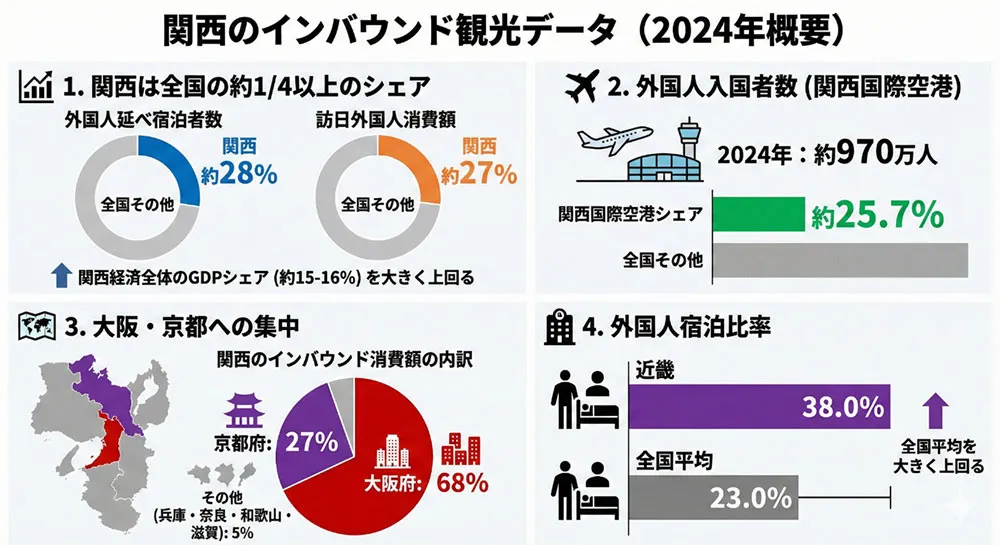
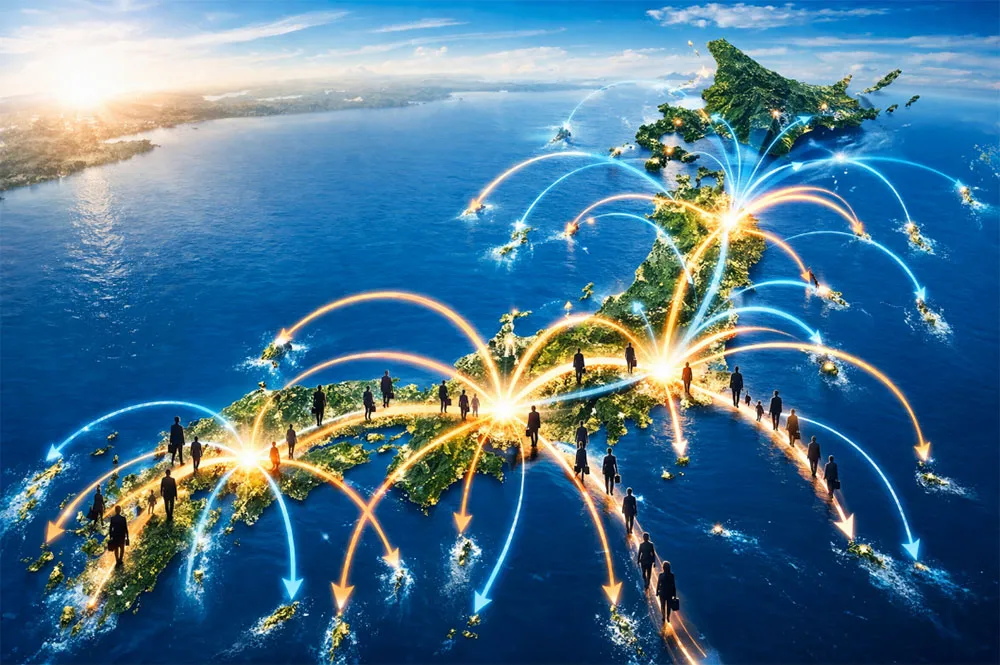
Tourism Organization, Kansai Airport, and the Asia-Pacific Research Institute (This image was created using generative AI.)
4. Implementing “Circuit Tourism” — The Concrete Vision of Transformation Indicated by Tourism SX
The term “itinerary-based travel” has been discussed repeatedly in the past. However, in reality, it has remained merely a concept and has not been fully implemented. The reason is clear: itinerary-based travel cannot be achieved through mere “calls to action”; it will not move forward without the will and mechanisms to change the structure.
This is where the concept of “Tourism SX (Sustainability Transformation),” which I have been advocating, becomes key. Tourism SX is not about tourism that forces people to make sacrifices in order to protect the environment or culture. It is a process of transformation that, through tourism, reconfigures the very relationships between regions, travelers, and businesses, simultaneously achieving sustainability and value creation.
Specifically, the first element is “visualizing and guiding tourist flows.” By monitoring congestion in real time and displaying this information digitally, travelers can proactively avoid crowded areas and choose different destinations or times of day. This is not a restriction but a mechanism to expand options, serving as a practical solution to overcrowding.
Second is “redesigning economic circulation.” By creating a system where local residents engage in tourism as guides or hosts, and where the revenue is directly reinvested in the restoration of cultural properties, the preservation of traditional events, and nature conservation, tourism transforms from a consumable commodity into a foundation that supports the region. Adding value does not simply mean raising unit prices; it also means clarifying where that value goes.
Third, “seamless mobility” is essential. If we assume wide-area travel, transportation systems fragmented by prefectural borders and paper-based tickets become obstacles. By digitizing wide-area passes and integrating transportation data, we can create an environment where travel from “points” to “areas” can be intuitively understood, turning wide-area travel into a realistic option.
All of these elements are already technically feasible. The challenge lies in determining who will take the lead and at what level they will be implemented. This is precisely why Tourism SX cannot be achieved through the efforts of individual tourist destinations alone. It requires a perspective that treats the entire Kansai region as a single testing ground, based on collaboration that transcends prefectural and sectoral boundaries.
Circuit tourism is not simply about increasing travel distances. It is an act of expanding travel options, enhancing the quality of stays, and, as a result, elevating the value of the Kansai region as a whole. Implementing circuit tourism from the perspective of Tourism SX is the key to transforming the challenges facing Kansai into opportunities.
5. Can Kansai Airport Become a “Device for Weaving People Flows”? — Moving Beyond Short-Term Fluctuations to Become the Foundation Supporting a Tourism-Driven Nation —
The existence of an “entry point” plays a decisive role in implementing circuit tourism. An entry point is not merely the place where people first set foot. It is the starting point where travel expectations are formed and subsequent actions are directed; it is also a mechanism that influences the tourism structure itself. In that sense, Kansai International Airport possesses the potential to reshape Japanese tourism.
The defining feature of Kansai International Airport is that it is an international hub capable of 24-hour operation. The lack of time-of-day constraints not only enhances the flexibility of the air network but also serves as a major strength as the inbound market diversifies and becomes more dispersed in the future. There are very few airports in Japan that have the capacity to redesign passenger flows—including those from emerging markets—without relying on specific countries or regions.
On the other hand, inbound demand is not always stable. In the past, we have experienced situations where specific routes or markets saw a sharp decline due to infectious diseases or changes in the international political landscape. While such short-term fluctuations in the external environment are unavoidable, what matters is not the immediate number of flights, but how to leverage the airport’s structural value. The characteristic of being a 24-hour airport can serve as a foundation to overcome short-term demand fluctuations and support Japan’s position as a tourism-oriented nation in the medium to long term.
Furthermore, throughout the Expo period, several challenges became clear: fragmented information provision upon arrival at the airport, confusion regarding secondary transportation, and differing guidance systems across different regions. If options beyond the airport are not sufficiently visible, the flow of people will concentrate in the most easily accessible urban areas. This is not merely an issue with the airport itself, but a structural problem stemming from the failure to position the airport as the core of the tourism strategy.
What is now required of Kansai International Airport is to break free from its role as a mere “transit point.” Can it evolve into a place where, upon arrival, travelers are presented with tour routes and transportation options that offer a bird’s-eye view of the entire Kansai region—a place where the curation of their journey begins? Whether Kansai International Airport can be utilized not merely as a receptacle for passenger flow, but as a mechanism that intentionally “weaves” that flow, will determine the future of tourism in Kansai and, by extension, Japan.
6. The “Next Move” for Kansai Tourism After the Expo: Can the Excitement Be Transformed into a Sustainable Structure?
The 2025 Osaka-Kansai Expo brought unprecedented international attention and a surge of visitors to the Kansai region. During the event, a diverse array of visitors from both Japan and abroad gathered, and in this sense, the Expo played a significant role in highlighting the region’s potential. On the other hand, the Expo also served as a venue that brought to light the structural challenges facing Japan’s tourism industry.
A telling example was that while people gathered at the Expo—a single “point”—it is difficult to say that the mechanisms to naturally extend that enthusiasm across the entire Kansai region functioned adequately.Constraints on secondary transportation, the fragmentation of information across regions, and the difficulty of collaboration across prefectural borders were likely challenges that many stakeholders experienced firsthand during the Expo. This is not a matter of debating the Expo’s success or failure; rather, it should be viewed as empirical evidence of the constraints inherent in Japan’s tourism structure itself.
What is important is not to treat the Expo as a “concluded event,” but rather to consider how to build on the possibilities and limitations revealed there. The key question is whether we can establish a pattern where people who visited Kansai for the Expo return after the event ends, or use the Expo as a gateway to explore surrounding regions. The success of this effort depends on the initiatives taken after the Expo.
Kansai possesses the conditions necessary to ensure that the Expo’s enthusiasm does not fade away as a fleeting phenomenon. This is because the region offers a geographical setting where cities, nature, and historical and cultural sites are in close proximity, making it easy to plan itineraries that allow visitors to explore the area. What is needed is a shift away from the mindset that treats the event as an endpoint. Instead, we must repurpose the visitor flow data accumulated during the Expo and the framework for wide-area collaboration for everyday tourism, adopting a perspective that “reweaves” visitor flows by treating the Expo as a waypoint.
Now that the Expo is over, what is required of Kansai is not to wait for the next major event. Rather, it is to combine airports, transportation, local stakeholders, and digital technology to renew the very structure of everyday tourism. The Expo has ended. However, whether Kansai will serve as the core of Japan’s tourism industry depends on the choices made from here on out.
7. Kansai, the Tourism Capital of Japan: The Core Role Kansai Must Assume in a Tourism-Driven Nation
Japanese tourism is shifting from a phase of competing for higher visitor numbers to a phase of reexamining its very structure. How can we design tourism that enhances the quality of stays, generates economic circulation within the region, and harmonizes with the lives of residents? The answer lies not in the efforts of individual tourist destinations, but in the perspective of how to weave the entire region together anew.
As we have seen in this article, Kansai possesses the conditions necessary to fulfill this role. It boasts a diverse natural environment, globally acclaimed historical and cultural assets, a rich tradition of fermentation and cuisine, and a geographical characteristic where urban and rural areas coexist in close proximity. Furthermore, it possesses an international gateway in the form of Kansai International Airport, which operates 24 hours a day, and has experienced both the potential and challenges of hosting a large-scale event like the World Expo. These factors are no coincidence; they demonstrate that Kansai is a region worthy of discussing the “structure of tourism.”
On the other hand, localized congestion—symbolized by Kyoto—and the fragmentation of systems, transportation, and information that has hindered travel throughout the region could undermine the value of the entire Kansai area if left unaddressed. This is precisely why the perspective of “Tourism SX,” as advocated by the author, is so important.Tourism SX is a concept that goes beyond tourism for the sake of preservation; it leverages digital technology and wide-area collaboration to transform the very flow of people and the circulation of value. We must convert congestion into appropriate dispersion and circulation, evolving tourism into a mechanism that connects the region to its future.
It can be said that Kansai tourism has, until now, been characterized by a somewhat passive “wait-and-see” attitude. However, what is needed going forward is the resolve to intentionally “weave” the flow of people using tools such as airports and events. We must transcend prefectural boundaries and the divide between the public and private sectors to enhance value across the entire Kansai region. Without this challenge, the next stage for a nation built on tourism will remain out of sight.
Kansai, the tourism capital of Japan. This is not merely a title, but a role we must choose to embrace. By leveraging our culture and diversity as strengths and taking the lead in concretely envisioning the future of Japanese tourism, Kansai can take that first step toward expanding the potential of Japan as a tourism-oriented nation.
著者