Post-COVID International Expansion: Exploring the Factors Behind the Rise of LCCs

The number of international flight seats nationwide has recovered to 71% of the level seen in the winter of 2019 by the summer of 2023. Fukuoka and Tokyo, in particular, have seen significant increases. This recovery is driven by the rapid growth of low-cost carriers (LCCs). What role will LCCs play in international travel in the post-pandemic era? In this column, we will examine the factors behind the rise of LCCs and consider their future prospects.
The COVID-19 pandemic has completely transformed the market environment!
Although there have been temporary spikes due to the pandemic, airfares globally are on a long-term downward trend. As many of you are aware, this has led to the emergence of low-cost carriers (LCCs), which have significantly revised their operating costs to offer low fares and better meet market demand. Not only independent carriers but also major airlines have launched LCC operations within their groups and expanded their scale. By building business portfolios tailored to specific market segments, they have been striving to increase revenue and profits.
During the pandemic, the demand for high-priced business travel declined or stagnated as online meetings became the norm.Alarmed by this situation, airlines realized they needed to secure revenue from other market segments. The cornerstone of this strategy is the leisure and VFR (Visit Friends and Relatives) market. Since these ticket purchases are funded by personal expenses, low-cost pricing is essential. Consequently, this spurred the expansion of LCC operations, which leverage low fares as their key competitive advantage.
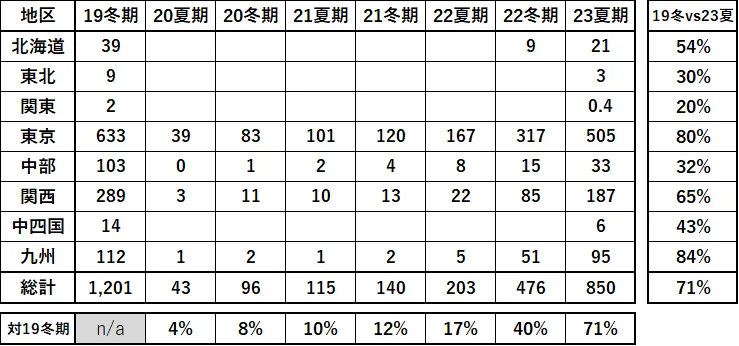
Air passenger numbers declined significantly during the COVID-19 pandemic, a trend particularly evident on international routes. Subsequently, starting especially in 2022, the inbound tourism market began to recover first, leading to an increase in international flight capacity through the resumption of suspended routes and the use of larger aircraft. Let’s examine the trend in weekly seat capacity for international flights departing from Japan from the pre-pandemic period to the present—specifically, from the 2019 winter schedule through the 2023 summer schedule.
Nationwide, using the 2019 winter season as a baseline, the figure plummeted to 4% by the following 2020 summer season, with flights operating only out of Tokyo, Kansai, and Fukuoka airports. It then increased gradually, reaching 40% by the 2022 winter season. Over the subsequent year leading up to the 2023 summer season, it recovered to 71%.By domestic departure region, while the Kyushu region recovered to 84% and the Tokyo region to 80%, the Kanto region (Ibaraki Airport) remained sluggish at 20%, the Tohoku region at 30%, and the Chubu region at 32%. The fact that the Kyushu region exceeded the national average by 13 percentage points is due to the concentrated resumption of flights to Fukuoka Airport, which boosted the region’s total. (See Table 1)
Looking at changes by destination region, routes to China—which boasted the highest number of seats in the summer of 2019—remained at a low level of 29% (80,214 seats) in the summer of 2023. On the other hand, routes to South Korea, which ranked second, showed a significant increase to 122% (200,487 seats).Other high-volume regions—Taiwan, Hong Kong, and other Asian destinations—showed resilience, ranging from 73% to 75%, exceeding the overall average of 71%. Additionally, the Pacific (North America) region posted strong results at 109%.

Surge in Air Cargo Demand and Changes in Flight Operations Due to the COVID-19 Pandemic
During the COVID-19 pandemic, flights were particularly concentrated in Tokyo. This was due to the need for strict quarantine management, which led to the consolidation of flights at major airports, as well as robust demand for air cargo. In 2020–2021, when the impact of the pandemic peaked, cargo backlogs occurred due to reduced customs clearance capacity at port facilities. Additionally, demand for smartphones and PCs surged due to the global rise in “stay-at-home consumption.”Driven by social restrictions such as stay-at-home orders, the rapid expansion of production for these information and communication devices led to increased demand for core components, such as semiconductors. Furthermore, there was a need not only to transport these components to assembly sites but also to minimize the time required to deliver finished products to target markets, resulting in an unprecedented surge in demand for international air cargo transport.
In addition to transport via dedicated cargo aircraft, the use of passenger aircraft bellies (the cargo space beneath the floor) for cargo transport also garnered significant attention.This is the reason why a certain number of scheduled passenger flights continued to operate despite low passenger load factors. Furthermore, the practice of operating passenger aircraft as de facto cargo planes—using only the cargo hold without carrying passengers—became widely adopted. Moreover, as a last-ditch measure to increase cargo capacity, emergency transport methods emerged, such as removing passenger seats to create cargo space or loading cargo while the seats remained installed.
LCC Market Share Expands in the Post-COVID Environment
Let’s take a look at the development of LCCs.
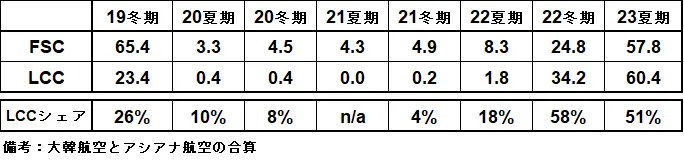
Nationwide, the LCC market share stood at 23% in the summer of 2019 but dropped to 4% in the summer of 2020. After that, there were no major changes, but the share began to increase from the summer of 2022, showing a rapid recovery to account for 31% by the summer of 2023. (See Table 3)

During the COVID-19 pandemic, LCCs were the first to suspend or reduce flights. Although FSCs subsequently followed suit with suspensions and reductions, they maintained the minimum necessary transport capacity. Starting in 2022, as passenger demand began to recover rapidly, both FSCs and LCCs expanded their transport capacity.
Here is an example involving Korean companies on the Japan-Korea route. Currently, the merger process between Korea’s two major airlines, Korean Air and Asiana Airlines, is underway; if successful, it will create a massive airline group. Both companies operate both FSC and LCC services, and their combined LCC market share stood at 26% as of the winter of 2019.Although this figure dropped to zero during the summer of 2021, when the impact of the COVID-19 pandemic was severe, it has since rebounded sharply, reaching 51% by the summer of 2023 following the resumption of operations. (See Table 4)
What are the reasons for expanding the LCC business?
During the COVID-19 pandemic, the industry implemented thorough rationalization measures, including reducing the number of aircraft in operation through the postponement of new aircraft deliveries, the early retirement of older models, and the long-term storage of unused aircraft, as well as reducing the workforce through layoffs, temporary furloughs, and job reassignments.
A key characteristic of airline management is the need to secure qualified personnel with advanced knowledge and skills, such as pilots and maintenance technicians. Prior to the pandemic, there were concerns about a global pilot shortage. However, the pandemic led to a sudden oversupply of pilots, who faced reduced income due to fewer flight hours and a lack of flight experience required to maintain their pilot licenses.If airlines lack aircraft, flight crews, ground staff, and airport facilities when demand returns, they will be unable to provide air transport services and meet that demand. There is also a risk that this could limit their potential for future growth. In short, business management must possess the flexibility to respond immediately to changing circumstances.
Under these highly volatile conditions, the industry avoided bankruptcy and service suspensions not only through rigorous cost-cutting but also by relying on full-service carriers (FSCs)—which generally offer better working conditions and have strong employee representation through unions—to handle the minimum necessary transport operations. This approach also served to ensure pilots met the required flight experience within a specified period to maintain their piloting skills.Subsequently, during the recovery phase when an increase in passenger demand was anticipated, LCCs expanded seat capacity at a faster pace than FSCs.
In other words, could it not be argued that LCCs serve as a “regulatory valve”—a flexible mechanism that adapts to the situation? The operational structure observed this time could be described as a form of “risk diversification” that leveraged the functions of both FSCs and LCCs with an eye toward a “normal” state—essentially, a return to pre-pandemic conditions.
Hybrid LCCs Operating Medium- and Long-Haul Routes Set to Expand
Following the pandemic, average ticket prices rose. This was because the resumption of aircraft operations and the restoration of airport operational systems lagged behind the rapid recovery in demand. However, as flight resumption progresses, ticket prices are likely to decline.
The establishment of LCCs began with short-haul routes. As the number of passengers increases, the barriers to using LCCs for medium- and long-haul flights will decrease.
Recently, efforts to establish medium- and long-haul LCCs have intensified. ZIPAIR Tokyo and Air Japan—LCC ventures operated by major Japanese airlines—are prime examples. Compared to short-haul LCCs, these carriers offer more spacious seating and have introduced a system where passengers can purchase add-on services such as in-flight meals and checked baggage as needed. We can expect the establishment of so-called “hybrid LCCs”—which pursue comfort while enabling efficient travel—to continue moving forward.
*Source of all charts and graphs: Weekly Travel Journal “Airline Seat Survey” (compiled by the author from data collected between Winter 2019 and Summer 2023)
著者