Toward an Era of Rediscovering the Cultural Value of Living Architecture: Developing Modernist Architecture as a Tourism Resource

In 2016, the Agency for Cultural Affairs announced its initiative to “revitalize the economy through the utilization of cultural and artistic resources” (expanding “cultural GDP”). By interpreting “culture” as a broad concept and pursuing economic revitalization with an eye toward its spillover effects on tourism and other industries, the initiative aims to expand cultural GDP to 3% of Japan’s total GDP. Currently, Japanese Modernist architecture is at the center of a debate over “preservation versus utilization.” Why should it be preserved? What is the best way to preserve it? And how can we foster a desire to preserve it? From a tourism perspective, we will examine how architectural cultural resources can be understood and utilized.
While shrines, temples, and historic sites have long been regarded as cultural tourism resources that symbolize Japan, buildings that people still use on a daily basis have not traditionally been viewed as cultural properties worthy of appreciation. Although there are efforts to preserve pre-war architecture, such as Tokyo Station, much of the “Japanese Modernist architecture”—built after the war and still in use today—has disappeared over the past five to ten years. The demolition of the main building of the Hotel Okura Tokyo garnered attention as a symbolic event, prompting preservation campaigns led primarily by cultural figures from Western countries. A major reason for demolition is that buildings serve as the stage for people’s daily lives, and the fundamental premise is that they should be utilized safely and comfortably. Particularly in earthquake-prone Japan, it was common for aging postwar buildings with concerns regarding seismic resistance to reach the end of their useful life at a certain point. Nevertheless, architecture reflects the social climate, culture, and cutting-edge technology of its time, and serves as evidence passed down to the present.
1. What is Modernist Architecture?
The Modern Movement (Modern Architecture Movement) was a major trend in 20th-century architecture, aiming to create buildings suited to the society that emerged after the Industrial Revolution. This movement gained international momentum in response to the rapid transformation of urban structures across various countries due to urbanization.
One of the leading figures of the Modern Movement was Le Corbusier. It is still fresh in our memory that “The Architectural Works of Le Corbusier” was inscribed on the World Heritage List.The reason this was recognized as a World Heritage Site is not merely because Le Corbusier’s works are magnificent in and of themselves, but because, when viewed as a snapshot of a specific era, they represent the manifestation of a particular culture that spread widely across the globe—spanning three continents and seven countries—and served as a pioneer of that movement. In other words, they served as “evidence of the cultural landscape of a certain era” and signaled “the dawn of an era in which specific values could spread throughout the world.”Japan was no exception; three architects known as Le Corbusier’s “three disciples” studied under him and brought Modernist architecture to full bloom within the country. Through these three disciples, the concepts and styles of Modernist architecture spread widely throughout Japan.In addition to the Hotel Okura mentioned earlier, examples can be found in numerous museums, concert halls, and government buildings, such as the Tokyo Bunka Kaikan (completed in 1961) by Kunio Maekawa—which stands like a sibling opposite Le Corbusier’s National Museum of Western Art in Ueno Park, Tokyo—and the Hiroshima Peace Memorial Museum (completed in 1955), considered a masterpiece by Kenzo Tange.
2. Awareness of Modernist Architecture and Movements Toward Preservation
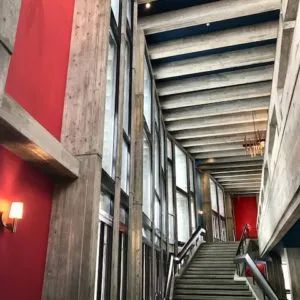
To be honest, Modernist architecture is difficult to understand. Sophisticated Modernist architecture, which helped build the social infrastructure during the transition from the modern to the contemporary era, lacks both nostalgic romanticism and decorative flamboyance. In other words, it is human-centered architecture designed to put the people who work and live in those buildings at the forefront. It is a fact that this lack of obvious visual appeal makes it difficult to view postwar architecture as a cultural resource.
In fact, when asked about the recognition of architects from the modern era onward within Japan, the situation is as follows.
In order of recognition, they are Kisho Kurokawa (65%), Tadao Ando (54%), and Kenzo Tange (46%). It is reasonable to assume that Kisho Kurokawa (during his run for Tokyo Governor) and Tadao Ando enjoy high recognition due to their relatively frequent media exposure, while Kenzo Tange’s recognition stems from extensive coverage regarding the Yoyogi National Gymnasium in the lead-up to the Tokyo Olympics and his design of the current Tokyo Metropolitan Government Building.Following them in terms of recognition are Kengo Kuma, Le Corbusier, Frank Lloyd Wright, and Kingo Tatsuno, all of whom have recognition rates of just under 30%. The recognition rates for Le Corbusier’s three disciples—Kunio Maekawa and Junzo Sakakura—remain around 10%. (Figure 1)
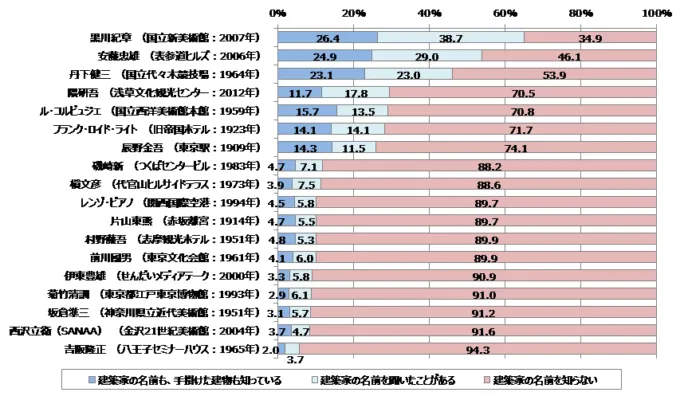
Modern Era Onward Source: Modern Architecture Tourism Network
Modernist architecture, which has historically lacked recognition as cultural heritage, remains largely at risk of demolition today, and there have been many cases where buildings that have outlived their original purpose have been demolished without leaving a record.In 1988, with the aim of raising public awareness of these Modern Movement buildings (MOMO architecture) as cultural heritage, the international academic organization "DOCOMOMO (International Working Party for Documentation and Conservation of buildings, sites and neighborhoods of the Modern Movement)" was established, with the Netherlands at its core. In Japan, DOCOMOMO Japan was established in 2000.
3. Modernist Architecture as Something to “See, Enter, and Enjoy”
In November 2016, the “Modern Architecture Tourism Network” was established in Japan. Starting with Le Corbusier and using his direct disciple Kunio Maekawa as a springboard, the network is promoting activities aimed at preserving modernist architecture by raising awareness of its value—including works by Murano and Tange—through the market and utilizing them as tourism resources. By shifting public perception to view these structures as “must-see attractions,” the initiative seeks to foster preservation efforts.
That said, when examining market interest in architecture, interest in 20th-century architecture remains relatively low. “Domestic historic buildings” top the list of buildings of interest at 87%. This is followed by “domestic villages and streetscapes” at 62% and “overseas historic buildings” at 58%. In contrast, interest in “domestic architecture from the modern era onward” is relatively low compared to historic buildings, standing at just 40%.Looking at the generations with the highest interest, men in their 20s account for nearly 60%, while men in their 40s and women in their 40s and 50s exceed 45%, suggesting that modern architecture has a relatively stronger appeal to men.While interest in cultural heritage typically correlates with age, a distinctive feature of modern architecture is that men in their 20s and those in their 40s and 50s show higher levels of interest than older age groups. It is presumed that older adults find it difficult to recognize these buildings as “cultural assets worth seeing” precisely because they have been familiar sights in their daily lives. (Figure 2)
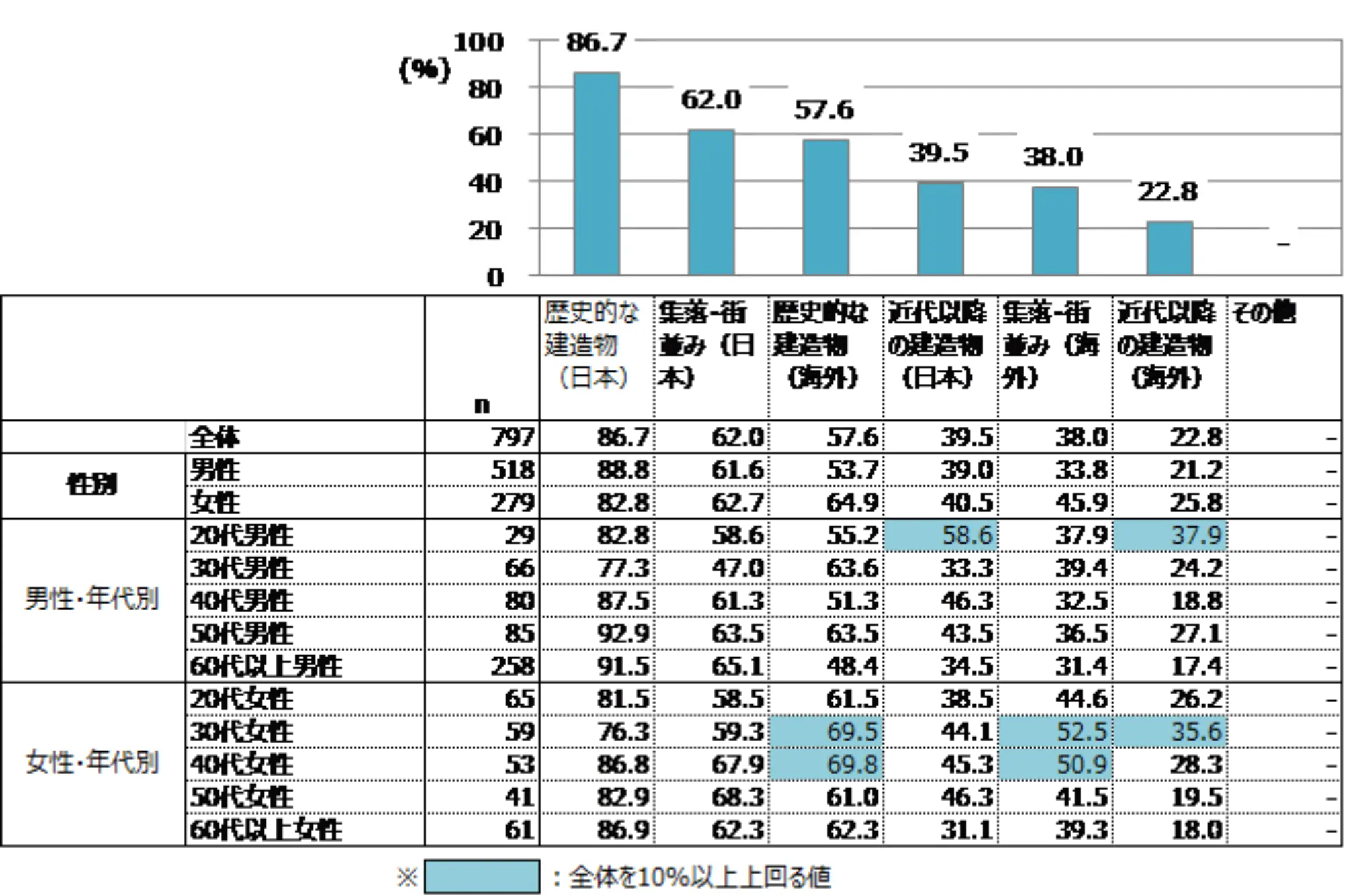
Source: Modern Architecture Tourism Network
Regarding the reasons for a lack of interest in visiting buildings from the 1900s onward, “No interest in the buildings themselves” (44%) was the most common response, followed by “Don’t understand their appeal” and “Lack of knowledge,” both in the 20% range.Among men in their 20s, “my companions are not interested” was the top reason, while among women in their 20s, “lack of knowledge” was cited—both more than 10% higher than the overall average. It is essential to implement initiatives that broaden the base of visitors by promoting these sites as places that can be enjoyed casually, even without extensive knowledge. (Figure 3)
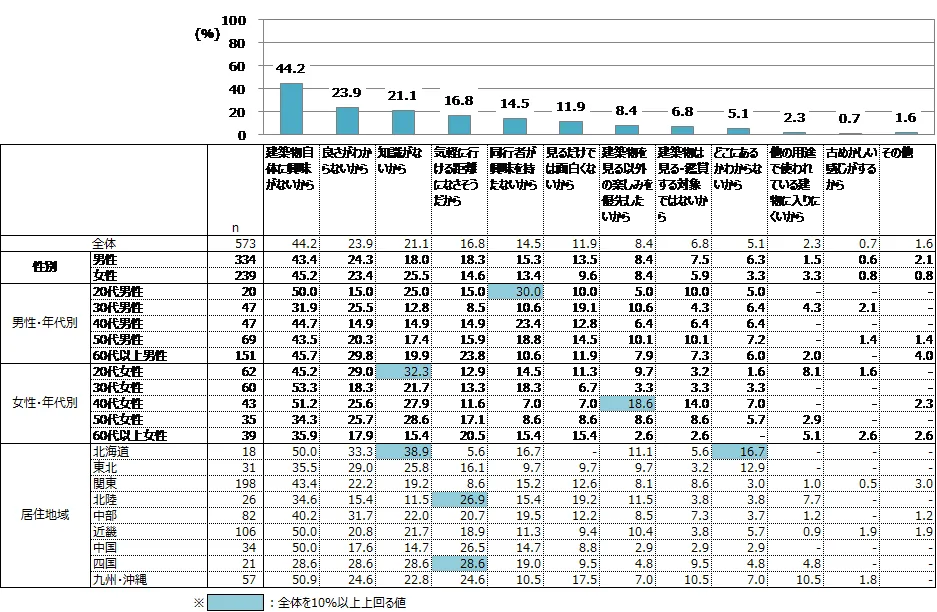
Source: Modern Architecture Tourism Network
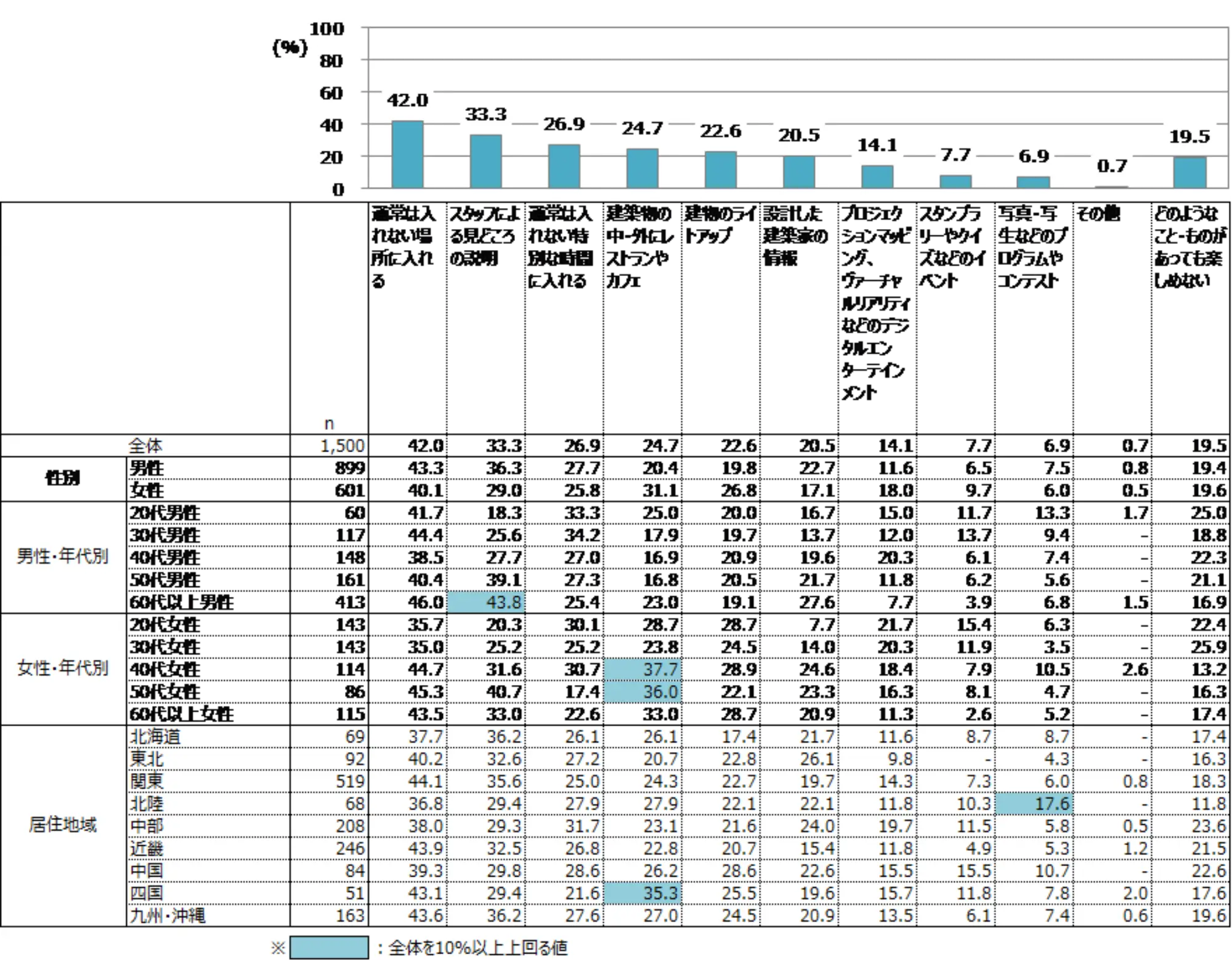
Regarding what would be desirable for enjoying architectural sites, “access to areas normally off-limits” was the most common response at 42%. This was followed by “explanations of highlights by staff” (33%), “access during hours normally off-limits” (27%), and “the presence of restaurants, cafes, or similar spaces” (25%)."Explanations of highlights by staff" was most popular among men and women in their 50s and 60s, while "restaurants and cafes" was most popular among women in their 40s and 50s. "Events such as stamp rallies" (8%) was most popular among men and women in their 20s and 30s. "Information about the architect who designed the building" exceeded 20% among men in their 50s and 60s and women aged 40 and older, but was not sought after by younger generations.While the importance of interpretation for people in their 50s and 60s—who typically have more time in their itineraries—is obvious, the comfort of the space itself, designed to encourage visitors to linger and appreciate the architecture, is also essential. Efforts are needed to present diverse ways of enjoying architecture tailored to the target audience. (Figure 4)
Source: Modern Architecture Tourism Network
4. Examples of Specific Initiatives
The ideal state for a building is for it to be actively utilized and alive. It is hoped that by promoting initiatives that allow people to experience how the building is actually used or to participate in its preservation, the value of the architecture will be widely recognized, leading to the inheritance of these resources rather than their mere preservation in a frozen state. While the movement to preserve and utilize Modernist architecture began in Europe and the United States, active initiatives have also been implemented in Japan in recent years.
(1) Unité d’Habitation (Marseille, France, and other locations)
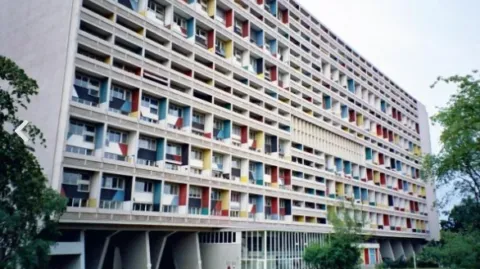
The photograph shows a building designed by Le Corbusier and completed in 1914. At a time when stone masonry was the mainstream in Western architecture, he devised the “Domino System,” which uses reinforced concrete and columns to support the structure.Designed as a “vertical city”—a way of living in densely populated urban areas—it reimagines urban space in a vertical dimension. The Unité in Marseille consists of apartment buildings (337 units, accommodating 1,600 residents) and a hotel. The ground floor represents a street, with mailboxes, public telephones, and a post office located in the lobby.The second floor and above are designed as residential units, while the third and fourth floors house a hotel, restaurants, a bakery, and a real estate agency. The rooftop is designed to serve as a school and a plaza. (*“Unité d’Habitation” is the collective name for a series of apartment complexes designed by Le Corbusier (commonly known as “Unité”). The Unité in Marseille is a component of a UNESCO World Heritage Site.)
As of May 2017, the building’s common areas (corridors, lobby, rooftop, etc.) are open to the public during the day for free viewing, and photography is permitted. Guided tours of the residential units are offered twice daily on Tuesdays and Saturdays for 90 minutes at a cost of 10 euros; during these tours, visitors may view the residential units with the residents’ permission.
: www.emprendewiki.com
(2) Living Architecture Museum (Commonly known as “Ikefes,” Osaka City)
Since FY 2013, the City of Osaka has viewed the city as a single, large museum and has implemented initiatives to create and promote the appeal of the “Living Architecture” found within it. As part of the “Living Architecture Museum Project” targeting the Midosuji area—one of the priority areas under the City Attractiveness Creation Strategy—70 “Osaka Selections” were chosen, and pilot projects such as special public viewings and walking tours have been conducted.Held in FYs 2014 and 2015 through cooperation and collaboration with building owners, private companies, universities, and other entities, the “Living Architecture Museum Festival Osaka (Ikefes Osaka)” has established itself as one of Japan’s largest architecture events originating in Osaka. In 2016, it became one of Japan’s largest public architecture events, attracting a total of 37,000 participants.With the cooperation of building owners and others, “Living Architecture”—structures that are normally off-limits to the public—are opened to the public for two days only. On the day of the event, employees from the companies actually using the buildings serve as guides, explaining the architecture’s unique features and appeal. Needless to say, the strength of this cooperative relationship with the building’s users is a key factor in the event’s continued success. Currently, the event operates independently as a self-sustaining initiative led by the Living Architecture Museum Osaka Executive Committee.
(3) Arch Walk Hiroshima (Hiroshima City)
Hiroshima is home to many renowned architectural works, such as the Peace Memorial Cathedral designed by Togo Murano and the Hiroshima Prefectural Government Building, which bears the strong influence of Kenzo Tange. Arch Walk Hiroshima is a citizen-led organization composed of architecture enthusiasts. As part of Hiroshima City’s city promotion strategy, it promotes activities aimed at repositioning architecture as a key tourism resource for the city through initiatives such as hosting architectural open house events and publishing architectural guidebooks.
For special open-house events at buildings that are normally off-limits to the public, the group incorporates creative elements designed to add value and foster interaction, such as hearing firsthand accounts from building owners and architects, providing detailed commentary, and incorporating music and art. Additionally, to enable visitors to enjoy architectural walking tours of Hiroshima even without a guide, the group produced 7,000 copies of the guidebook “HIROSHIMA ARCHITECTURE” in 2010 and distributed them free of charge at various locations throughout Hiroshima City.An additional 8,000 copies of the guidebook were printed in FY 2011. Downloads from the website exceeded 5,000, generating a significant response. Subsequently, in 2012, the guidebook was expanded and published as a book titled “Archimap Hiroshima.”In recent years, the scope has expanded beyond Hiroshima City to include the “Setouchi Sea Project,” which focuses on notable architectural works scattered throughout the Setouchi region, with the aim of promoting interregional collaboration.
5. To Develop Architecture into a Cultural Tourism Resource
Over the past five years, movements have been gaining momentum across Japan to recognize the value of postwar architecture, position it as part of the city’s identity, and utilize it as a tourism resource. The greatest barrier to establishing modern architecture as a tourism resource with cultural value is the aforementioned “difficulty in understanding.” To overcome this barrier, the skills of those who interpret architecture are crucial.The key is not to convey detailed knowledge about architecture or architects, but rather to convey “how to view and appreciate architecture” itself. We must explore methods to make people feel a connection to Modernist architecture—which can be considered the progenitor of the contemporary architecture we take for granted—while helping them recognize the technical sophistication and coolness that cannot be replicated today (and that no one attempts to replicate), thereby bridging the gap between people and architecture.
Architecture has the advantage of being “touchable” and “enterable.” It can function as a space where visitors experience ways of engaging with and approaching culture that are unique to architecture—experiences that are simply impossible with cultural properties enshrined behind glass cases. Returning to the fundamental principle that Modernist architecture was created for the people who live and work within and around it, ensuring that visitors truly feel its comfort and livability is also key.While the specific elements that contribute to comfort—such as the way light enters, the color palette, the acoustics, and a sense of solid reassurance—will vary from facility to facility, it is essential to create comfortable spaces for visitors. To bring out the “maximum value” (the architect’s original intent) of each building, we must be prepared to undertake renovations if necessary. It is important to note that, in the case of architecture, preserving the original state exactly as it is does not necessarily maximize its value. As an aside, in facilities that have converted historic buildings into museums, if all one sees are chains saying “Do not enter this room” or signs saying “Do not sit on this chair,” it leaves one feeling quite disillusioned when considering the very purpose of preservation and public access.
From the perspective of tourism resources, I would add that visitors should not merely enjoy the architecture itself, but rather, by conveying the inevitability of “why it is there” (it exists in this land and serves this function, which is why it has this form), they should be able to take a moment to reflect on the geographical characteristics of the area, the mindset of its people, and the history of the past century. Architecture, just like shrines, temples, and natural landscapes, remains a valuable cultural resource for understanding a region’s climate and culture. However, what is particularly noteworthy is that it allows us to sense the intense individual talent, vision, and passion of the “architect”—a quality unique to the 20th century and absent in natural resources or traditional shrines and temples. It is both a regional tourist resource and the work of a single individual. Furthermore, unlike paintings or sculptures, this work is not frozen in time; people move within it, and the air and light of daily life circulate through it. The public and the private, history and the everyday—I believe it is this precarious balance that constitutes the greatest charm of Modernist architecture.
著者