DMO Management as It Moves into the Implementation Phase
“DMOs (Destination Management/Marketing Organizations)” are currently attracting attention as organizations that play a central role in promoting regional tourism. In this article, I would like to examine the “management of regional tourism promotion,” which is a key requirement for DMOs. *This column is a reprint, with permission, of an article originally published in the August 2017 issue of “KER Economic Information,” published by Kyushu Economic Research Institute, Inc.
1. DMOs: Driving Regional Tourism Development
Have you ever heard the term “DMO”?
While there are many examples of DMOs in countries such as Europe, the United States, and Australia, in Japan, the Japan Tourism Agency launched a registration system for “Japanese-style DMOs” in November 2015. As of July 2017, 145 organizations nationwide had been registered as “Japanese-style DMO candidate organizations,” with 19 registered in the Kyushu region.
There are three types of “Japanese-style DMOs”: “Wide-Area Collaborative DMOs” that span multiple prefectures; “Regional Collaborative DMOs” that treat an area spanning multiple municipalities as a single tourism region; and “Regional DMOs” that cover the territory of a single municipality. In Kagoshima Prefecture, four organizations are registered: the Osumi Wide-Area Tourism Association (tentative name), the Amami Oshima Tourism and Local Products Federation (General Incorporated Association), and Yasashii Machi Co., Ltd. as “Regional Collaboration DMOs”; and the Satsumasendai City Tourism and Local Products Association Co., Ltd. as a “Local DMO.”
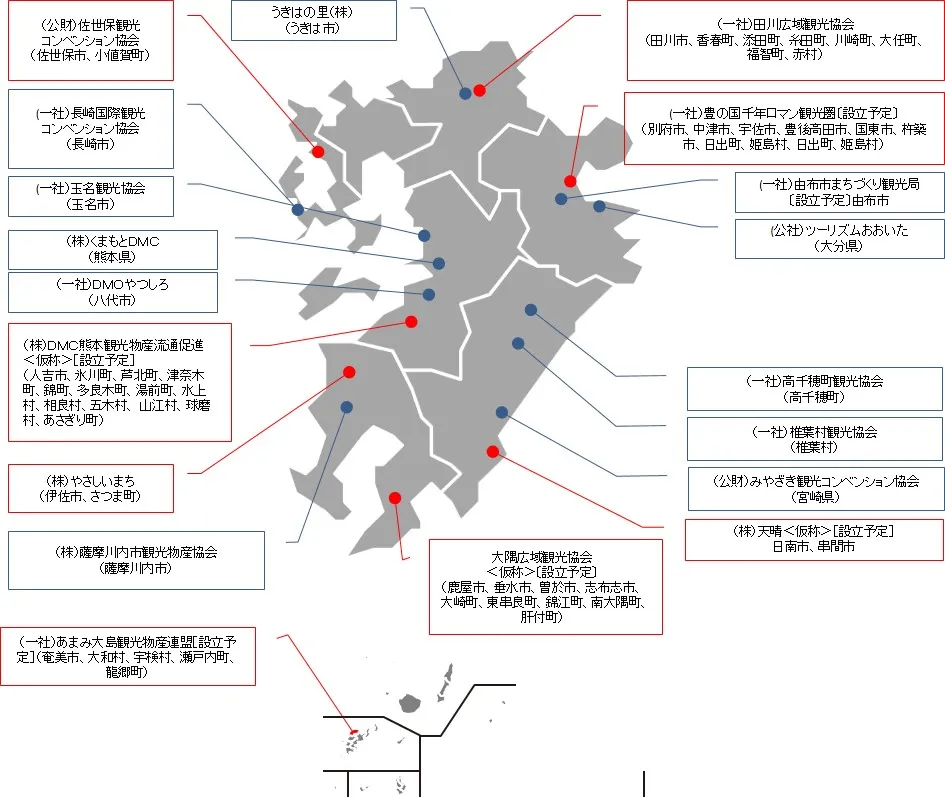
*Red frame: Regional Collaboration DMO (multiple municipalities); Blue frame: Regional DMO (single municipality)
Source: Created by the author based on Japan Tourism Agency materials
2. From DMO Candidate to Official DMO
As the term “Candidate Organization Registration” suggests, Japan’s DMO system is currently limited to the registration of candidate organizations. As indicated by the goal of “establishing 100 world-class DMOs nationwide by 2020” (Tourism Vision to Support Japan’s Future, March 2016), the current “Japanese-style DMOs” are positioned as being in the formation stage. They aim to be certified as official “Japanese-style DMOs” by consistently producing results through initiatives carried out during the period leading up to 2020.
To be certified as a formal “Japanese-style DMO,” organizations must demonstrate sound management based on the “Japanese-style DMO Formation and Establishment Plan” created during the registration phase (demonstrating progress and results on the items to be addressed).
In particular, for DMOs formed in the early stages, it is important to check, after more than a year and a half since formation, whether the items outlined in the plan are progressing. It is essential to organize and analyze not only the results but also points for reflection and areas for improvement, and to steer or lead the promotion of regional tourism toward the next phase.
3. What does a DMO manage?
So, what exactly does a DMO manage?
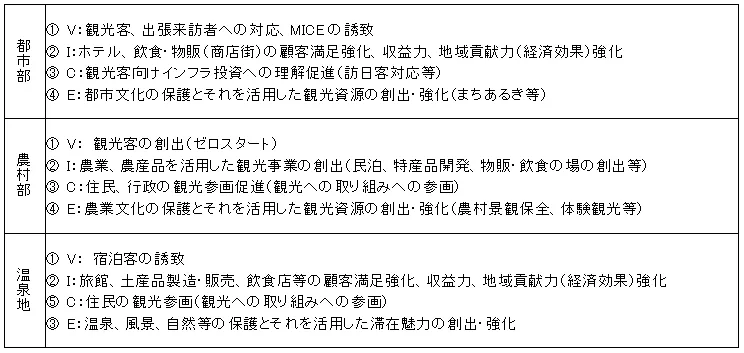
Using the “VICE Model” outlined in the World Tourism Organization (UNWTO) textbook *A Practical Guide to Tourism Destination Management*, the areas to be managed can be categorized into the following four points:
- Visitor = Tourists, as well as business travelers and MICE visitors
- Industry: The region’s industries, including the tourism sector, agriculture, forestry, fisheries, and traditional crafts
- Community: Residents and local government organizations
- Environment and Culture: Natural and historical environments and culture
Source: “A Practical Guide to Tourism Destination Management,” UNWTO (2007)
The term “management” may seem vague, but it becomes clearer when considered in terms of the specific tasks a DMO should undertake. Of course, the vision for the future (GOAL) and the challenges to be addressed will vary depending on how the region has approached tourism in the past. For example, the priorities will differ between a hot spring resort focused on overnight guests, a regional city visited not only by tourists but also by business travelers, and a rural area that has historically seen few tourists.
When promoting regional tourism, it is crucial for each region to proactively determine its own approach to tourism promotion while taking into account its unique characteristics. DMOs are expected to play a central role in both the planning and implementation of these strategies.
Currently, the “Japanese DMO Candidate Organizations” registered in the initial phase are already transitioning from the formation and establishment stage to the implementation stage. In this implementation stage, DMOs are required to navigate the difficult task of managing outcomes—a process that cannot progress without involving others.
For example, a look at the aforementioned VICE model reveals that it is not merely a matter of the DMO taking the lead in its own initiatives; it must also demonstrate management capabilities toward the local tourism industry, government, and at times, residents.
The "coordination function to formulate strategies for realizing tourism region development based on a clear concept while collaborating with diverse stakeholders, and to ensure the steady implementation of those strategies" (from the Japan Tourism Agency website) that the Japan Tourism Agency requires of Japanese-style DMOs refers to these management functions.
4. Recommendations for Creating Business Plans and Activity Reports
To demonstrate the management capabilities expected of a DMO—including the ability to engage others—the author believes it is crucial to thoroughly grasp and organize inputs and outputs; specifically, “business plans (inputs) and business reports (outputs).”
DMO management involves determining how to move forward toward an ideal (goal) within limited budgets, personnel, and time (business plan), as well as organizing what has and has not progressed as a result of the budget and time invested, and clarifying initiatives for the next phase (business report).
While DMOs set FY targets within their formation and establishment plans, DMO management is often evaluated solely based on whether these targets are met or not. However, evaluating performance solely on the basis of whether targets are met or missed is akin to merely chasing ideals without making progress, and cannot be considered true management.
As an organization central to regional revitalization through tourism, it is crucial for the DMO to thoroughly grasp, organize, and disclose the subjects of its management and the initiatives undertaken in response. We believe that by consistently maintaining this process, the DMO can become an organization that steadily fulfills its role in relation to its ideals (goals).
It is also important to publicly disclose business plans and activity reports. This is not only important as a form of communication—such as sharing information (particularly challenges) with stakeholders within the region—but also because when a DMO’s business plans and activity reports are published online, government officials, DMO practitioners, researchers, and others are sure to see them. Furthermore, we can expect that this will lead to collaborative efforts to address regional challenges.
I believe this could lead to new developments, where regional challenges are not borne solely by the region itself, but are resolved by connecting with experts nationwide.