Toward a Society Where "Visiting Deities" Will Never Disappear: On the Extension of the Intangible Cultural Heritage Listing

On November 29, 2018, the United Nations Educational, Scientific and Cultural Organization (UNESCO) decided to inscribe “Visiting Deities: Masked and Costumed Deities” on the List of Intangible Cultural Heritage. What are the key considerations when utilizing intangible cultural heritage rooted in such regional distinctiveness?
1. What Are the “Visiting Deities: Masked and Costumed Deities”?
On November 29, 2018, the United Nations Educational, Scientific and Cultural Organization (UNESCO) decided to inscribe “Visiting Deities: Masked and Costumed Deities” on the Representative List of the Intangible Cultural Heritage of Humanity. This was an expanded registration added to the “Toshidon of Koshiki Island,” which had already been inscribed in 2009. It includes additions such as “Namahage of Oga” in Oga City, Akita Prefecture; “Amamehagi of Noto” in Noto Town, Wajima City, Ishikawa Prefecture; and “Pantu of Miyako Island” in Miyako City, Okinawa Prefecture, comprising a total of 10 events across 8 prefectures.
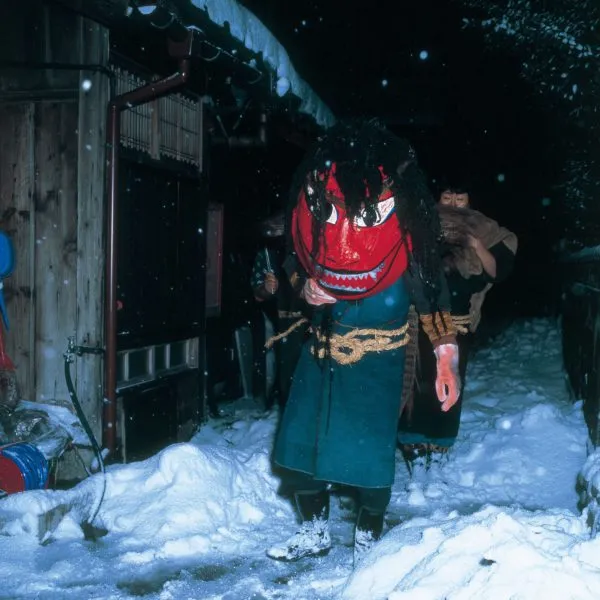
"Visiting deities" refer to gods believed to visit the human world at key times of the year, such as New Year’s and Obon, to admonish the lazy, ward off evil spirits, and bring happiness. While the masks and costumes vary by region, they generally appear in human settlements in the form of demons or monsters—creatures with forms distinct from humans.
Although the exact history of their introduction and establishment is unclear, similar events exist in China. It is believed that these traditions were transmitted to the Okinawa and Kyushu regions of Japan, then spread further north via Kitamaebune merchant ships to the Hokuriku and Tohoku regions, where they evolved into forms more suited to each locality by reflecting existing indigenous beliefs, climate, and industries. In other words, all the heritage sites listed this time are connected in terms of their meaning and value, making this expanded inscription a highly logical and appropriate decision.
Several of the listed events also appear in the photo book *YOKAI NO SHIMA* (Island of Yokai), which was photographed by the French photographer Charles Frégier during his visit to Japan. As a collection of portrait photographs of masks and costumes actually used in local festivals, the decision to collectively label them as “YOKAI” likely stems from a perspective unique to someone from a country with a cultural background where such supernatural beings do not exist. The visual impact of these “non-human beings” appearing in region-specific events—including those involving visiting deities—stands apart from what foreigners typically imagine as “Japanese,” embodying a strikingly unique and indigenous character.
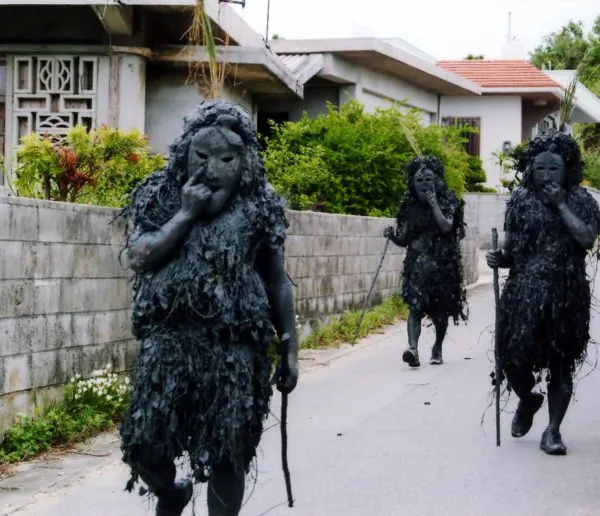
Miyako Island [Courtesy of Miyako City]
2. The Potential for Utilizing Intangible Cultural Heritage in Tourism
Although we use the term “Intangible Cultural Heritage” as a general category, there are various types. Taking examples registered in Japan, performing arts such as Noh, Kabuki, and Okinawa’s Kumiodori are likely the best known. Beyond these, the range spans diverse genres, including faith-based rituals and festivals like the recently registered “Visiting Deities” and Kagura, as well as crafts such as washi paper, and even comprehensive cultural traditions like Japanese cuisine. Even before its registration as Intangible Cultural Heritage, Japanese cuisine was highly recognized, ranking among the top reasons for foreign visitors to come to Japan. Furthermore, professional performing arts such as Kabuki and Joruri can be presented to a wide range of audiences regardless of time or place, and overseas performances are also held. For these types of heritage that are widely recognized and offer many people the opportunity to experience them, the potential for tourism utilization is vast.
On the other hand, festivals and events with a high degree of uniqueness that are deeply rooted in specific localities—such as the “Visiting Deity” rituals—cannot be separated from their local setting and are held on limited dates as seasonal events. Furthermore, the people who portray the deities are ordinary residents of the area, engaged in various occupations. For events with these characteristics, the time and place to convey their value to outsiders are inevitably limited. Opportunities to directly experience the indigenous culture rooted in the land through the reality and vividness of events that have developed uniquely within that region and been passed down to the present day are not common in typical tourist settings. Precisely because we live in an era where social media has advanced and information is instantly accessible at our fingertips anytime, anywhere, the “authenticity” seen in “Visiting Deities” and the “cultural customs and values that can never be understood without visiting the area” have a profound impact on people’s hearts, regardless of age or nationality.
3. The Pros and Cons of Registering “Visiting Deities” as Intangible Cultural Heritage
While there are high hopes for leveraging these traditions for tourism, the burden placed on small villages by the influx of visitors on event days is immeasurable. To mitigate this risk, some communities keep the event dates secret until the very last moment. Because the visual impact tends to attract attention, it is difficult to eliminate the number of people who visit these events with the mindset of watching a “show. ”Unfortunately, it is extremely difficult to ensure that visitors consistently maintain an appropriate distance and behave in a way that does not burden the local community. Consequently, there may be cases where the decision is made that, for the sake of preserving the event’s intrinsic value, it is better not to open the doors to the outside world. One example of this is the decision by Munakata Taisha to abolish the annual on-site grand festival held on Okinoshima immediately after the site’s inscription as a World Heritage Site.
Due to recent changes in living conditions, an increasing number of local residents are reluctant to have the deity enter their homes or get their homes and clothes covered in mud, and there is also a growing number of younger people who feel uncomfortable seeing children cry out of fear. In this environment, the preservation of similar events is becoming increasingly difficult year by year.A similar traditional event in the Koshino district of Fukui City, known as “Apposha,” had been passed down intermittently until it was discontinued in 2015, partly due to the declining birthrate.
The significance of this registration lies in raising awareness both domestically and internationally of the value of this highly local heritage; in particular, I believe that “communicating this value to the local community” holds special significance. When the value of these events is recognized internationally and people travel from afar specifically to experience them, it allows the community to reevaluate its own value from an outside perspective. While the economic impact on the region from visitors coming on the limited days of these events is by no means substantial, it is hoped that participating in these events in some form—regardless of whether one resides in the area—will be perceived as “cool” and serve as an opportunity for people both inside and outside the region to recognize that they have a connection to Japanese culture that has been passed down to the present day.
In the Kotaki Bugaku Preservation Society in Yuri District—one of the groups preserving “Ennen Chokurairo Dance,” a traditional performing art of Akita Prefecture—everyone who joins the local volunteer fire department is assigned a role in either Bugaku or Bangaku. Amid the challenge of a shortage of people to carry on local events and performing arts, this registration will likely serve as an opportunity to explore new mechanisms for event participation that engage supporters both within and outside the region. Regarding the aforementioned “Apposha,” I earnestly hope that it will not merely be revived as a formality, but that a day will come when it is once again awakened as a deity through the voices of children.
Village, Fukui City [Courtesy of the Fukui Prefecture Tourism Federation]
4. Examining “Visiting Deities” as a Form of Cultural Transmission
When conveying the value and significance of “Visiting Deities,” the most desirable approach is not merely to showcase the event itself, but to express how it is alive and breathing within the everyday life of the local community. Iwami Kagura is traditionally performed before the gods, but since it is frequently staged at local shopping malls and izakaya, local residents have the opportunity to become familiar with it from childhood. Kindergarteners even play “Kagura games” as if they were playing hero games. The very fact that Kagura is so seamlessly integrated into the daily landscape of the region is, to outsiders, an extremely mysterious and surprising phenomenon. Perhaps visitors can feel the close connection between Kagura and the community more deeply than they could by simply watching Iwami Kagura in its “proper setting.” By witnessing how it is passed down from person to person, a sense of respect for Kagura naturally arises in visitors. It makes no sense to expect outsiders to respect something they cannot see—something that local people cherish and protect as a source of pride.
The “visiting deity” is thought to represent a “stranger (marebito)” who comes to human settlements from “some other land or space,” and is deeply connected to the religious views, social, and historical backgrounds unique to Japan, a nation surrounded by the sea. It is also interesting that those who portray the deities are not limited to chosen individuals or priests, but include many “ordinary people living in the local community. ”By wearing a mask or concealing their face and donning unusual attire, people cease to be “human.” Having ceased to be human, they are moved by the Kami, take on individual divine personalities, behave differently from their usual selves, and sometimes enter a trance-like state. The dynamic between human and Kami, where the putting on and taking off of “masks and costumes” serves as a switch, offers a universal perspective on the close intertwining of faith and daily life in Japan, as well as the nature of the relationship between Kami and humans.
Unlike performing arts intended for entertainment, the quality of the movements in bugaku or the portrayal of the Kami does not significantly determine the value of the event. I believe the essential, unarticulated value of these rituals lies precisely in the awe-inspiring nature of seeing beings who were just moments ago human beings cease to be human. Every time I see the form of a non-human wearing a mask, I am always filled with anxiety, wondering if they will return safely to this world.
著者