A Culinary Journey That Challenges the Future of Tourism: A Case Study of the "Okinawa Ryukyu Gastronomy" Initiative

Food is a key element of the travel experience, and initiatives that utilize food as a tourism attraction—such as “food tourism”—are being implemented nationwide. In recent years, however, there has been a growing trend toward initiatives known as “gastronomic tourism.”In this article, I will examine the significance of “gastronomic tourism” (hereinafter referred to as “GT” unless otherwise noted in quotation marks) for regional tourism promotion, using examples such as the “Okinawa Ryukyu Gastronomy” project implemented in Okinawa in 2022, in which I participated as a committee member.
1. What is “Gastronomic Tourism”?
The UNWTO (United Nations World Tourism Organization) defines it as follows: “It is characterized by tourist experiences and activities linked to food and ingredients. In addition to authentic, traditional, or innovative culinary experiences, gastronomic tourism may also include other related activities such as visits to local production sites, participation in food festivals, and attendance at cooking classes” (*1).Furthermore, the Japan Tourism Agency supports its promotion in local communities, defining it as “tourism aimed at enjoying food nurtured by local ingredients, customs, traditions, and history shaped by the region’s climate and environment, and experiencing food culture” (*2).Efforts to utilize “food” as a tourism resource have been underway nationwide for some time, and these definitions alone may not seem particularly novel. However, a closer look at the UNWTO guidelines reveals a strong emphasis on building local value chains that encompass regional natural and cultural resources, gastronomic tourism (GT) resources, producers, the food industry, accommodation facilities, restaurants, schools, and other businesses.Furthermore, for travelers, the guidelines call for the provision of experiential value through “stories,” “interaction,” “learning,” and “emotional release.”
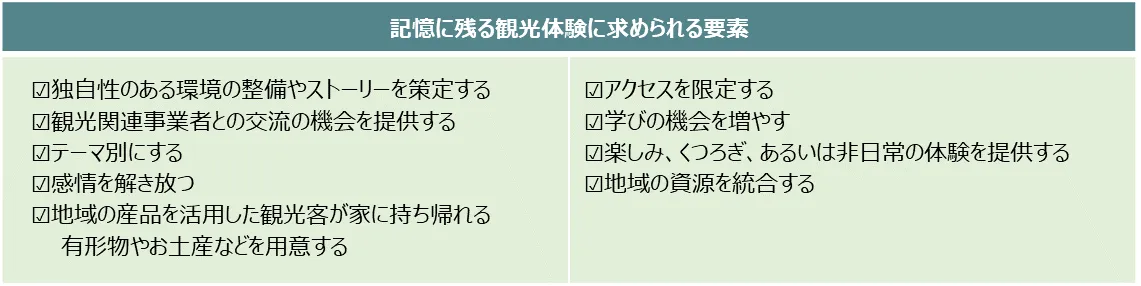
Development of Gastronomic Tourism'" Source: UNWTO, 2018, "Guidelines for the Development of Gastronomic Tourism"
The COVID-19 pandemic has brought to light various pre-existing challenges in tourism, making a sustainable perspective essential for regional tourism promotion.Amid calls for tourism promotion that goes beyond merely seeking economic benefits from tourism and instead considers the sustainability of the region’s natural environment, industries, culture, and people’s livelihoods, the concept of gastronomic tourism (GT)—which involves building regional value chains and offering travel experiences that encompass the local climate, history, culture, people’s daily lives, and food production sites—is considered highly valuable.
In December 2022, the “7th UNWTO World Forum on Gastronomic Tourism,” co-hosted by the UNWTO and the BCC (Basque Culinary Center), was held in Nara Prefecture. Hosting this event in Japan likely served to raise awareness among regions across the country that are considering the promotion of GT.
2. A Proposal for a New Way to Enjoy Food in Okinawa: “Okinawa Ryukyu Gastronomy: Chura-Zan”
Prior to the COVID-19 pandemic, the number of visitors to Okinawa had set new records for seven consecutive years, reaching 10.16 million in 2019. However, the influx of foreign tourists—who had been driving these numbers—came to a halt in April 2020, dealing a severe blow to Okinawa Prefecture, where tourism is a key industry.Against this backdrop, the Cabinet Office launched the “Project to Support the Creation of New Okinawa Tourism Services” with the aim of building a tourism industry in Okinawa that is resilient to changes in the external environment and improving the profitability of Okinawa tourism. Various initiatives were carried out during the COVID-19 pandemic. “Okinawa Ryukyu Gastronomy” is a project implemented in 2022 as part of this initiative.
According to Okinawa Prefecture’s “Survey on the Actual State of Tourism Statistics” (2018), while the majority of Japanese travelers visiting Okinawa rated their overall experience as satisfactory, a closer look at satisfaction with “meals” revealed a notable trend: while more than half of those in their teens through 40s gave positive ratings, satisfaction rates were in the low 30% range among those in their 60s and 70s and older—a demographic that tends to dine at their accommodations at a relatively high rate.Furthermore, a survey of accommodation facilities conducted as part of this project revealed that few establishments offer Okinawan cuisine. We shared the view that the inability to enjoy authentic Okinawan cuisine at resort hotels—which serve as key touchpoints for conveying the appeal of Okinawa’s food culture to travelers—and the failure to communicate the appeal of Okinawan cuisine to middle-aged and older demographics represent a significant missed opportunity. Resort hotels andand tourism facilities that endorsed the project’s objectives developed plans centered on the theme “A Special Place, A Special Time: The Timeless Ryukyu Where You Savor Food and Culture,” allowing guests to experience authentic Okinawan culinary culture.
Based on previous examples of gastronomic tourism (GT), the project established the following six requirements as guidelines for “Okinawa Ryukyu Gastronomy” and defined rules for the plans to be developed by the hotels. While the use of locally produced ingredients is a key element of GT, there is a challenge in that stable procurement is difficult using only ingredients produced in Okinawa.
Furthermore, since it was necessary for resort hotel chefs to acquire knowledge of the GT concept and the required aspects of Okinawan food culture, study sessions were held with experts from various fields to cover topics such as the definition of gastronomic tourism, Okinawan history and food culture, awamori and food pairing, and menu development.
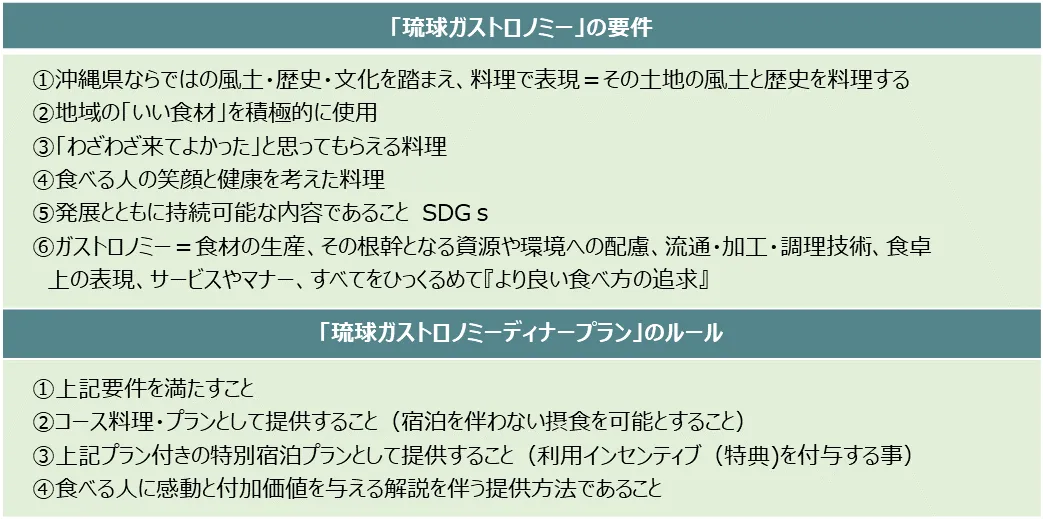
Okinawa possesses a unique and appealing food culture distinct from that of the mainland, inherited from the Ryukyu Kingdom and nurtured through long-standing trade with East and Southeast Asia. Reflecting the Okinawan belief that food is “nuchigusui” (medicine for life), a culinary culture centered on local ingredients and linked to longevity has flourished here. During the study sessions, participants shared a common policy: to understand this food culture, shaped by Okinawa’s climate and history, and for each hotel to express Okinawan culinary culture while highlighting its own unique characteristics.
3. Development of Gastronomic Plans at Resort Hotels
For this project, dinner plans were developed at five resort hotels on the main island of Okinawa. Below, we present case studies from Hotel Nikko Alivila and Novotel Okinawa Naha.
(1) Hotel Nikko Alivila: A Special Kaiseki Course Connecting Guests with Okinawa
At Hotel Nikko Alivila, a resort hotel located in Yomitan Village in central Okinawa Island, a course named “Island’s Bounty: Utuimuchi Kaiseki” was created. Based on the concept that “the story of how officials during the Ryukyu Dynasty entertained the Chinese imperial envoys is linked to the menu, and guests who order this course are welcomed by ‘Okinawa’ as a whole,” —The concept is that guests enjoy local ingredients as a gesture of hospitality: the appetizer from the farmers (Harusa), the sashimi from the fishermen (Uminchu), and the sukiyaki from the cattle farmers (Ushikaraya).—Based on this concept, a plan was developed targeting couples in their 40s and older within Japan.
The course name “Utuimuchi” is used to mean “hospitality,” but its etymology is said to derive from the verb “to mediate” or “to bring together.” Dishes made with local ingredients such as Motobu beef and island vegetables are served on large plates of Yachimun pottery fired in Yomitan. At an atmospheric table specially set up for the plan, staff provide detailed explanations about the ingredients and cooking methods for each dish.Additionally, the plan features culinary demonstrations where dishes are finished right in front of guests, creating a dinner experience where guests can leisurely savor Okinawan food culture infused with the head chef’s passion.
Priced at 12,000 yen, the plan has received high satisfaction ratings from guests who have dined during the promotional period. The hotel has also expressed a positive intention to continue the program, stating, “Our own passion for our cuisine has changed,” and “We want to convey the charm and culture of Okinawan cuisine to our guests.”
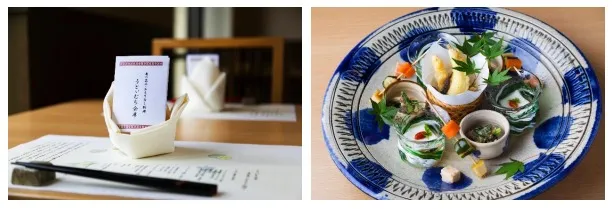
(2) Novotel Okinawa Naha – The King’s Table (Ryukyu French)
At the city hotel "Novotel Okinawa Naha," located in the Shuri area of Naha City, a plan was developed targeting intellectually curious couples in their 40s and 50s, based on the concept of a "special dinner aiming to serve as a beautiful bridge between guests and Okinawa, and between Okinawan ingredients and French cuisine."The chef personally explains the day’s recommended ingredients and cooking methods from behind the counter, presenting the dishes as an “ayahashi” (bridge) that the King of Ryukyu might have served to important guests. This concept is rooted in the idea of “food as medicine” (nuchigusui), which views food as the “medicine of life.” The plan offers a beautiful French-style course dinner.
Priced at 15,000 yen, the majority of guests who dined during the campaign period rated the experience as satisfying. Feedback such as “I liked the SDGs concept of using ingredients sourced in Okinawa,” “The presentation and service were excellent; I could feel the staff’s sincerity,” and “I thought it was wonderful that they used familiar, locally sourced ingredients with a focus on local production for local consumption” confirms that the plan’s concept resonated with guests.
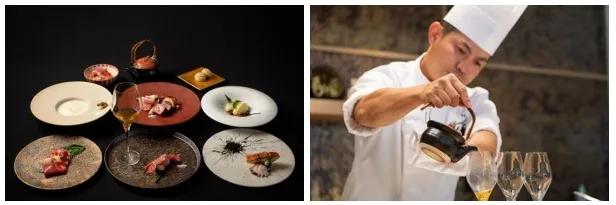
When we confirmed the intention to continue with the hotels that participated in the project, although there are many challenges such as securing a stable supply of ingredients, every hotel expressed a strong desire to continue. Comments included: “My passion for my cuisine has deepened,” “I want to convey the charm and culinary culture of Okinawa to our guests,” and “I want to maintain the brand and establish the term ‘Ryukyu Gastronomy.’”
4. Gastronomy Plans for MICE at Tourist Facilities
In addition to collaborating with resort hotels, the project also developed a plan for Ryukyu Village, a leading tourist facility in Okinawa. Located in Onna Village on the west coast of central Okinawa Island, Ryukyu Village is a facility that conveys Okinawa’s history and culture, as well as the Okinawan spirit of “utui-muchi” (hospitality), through the relocation of valuable dwellings and buildings—such as those from the Yaeyama Islands and other parts of Okinawa—that survived the ravages of war.As future plans were being considered during the COVID-19 pandemic, which had brought visitor numbers to a standstill, it was decided to explore utilizing the site as a unique venue for MICE visitors—a segment that is attracting attention as a target market for GT.
The program is designed as a reception where officials and villagers of the Ryukyu Kingdom welcome a delegation from China. Mr. Kōta Suzuki, an associate professor at the Research Institute affiliated with the Okinawa Prefectural University of Arts and a researcher of Kumiodori, serves as the official (guide). Dressed in the costume of a Ryukyu Kingdom official, he welcomes participants, who then take a leisurely tour of the village while listening to explanations about Okinawan history and culture.In terms of adding high value to the content, this narration, rooted in deep knowledge, is a crucial element. A Ryukyuan dance performance takes place at an old folk house along the way. Knowledge about Okinawan food culture is naturally absorbed throughout the itinerary, and as the sun begins to set, the group arrives at the final destination: the plaza in front of Sakimoto Shuzo, the party venue.Sakimoto Shuzo, with over 100 years of history, was the first distillery permitted to produce awamori after the war under the name “Shuri Shuzojo,” and has dedicated itself to the revival of awamori. It relocated from Shuri to Ryukyu Village in 2020.Served alongside the awamori was court cuisine prepared by the head chef of Okinawa Kariyushi Resort EXES Onna, who holds certification in traditional Ryukyuan cuisine. The dishes were beautifully arranged in vessels modeled after the “Tondabon” trays traditionally used for serving court cuisine. While enjoying the meal, Ryukyuan dance and Eisa performances were held in the illuminated plaza, creating a program that thoroughly highlighted Okinawan food culture.
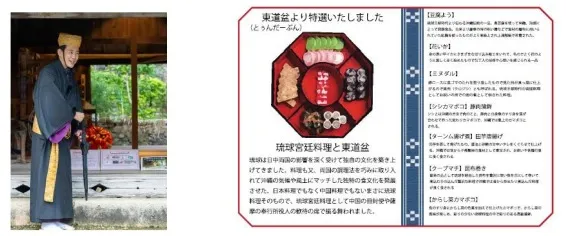
*(Right) Photo by the Secretariat
5. Prospects for “Gastronomic Tourism”
A major achievement of this project was the heightened awareness among hotel staff, driven by the high satisfaction levels among guests who experienced Okinawan culinary culture presented in a way that aligned with each facility’s unique style and the chefs’ personal touches. However, challenges remain, such as ensuring a stable supply of local ingredients and determining how best to offer this program to international guests.
“Okinawa Ryukyu Gastronomy” has only just crossed the starting line. It is expected to evolve into an initiative that involves the entire region, with hotels at its core, through further collaboration with local producers and the diverse entities that enrich the region’s culture. The true significance of GT lies in the process of continuing these efforts without interruption, learning through trial and error, and ultimately linking them to regional initiatives and branding.
Even before the term “GT” became widespread, pioneering initiatives incorporating its elements were already underway across the country. However, following the COVID-19 pandemic, there has been a shift in focus from quantity to quality in regional tourism promotion, and a greater emphasis on sustainability. At this juncture, it is highly meaningful to revisit the concept of GT and use it to rethink the future of regional food culture and tourism.
References:
*1 UNWTO, 2021, “Guidelines for the Development of Gastronomic Tourism”
*2 Definitions used in UNWTO / Japan Tourism Agency / Gurunavi Co., Ltd., 2018, “Survey Report on Gastronomy Tourism in Japan”
* For details on “Okinawa Ryukyu Gastronomy,” please refer to the URL below
* Katsutoshi Yoshiguchi, 2023, “Creating High-Value-Added Content Through ‘Food × Region’—A Case Study of the ‘Okinawa Ryukyu Gastronomy’ Initiative,” *Transportation and Economy*, July 2023 issue, Institute of Transportation Economics
著者