What Is Needed to Implement a Sustainable Tourism Program

Tourism programs are being developed across the country in an effort to revitalize local communities by attracting visitors. However, many of these initiatives remain merely at the development stage, and there are by no means many cases where they have led to sustained sales. In this article, we examine what is necessary to ensure the sustainability of regional tourism programs.
1. Trends in Strengthening Regional Tourism Programs
(1) The Shift from “Quantity to Quality” Amid the COVID-19 Pandemic and the Resurgence of Inbound Tourism
According to a survey by the Japan Tourism Agency, the rate of companies organizing employee trips stood at 88.6% in 1994.This was truly the heyday of group travel. Large buses crisscrossed tourist destinations nationwide, and local communities and tourism operators made concerted efforts to accommodate groups through banquets in large venues. However, subsequently—driven in part by the spread of the internet, which enabled individuals to gather a wide variety of information—travel patterns shifted from group-based to individual-based. The proportion of package and group tours within domestic travel has declined year by year, and by 2020, over 90% of domestic travel consisted of individual travel.
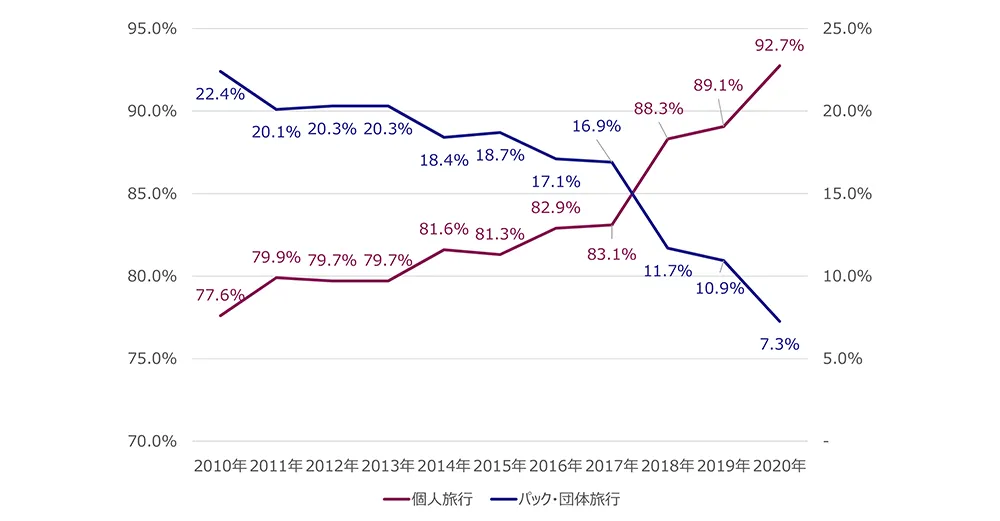
Currently, the global tourism slump caused by the COVID-19 pandemic that began in 2020 is showing signs of abating, and many tourists from both Japan and abroad have returned to tourist destinations nationwide. In addition to the shift toward individual travel, the pandemic has led to a diversification of needs and styles, with people seeking health-conscious and sustainable travel experiences, as well as interaction with local communities. We have entered an era where tourism programs such as adventure tourism and health tourism are chosen based on people’s values.
In other words, tourism has become not an “end in itself” but a “means” for self-expression, and regions must now work to meet these needs.
(2) The Need to Create Regional Originality
When considering tourism programs, sustainability is enhanced not by creating something entirely new, but by utilizing existing local resources. However, when it comes to differentiating their region from others, local residents often fail to recognize its appeal, thinking, “What should we promote?” “Our region has nothing to offer,” or “We’re not a tourist destination to begin with. ”On the other hand, keywords such as “abundant nature,” “hot springs,” and “delicious food” are promoted as attractions across various regions nationwide, leading to intense competition based on visual appeal, name recognition, and brand power. Therefore, it is necessary to highlight the region’s uniqueness by clarifying “how” these elements—food, hot springs, and nature—constitute its appeal. This clarification serves as a first step toward avoiding direct competition with other tourist destinations.
As an example, when the Ministry of the Environment considers experiential programs in national parks, it begins by understanding the region’s natural formation, the history and culture nurtured within that natural setting, and how these have been passed down through the generations to connect with the lives of people today. By deepening this understanding, the quality of how the region is presented to travelers improves.
2. The Importance of the Role in Coordinating Regional Tourism
(1) Challenges in the Implementation Structure of Tourism Programs
Challenges in the sustainable marketing of tourism programs primarily stem from issues within local governments and regional stakeholders such as DMOs. The first challenge, regarding local governments, is that they have not yet identified a clear vision or direction for regional tourism, resulting in a lack of decision-making that gains the understanding of regional stakeholders in policy implementation. The second challenge, concerning regional stakeholders such as DMOs, is that the entity responsible for implementing tourism programs—from development to marketing—is not clearly defined. Even when programs are developed, many cases fail to move forward because there is no clear organization to coordinate and drive the initiative.
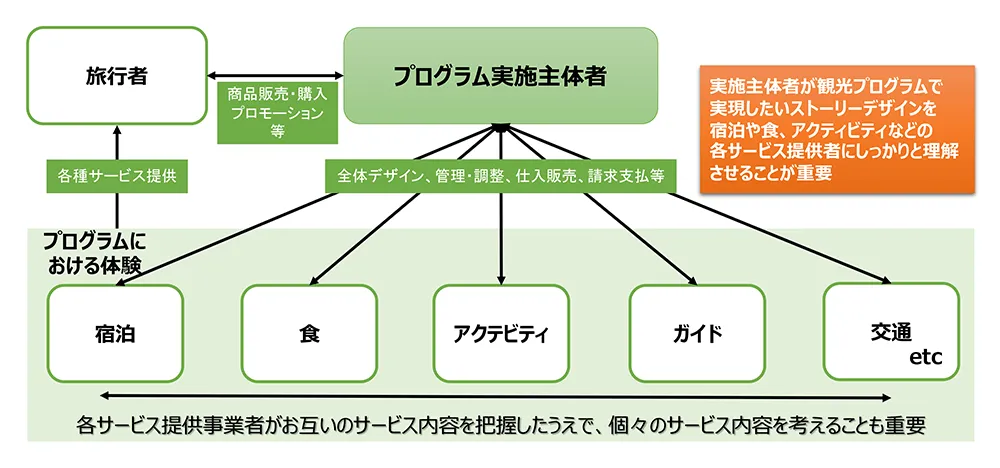
Here, we will focus on the second challenge and consider the role of the implementing entity for tourism programs. The term “implementing entity” used here refers to the overall coordinating entity for a tourism program that carries out tasks such as overall design, stakeholder coordination, and quality control based on the region’s unique story.
While the implementing entity’s functions are broad—including leadership and marketing—it is particularly important for them to design the region’s story and carefully communicate its details to service providers such as lodging facilities, restaurants, and activity operators. When service providers understand this story design, it fosters a sense of teamwork in program operations and provides insights for welcoming travelers. For travelers, this sense of being welcomed by the community can be felt through various interactions. Through these efforts by the implementing entity, tourism programs can be transformed from isolated services into a cohesive, integrated experience, thereby enhancing the region’s uniqueness.
(2) Value Enhanced Through “Editing”
① Curation by Travelers Themselves and Curation by Organizers
While there are “free-plan” products that allow travelers to move about freely, there are also “full-board” plans that bundle accommodations, meals, and experiences into a single package. Both offer distinct benefits that enhance the value of the trip. With a free plan, travelers are not bound by a strict schedule and can freely enjoy the places and cuisine they have researched in advance. With a full-board plan, travelers can enjoy the region with peace of mind, as the itinerary is already prepared for them, eliminating the need to make reservations or plan the route themselves. Both are attractive travel styles.
Here is an example. The following photo shows a scene where a traveler rides an e-bike through the great outdoors and then sits back in a comfortable chair, sipping coffee while taking in the breathtaking views at a scenic spot.

In this case, the organizer provides the e-bikes, takes participants along routes known only to locals, and guides them to recommended scenic spots. At these locations, chairs, tables, coffee, and local snacks are set up, and the guide even engages in conversation with locals, such as those conducting controlled grassland burning. This is an experiential value that cannot be obtained through a free plan. On the other hand, if you visit the same scenic spot on a self-guided plan, you’re not bound by a schedule. You can bring your own food and drinks purchased at a local supermarket and enjoy taking photos and chatting with your companions.
In short, while both the self-guided plan and the full-board plan offer experiential value during travel, you must be aware that the nature of that experience differs: is it “curated by the traveler themselves,” or is it “curated by the host organization”?
② The Value of Curating Experiences at Tourist Destinations
Applying the previous example to the value of the organizer curating the experience, for travelers, this allows organizers to provide information that travelers could not obtain on their own, enabling them to gain a deeper understanding of the region. Furthermore, linking the natural and rural scenery seen along a cycling route with the content provided by the guide and the food and drinks offered enhances the program’s regional narrative and helps differentiate it from other destinations. Furthermore, for the region itself, extending the length of stay encourages spending and leads to regional economic revitalization. Moreover, conveying the region’s nature, history, culture, and the daily lives of its people to travelers fosters civic pride and heightens the momentum to preserve and pass on the region’s cultural heritage.
3. Requirements for Organizers (Editors)
(1) Delve Deeply into the Region
To create high-value experiences in the region, you must first gain a deep and comprehensive understanding of the area yourself. By unraveling the historical context—including the natural environment, history, culture, and the daily lives of the people—you can appreciate the value of the region as it exists today. This process may reveal not only the value of specific local resources, such as facilities, but also the connections within the broader local community. Rather than merely providing “explanations” for each theme, you should aim to offer “commentary” that takes these regional connections into account.
(2) Design Skills from a Local Perspective
The ability to identify what regional values you want travelers to experience, determine which local resources can best express those values, and identify who within the community can help achieve this goal is key to creating regional originality.
(3) Building Broad Networks and Fostering Communication Within the Community
The most crucial point is the connections between people. The in-depth exploration of the region and the design process described above are founded on communication with a diverse range of people within the community. Just as one might say, “Consult that person about agriculture” or “Ask that elderly woman about the old way of life,” it is essential to build broad human relationships and create opportunities for communication within the region. Furthermore, it is an indispensable skill for the implementing organization not only to connect with the region itself but also to serve as a hub that connects people within the community.
4. Summary: Tourism Programs Start with “Building a Sustainable System”
To provide tourism programs on a sustainable basis, the fundamental prerequisite is a “sustainable framework” within which stakeholders can take pride in their local community and reap tangible benefits. It is crucial for stakeholders with differing perspectives to first bring their individual visions to the table—including their desired form of tourism, their feelings toward the region, profitability, visitor numbers, and their level of involvement in the programs—to organize these ideas and ensure that all stakeholders are working toward the same goal. The foundational framework built through these discussions will lead to sustainable activities.
At the heart of these activities are the implementing organizations. We believe that the key to a sustainable tourism program lies in discussing what kind of future you envision for your region and bringing together local stakeholders and the community as a whole.
著者