Initiatives for Sustainable Tourism Destinations: Hyogo—A Leader in Universal Tourism
In 2023, Hyogo Prefecture became the first in the country to enact the “Universal Tourism Promotion Ordinance.” Universal tourism is key to fostering “tourist destinations that anyone would want to visit” and serves as the foundation for sustainable tourism. We will examine the relationship between sustainable tourism and Hyogo Prefecture’s universal tourism initiatives.
In recent years, as interest in sustainability in tourism has grown, the importance of universal tourism—which is accessible to everyone—has come into focus. To address an aging population and the diversifying needs of travelers, initiatives promoting universal tourism are gaining momentum in various regions. In this article, we will explore the current state and future prospects of universal tourism, using the case of Hyogo Prefecture—a region recognized as a leader in this field—as a basis.
1. Reasons for the Enactment of the Universal Tourism Promotion Ordinance in Hyogo Prefecture
There are three main factors behind Hyogo Prefecture’s decision to promote universal tourism.
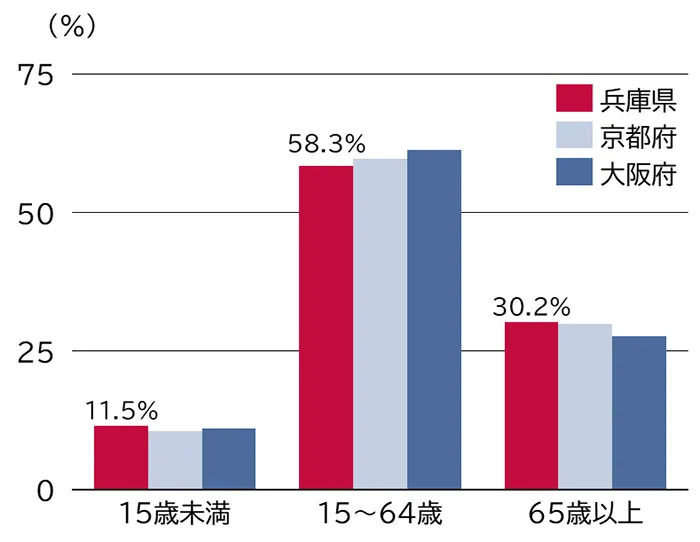
The first is “societal trends.”Amid a declining population and an aging society with a low birth rate, a decrease in the number of travelers and a shrinking tourism market are inevitable. Within the prefecture, the proportion of elderly residents and people with disabilities exceeds 30% (Figure 1), making it necessary to address increasingly diverse needs in the future. Furthermore, due to concerns over a decline in overall consumer activity stemming from the “2025 Problem” (*1), the tourism industry is also required to take measures such as developing infrastructure that is accessible to everyone, creating tourism content that everyone can enjoy, and establishing reception systems.
(Figure 1) Population distribution by three categories in the three major cities of the Kansai region
The second factor is “social demand.” Following amendments to the Act on the Elimination of Discrimination against Persons with Disabilities, private-sector businesses have been required to provide reasonable accommodations since April 2024. In urban planning as well, there is a stronger demand than ever to promote understanding of “barrier-free mindsets”—eliminating prejudice, discrimination, and stereotypes, and considering the perspectives of those facing difficulties.
The third factor is the “growing demand for tourism in Hyogo Prefecture.” With major international events on the horizon—such as the World Para Athletics Championships held in Kobe in 2024 and the Osaka-Kansai World Expo in 2025—establishing a system to accommodate diverse travelers had become an urgent priority.
Against this backdrop, in April 2023, Hyogo Prefecture enacted the “Ordinance for the Promotion of Universal Tourism” (*2)—the first of its kind in Japan. The SDG principle of “leaving no one behind” is beginning to take root in the tourism sector as well.
2. The “Society Where Everyone Can Enjoy Travel” Envisioned by the Ordinance
Hyogo Prefecture’s ordinance aims for more than just establishing systems. To realize “ordinary travel”—where older adults and people with disabilities can “go where they want to go” and “do what they want to do”—the ordinance seeks to broadly advance the development of both physical and social infrastructure, foster a welcoming mindset among hosts, and ensure these measures function effectively in real-world situations.
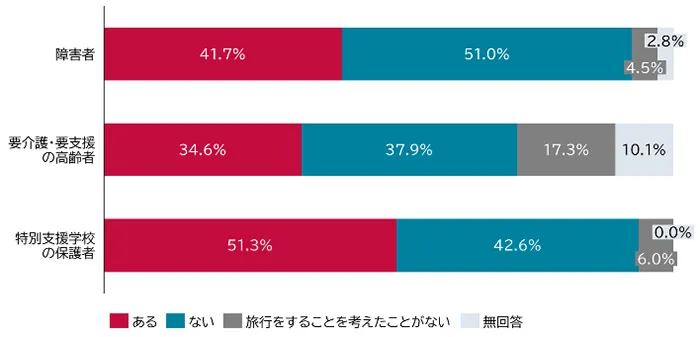
According to a 2022 survey by Hyogo Prefecture, approximately half of respondents said they had “given up on traveling” due to disability or aging (Figure 2). In response to this challenge, Hyogo Prefecture is working to create an environment where older adults and people with disabilities can freely choose their destinations, modes of transportation, facilities, and activities, and enjoy safe and comfortable travel with family and friends.
Under the ordinance, initiatives are being advanced based on the following three pillars:
- Enhancing reception systems (improving the quality of service, etc.)
- Ensuring information accessibility
- Fostering momentum for the promotion of universal tourism
Under these goals, while Hyogo Prefecture officials play a central role, diverse stakeholders—including municipalities, tourism businesses, residents, and support organizations—are each fulfilling their respective roles to advance efforts toward the implementation of the ordinance.
(Figure 2) Percentage of people who have given up on traveling due to a disability or other reason
3. Universal Tourism Initiatives in Hyogo Prefecture
Hyogo Prefecture’s initiatives ensure that the ordinance is not merely a concept but is generating concrete changes on the ground in the tourism sector. Specific initiatives implemented by Hyogo Prefecture in FY2024 are as follows.
- Fostering Momentum Among Tourism-Related Businesses
- Dispatching Reasonable Accommodation Advisors
- Top-Level Seminar on Promoting Universal Tourism
- Enhancing Reception Capabilities at Tourist Destinations
- Universal Tourism Hospitality Training
- Holding of the Universal Tourism Promotion Liaison Committee
- Training of Hyogo Universal Tourism Concierges
- Expansion of the "Hyogo Universal Accommodations" Declaration and Registration System
- Model Projects for Creating Hyogo Universal Tourism Destinations
- Information Dissemination and Promotion
- Information Dissemination Utilizing Universal Tourism Monitor Tours
- Information Dissemination via the Prefecture’s Official Tourism Website “HYOGO! Navi”
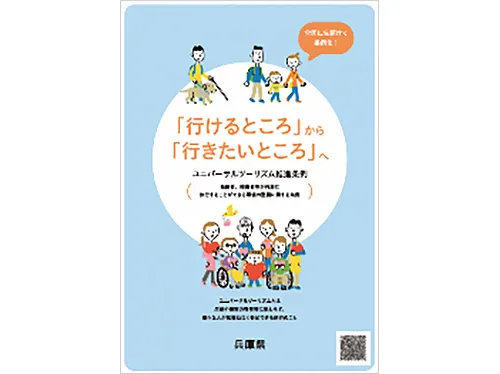
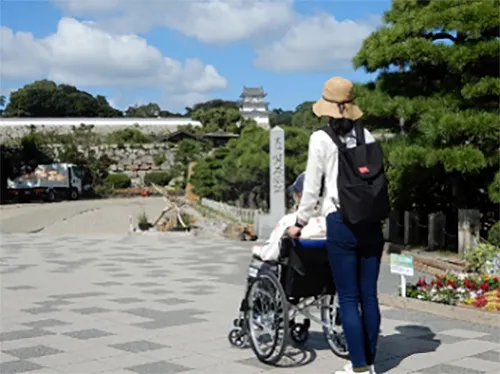
The "Hyogo Universal Accommodations" Declaration and Registration System is a program through which Hyogo Prefecture supports, registers, and promotes accommodation facilities that have declared their commitment to actively promoting universal tourism (*3).
To make the declaration, facilities must: (1) conduct a self-assessment using a checklist and publish the results, and (2) provide customer service training to employees or have them complete the Universal Tourism Hospitality Training. The key point here is that the focus is not on evaluating the physical accessibility of the facility’s infrastructure, but rather on management demonstrating a “commitment to taking the first step” both internally and externally, and fostering an employee mindset that welcomes a diverse range of guests.
Furthermore, facilities that meet 35 or more of the 73 items on the prefecture’s checklist are registered as “Hyogo Universal Accommodations.”As of the end of May 2025, 136 facilities had made the declaration, and 74 of those have been registered. According to the Ministry of Health, Labour and Welfare’s “FY2023 Report on Public Health Administration,” there are 1,433 inns and hotels operating in Hyogo Prefecture, meaning that approximately 10% of them have made the “Universal Accommodation Declaration.” The prefecture provides support in both software and hardware aspects to accommodation facilities aiming for registration, and the number of registered facilities is expected to increase further.As the number of registered facilities increases, travelers in need of universal accommodation will have a wider range of options, which will also help tap into potential travel demand. Furthermore, this is expected to contribute to improving the overall tourism image of the region.
Furthermore, under the “Hyogo Universal Tourism Destination Development Model Project,” three regions have been selected: the Kinosaki Onsen area, the Yumura Onsen area, and Tamba-Sasayama City. In these regions, efforts extend beyond simply improving accommodation facilities; initiatives such as making tourist resources like footbaths barrier-free and creating universal maps are being implemented to promote the universal accessibility of the entire tourism area.
These initiatives are expected to promote not only tourism within Kobe City but also round-trip tourism to various locations throughout Hyogo Prefecture.
4. Expanding Networks, Deepening Initiatives—The Future of Universal Tourism
Since 2023, the author has been involved in promoting universal tourism in Hyogo Prefecture as a “Hyogo Universal Tourism Promotion Advisor.” Of particular note is the training of “Hyogo Universal Tourism Concierges” (hereinafter referred to as “Concierges”).
This program began in FY 2022, and 60 individuals have been certified to date. To receive certification, participants must complete all five specialized courses, including “Introduction to Universal Tourism,” “Lectures by People with Disabilities,” and “Wheelchair City Walks.” Participants come from diverse fields such as the hospitality, nursing care, and tourism industries, as well as tourism associations, fostering a group of professionals with varied backgrounds.
After certification, these individuals contribute to making tourism more accessible throughout the prefecture from their respective professional perspectives. I feel that their efforts represent an ideal model for a community-wide promotion system.
A distinctive feature of this program’s design is that it goes beyond mere certification; it emphasizes deepening understanding of “disability” and “reasonable accommodation” while prioritizing connections among the concierges themselves. Rather than ending with the completion of the course, the formation of a network that transcends industry, generation, and training cohort through post-training follow-up sessions is highly significant.
The role of the concierges extends far beyond simply advising older adults and people with disabilities on travel. Based on an understanding of the “social model of disability”—which views disability not as a problem of an individual’s body or functions, but as arising from societal barriers—they serve as the “cornerstone” in building a system that embraces regional diversity, thereby supporting tourism in Hyogo Prefecture.
In the Kinosaki Onsen, Yumura Onsen, and Tamba-Sasayama areas—which are part of the aforementioned “Hyogo Universal Tourism Development Model Project”—concierges are also playing a central role in driving the region’s transition toward universal accessibility. Going forward, the need for such “community-rooted specialists” is expected to grow nationwide, and Hyogo Prefecture’s initiatives will likely garner attention as a leading example.
Universal tourism is by no means a topic limited to the welfare sector. It leads to the creation of tourist destinations that are comfortable and welcoming for everyone—including the elderly and people with disabilities, as well as families with children, international travelers, and those temporarily injured. This inclusivity can be said to embody the very essence of “sustainability” in tourist destinations.
If the role of tourism is to go beyond mere economic benefits and foster the richness and diversity of a region, then universal tourism is precisely the perspective that should lie at its core. It is hoped that Hyogo Prefecture’s initiatives will spread to other regions as “best practices for sustainable tourism destinations.”
(*1) For more on the “2025 Problem,” see the column “Toward an Inclusive Tourism Nation.”
(※2) Ordinance for the Promotion of Universal Tourism (commonly known as)
(※3) “Hyogo Universal Accommodation” Declaration and Registration System
著者