The Act on the Promotion of Understanding of LGBT Issues: What Tourism Businesses Need to Know

In June 2023, the so-called “LGBT Understanding Promotion Act,” aimed at fostering understanding of sexual minorities, was enacted during the regular session of the Diet. However, some have argued that “more discussion was needed” regarding the passage of this law. In this article, we examine the LGBT Understanding Promotion Act to explore what steps tourism-related businesses should take to create a more inclusive environment for members of the sexual minority community.
1. What Is the Act on the Promotion of Public Understanding of LGBT Issues?
The official name is the "Act on the Promotion of Public Understanding of Diversity in Sexual Orientation and Gender Identity" (*1). Japan has long faced criticism that its legal framework regarding sexual minorities "lags behind the rest of the world" (in the EU, the prohibition of discrimination against sexual minorities was included in the Charter of Fundamental Rights of the European Union in 2000 *2).
Although there was a push to enact legislation, seeing the legacy of the 2020 Tokyo Olympic and Paralympic Games—"Diversity and Harmony"—as a prime opportunity, the bill was shelved due to opposition from conservative factions within the ruling party over the wording, specifically whether the focus should be on "discrimination" or "understanding. "The debate reignited in May 2023, just before the G7 summit in Hiroshima, following discriminatory remarks made by a government official regarding sexual minorities. Consequently, the Act on the Promotion of Understanding of LGBT People was passed and enacted in June.
The key points of the Act on the Promotion of Understanding of LGBT People are as follows:
- Establish basic principles, clarify the roles of the national and local governments, and formulate a basic plan
- To foster a spirit of acceptance toward the diversity of sexual orientation and gender identity
- To realize a society that is tolerant of diversity in sexual orientation and gender identity
Going forward, the government will take the lead in formulating a basic plan to promote understanding of sexual minorities, and government agencies, businesses, schools, and other organizations will need to make efforts to improve their environments by establishing consultation systems and providing training.
2. What Are “Sexual Orientation and Gender Identity”?
While “LGBT” has become a common term to refer to sexual minorities, there are also those who do not fit into the LGBT category, such as “Q” (referring to sexual minorities or people who do not fit into existing gender categories) and “Questioning” (referring to people who are exploring their gender or gender identity). Consequently, terms like “LGBTQ” or “LGBTQ+” are increasingly used today.
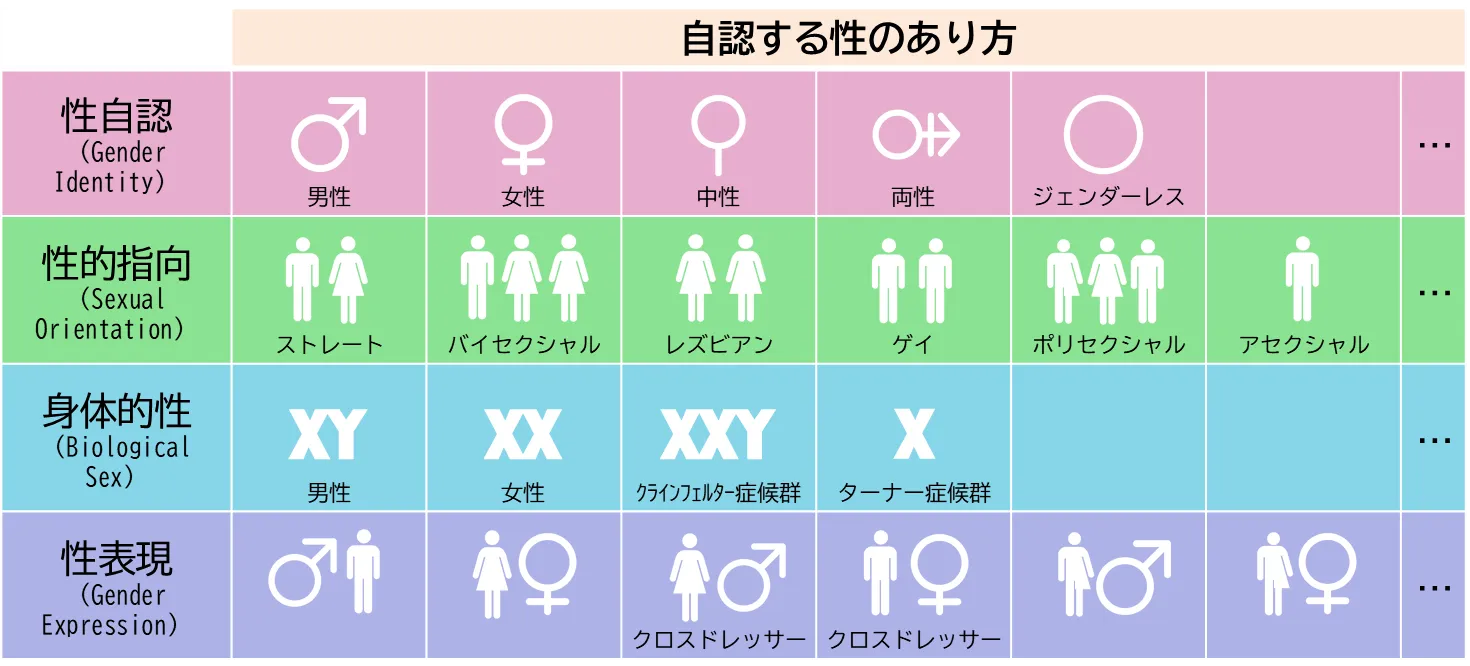
It is said that one’s gender identity consists of four elements: (1) “gender identity” (the gender one consciously identifies with), (2) “sexual orientation” (the gender of the person toward whom one feels romantic or sexual attraction), (3) “biological sex” (determined by physical characteristics at birth), and (4) “gender expression” (how one expresses their identity through clothing, language, and behavior).
One’s gender identity does not necessarily fall into a single category such as LGBT; rather, it is extremely diverse, depending on one’s position or combination of these four elements.
While "gender identity" is the English term for "性自認," the Act on the Promotion of Understanding of LGBT defines it as "the awareness regarding the presence or degree of identity concerning one’s perception of the gender to which one belongs."
3. Challenges Faced by Sexual Minorities
As part of our efforts to promote universal tourism, our company conducted a survey in 2021 on “Challenges Faced by Sexual Minorities When Traveling” (*3) and examined the need to establish an inclusive environment for those directly affected.
In that survey, we concluded that the term “LGBT” itself may be lumping all sexual minorities together, making it difficult to consider their individual characteristics; therefore, we use the term “sexual minorities” in this article.
A notable finding from our survey was that a high percentage of respondents answered that “there are no sexual minority individuals in their immediate surroundings.”
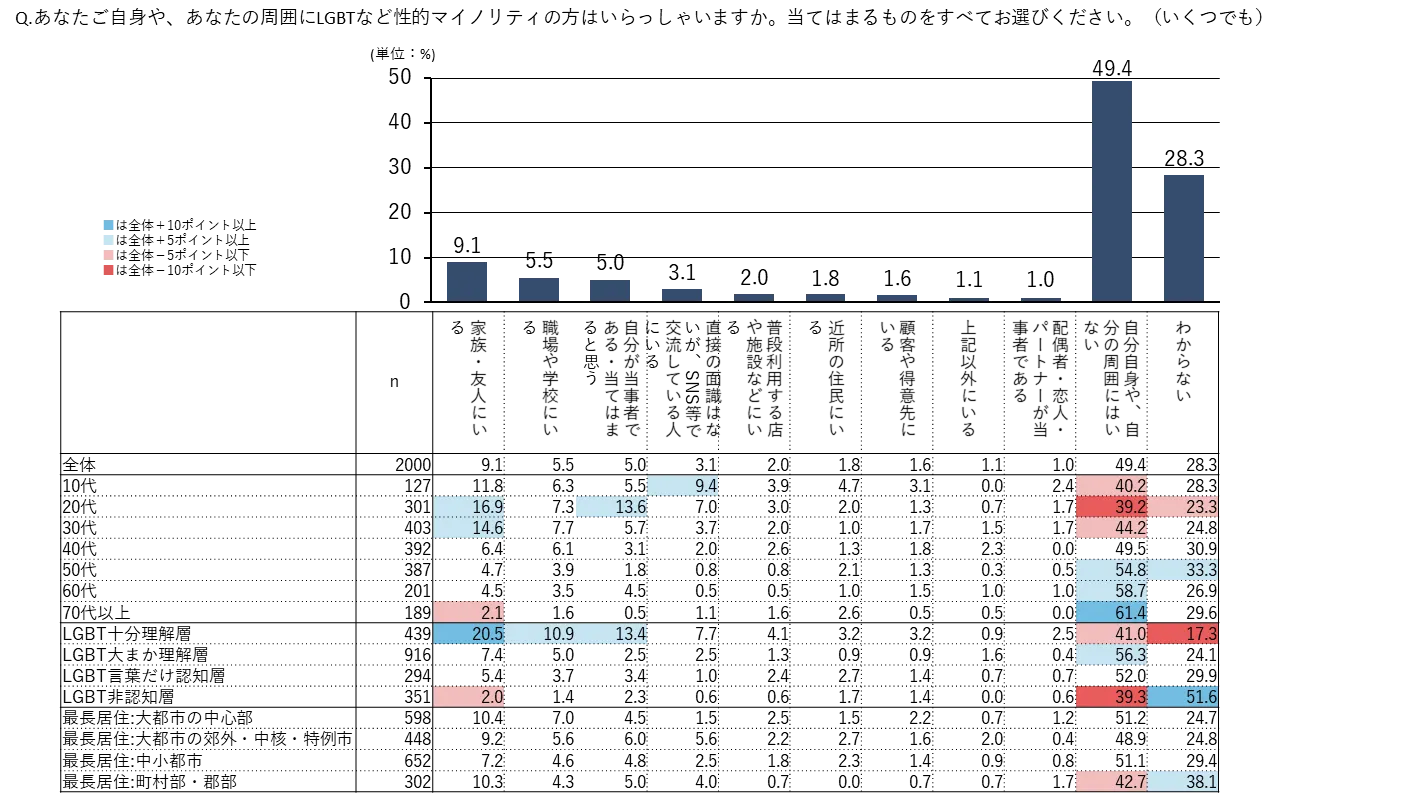
The “LGBT-well-informed group” used as a category in the analysis consists of those who answered “I have a good understanding of LGBT issues” in a preliminary question.
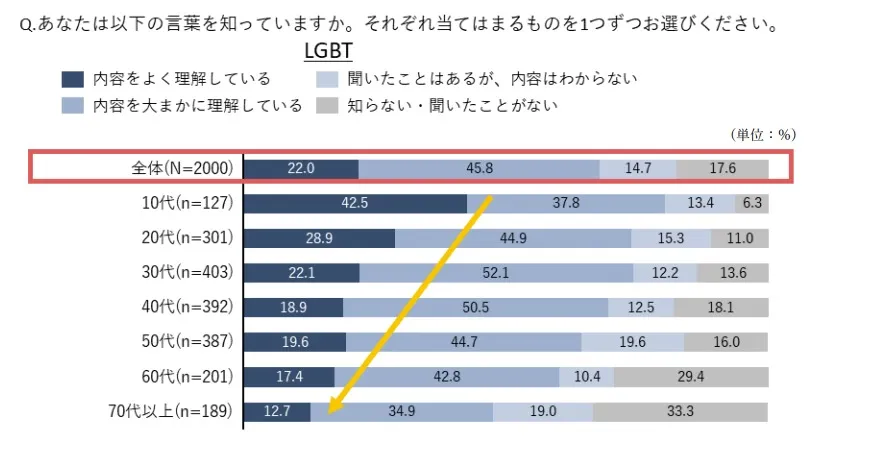
Comparing these two results reveals that younger people are more likely to understand sexual minorities and are more aware of their presence in their surroundings. It may be that, thanks to inclusive education and information dissemination, the number of people with knowledge and understanding of sexual minorities is increasing, starting with younger generations.
Next, regarding the results of the question “What are your thoughts on sexual minorities?”, there was a gap of nearly 14 percentage points between non-LGBT individuals and LGBT individuals in the belief that “LGBT people constantly face challenges,” indicating a significant disparity in awareness regarding the difficulties they face.

Today’s society has been structured to prioritize the comfort and convenience of the majority. However, this environment has created barriers that make it difficult for minorities to live in society. These results also suggest that people tend to become oblivious to those in distress or to inappropriate behavior when they themselves are comfortable, or to pretend not to notice (*4).
4. Creating an Inclusive Environment for Sexual Minorities: Key Considerations for Tourism Businesses
In a survey regarding travel for sexual minorities, specific difficulties cited included:
- Public baths and restrooms: Transgender individuals, in particular, face difficulties due to a mismatch between their physical sex and gender identity. Additionally, school trips can become traumatic experiences for children who lack information and knowledge and have not yet established their gender identity.
- Booking and Information Gathering: Unnecessary requests to specify gender or service based on the assumption of heterosexuality. There are instances of being asked unnecessary personal questions, or being unable to choose desired amenities, yukata, or travel plans.
- Staff response: Even at locations displaying rainbow flags, staff training is often completely lacking, and I have experienced discriminatory treatment.
- Stares from others: People may stare or make discriminatory remarks, causing individuals to suppress their true selves and making it difficult to even enjoy going out.
These were among the issues cited. Looking at these, it is clear that there are more challenges in the “soft” aspects than in the “hard” infrastructure.
In response to the question, “What kind of treatment would make you feel positively toward the establishment?” the most common answer was, “Being treated and served as a regular customer.” Even those working in the service industry may feel on edge when dealing with a customer for the first time, struggle to understand their needs, or—especially when the customer belongs to a minority group—unconsciously fall back on assumptions or prejudices.
Do you ever find yourself saying things like, “That person is ‘that kind of person,’ right?” in everyday conversation? Terms like “that kind of person,” “faggot,” “queer,” “tranny,” or “dyke” are discriminatory. Perhaps you have a friend or colleague who is part of the sexual minority community, and hearing such discriminatory remarks has left you hurt by the lack of understanding among those close to you.
Since tourism-related businesses have frequent opportunities to interact with a diverse range of customers, they are expected to take a leading role in promoting understanding of sexual minorities. Why not start by deepening your understanding of what constitutes discriminatory treatment and harassment within your own workplace, and consider how to create an environment where everyone can enjoy their travels without hesitation?
(*1) Cabinet Office: Act on the Promotion of Public Understanding of Diversity in Sexual Orientation and Gender Identity
(※2) December 2000: Charter of Fundamental Rights of the European Union
(※3) 2021 JTB Tourism Research & Consulting Independent Study "Challenges Faced by Sexual Minorities When Traveling": After collecting survey responses from10,000 people using a research firm’s panel, we analyzed the results by selecting 100 sexual minority individuals and 1,900 non-minority individuals who had traveled between 2018 and 2020. We also conducted interviews with advocacy groups and collected survey responses from 79 members of those groups.
著者