The Future of "Shrines and Temples × Online & Cashless"—Digital Tools for Deepening the Relationship Between Worshipers and Shrines and Temples—

Due to the impact of the COVID-19 pandemic, various online services have emerged in the world of shrines and temples, and virtual visits, as well as online payments for religious items and offerings, are gradually becoming more widespread. However, when it comes to shrines and temples, there are human psychological needs and desires that run counter to the convenience offered by online services. We will explore the creation of value in the realm of “Shrines and Temples × Online,” which stands apart from typical tourist attractions.
1. The Advancement of Cashless Payments at Shrines and Temples
Cashless payments are gaining significant momentum due to the Cashless Point Rebate Program implemented from 2019 to 2020, as well as the promotion of “contactless” payments during the COVID-19 pandemic and the rapid growth of online shopping and delivery services. However, compared to other countries, the penetration rate remains low (cashless payment ratios by country: South Korea 96.4%, China 60%, Singapore 58.8%, Japan 19.8%. *Source: Nomura Research Institute, “Current Status of Cashless Payment Promotion in Japan and Abroad” (2018)).
The government aims to increase the ratio of cashless payments in domestic transactions to 40% by 2025 and eventually to 80%. According to the “Cashless Vision” released by the Ministry of Economy, Trade and Industry, factors hindering the advancement of cashless payments in Japan include “high trust in cash,” “good public safety,” “accurate and fast checkout processing,” and “high convenience of ATMs,” with the underlying reason being that “using cash does not cause any inconvenience.”
In recent years, the number of shrines and temples where cashless payments can be made for items such as amulets has increased, but resistance to using cashless methods for offering money at shrines remains strong. In June 2019, the Kyoto Buddhist Association issued a statement declaring that the shift to cashless payments for religious activities was “inappropriate and unacceptable.” The main reasons cited were the risk that religious activities—such as offering money and admission fees—could be tracked by third parties as personal information, and the possibility that payment processing fees could result in what was previously considered a “religious act” being reclassified as a “profit-making business” and thus subject to taxation.
The pioneer in introducing cashless offerings was Atago Shrine in Tokyo, which adopted Rakuten Edy in 2014. Nikko Futarasan Shrine in Nikko City, Tochigi Prefecture, also introduced WeChat Pay and Alipay in October 2018. This move was driven by the rapid increase in Asian inbound tourists visiting Nikko and was specifically aimed at the Chinese market, where cashless payments are already widespread. In February 2019, the shrine also began accepting PayPay, expanding its services to the domestic market.
Kanda Myojin Shrine in Tokyo introduced J-Coin Pay on January 1, 2021.Additionally, for the 2021 New Year’s pilgrimage season only, the shrine offered “Online Granting,” which allowed visitors to order and pay for prayers and amulets via an online shopping-style interface and have them mailed to them, as well as “Mobile Order,” where visitors could pick up amulets and talismans at a dedicated pickup counter set up on the shrine grounds at a later date. These measures were well-received as responses to the COVID-19 pandemic (ended January 17, 2021).
2. People’s “Preference for Cash” Regarding Offerings
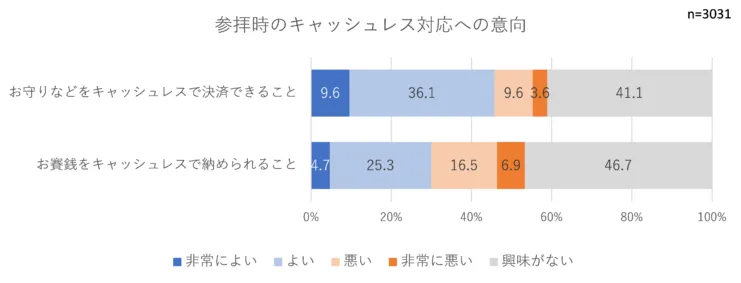
According to a survey conducted by our company in May 2021, regarding cashless options during temple visits, 45.7% of respondents—nearly half—expressed a positive view of “being able to pay for religious items via cashless payment.” In contrast, only 30.0% favored “being able to make cashless donations,” a gap of more than 15 percentage points. If consumers were solely seeking payment convenience, this disparity would not exist.This suggests that there remains a strong preference for cash when it comes to offering donations.
The character “sai” in “saisen” (offering money) signifies expressing gratitude and repaying a favor received from the gods; in ancient times, people offered rice and vegetables.Practices such as “sanmai” (scattering rice), “sankyo” (scattering offerings), and “uchisame” (throwing rice) before the altars of gods or Buddhas, as well as “ohineri” (offering washed rice wrapped in paper), involve actions more akin to “throwing” or “scattering” rather than “handing over,” which is similar to how offerings are handled today. From the medieval period onward, as the monetary economy and the culture of visiting shrines and temples became widespread among the common people, the offerings gradually shifted to money.There is a record stating that a box called a “sansenbitsu” (coin box) was placed at Tsurugaoka Hachimangu Shrine in 1540, and this is considered the oldest record of an offering box in Japan. In other words, given that the history of ancient shrines spans over 1,000 years, the history of offering boxes is less than half that.
It should be noted that while similar practices to offering coins can be found in other countries, their underlying meanings differ. In the Chinese-speaking world, such as China and Taiwan, there is a practice called “xiangyouqian,” which is intended to cover the cost of incense and candles. In Korean temples, donation boxes called “Bokcheonham” (Buddha’s Money Box) are sometimes placed, but these also have a strong emphasis on donations and support for the facility.
In Japan, offering money is said to have multiple meanings: in addition to the common sense of “facility maintenance fees and donations” shared with other countries, it also serves as an “offering to the gods and Buddhas” and a “sign that one has come to worship.” The belief is that money acts as a substitute for the person, taking on “impurity” (kegare) in their place; thus, by throwing it in, the person is purified, allowing them to stand before the gods and Buddhas with a clean mind and body.
Furthermore, just as ringing the bell rope or the bell-shaped clapper hanging above the offering box serves to ward off evil spirits and signal one’s presence to the deities, worshippers find meaning in the very act of tossing coins into the box and hearing the “clink” they make.At 11 Shingon Buddhist temples in Tokushima Prefecture, a traditional event called “coin-throwing memorial service” is held annually on a rotating basis. A monk reads aloud from the register of the deceased, and worshippers who have confirmed the names of family members and relatives throw a bucketful of 1-yen coins into the offering box. It is believed that the louder the sound the coins make when they hit the platform, the more effective the memorial service will be.
Viewed in this light, it becomes clear that in the context of offering money to deities and Buddhas, “money” plays a role for the Japanese that goes beyond simply being “currency (as a medium of exchange and circulation).” There is a positive significance in the act of scattering coins to make a sound and announce one’s presence, and in physically letting go of them from one’s own hands—this “currency (as a physical object)” serves to connect oneself with the deities and Buddhas.
3. What Digital Tools Need Is Not a Simulated Experience, but Informational Value
(1) What worshippers expect from online services is “information needs”
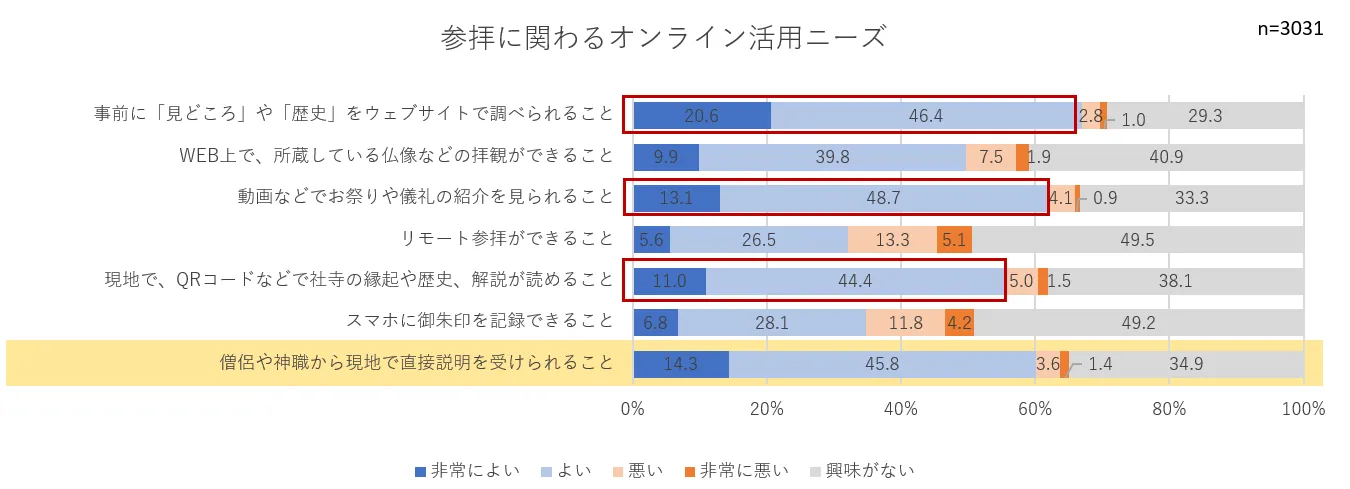
Similar to cashless payments, the use of digital tools such as smartphones has advanced rapidly in terms of improving convenience. Looking at the needs for online use related to shrine and temple visits, there is high demand for “being able to research highlights in advance” (66.9% combined “Good” and “Very Good”), “being able to watch introductions to festivals and rituals via videos” (61.8%), and “being able to read explanations on-site using QR codes” (55.4%).On the other hand, for “being able to visit remotely (virtual visits)” and “being able to save goshuin stamps on a smartphone,” the combined percentage of “bad” and “very bad” responses exceeds 15%. This indicates that while there is a high demand for gathering information on the origins and history of shrines and temples, a significant proportion of people feel resistant to using online tools for activities more closely tied to the essence of faith and worship.Furthermore, the demand for the in-person experience of “receiving explanations directly from monks or Shinto priests on site” is high, exceeding 60%. It appears that even though information is available online, it does not replace the value of on-site interaction and direct conversation. This indicates that consumers prioritize “obtaining information to enrich the act of worship” rather than simply enhancing the convenience of the visit itself as a benefit of digital tools.
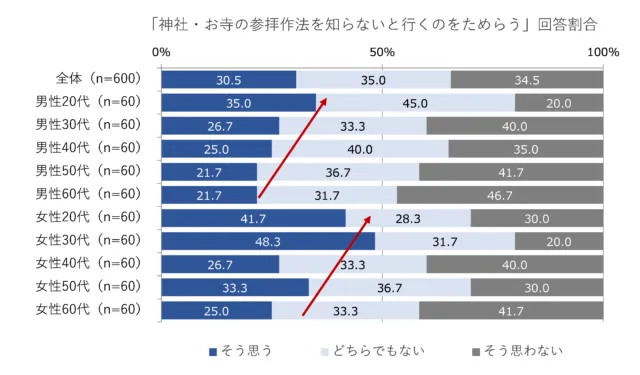
Looking at the data below, the proportion of people who feel they would “hesitate to visit if they did not know the proper etiquette for visiting shrines and temples” is higher among younger age groups, exceeding 40% particularly among women in their 20s and 30s.Many young people sincerely want to ensure they do not act rudely when observing proper etiquette. For those who believe, “If I’m going to visit, I want to do it properly,” the availability of online resources to gather information on etiquette and the characteristics of shrines and temples beforehand actually means that opportunities to encourage visits have expanded.
(2) Virtual worship has existed since the Edo period
The debate over the merits of virtual worship began around the year 2000, and in 2006, the Association of Shinto Shrines made headlines when it issued a statement criticizing the promotion of virtual worship. This was exactly one year before the release of the first-generation iPhone. Fifteen years have passed since then, and PCs and smartphones have become integral tools of daily life throughout society. In the midst of the COVID-19 pandemic, new methods of worship have emerged, such as online ema dedications, remote prayers, and remote worship via the internet.
Fundamentally, the core reason why the term “virtual worship” unsettles those involved and consumers lies in the ambiguity surrounding the interpretation of the word “virtual.” The
English word “virtual” refers to something that appears different on the surface but is essentially the real thing, and is often translated as “in essence.” On the other hand, the loanword “virtual” as it has taken root in Japan is often used to mean something that lacks substance but is a virtual or simulated replica of reality. It has permeated the market with a meaning far removed from its original sense and is frequently translated as “virtual.” Consequently, when the term “virtual worship” is used, interpretations diverge: does it refer to essential worship despite physical distance, or does it refer to performing a mere “imitation” of worship online?Going back
in time, the Sazaedo (an Important Cultural Property) built in 1796 (the 8th year of the Kansei era) on Mt. Iimori in Aizu-Wakamatsu is a compact hall known for its unique double-helix ramp. The Thirty-Three Kannon statues of the Saigoku Pilgrimage are enshrined along this ramp, and the hall became popular because visiting it allowed one to complete the pilgrimage to all thirty-three Kannon statues.It is, so to speak, a “virtual pilgrimage to the 33 Kannon sites of the Saigoku region.” There are other examples like this, suggesting that “virtual pilgrimages based on genuine faith” had already become widely established in society since the Edo period. One could argue that technological advancements have simply added the option of digital technology as a new method to achieve this.

4. Online Platforms Are Designed to Support and Enrich Pilgrimage Activities
During the COVID-19 pandemic, numerous paid services related to online tourism have emerged, and there is no shortage of content related to visiting shrines and temples. One example is a travel package that includes a virtual prayer session following an explanation of “Shrines and the Gods of Japan” by an interpreter who is a certified Shinto priest, an overview of the shrine’s layout and individual facilities, an explanation of proper worship etiquette, and an introduction to the people serving at the shrine. This perfectly meets the needs of those who"I want to properly understand the etiquette for worship" and "I want to research the history and origins of the shrine or temple beforehand," and it is a prime example of how such services can lead to a far more fulfilling visit for individuals compared to visiting a site without prior knowledge.
Both shrines and temples hold significance simply by existing in their respective locations, and given the importance of physically being in a space of prayer, visiting the site in person remains the best way to worship. However, for those unable to visit in person for various reasons, or as a preparatory step before a visit, online platforms can play a significant supporting role.
Surveys indicate that consumers do not seek mere convenience or a “simulated experience” when it comes to worship. Even as convenient methods like digital tools and cashless payments become widespread, it is unlikely that people will feel satisfied simply by—such as “I can just make an offering from home” or “I’m satisfied because I visited online.” To use a simple analogy, the relationship between worshippers and shrines and temples is actually closer to that between fans and artists at a live concert, where the audience wants to enjoy the unique sounds and atmosphere of the moment. Even as digital tools become more widespread, the true purpose of worship lies in “going to the site,” and I do not believe there is a significant risk that this fundamental mindset will fade.
Videos and VR content related to shrines and temples are not meant to be consumed and enjoyed in and of themselves—like, say, videos of scenic views—but are required solely to aid in a deeper understanding of their essence.The consumer need to gain a deeper understanding of shrines and temples online serves as “knowledge and mental preparation” and “tools for building relationships” to make the act of worship—a deeply personal endeavor—more meaningful. Addressing this need will help bring the true essence and value of worship into sharper focus within our online society.
=================
"Survey on Consumer Attitudes Toward Shrines and Temples" (2021) Overview Survey Method
: Online questionnaire survey Survey Participants
: Men and women aged 20–69 residing in Japan
; total of 3,031 respondents Survey Period: May 10 (Mon) – 12 (Wed),
2021 *Survey Cooperation: Bulk Co., Ltd.
著者