[Special Feature] “Tourism x LCC”: “Cheaper and Further” — A New Era for LCC International Flights: A Look Ahead at the New Routes Pioneered by the State-of-the-Art “LR” Aircraft

In response to the need to restructure their businesses in the post-COVID-19 environment, airlines have announced plans to downsize their fleets and enhance the capacity of their low-cost carrier (LCC) operations. While large aircraft have traditionally played a central role on long-haul routes, the smaller aircraft set to be introduced in the future will also need to have the range to fly long distances. This article therefore focuses on these new aircraft to explore the potential for new international routes operated by LCCs and the implications of such developments.
1. Growing Demand for Value in the Post-COVID Environment
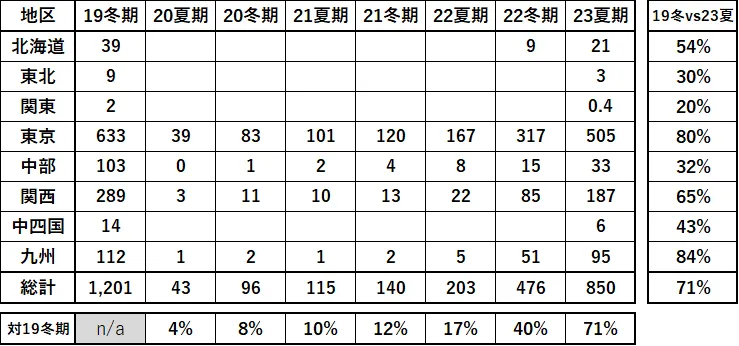
Until 2019, the air travel market enjoyed robust demand, and for airlines, revenue from their FSC operations served as a pillar of their business. FSC stands for Full Service Carrier and refers to traditional full-service airline operations.This business model aims to retain and attract customers by maintaining high service quality at airports and on board, while also making frequent flyer programs more appealing. Particularly on long-haul routes, airlines have successfully captured high-fare business demand by offering a large number of premium class seats to ensure comfort. However, as you all know, the situation changed dramatically after the COVID-19 pandemic, with revenues plummeting and the industry being pushed into a dire situation.
In the fall of 2020, the ANA Group commented on changes in demand amid the COVID-19 pandemic as follows (1).
- Business demand has declined and will not fully recover. (Due to changes in work styles, such as the widespread adoption of web conferencing)
- The leisure market and the market for visiting friends and relatives will remain robust. There is potential for growth driven by trends such as workation and decentralized living.
- Addressing new customer needs (ESG; hygiene, cleanliness, contactless; self-service, simplicity, personalization)
Furthermore, the company cites promoting responses to the market’s “value-for-money orientation” and “simplification and contactless services” as part of the transformation of the airline business model.
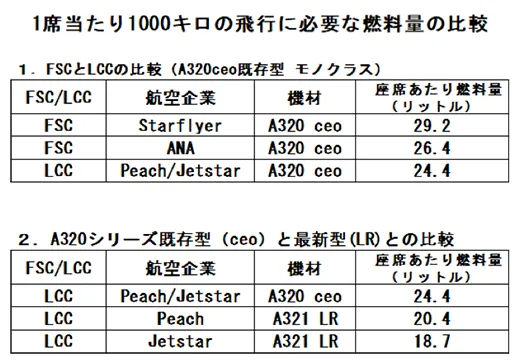
From the perspective of airline revenue, domestic airfares have fallen by approximately 20% over the nine-year period from 2011 to 2020, with no sign of this decline stopping (2), making how to respond to passengers’ preference for low prices an urgent issue.On the cost side, there is a growing demand for “low-cost” and “eco-friendly aircraft” with low fuel consumption, driven by the need to cope with soaring fuel prices and the promotion of ESG management, including CO2 emission reductions.
It is also necessary to take into account the recent rise in consumer awareness of "selective spending." A travel style in which people adjust their spending according to their preferences—for example, using the money saved by flying with an LCC to enjoy a luxurious experience at a higher-class hotel—is becoming established. LCCs, which offer low fares and simple services, perfectly match market needs, and their user base continues to grow.
In light of these circumstances, airlines have been announcing revisions to their business plans one after another. The key pillars of these plans are the accelerated retirement of large aircraft in the full-service carrier (FSC) business, the expansion of the low-cost carrier (LCC) business, and the accelerated introduction of new, smaller aircraft. The ANA Group explains that it intends to emerge from the COVID-19 crisis by temporarily scaling back the size of its airline operations.However, a recovery in business demand is unlikely, so following the retirement of the large Boeing 777s that have long served the FSC sector, the fleet is being updated with medium-sized aircraft such as the slightly smaller Boeing 787. For the LCC sector, the introduction of the small Airbus A320neo and its long-range variant, the Airbus A321LR (hereinafter referred to as the LR), is the key focus.
What impact will this expansion of the LCC business and the shift to smaller aircraft have in the future?
2. Potential New Routes Opened by the LR’s Longer Range
Japan’s two major LCCs, ANA-affiliated Peach Aviation and JAL-affiliated Jetstar Japan, have also introduced the LR, and it has already begun operating on domestic routes. Additionally, Peach Aviation announced plans to enter the medium-haul international market during FY 2022.
This aircraft was developed based on the A321ceo, a member of the Airbus A320 family of single-aisle narrow-body jets. By adding fuel tanks and retrofitting the aircraft with fuel-efficient engines, the range has increased by the amount of excess fuel capacity, making it possible to serve long-haul routes that were previously out of reach for the standard A320.
Therefore, based on publicly available data, I have attempted to project the new international routes that LR could potentially operate (3).
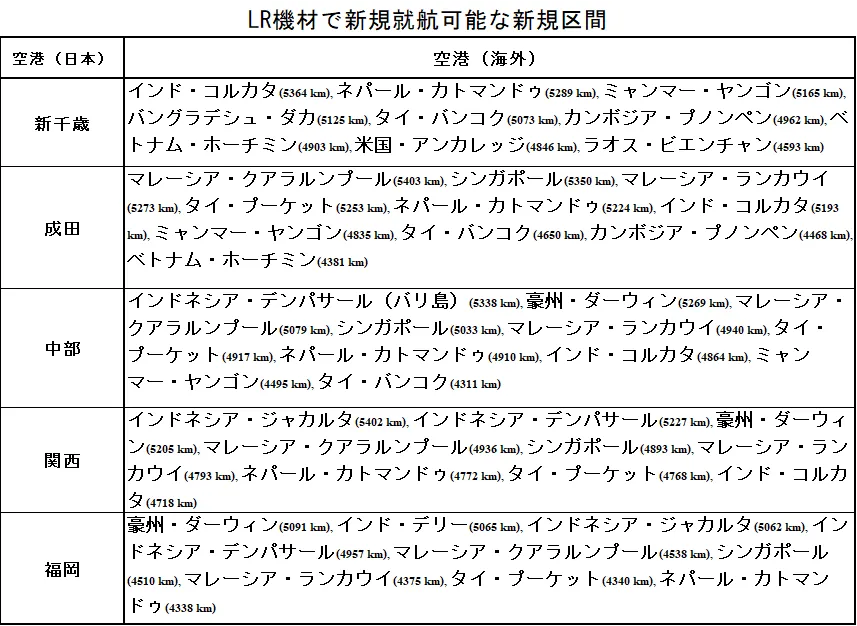
[Routes to and from New Chitose Airport]
Two key points deserve attention regarding routes to and from New Chitose Airport. First, the possibility of launching direct flights to Bangkok, Thailand, has emerged. In Thailand, a Southeast Asian nation, a travel boom has been gaining momentum against the backdrop of economic development. Within the country’s outbound market, travel to Japan—particularly to Hokkaido, where visitors can experience a cool climate—enjoys high popularity, and the launch of a New Chitose–Bangkok route could serve as a channel to capture this demand.
Second, the route to Anchorage, Alaska, is now within the aircraft’s range. Package tours organized and sold by travel agencies are popular for trips from Japan to Alaska. Excluding aurora viewing, travel is concentrated in the summer months, with popular attractions including Denali National Park—centered around Denali (Mount McKinley), North America’s highest peak—scenic train rides, and the experience of the midnight sun in high-latitude regions.Traditionally, access to Alaska required a layover in cities on the North American west coast, which resulted in wasted time. If this direct flight is established, such issues will be resolved. Furthermore, since New Chitose Airport has an extensive domestic flight network, it will be possible to attract travelers not only from Hokkaido but also from other regions.
[Routes to and from Narita Airport]
A notable development at Narita Airport is the opening of access to Bangkok, Thailand, and Phuket, a beach resort in the same country. In 2019, before the impact of the COVID-19 pandemic, the number of Japanese visitors to Thailand (outbound) was approximately 1.81 million, while the number of Thai visitors to Japan (inbound) was approximately 1.32 million, bringing the total annual passenger flow between the two countries to over 3 million.In 2009, outbound visitors numbered only about 1 million and inbound visitors only about 110,000, making this growth truly remarkable. Until now, the Narita-Thailand route has been operated using wide-body aircraft with two aisles.The LR aircraft featured here is a single-aisle, smaller model with a capacity in the low 200s. Given its low operating costs and low passenger attraction risk, it is expected to contribute to stable business operations by enabling the continued offering of low fares and the maintenance and improvement of load factors.
Furthermore, there are high hopes for the launch of routes to Malaysia and Singapore.
[Routes to and from Chubu Centrair International Airport, Kansai International Airport, and Fukuoka Airport]
In addition to Thailand, Malaysia, and Singapore, the network now extends to Indonesia, Eastern India, and Nepal, as well as Darwin, Australia.
3. The Three Possibilities Brought About by LR
Based on the above assumptions, the following three possibilities have emerged.
(1) The potential for new direct routes to resort destinations
According to a survey by JTB Tourism Research & Consulting, “low cost” is the overwhelming appeal of LCCs, and younger generations have been the driving force behind their use. Furthermore, according to the company’s survey on behavior at overseas travel destinations, “swimming, beaches, and snorkeling” account for only 9.0% of the total, and 11% in Southeast Asia.However, in Hawaii—where beach resort activities are the main attraction—this figure reaches 29.2%, and in Guam and Saipan, it rises to 43.2%. It has been confirmed that the LR can serve Asian resort destinations such as Phuket in Thailand, Langkawi in Malaysia, and Denpasar (Bali) in Indonesia. Previously
, travel to these airports required either flights on large aircraft or connecting flights via other cities.Considering the low travel costs in Southeast Asia, the launch of direct flights to resort destinations using this aircraft is expected to revitalize resort travel, particularly among younger travelers. Many readers are likely also looking forward to flights to Cairns, a resort destination in northern Queensland, Australia
. However, based on current estimates, the 5,855 km distance places it outside the range of reachable airports.While Jetstar Japan’s LR aircraft features a high-density configuration with 238 seats, Peach Aviation limits its capacity to 218 seats. Providing more legroom improves passenger comfort while allowing for a larger fuel load due to the reduced weight of passengers and baggage. I would also like to note that by combining this with operational techniques (4), it may be possible to operate flights to Cairns.
(2) Support for Taking Paid Leave and the Potential for Expanding Overseas Workations
The government has highlighted the importance of “distributed travel” as a shift in tourism trends following the COVID-19 pandemic. This involves a joint public-private effort to implement campaigns promoting travel that disperses “the number of people, timing, time of day, and locations,” as well as encouraging “travel and transportation companies to develop products that promote travel on weekdays.”Furthermore, as it becomes easier to take paid leave, momentum is building for “longer-distance, longer-term travel” to become the norm. Destinations requiring long-distance travel typically involve longer trips, leading to an increase in the number of paid leave days taken and, furthermore, promoting overseas workations. The potential for establishing direct flights to major cities and resort destinations in Southeast Asia, as seen in this scenario, can be expected to serve as a catalyst for this trend.
(3) Potential for Expanding Air Access to and from Regional Areas
Operations using small aircraft allow for service to smaller markets that large aircraft could not effectively serve, as well as the establishment of new routes and increased flight frequencies at regional airports. The primary destinations highlighted in this scenario were airports in Southeast Asian countries.Economic growth in this region is remarkable, and incomes are steadily rising; as a result, demand for travel to Japan is expected to recover rapidly in the post-COVID era. With the increase in repeat visitors from this region, we have entered an era where access to diverse destinations beyond major cities is in demand. The launch of direct flights to and from regional airports will serve as a platform for this, contributing not only to improved convenience for travelers but also to the economic revitalization and internationalization of these regions.
4. Conclusion
Improvements in aircraft range will continue. In 2024, the debut of the XLR (eXtra Long Range)—an evolution of the LR—is expected to lead to the emergence of even longer-haul routes.
We will certainly need to keep a close eye on the trends surrounding these high-performance small aircraft.
[Footnotes]
(1) Source: ANA HOLDINGS NEWS, "Transformation of the ANA Group’s New Business Model"
(2) Source: Ministry of Land, Infrastructure, Transport and Tourism, “Disclosure of Information on Air Transport Services”
(3) Calculated based on great circle distance. Taking various operational constraints into account, major routes falling within the range were listed based on the difference between the maximum range of conventional aircraft (ceo/neo) (4,296 km) and the estimated maximum range of LR aircraft (5,407 km). Please note that this differs from the range figures provided by aircraft manufacturers and airlines. Other constraints include seasonal winds, ETOPS (operational restrictions for twin-engine aircraft), and labor regulations.
(4) ACL restrictions and re-clearance procedures, etc.
(Note: This article is based on the content of "Projected New Routes Using the Airbus A321LR/XLR" by Naoji Nomura (Faculty of International Tourism, Toyo University).)
著者