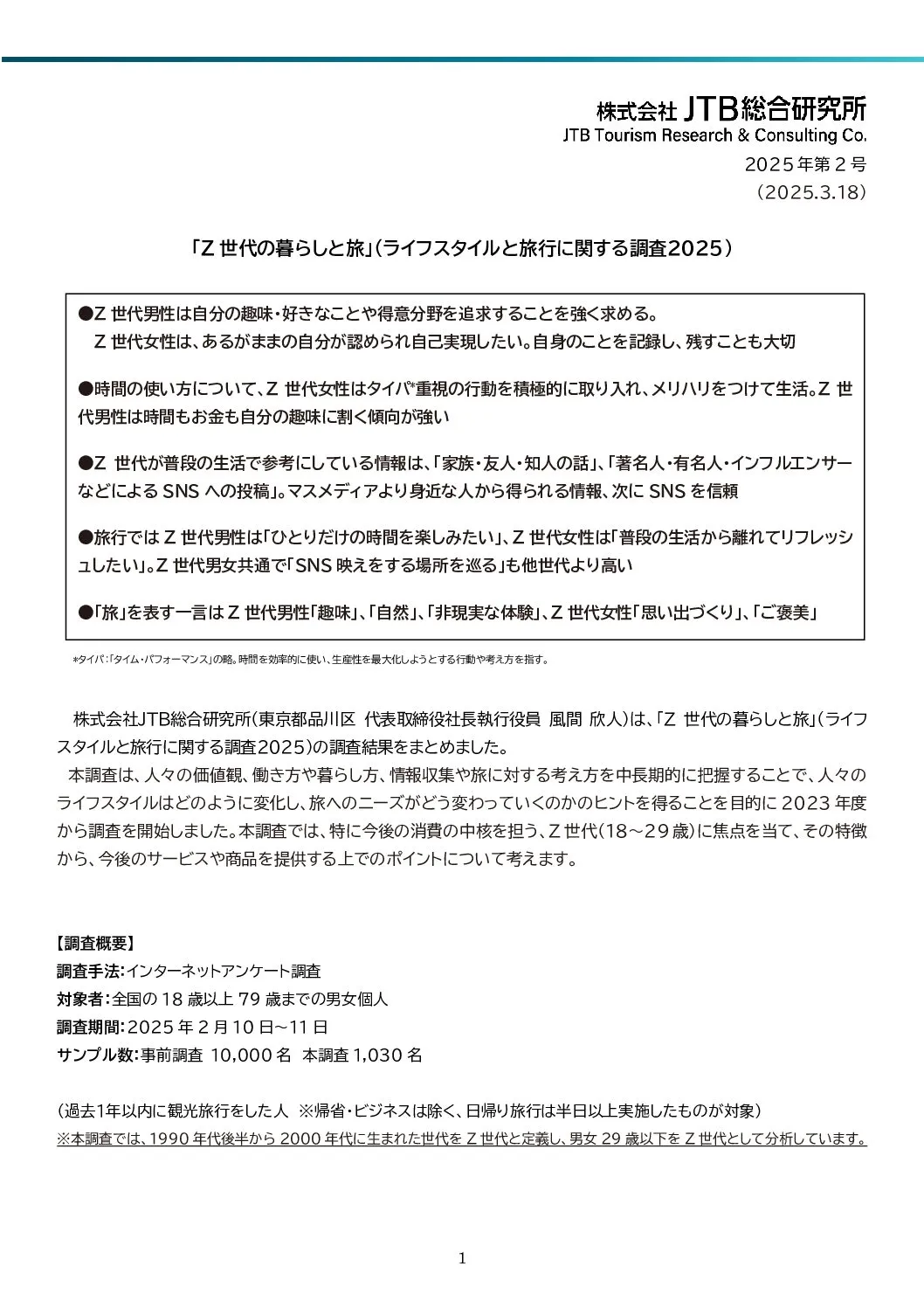
"Gen Z Lifestyle and Travel" (2025 Survey on Lifestyle and Travel)
This survey was launched in FY 2023 with the aim of gaining insights into how people’s lifestyles are changing and how their travel needs are evolving by understanding their values, work styles, lifestyles, and attitudes toward information gathering and travel from a medium- to long-term perspective.This survey focuses specifically on Generation Z (ages 18–29), who will play a central role in future consumption, and examines key points for providing future services and products based on their characteristics.
*Tipa: Abbreviation for “Time Performance.” Refers to behaviors and mindsets aimed at using time efficiently and maximizing productivity.
Key Findings
- Gen Z men have a strong desire to pursue their hobbies, interests, and areas of expertise. Gen Z women want to be accepted for who they are and achieve self-actualization. They also value documenting and preserving their lives.
- When it comes to managing their time, Gen Z women actively prioritize time efficiency* and lead a well-balanced lifestyle. Gen Z men, on the other hand, tend to devote both their time and money to their hobbies.
- The sources of information that Gen Z relies on in their daily lives are "stories from family, friends, and acquaintances" and "social media posts by celebrities, public figures, and influencers." They trust information obtained from people close to them more than mass media, followed by social media.
- When it comes to travel, Gen Z men want to “enjoy some time alone,” while Gen Z women want to “get away from their daily lives and recharge.” Both Gen Z men and women are more likely than other generations to “visit Instagram-worthy spots.”
- When asked to describe "travel" in a single word, Gen Z men cited "hobby," "nature," and "unreal experiences," while Gen Z women cited "making memories" and "a treat."
Happiness and Life Values
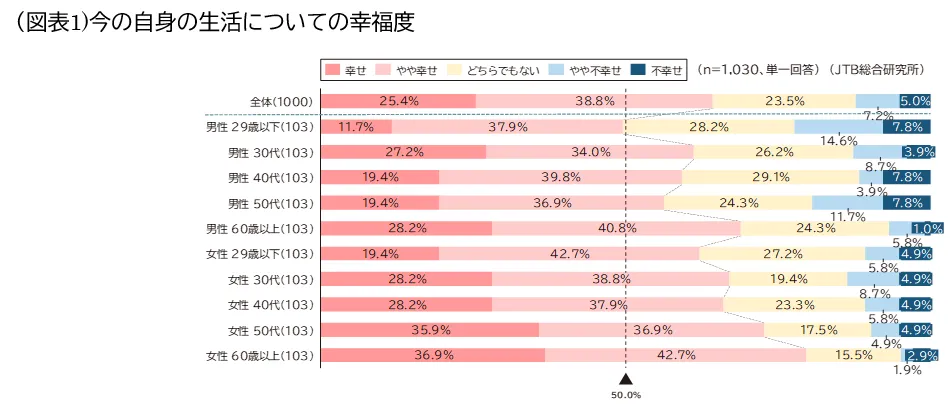
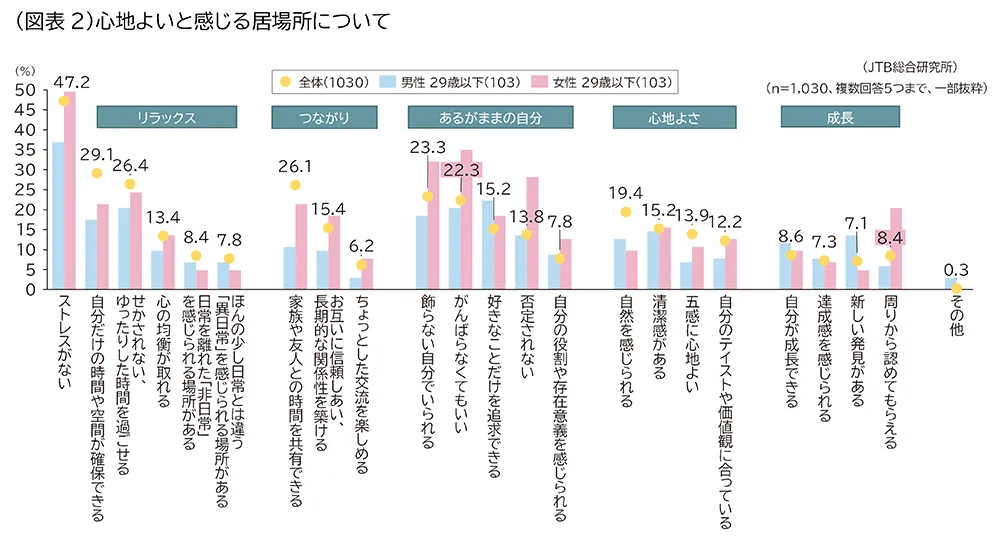
The results show that both men and women aged 29 and under report the lowest levels of happiness with their current lives. For men aged 29 and under, a "comfortable place" is one where they can pursue only the things they love and make new discoveries; for women aged 29 and under, it is a place where they can be accepted just as they are.
When asked about their current level of happiness with their lives, women tended to report higher levels overall than men. However, when broken down by gender, those aged 29 and under reported the lowest levels for both men and women. In particular, for men aged 29 and under, the combined percentage of those who were “happy” and “somewhat happy” was 49.5%, the only group to fall below a majority (Figure 1).
Regarding what makes a place feel comfortable, men aged 29 and under had the highest percentages among all demographics for “being able to pursue only what I like (22.3%)” and “making new discoveries (13.6%)”. For women aged 29 and under, “not having to try so hard (35.0%)”,“not being criticized (28.2%)” and “being recognized by others (20.4%)” were notably higher than the overall average. For Gen Z women, being accepted for who they are appears to be a key factor in feeling comfortable (Chart 2).
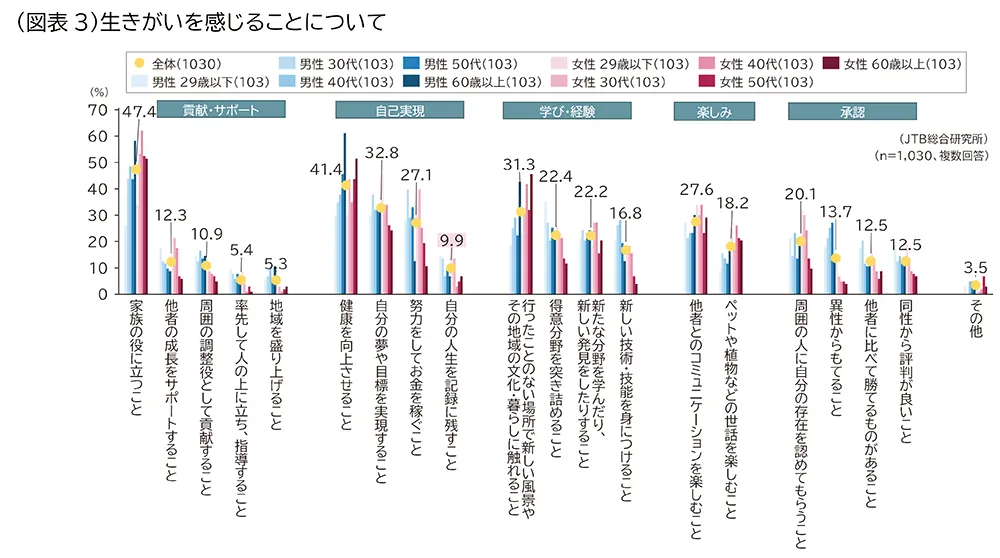
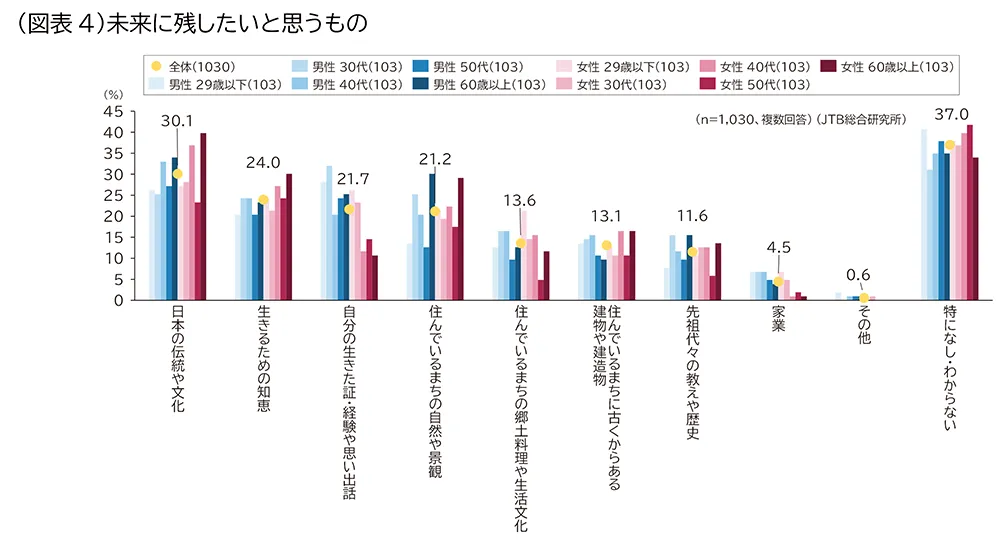
Regarding a sense of purpose, men aged 29 and under cited “pursuing their areas of expertise,” while women aged 29 and under cited “realizing their dreams and goals,”“being acknowledged by those around me,” and “leaving a record of my life.” Regarding what they wish to leave for the future, items related to themselves—such as “proof of my life, experiences, and memories”—were emphasized more strongly than in other generations
Regarding what gives them a sense of purpose, “pursuing one’s area of expertise (35.0%)” was the highest result among men aged 29 and under.Among women aged 29 and under, “realizing one’s dreams and goals (45.6%),” “gaining recognition from those around them (32.0%),” and “leaving a record of one’s life (19.4%)” had the highest results across all demographics.Perhaps influenced by social media, it appears that they place a strong emphasis on documenting and sharing their lives, gaining recognition, and realizing their dreams and goals.Furthermore, while “being popular with the opposite sex” was high among men in their 40s and 50s, “having a good reputation among people of the same sex” was high among men aged 29 and under and women aged 29 and under, revealing generational differences in values regarding the opposite and same sexes (Figure 3).
Regarding what people wish to leave behind for the future, “evidence of one’s life, experiences, and memories” was highly ranked among men in their 30s (32.0%), men aged 29 and under (28.2%), and women aged 29 and under (26.2%). This result also highlights the characteristic desire among younger generations to leave something of themselves behind(Figure 4).
Views on work and lifestyle
When it comes to work and learning, many people in this demographic are becoming more aware of career changes, side hustles, and starting their own businesses as they gain greater flexibility in how they work. Regarding their ideal lifestyle, both men and women aged 29 and under cited “enjoying a variety of hobbies.”
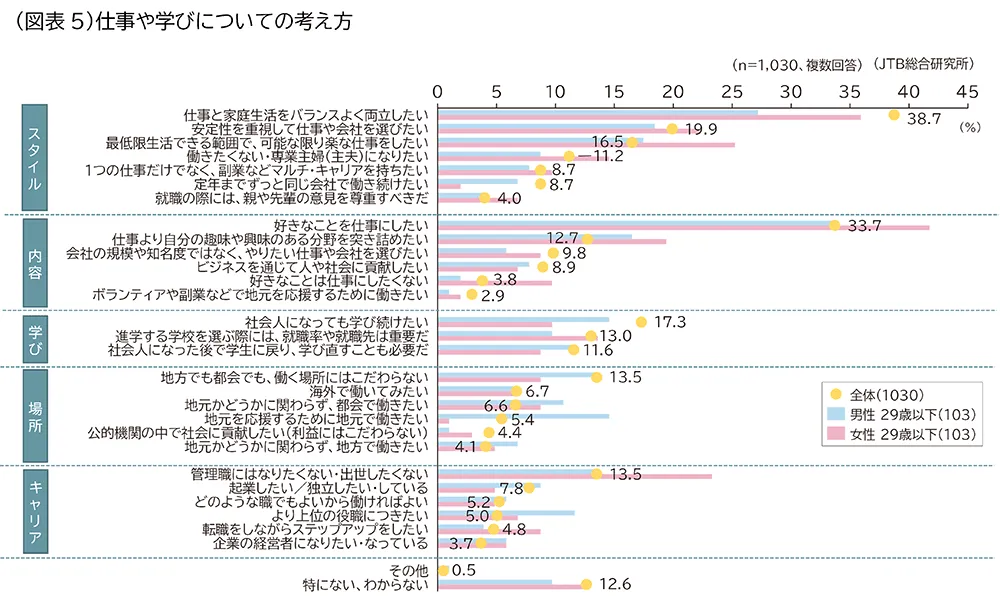
Next, we asked about work and education. Among men aged 29 and under, the items with higher percentages than the overall average were “I want to work locally to support my hometown (14.6%)” and “I want to hold a higher-level position (11.7%).”Among women aged 29 and under, the top responses were “I want to turn my hobbies into a career (41.7%),” “I want a job that is as easy as possible while still allowing me to make a living (25.2%),” and “I don’t want to become a manager or advance in my career (23.3%)” (Figure 5).
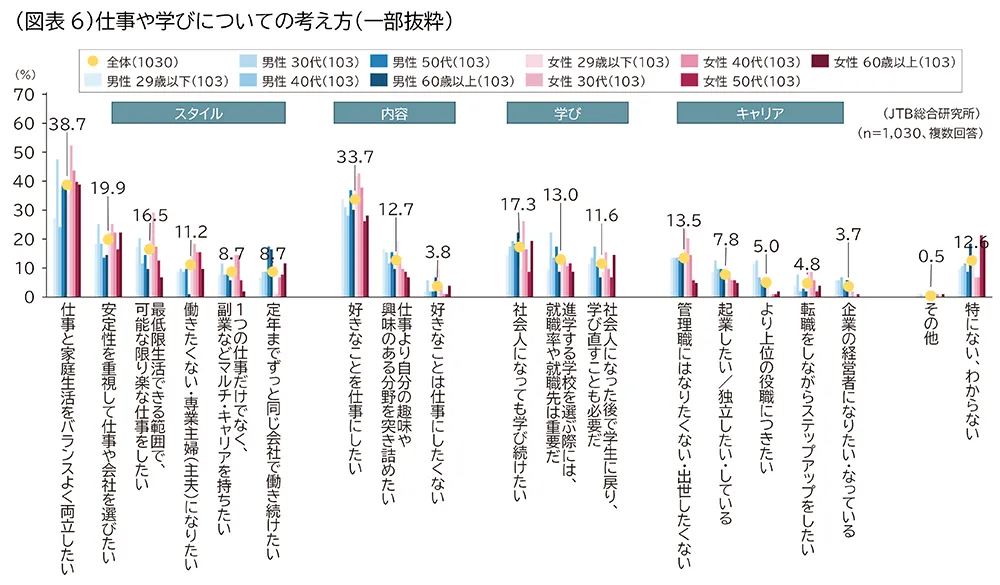
Additionally, when combining women aged 29 and under with those in their 30s, the trend showed that “I want to continue working at the same company until retirement” was low, while “I want to advance my career by changing jobs” was the highest among all demographic groups. Furthermore, “I want to have a multi-career path, such as a side job, rather than just one job” also tended to be higher compared to other groups.Furthermore, “I want to start my own business/become self-employed or am already doing so (12.6%)” was highest among men in their 30s. This suggests that, particularly among Gen Z and those in their 30s, there is a growing group that values greater flexibility in their work style and is increasingly considering changing jobs, taking on side hustles, or starting their own businesses (Chart 6).
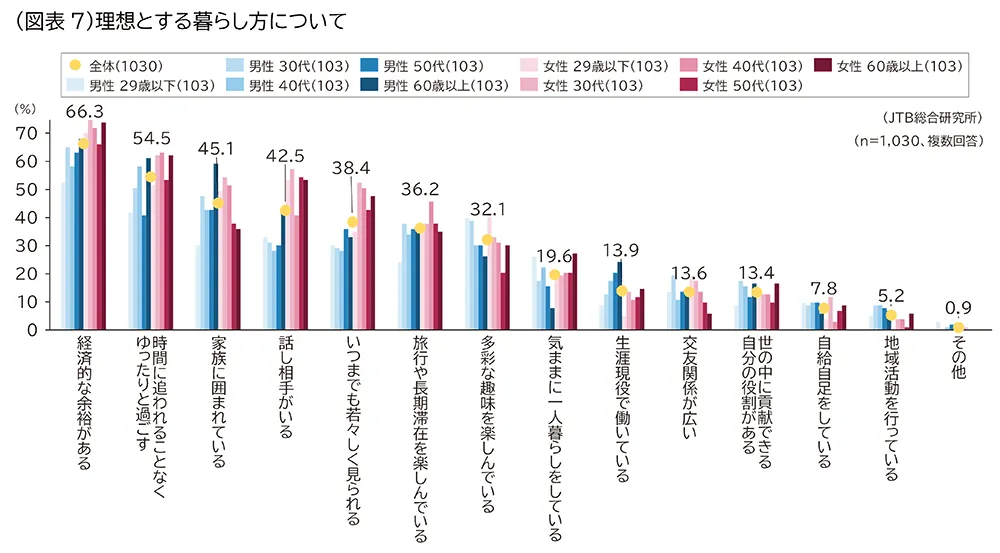
Regarding ideal lifestyles, among men aged 29 and under, “enjoying a variety of hobbies (39.8%)” and “living alone freely (26.2%)” were higher than the average, while “enjoying a variety of hobbies (41.7%)” was highest among women aged 29 and under.Furthermore, while “living alone at my own pace” was highest among women aged 60 and older (27.2%), it was lowest among men aged 60 and older (7.8%), resulting in contrasting findings. Significant gender differences were also observed in items such as “having someone to talk to” and “being perceived as youthful forever” (Figure 7).
How to Spend Your Time and Money
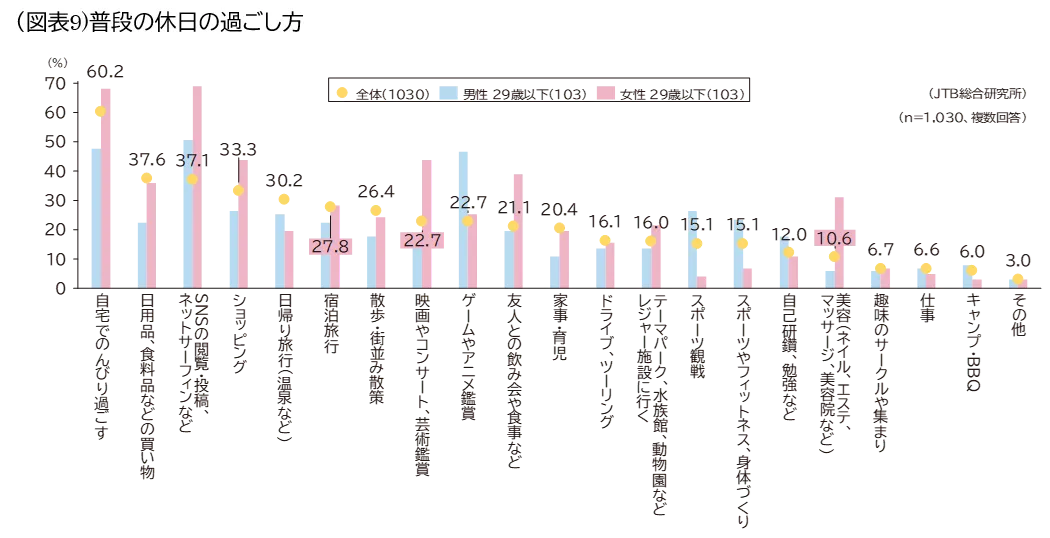
Women aged 29 and under are proactive in adopting time-saving habits to make the most of their time, maintaining a balanced lifestyle. When it comes to how they typically
spend their days off, “browsing and posting on social media, surfing the web, etc.” ranks high for both men and women. Regarding spending
habits, men aged 29 and under tend to allocate both their time and money to their hobbies.
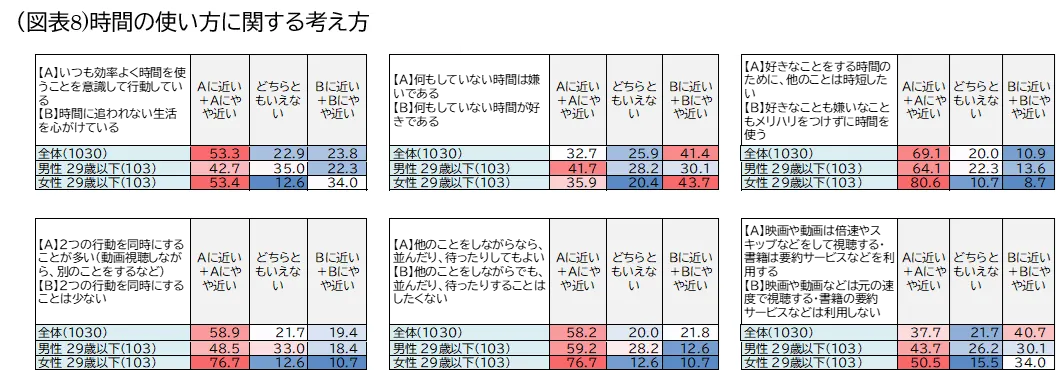
Regarding attitudes toward time management, men aged 29 and under showed higher rates than the overall population in the following areas: “I dislike doing nothing (41.7%)” and “I watch movies and videos at double speed or skip through them, and use summary services for books (43.7%).”Among women aged 29 and under, higher than average percentages were seen in the items “I want to save time on other things to make time for what I enjoy (80.6%),” “I often do two things at once (76.7%),” “I don’t mind waiting in line or waiting if I can do something else at the same time (76.7%),”and “I watch movies and videos at double speed or skip through them, and use summary services for books (50.5%)”—all of which showed a higher tendency than the overall average. This suggests that women are more likely than men to adopt time-saving behaviors to make effective use of their time.On the other hand, among women aged 29 and under, “I try to live a life where I’m not constantly rushed” (34.0%) was higher than the overall average, suggesting they maintain a good balance between work and rest (Figure 8).
Regarding how they typically spend their days off, men aged 29 and under showed higher rates for “browsing and posting on social media, surfing the web, etc. (50.5%),” “relaxing at home (47.6%),” “playing video games or watching anime (46.6%),”and “watching sports (26.2%)” in that order.For women aged 29 and under, the top activities were “browsing and posting on social media, surfing the web, etc. (68.9%),” followed by “relaxing at home (68.0%),” “shopping (43.7%),” and “watching movies, attending concerts, or appreciating the arts (43.7%)”(Figure 9).
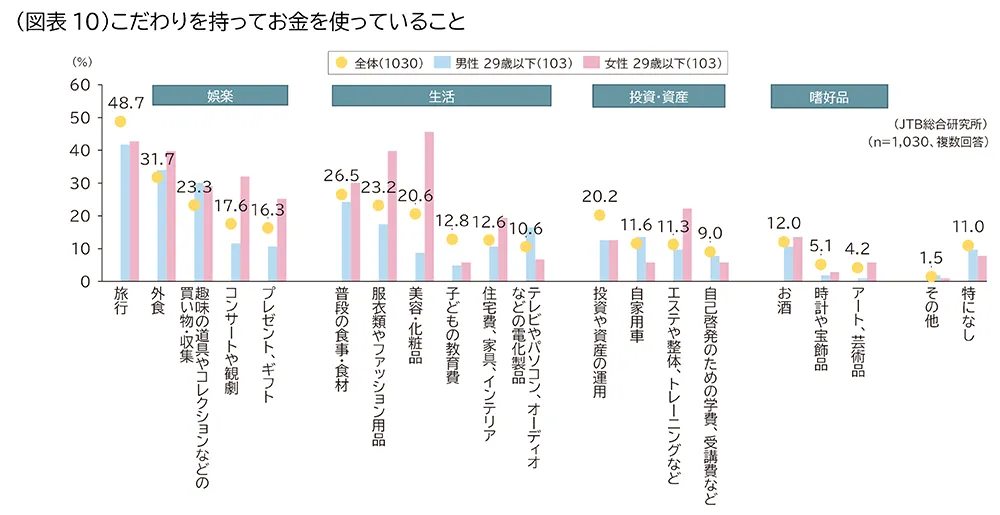
Regarding spending habits, men aged 29 and under were most likely to spend on “eating out (34.0%)” and “purchasing or collecting hobby equipment and collectibles (30.1%)”, while women aged 29 and under were most likely to spend on “beauty and cosmetics (45.6%)”,"Clothing and fashion items (39.8%)", "Eating out (39.8%)", and "Concerts and theater (32.0%)" were the highest among all demographic groups.Men aged 29 and under show a strong tendency to devote both time and money to their hobbies (Figure 10).
About Gathering Information
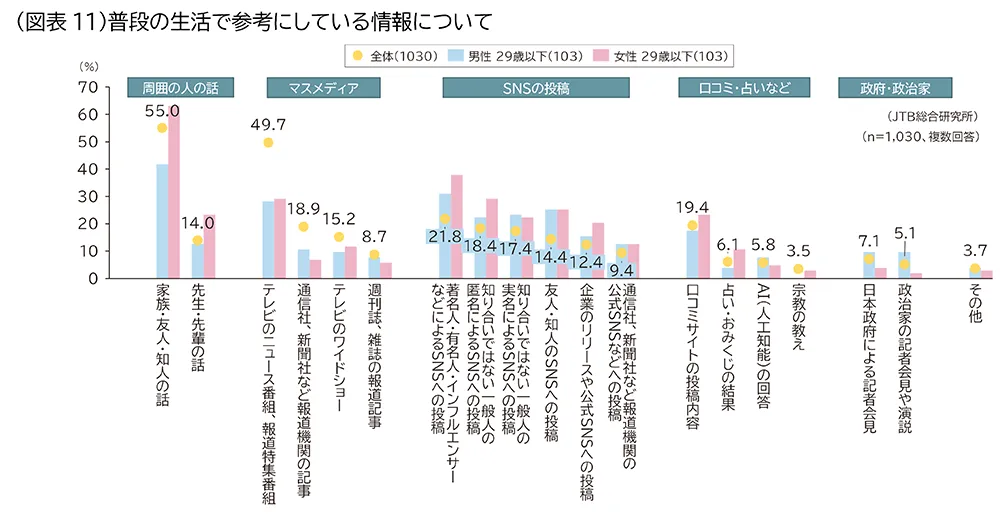
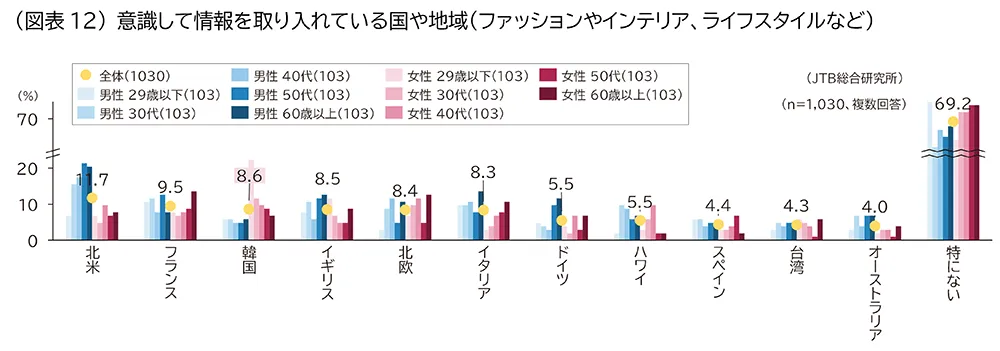
The sources of information that Gen Z relies on in their daily lives are “stories from family, friends, and acquaintances” and “social media posts by celebrities, public figures, and influencers.”"Social media posts" are higher than in other demographics. Regions where people are most conscious of actively seeking out this information include North America for men in their 50s and 60s, and South Korea for women aged 29 and under.
We asked about the sources of information they rely on in their daily lives. Overall, the top responses were “stories from family, friends, and acquaintances (55.0%)”, “TV news programs and special reports (49.7%)”,"Social media posts by celebrities, public figures, influencers, etc. (21.8%)". When respondents were asked to select the one source they trust the most, the percentage for "Stories from family, friends, and acquaintances" increased even further.In contrast, for both men and women aged 29 and under, “posts on social media by celebrities, public figures, and influencers” ranked second after “stories from family, friends, and acquaintances.”While the “social media posts” category scored higher than in other demographic groups, “TV news programs and special news programs” scored more than 20 percentage points lower than the overall average. It appears that for Gen Z, social media is a more trustworthy source than news programs and the like (Figure 11).
Regarding countries or regions where they consciously seek out information, “None in particular (74.8%)” was the highest response among men aged 29 and under, whereas North America was the top choice for men in their 50s and 60s, and South Korea was the top choice for women aged 29 and under (Figure 12).
Attitudes and Values Regarding Travel
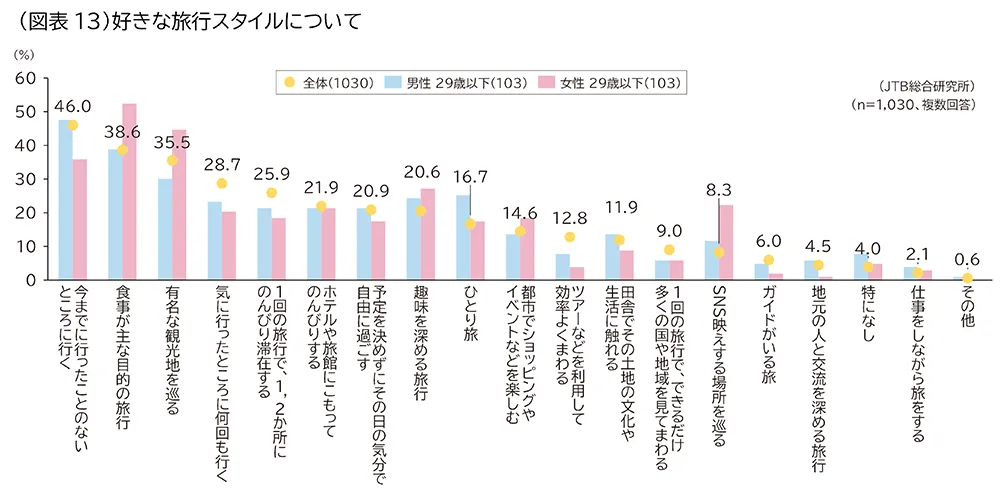
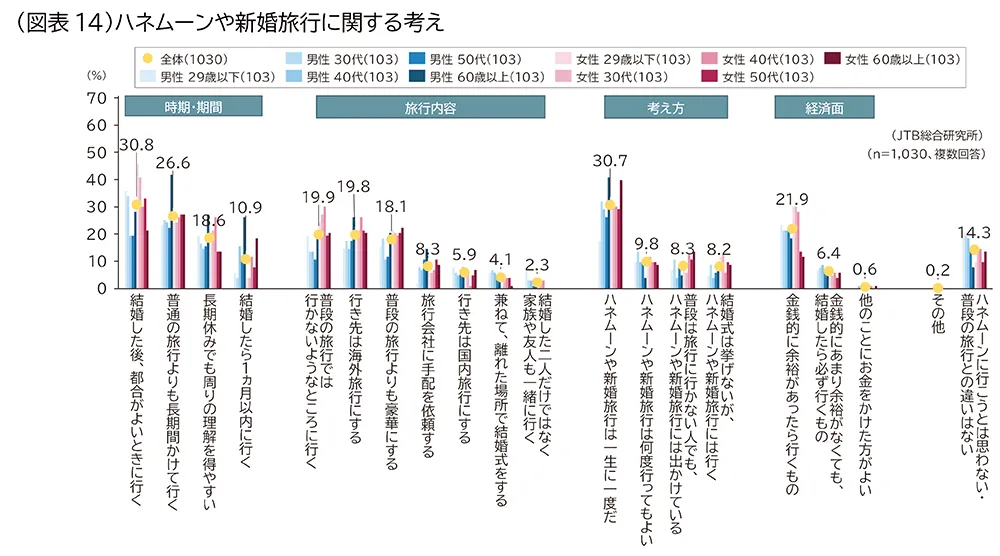
Preferred travel styles among men aged 29 and under include “solo travel” and “trips to pursue hobbies,” while those among women aged 29 and under include “trips focused primarily on dining” and “visiting famous tourist spots.”"Visiting Instagrammable spots" is popular among both men and women aged 29 and under, with a particularly strong trend among women. Changing values regarding honeymoons and generational gaps are revealed.
Regarding preferred travel styles, items that were particularly higher among men aged 29 and under compared to the overall population include “solo travel (25.2%)” and “travel to deepen hobbies (24.3%)”,and “visiting Instagram-worthy spots (11.7%)”; for women aged 29 and under, “trips where dining is the main purpose (52.4%)”, “visiting famous tourist spots (44.7%)”, and “visiting Instagram-worthy spots (22.3%)” were particularly high.
While “visiting Instagram-worthy spots” was popular among both men and women aged 29 and under, the trend was particularly strong among women (Figure 13).
Regarding honeymoons and newlywed trips, while 26.2% of men aged 60 and older said they would “go within one month of getting married,” only 5.8% of men aged 29 and younger agreed.Regarding the statement “A honeymoon or newlywed trip is a once-in-a-lifetime experience,” 40.8% of men aged 60 and older agreed, compared to 17.5% of men aged 29 and younger, highlighting shifting values and generational gaps (Chart 14).
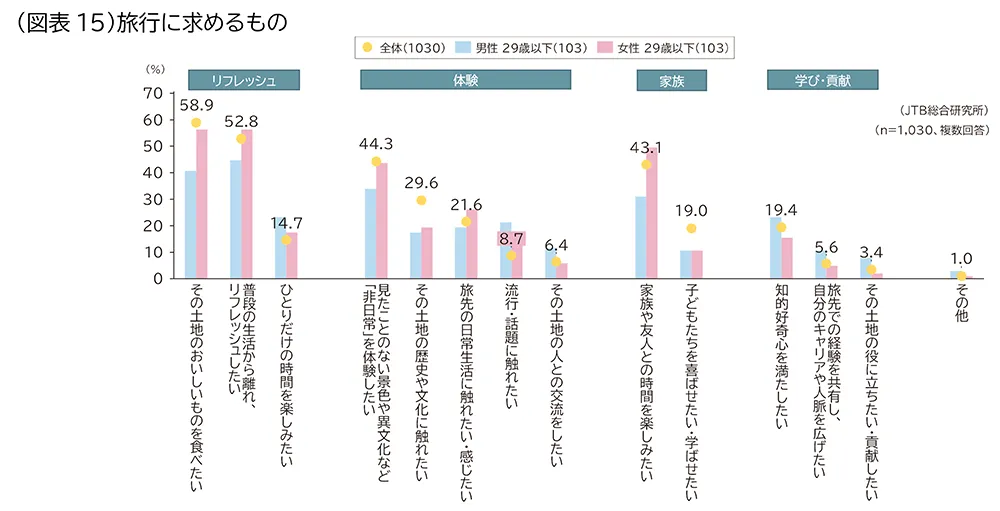
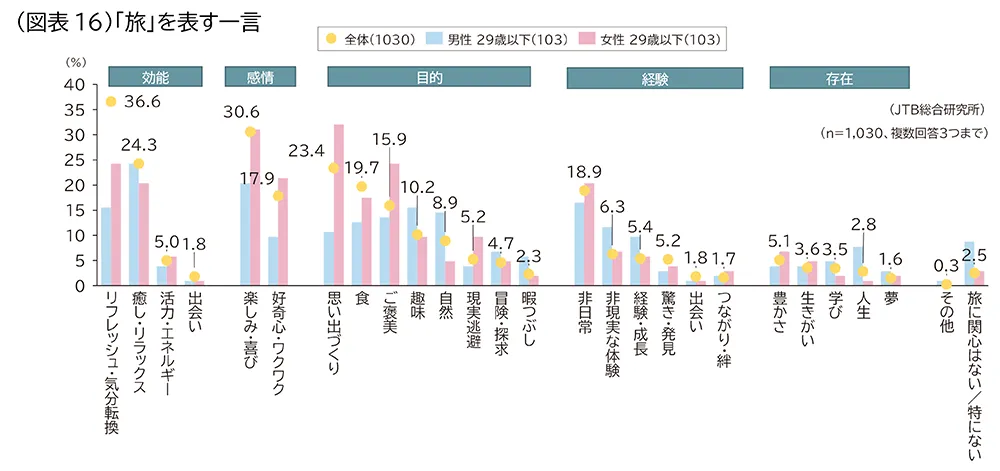
When asked what they seek from travel, men aged 29 and under cited “enjoying time alone,” “experiencing trends and hot topics,” and “interacting with local people,” while women aged 29 and under cited“I want to enjoy time with family and friends.” When asked to describe “travel” in one word, men aged 29 and under cited “hobby,” “nature,” and “unreal experiences,” while women aged 29 and under cited “making memories” and “a reward.”
Regarding what they seek from travel, items that were particularly high among men aged 29 and under compared to the overall group included “I want to enjoy time alone (23.3%)”, “I want to experience trends and hot topics (21.4%)”,“Want to interact with local people (11.7%)”, and “Want to share travel experiences to expand my career and network (10.7%)”; for women aged 29 and under, it was “Want to enjoy time with family and friends (49.5%)” (Figure 15).
Regarding one-word descriptions of “travel,” the overall results were “Refreshment/Change of pace (36.6%),” “Fun/Joy (30.6%),”"Healing and relaxation (24.3%)," "Creating memories (23.4%)," and "Food (19.7%)." With the exception of "Food," women scored higher across the board.Among men aged 29 and under, the items that were particularly higher than the overall average were “hobbies (15.5%),” “nature (14.6%),” and “unrealistic experiences (11.7%),” which were higher than other demographic groups. Conversely, “refreshment and a change of pace (15.5%)” and“Creating Memories (10.7%)” were less than half the average.Among women aged 29 and under, “Creating Memories (32.0%)” and “Treats (24.3%)” were higher than the overall average, while “Refreshment/Change of Pace (24.3%)” was the second lowest after men aged 29 and under (Figure 16).
Summary
This survey revealed that one of the defining characteristics of Gen Z is the strong influence of social media on their daily lives.When it comes to the information they rely on, they cited information obtained from people close to them as more trustworthy than mass media, followed by social media. Regarding travel styles, “visiting Instagrammable spots” was more prevalent among both men and women than in other generations. While “Generation Z” is often lumped together as a single group, this survey revealed distinct trends between men and women within the generation.
The key to motivating Gen Z men to travel lies in how effectively “hobbies” and “travel” are linked
Gen Z men are highly interested in pursuing their hobbies, interests, and areas of expertise. Perhaps because many are single, they tend to allocate a significant amount of both time and money to their hobbies and interests.When asked to describe “travel” in a single word, “hobbies” and “nature” were frequently cited. While “hobbies” may seem diverse and elusive, it may be effective to target specific, even niche, interests—or to connect travel with games and sports that are popular among young men.
Furthermore, while “wanting to enjoy time alone” was the top reason for traveling, our past surveys have identified “not being able to find a travel companion” as a major barrier to travel for Gen Z.While it may be difficult to find a travel companion when planning a trip centered around a personal “hobby,” there is potential to boost motivation for travel by matching solo travelers through participation in hobby-related events or tours at their destination.
Gen Z women prioritize time efficiency. They also place importance on recording and preserving their own experiences
We found that Gen Z women engage in time-efficiency-focused behaviors, such as “doing two things at once” and “multitasking.”It is likely that they also prioritize time efficiency when gathering information at their travel destinations and during their experiences. For Gen Z women, being able to easily and seamlessly access information and enjoy experiences—such as when receiving travel-related information—is likely a key priority.
Additionally, there is a tendency to prioritize satisfying the desire for validation and documenting their own experiences.A recent trend shows a shift from “experiences over things” (finding satisfaction in experiences rather than purchasing products) back toward “things over experiences.” However, the “things” that are regaining attention are not merely products to be purchased; instead, they are increasingly positioned as “things” that serve as recording media to capture their own experiences.For example, creating a unique piece of handicraft while traveling is one such example. It seems that the key to Gen Z women’s behavior lies in the fact that acquiring an object allows them to document their own experiences, and by sharing these, their need for validation is fulfilled.