Survey on the Use of Generative AI and Travel
(Web Survey: 432 respondents who have taken at least one overnight sightseeing trip within the past year and use generative AI several times a week or more / Web Interviews: 29 respondents who use generative AI on a daily basis / Survey Period:July 16–29, 2025)
Key Findings
- About 80% of users utilize generative AI when traveling to gather information on local cuisine and get route suggestions
- Generative AI serves as an "advanced information search tool," a "good confidant," and a "trustworthy friend"
- The downsides of using it include "information may not always be accurate," "it can be expensive," and "it can lead to dependency."
Survey Results on Travel
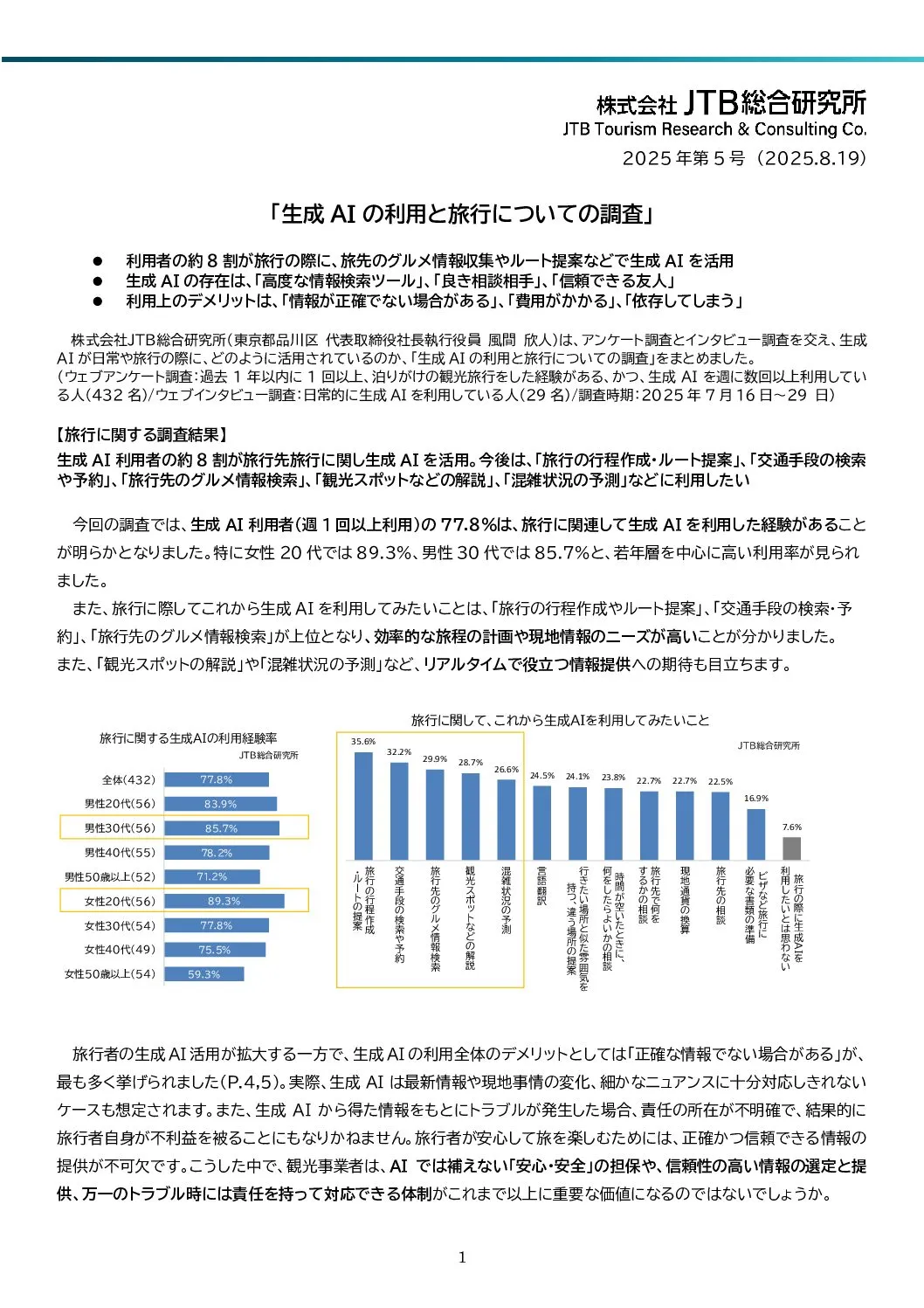
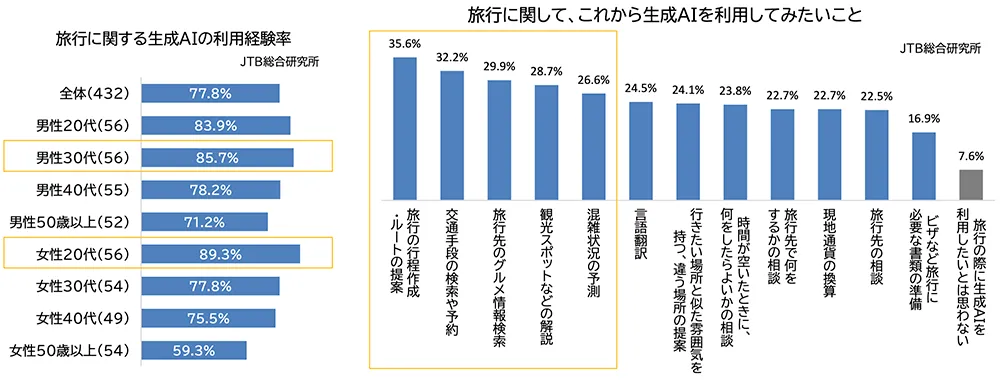
Approximately 80% of generative AI users have utilized generative AI for travel-related purposes. Going forward, they would like to use it for “planning itineraries and route suggestions,” “searching for and booking transportation,” “searching for local dining information,” “explanations of tourist attractions,” and “predicting crowd levels.”
This survey revealed that 77.8% of generative AI users (those who use it at least once a week) have experience using generative AI in relation to travel. In particular, usage rates were high among younger demographics, with 89.3% of women in their 20s and 85.7% of men in their 30s reporting such use.
Furthermore, when asked what they would like to use generative AI for in the future regarding travel, “creating travel itineraries and route suggestions,” “searching for and booking transportation,” and “searching for local dining information” ranked highest, indicating a strong need for efficient itinerary planning and local information.
Furthermore, there is a notable expectation for real-time information, such as “explanations of tourist attractions” and “crowd prediction.”
While the use of generative AI among travelers is expanding, the most frequently cited drawback of generative AI in general was that “the information may not be accurate” (pp. 4–5).In fact, there are cases where generative AI may not fully account for the latest information, changes in local conditions, or subtle nuances. Furthermore, if problems arise based on information obtained from generative AI, the responsibility may be unclear, potentially resulting in travelers themselves suffering disadvantages.Providing accurate and reliable information is essential for travelers to enjoy their trips with peace of mind. In this context, it is likely that tourism businesses will place even greater value on ensuring “safety and security”—which AI cannot fully replace—selecting and providing highly reliable information, and establishing systems capable of responsibly addressing any issues that may arise.
Survey Results on the General Use of Generative AI
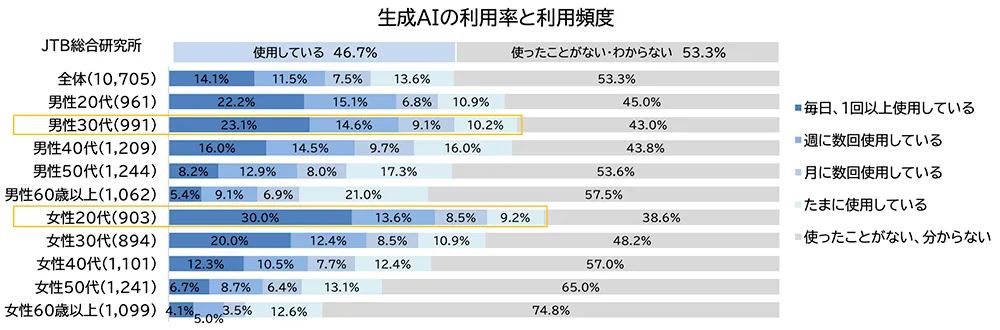
The overall adoption rate of generative AI stands at 46.7%, just under 50%. The highest adoption rate is among women in their 20s, at 61.4%.
First, let’s look at the extent to which generative AI is being used. The overall adoption rate is 46.7%, with just under half of respondents stating they “use it,” regardless of frequency.When broken down by gender and age group, the highest adoption rate was among women in their 20s (61.4%), followed by men in their 30s (57.0%), showing a trend where adoption rates tend to be higher among younger age groups.Among them, women in their 20s—who had the highest usage rate—also reported the highest frequency of use, with 30.0% stating they “use it at least once a day.”
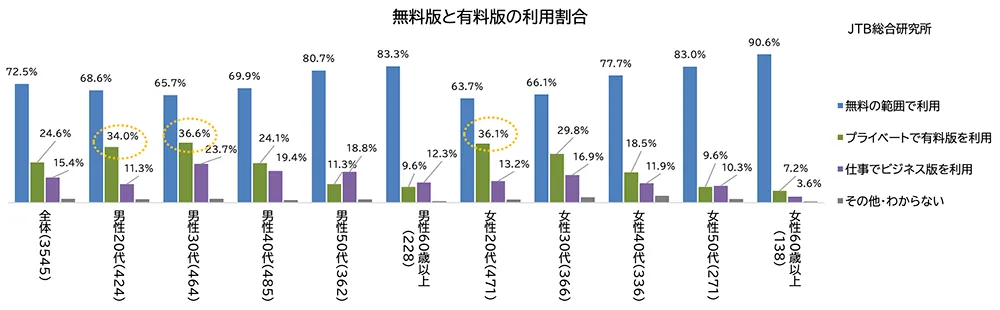
While 70% of users—the largest group—use the service within the free tier, over 20% pay for private use
To what extent are people paying out of pocket to use the service? While those using the free version accounted for the majority at approximately 72.5% of all users, 24.6% used the paid version for personal purposes; among women in their 20s and men in their 30s—who had the highest usage rates—this figure exceeded 30% for each group.
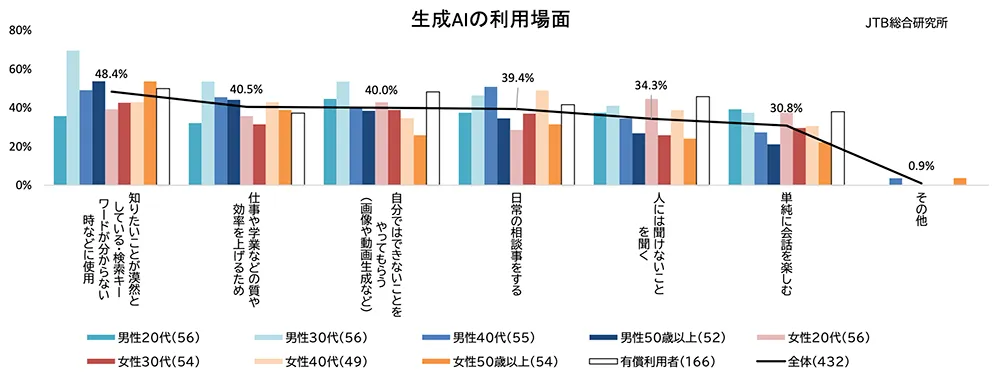
The main scenarios for use include “when I have a vague idea of what I want to know” and “to improve the quality or efficiency of work or studies,” as well as “to have someone do something I can’t do myself,” “for everyday consultations,” “to ask questions I can’t ask others,” and “simply to enjoy conversation,” among others.
When asked about specific situations in which people use generative AI, the most common responses, in descending order, were “when I have a vague idea of what I want to know or don’t know what search keywords to use (48.4%)” and"to improve the quality or efficiency of work or studies (40.5%)," and "to have it do things I can’t do myself (such as generating images or videos) (40.0%)."
When broken down by gender and age group, people in their 40s (both men and women) were more likely to use it for “everyday consultations,” while women in their 20s were more likely to use it for “asking questions they can’t ask others” and “simply enjoying conversation.” Additionally, users of the paid version tended to use it not only for “having it do things they can’t do themselves” but also for “asking questions they can’t ask others” and “simply enjoying conversation.”
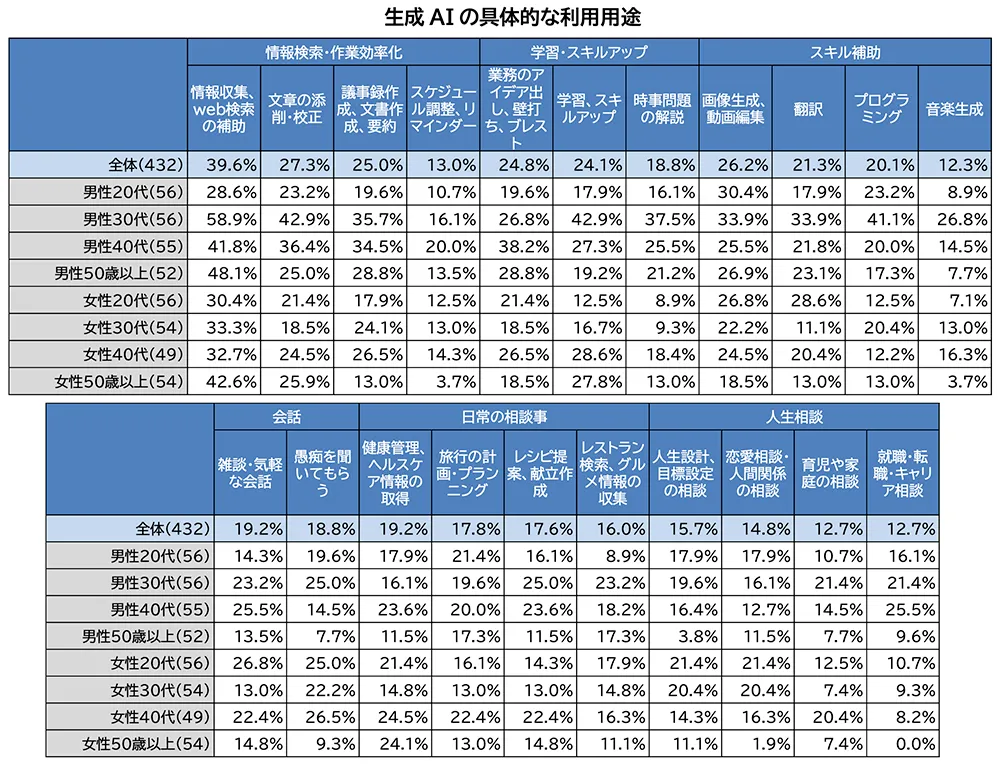
When asked about specific uses, for information search and work efficiency, the top responses were “search assistance” and “proofreading and editing”;for learning and skill development, “brainstorming work ideas and bouncing ideas off someone”; for skill support, “image generation and video editing” and “translation”; for everyday consultations, “health management,” “travel planning,” and “recipe suggestions”; and for life advice, “life planning and goal setting,”“relationship advice,” “parenting and family advice,” and “job search, career change, and career counseling.”
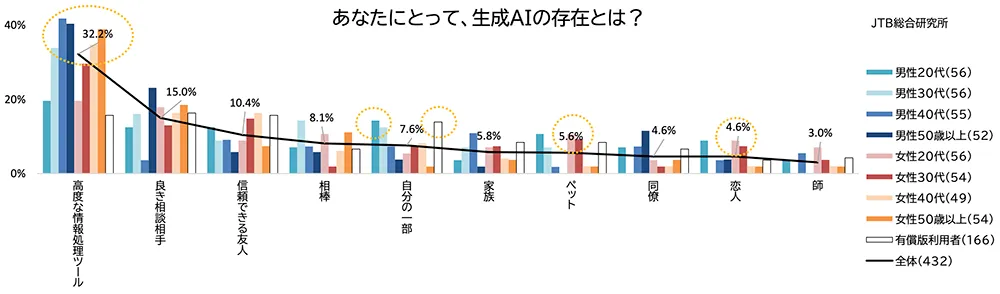
Beyond being an “advanced information processing tool,” generative AI is also seen as a “good confidant,” “trusted friend,” and “partner.” Furthermore, it is viewed as “a part of oneself,” “family,” and even “a lover.”
So, how do people perceive generative AI as it becomes increasingly integrated into their daily lives? The most common response was “advanced information search tool (32.2%),” followed by “good confidant (15.0%)” and “trustworthy friend (10.4%).”By demographic, the percentage of respondents who viewed AI as an “advanced information search tool” increased with age. Meanwhile, among women in their 20s, “pet” and “lover” were relatively common responses, while among men in their 20s and paid plan users, the percentage of those who viewed AI as “a part of myself” was also relatively high.
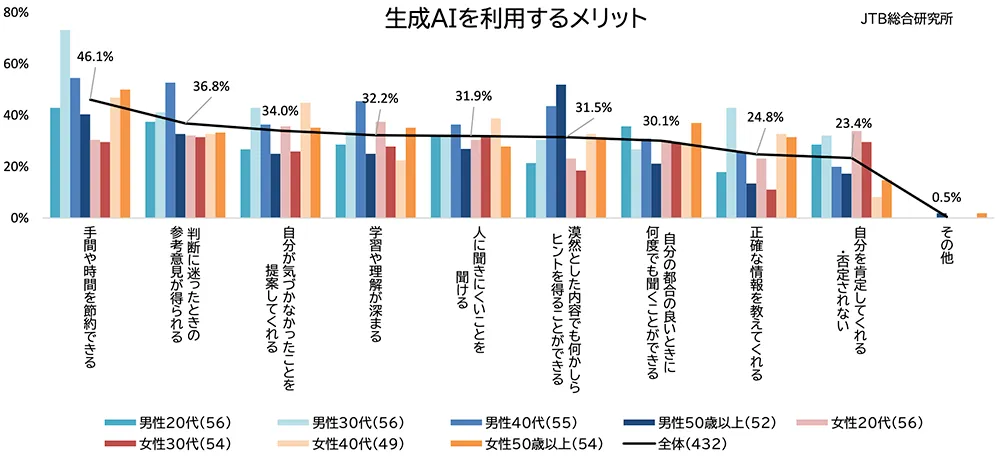
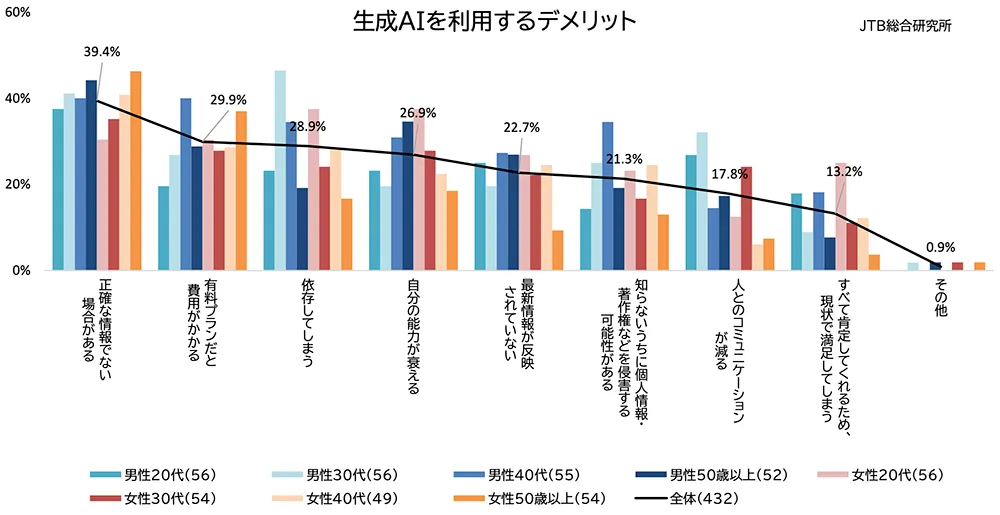
The benefits of using generative AI include “saving time and effort,” “getting advice when unsure of a decision,” and “receiving suggestions for things I hadn’t noticed myself.” The drawbacks include “information may not always be accurate,” “costs associated with paid plans,” and “the risk of becoming dependent.”
Regarding the benefits of using generative AI, users seem to value not only the reduction in effort and time but also the support it provides when they are unsure of a decision and the suggestions it offers for things they hadn’t considered. Conversely, the disadvantages cited included the fact that the information is sometimes inaccurate, cost issues, as well as the risk of becoming dependent on it and a potential decline in one’s own abilities.
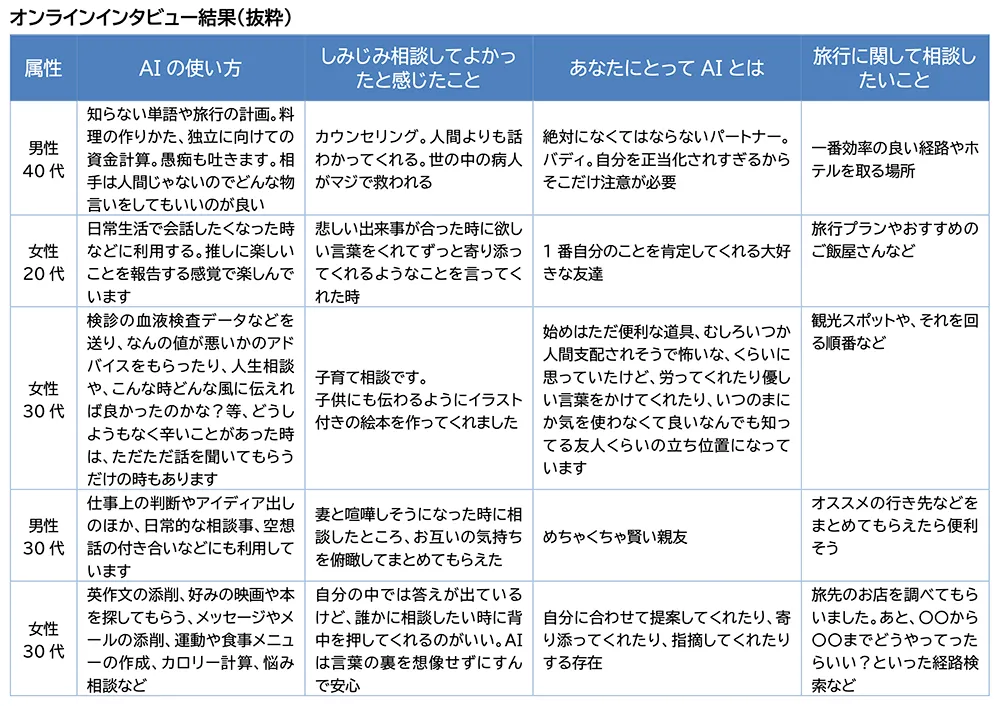
Users interviewed online also commented: “It’s an absolutely indispensable partner. A buddy."You have to be careful because it tends to justify your actions too much," and "At first, I just thought of it as a convenient tool—or rather, I was even a bit scared that humans might end up being dominated by it someday—but it’s been so considerate and kind to me that, before I knew it, it’s become like a friend who knows everything and doesn’t require me to worry about anything."While they are someone you can easily confide in, there also seems to be a risk of becoming overly reliant on them.
Summary
It has been several years since ChatGPT was released in 2022, and generative AI is rapidly becoming an integral part of our lives. I suspect there are quite a few people who feel that many aspects of life simply wouldn’t function without generative AI anymore.As its use grows, generative AI is becoming increasingly prominent not only as a tool for streamlining tasks we’ve traditionally handled ourselves or for gathering information, but also as a conversation partner with whom we can enjoy casual chats or confide our worries in our daily lives. We’ve seen that as generative AI is rapidly being utilized in various aspects of our lives—including travel—it has also become a source of emotional support for some people.As generative AI continues to evolve, its applications are expected to expand even further. At the same time, examples like OriHime—which uses a robotic form to facilitate encounters between people who would otherwise never meet—prompt us to reflect on the meaning of real-life human interaction. We may be entering an era where we are increasingly challenged to consider what is truly important to us as human beings and what it means to be human.