What Minpaku (Private Lodging) Regulations Reveal About the Next Phase of Japan as a Tourism-Oriented Nation

To evaluate minpaku (private lodging) regulations, it is essential to look not only at how strict the regulations are but also at how residents' lives have changed. This article organizes the three regulatory frameworks and local government responses, and considers how to interpret complaint figures, what data should be recorded before enforcement, and how to measure impacts on lodging supply and local consumption. How can improvements to the living environment be reconciled with the sustainability of tourism? We examine the next phase of Japan as a tourism-oriented nation, with residents' lives as the starting point.
*This article is based on materials published as of October 4, 2026. Policies and draft proposals currently under consideration are subject to change.
1. How to Verify the Effects of Private Lodging Regulations
In September 2026, Shinjuku Ward announced a policy to strengthen regulations on the residential accommodation business [1]. Under the policy, operations would, in principle, be prohibited in residential-use zones (areas used mainly for housing) and limited to 120 days per year in commercial-use zones (areas where commercial facilities, offices, and the like are concentrated), among other measures. The ward intends to apply these rules to existing facilities as well, after transitional measures. While systems are being reviewed in various areas, it is necessary to distinguish between measures that have already been enacted or put into effect and those still under consideration. Note that this article is based on materials published as of October 4, 2026.
Debates over the regulations include whether they can protect the living environment, how they will affect operators, and whether they will lead to an increase in unregistered operations. All of these are important, but this article focuses on how to verify whether the regulations have actually improved residents' lives.
To do so, it is essential to record conditions before enforcement and to prepare to track them with the same indicators after enforcement. This means examining not only the number of complaints but also the number of facilities, their operating status, administrative responses, lodging supply, and local consumption. After organizing the differences among the systems, we consider a framework for this evaluation.
2. The Three Frameworks Underlying “Private Lodging”
"Private lodging" is not the name of a single legal system. The Japan Tourism Agency generally describes it as providing lodging services to travelers and others using all or part of a dwelling [2]. Operating it involves three systems: filing a notification under the Residential Accommodation Business Act, obtaining certification as Special Zone Private Lodging under the National Strategic Special Zones Act, and obtaining a license under the Hotel Business Act.
Table 1: Three Regulatory Frameworks for Private Lodging
| System/Procedure | Operating Days / Length of Stay | Main Treatment of Building Use, etc. |
|---|---|---|
| Residential Accommodation Business Act / Notification | Up to 180 days per year. Area and duration restrictions may be imposed by ordinance. | Residential property. Must meet statutory equipment and occupancy requirements. |
| Special Zone Private Lodging / Certification | Subject to the ordinances of the implementing local government. The minimum stay is, in principle, 2 nights and 3 days or longer. | If certain requirements are met, the property is treated as a residence. Conditions apply regarding designated areas and other factors. |
| Operations under the Hotel Business Act (Simple Lodging Facilities, etc.) / License | No annual limit of 180 days such as that under the Residential Accommodation Business Act. | Hotels, inns, etc. Must comply with zoning regulations, as well as building, fire safety, and sanitation standards. |
This distinction matters when considering the scope of regulations. Restrictions on the residential accommodation business do not automatically become restrictions on all short-term lodging facilities. At the same time, shifting to the hotel business is not simply a matter of changing procedures. Location is restricted in areas such as Exclusively Residential Zones under the Building Standards Act, and even in other areas, buildings must meet standards for construction, fire safety equipment, and the like. Rather than lumping everything together as "residential areas," it is necessary to check the zoning designation and building conditions.
The national technical advice issued on July 15, 2026 [5] sets out the approach to take when considering area and duration restrictions on the residential accommodation business. Its intent is to examine specifically whether strong restrictions are necessary, for example where serious impacts on the living environment arise and are difficult to prevent by other means. It is not appropriate to read this as grounds for uniform bans anywhere. Explanations tailored to local circumstances are required, including the actual impacts, alternative measures, and transitional measures for existing operators.
3. Impacts on the Living Environment and Responses by Local Governments
The problems residents face are more concrete than the names of systems. They appear in everyday life: noise at night, how garbage is put out, the use of common areas, unclear contact information, and so on. Identifying which problems arise at which facilities and under which operating models is the starting point for countermeasures.
In a survey published by the Japan Tourism Agency in March 2022 [6], the share of properties that had ever received complaints was 6.6% for host-occupied properties and 18.8% for host-absent properties. In addition, the share of host-absent properties was 96.9% among condominiums and 79.3% among apartments. Whether a manager is on-site can be considered a key operational issue.
However, this survey was conducted in November–December 2021 and is based on responding properties. It asked whether properties had ever received a complaint, so it does not represent an annual incidence rate. Because there are also differences in location, operating period, occupancy, and other factors, it cannot be concluded that host absence alone causes complaints.
With regard to garbage, it is also necessary to avoid confusion with household waste and to ensure disposal in line with local government rules for business waste. For example, Edogawa Ward treats waste from private lodging as business waste and advises operators not to put it out at the ward's household waste collection points [7]. Because disposal methods vary by local government, it is important to confirm how collection, storage, and removal are handled at each facility.
Local government responses differ both in the systems they cover and in their decision-making stage. In Sumida Ward, an amended ordinance took effect in April 2026 [8], and in Shibuya Ward, one took effect in July of the same year [9]. In Osaka City, an amended ordinance on the hotel business is scheduled to take effect on October 30 of the same year [10]. Toshima Ward's area and duration restrictions will take effect on December 16 of the same year [11]. Meanwhile, Shinjuku Ward is at the policy stage, and Setagaya Ward is at the draft stage. Lining them all up as the same type of regulation obscures the actual differences.
Table 2: Local Government Responses Differ by System and Decision-Making Stage
| Municipality | Covered System | Effective Date/Status | As of October 4, 2026 |
|---|---|---|---|
| Sumida Ward | Hotel business / Residential accommodation business | April 1, 2026 | In effect |
| Shibuya Ward | Residential accommodation business | July 1, 2026 | In effect |
| Osaka City | Hotel Business | October 30, 2026 | Enacted, not yet in effect |
| Toshima Ward | Area and duration restrictions on the residential accommodation business | December 16, 2026 | Enacted, not yet in effect |
| Setagaya Ward | Residential accommodation business | April 1, 2027 (proposed) | Draft, open for public comment |
| Shinjuku Ward | Residential accommodation business | Policy to strengthening regulations announced | Policy stage for system revision |
The treatment of existing facilities also differs. In Toshima Ward, existing facilities are exempt from the ban on operations under the area restrictions, but the restrictions on operating days and periods do apply [11]. Shinjuku Ward has presented a policy that includes application to existing facilities [1]. Simplifying matters as "new facilities only" or "all existing facilities too" without checking exceptions and transitional measures should be avoided.
- Toshima Ward (enacted): Existing facilities are exempt from the year-round area-based restrictions. However, duration restrictions also apply to existing facilities.
- Shinjuku Ward (policy stage): Considering measures such as a general ban on operations in residential-use zones. Application to existing facilities is planned after transitional measures.
- Setagaya Ward (draft stage): Proposes a system that exempts operations meeting conditions such as host residence from area and duration restrictions.
Note: Covered areas and conditions differ by local government. The systems in Shinjuku and Setagaya Wards have not been finalized.
What the author is watching closely is Setagaya Ward's draft proposal [12]. It presents a system that exempts operations meeting conditions such as the host residing on the premises from area and duration restrictions. This reflects the question of how to evaluate operations that can be managed on-site. As of October 4, 2026, the public comment period, which runs from September 15 to October 6, is under way. The comments received and the ward's responses will need to be reviewed, but the results of a public comment process do not directly represent the views of residents as a whole.
4. Combining Area Restrictions with Facility-Level Management
Responding individually to problem facilities and restricting operations by area or period each have a role. Individual responses require ongoing work such as checking the situation, contacting operators, providing guidance for improvement, and following up. If the number of facilities increases rapidly, the administration's capacity to respond is also put to the test.
There are cases in which individual responses have already been set in motion. On August 31, 2026, Kyoto City imposed business suspension orders and administrative fines on five operators for violating the on-site presence requirement and the face-to-face interview requirement for hotel business facilities, and announced the action the same day [13]. Four operators violated both requirements, and one violated only the face-to-face interview requirement. Kyoto City had also announced actions for violations of the on-site presence requirement in December 2025 and April 2026. Individual responses take effort, but they are not impossible to carry out.
There are also moves to revise operating conditions themselves. On September 30, 2026, Osaka City passed an amendment to its Ordinance for Enforcement of the Hotel Business Act [10]. For hotel business operations in buildings that contain residences, the amendment requires, in principle, that the building be of reinforced concrete or steel-reinforced concrete construction, and that the operator, employees, or others be stationed on-site while guests are using the facility. Transitional measures based on the timing of applications apply to the structural standards, but there are no transitional measures for the on-site staffing requirement, which will apply to existing licensed facilities from October 30, 2026.
Designs that vary treatment depending on whether staff are stationed on-site are already in operation [8]. On April 1, 2026, Sumida Ward put into effect a new ordinance on the residential accommodation business and an amendment to its Ordinance for Enforcement of the Hotel Business Act. For the hotel business, staff are required to be stationed on-site, such as within the facility. For the residential accommodation business, operations are not permitted from noon on Sunday to noon on Friday unless a manager is stationed on-site, such as within the registered home. Under this system, the period during which a facility can operate depends on whether it can be run with on-site staff. However, it applies only to facilities whose license applications or notifications were accepted on or after the effective date, and not to existing facilities. Even with the same on-site staffing requirement, whether it extends to existing facilities differs by local government.
In Osaka City, the acceptance of new applications for Special Zone Private Lodging ended in May 2026 [14]. Restrictions on the residential accommodation business can be accompanied by shifts to other systems, such as the hotel business. When considering area or day restrictions, it is also necessary to look at the operating conditions of the systems to which operators may shift. The actual extent of such shifts can be tracked by continuously checking the number of licenses and certifications under each system.
Area-based restrictions can be a means of reducing impacts on the living environment. However, even after a ban, it is still necessary to monitor unregistered operations and respond to violations. A system is needed that pursues the reduction of licensed and registered facilities together with the identification and correction of problematic operations.
Measures to improve management include securing a contact point and on-site response, providing explanations to guests, keeping records of waste disposal, and monitoring noise and other issues. When using ICT, it is important to clarify what information is collected, how long it is retained, and how privacy is protected, and to verify whether problems were actually responded to when they occurred.
Verifying legality through booking sites is also important. Japan already has mechanisms for residential accommodation intermediaries and others to check and display notification numbers and to deal with illegal listings. The challenge going forward is not to introduce these from scratch, but to advance the cross-checking of local governments' notification and license information against listing information, quickly identify unregistered and unlicensed listings, and lead to their correction.
The strength of regulations alone does not determine their effectiveness. Area delineation, operating conditions, individual guidance, and checks of listing information need to be combined to fit local realities and the administration's capacity to respond.
5. Prepare for Evaluation Before Enforcement
To judge the effectiveness of regulations, it is necessary to specify what is to be improved. Is the aim to reduce noise and garbage problems, to speed up nighttime responses, or to protect residential use? The indicators to be monitored change depending on the objective.
Table 3: Items to Record Continuously Before and After Enforcement
| Category | Items to Record | Points to Note When Comparing |
|---|---|---|
| Residents’ daily lives | Noise, garbage, problems in common areas, residents' sense of security and evaluations | Collect data in the same area, during the same period, and with the same survey method. |
| Complaints and inquiries | Content, location, facility, intake channel, duplicates, outcome of response | Distinguish increases and decreases caused by changes in outreach or intake methods. |
| Facilities and operations | Number of facilities by system, location, scale (e.g., guest rooms), operating status | Do not confuse the number of facilities at fiscal year-end with annual operating volume. |
| Administrative response | Staffing, number of guidance cases, response time, confirmation of improvement, identification of violations | Distinguish a decrease in complaints from cases that go unidentified or unaddressed. |
| Lodging supply | Supply of facilities and guest rooms, prices, occupancy rates, trends in surrounding areas | Check for the effects of seasonality, changes in demand, and other policies. |
| Local consumption | Spending on lodging, dining, shopping, etc.; changes in destinations and accommodations | Separate shifts to hotels, moves outside the area, cancellations, etc. |
Not all pre-enforcement data becomes impossible to obtain later. Some can be reconstructed from administrative records and existing statistics. On the other hand, things such as noise at that time, residents' perceptions, and response times to complaints are difficult to reconstruct unless they were recorded. A realistic approach is to take stock of existing materials and start by recording the missing items. It is also essential to handle information that could identify individuals or facilities with care and to standardize data definitions and aggregation methods.
Let us consider how to read complaint figures, using values published by Shinjuku Ward as an example [15]. The number of registered homes was 2,166 at the end of FY2023 and 3,749 at the end of FY2025, about 1.7 times higher. Meanwhile, the number of complaints and inquiries related to registered homes during the fiscal year rose from 299 to 924, about 3.1 times. In FY2024, there were 3,070 homes and 561 complaints and inquiries.
Figure 1: Registered Homes and Complaints/Inquiries in Shinjuku Ward
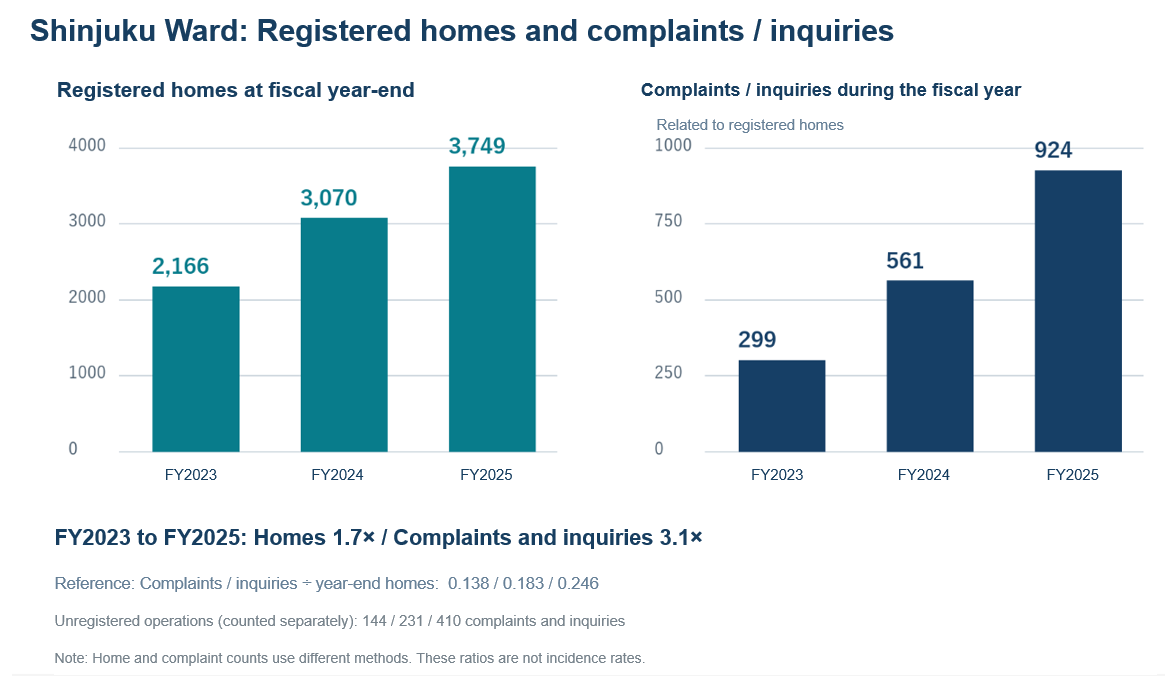
for the Residential Accommodation Business (Private Lodging)" [15] (includes AI-generated elements)
Simply dividing complaints and inquiries by the number of homes at fiscal year-end gives about 0.138 in FY2023 and about 0.246 in FY2025, about 1.8 times higher. This points to a trend that cannot be fully explained by the increase in facilities alone. However, this is not an incidence rate with annual operating volume as the denominator. Because multiple inquiries may concern the same facility, it cannot be used as a figure showing "the share of facilities where complaints occurred" or "how many times problems per facility have increased."
In addition, complaints and inquiries about unregistered operations are counted separately: 144 in FY2023, 231 in FY2024, and 410 in FY2025. Of the combined total of 1,334 related to registered homes and unregistered operations in FY2025, unregistered operations accounted for about 31%. This shows that there are issues that regulations covering only registered facilities cannot fully address. However, this share reflects cases received by Shinjuku Ward and cannot be applied directly to private lodging nationwide.
Even if complaints decrease after enforcement, that alone does not prove the regulations were effective. Changes in lodging demand and occupancy, intake methods, outreach to residents, and other measures also have an effect. It is necessary to compare with the same season of the previous year and with areas under similar conditions and, if possible, to check the difference in changes relative to areas not affected by the regulations. It is also important to track whether problems have shifted to neighboring areas and whether unregistered operations have increased.
Evaluation should not be a one-off exercise: in the short term, check changes in complaints and responses; in the medium term, check residents' evaluations and changes in lodging supply. Deciding on indicators and review timing before enforcement also helps avoid choosing only convenient indicators after seeing the results.
6. Measure Impacts on Lodging Supply and Local Consumption
Alongside improvements to the living environment, the impacts of regulations on lodging supply and local economic activity also need to be understood. Guests' spending is not limited to lodging fees. It extends to dining, shopping, transportation, and more, and generates ripple effects through businesses' purchases and employees' consumption. Our institute is also conducting studies that combine consumption estimates with input-output analysis.
Figure 2: Differences Between the Scale of Economic Activity and the Net Impact of Regulation
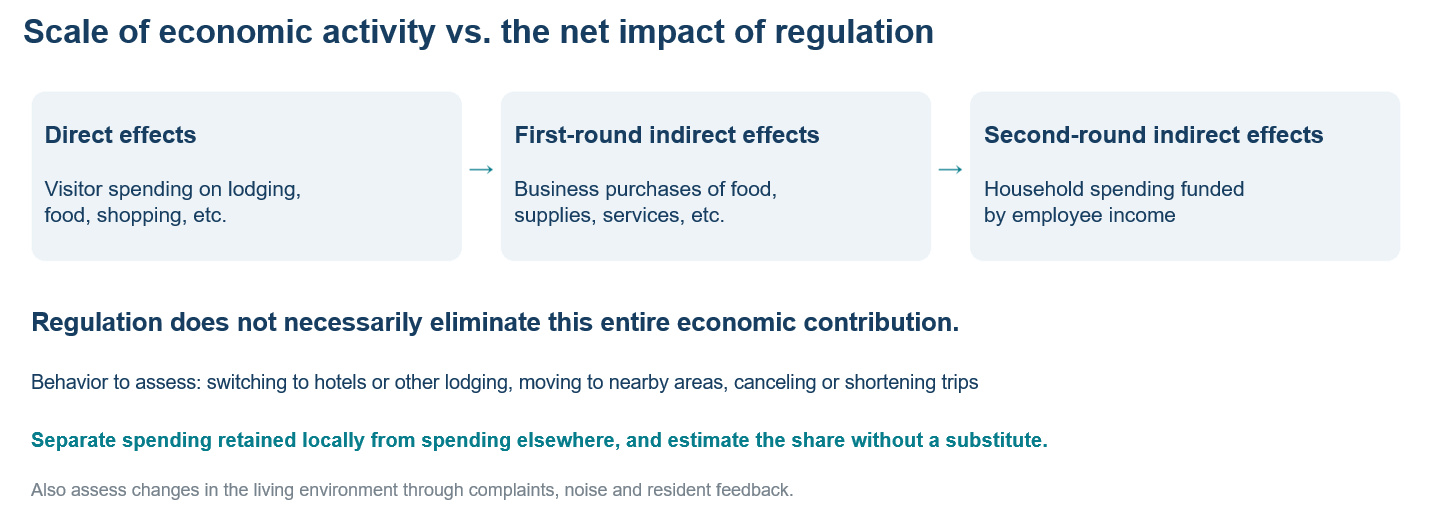
A useful reference is an estimate by Oxford Economics commissioned by Airbnb. According to an announcement for Japan on September 16, 2025 [16], Airbnb-related spending in 2024 contributed about 770 billion yen to Japan's GDP and supported about 87,800 jobs. This is an estimate of the scale of economic activity related to Airbnb; it is neither a tally limited to private lodging under the Residential Accommodation Business Act nor an estimate of the amount that would be lost due to regulations.
The report also states explicitly that these are not net effects adjusted for substitution with other demand. If travelers who can no longer stay in private lodging stay at a hotel in the same area, some spending remains in the area. If they move to a nearby area, the scope of the impact changes, and if they cancel the trip altogether, the lost spending becomes larger. Measuring the net impact of regulations requires distinguishing among these different behaviors.
The perspective of lodging opportunities for Japanese travelers is also needed. According to the Japan Tourism Agency's "Survey on Travel and Tourism Consumption Trends" [17], domestic overnight travel by Japanese residents in 2025 totaled 299.97 million person-trips, up 2.3% from the previous year, and travel spending was 21.7211 trillion yen, up 6.8%. Spending per person per trip was 72,412 yen, up 4.4%. This means that the growth in spending stems more from the rise in per-trip spending than from the increase in the number of travelers. As prices rise, who is able to choose what kind of lodging needs to be examined separately.
Private lodging is not used only by inbound visitors. It is also used in ways different from hotels, such as by families and groups and for long stays. Without examining whose lodging opportunities, and what kinds, were affected by the reduction in supply, the impact of regulations cannot be fully captured.
It is not easy to convert improvements in the living environment into monetary terms and compare them with economic impacts in a single figure. Rather than forcing them into the same unit, complaints, noise, and resident evaluations should be reviewed side by side with lodging supply, prices, and local consumption. Showing the changes in each and the limitations of the estimates leads to transparency in decision-making.
7. Toward Tourism with Residents' Lives as the Starting Point
Private lodging regulations can be seen as a move to review the volume, location, and operating conditions of lodging that a community accepts. However, this is not the first time local governments have adjusted the volume of tourism. Efforts are already under way in other areas, such as limiting the number of climbers on Mount Fuji [18]. In the case of private lodging, we have entered a stage of designing the relationship between life in residential areas and lodging in finer detail.
The Basic Plan for Promoting Japan as a Tourism-Oriented Nation [19], approved by the Cabinet on March 27, 2026, also emphasizes the sustainable development of tourism and coexistence with local communities. In addition to increasing the number of travelers, communities where residents can continue to live should be regarded as an outcome of tourism policy.
In doing so, it is not appropriate to treat urban and rural areas under the same conditions. Areas where lodging facilities are concentrated and the burden on the living environment is high require different responses from areas that lack lodging capacity. Systems need to be designed according to location and operating conditions, including the potential to make use of vacant houses and encourage stays in the region.
Regulation is not the goal. The goal is for the people who live there to be able to continue living there and, on that basis, to welcome travelers. The number of restricted operations alone does not show whether that goal has been achieved.
Where, under what conditions, and with whom can tourism be carried out? And how has daily life changed as a result of that design? Recording conditions before enforcement, verifying the results after enforcement, and reviewing the system and its operation as needed—I believe this accumulation of efforts will support the next phase of tourism with residents' lives as its starting point.
References and Sources
*Please note that all linked sources are in Japanese.
[1] Shinjuku Ward (September 2026) “Materials for Regular Press Conference: ‘New Rules for the Residential Accommodation Business and the Hotel Business’”
[2] Japan Tourism Agency, “Introduction: What Is ‘Private Lodging’? (Private Lodging System Portal Site)”
[3] Ministry of Health, Labor and Welfare, “Q&A on Private Lodging Services and the Hotel Business Act”
[4] Ministry of Land, Infrastructure, Transport and Tourism(November 2016), “Treatment Under the Building Standards Act of Facilities Used for Foreign Resident Accommodation Business Operations in National Strategic Special Zones (Technical Advice)”
[5] Ministry of Health, Labor and Welfare, Ministry of Land, Infrastructure, Transport and Tourism, and Japan Tourism Agency(July 2026) “Regarding the ‘Zero-Day Rule’ and Other Provisions Concerning Registered Accommodations as Defined in the Residential Accommodation Business Act (Technical Advice)”
[6] Japan Tourism Agency (March 2022) “Survey on the Actual State of the Residential Accommodation Business”
[7] Edogawa Ward(August 2026) “Regarding Waste Generated by Residential Accommodation Business Operators (Private Lodgings)”
[8] Sumida Ward (April 2026) “Significantly Strengthening Measures for Private Lodgings; ‘New Ordinance’ Takes Effect Today”
[9] Shibuya Ward(March 2026) “Overview of Amendments to the Shibuya Ward Ordinance and Regulations Concerning the Proper Operation of the Residential Accommodation Business (Promulgated March 26, Reiwa 8)”
[10] Osaka City (September 2026) “Ordinance Partially Amending the Osaka City Ordinance for the Enforcement of the Hotel Business Act”
[11] Toshima Ward(June 2026) “Ordinance Amending the Residential Accommodation Business Act”
[12] Setagaya Ward(September 2026) “Procedures for Submitting Resident Opinions on the Ordinance for Enforcement of the Hotel Business Act (Draft Amendment) and the Ordinance Concerning the Proper Operation of the Residential Accommodation Business (Draft Amendment)”
[13] Kyoto City (August 2026) “Public Disclosure of Accommodation Facilities in Violation of Regulations”
[14] Osaka City(May 2026) “Closure of New Applications for the Osaka City National Strategic Special Zone Foreign Resident Accommodation Facility Management Business”
[15] Shinjuku Ward “Status of Notifications, etc., for the Residential Accommodation Business (Private Homestays)”
[16] Airbnb/Oxford Economics (September 2025) “Oxford Economics Study on Airbnb’s Contribution to the Japanese Economy”
[17] Japan Tourism Agency (April 2026)“Survey on Travel and Tourism Consumption Trends: 2025 Annual Figures (Final Report)”
[18] Yamanashi Prefecture (2024) “Regarding Access to the Yamanashi Prefecture-Owned Mount Fuji Yoshida Trail (Yamanashi Prefecture Ordinance on the Establishment and Management of the Mount Fuji Yoshida Trail and its Enforcement Regulations)”
[19] Japan Tourism Agency (March 2026) “Basic Plan for Promoting Japan as a Tourism-Oriented Nation (5th Edition) (Approved by the Cabinet on March 27, Reiwa 8)”
著者