Identifying Optimal Policy Combinations Under Constrained Conditions: An Attempt at Conjoint Analysis Using the Example of a "Historic District with Architectural Landmarks" That Attracts Visitors

When considering various tourism initiatives, such as promotional campaigns, it can be difficult to decide what to prioritize within a limited budget. In such cases, if we have a reasonable understanding of what factors consumers value most—or what kind of initiatives are likely to yield the greatest results—the order of priority for implementation will become clear. In this article, we will use a method known as “conjoint analysis” to identify the combination of initiatives that will yield the greatest impact under limited conditions.
When considering various tourism initiatives, such as promotional campaigns, it can be difficult to decide what to prioritize within a limited budget. In such cases, if we can gain some understanding of what factors consumers value most—or what kind of initiatives are likely to yield the greatest results—the order of priority for implementation will become clear. In this article, we will use a method called “conjoint analysis” to identify the combination of initiatives that will yield the greatest impact under limited conditions.
Note that this analysis utilizes data from a survey on tourism in “settlements and townscapes featuring historic buildings (Important Preservation Districts for Groups of Traditional Buildings)” conducted by our company in May.
What is Conjoint Analysis?
Conjoint analysis is a method for analyzing what is prioritized under certain limited conditions.
For example, when conducting a survey, you may want to know the level of acceptance for a hypothetical product or service (e.g., whether respondents would like to have it, would like to use it, etc.).However, when actually asking these questions, respondents tend to think, “Well, it would be nice to have all of those features, and I’d like to try them,” the more attractive the product or service is. Consequently, they often give high scores to every option, making it difficult to determine what is truly most important to the consumer. In reality, however, consumers cannot obtain every product or service. For example, when a traveler is deciding where to stay, they might face a dilemma like this: “I’d like to stay in a stylish, traditional Japanese house, but it doesn’t seem to have a hot spring. In that case, should I choose a ryokan with an open-air hot spring bath instead?” In many cases, they must weigh these two mutually exclusive conditions and decide which to prioritize, often having to give up one of them.
Conjoint analysis is a method used to obtain evaluations that closely reflect this reality. It involves creating combinations of several conditions, artificially creating trade-off relationships where one condition meets a preference while another does not, and asking participants to evaluate the desirability of each option. This allows us to see what is prioritized when not all preferences can be fulfilled.
Using “villages and townscapes with historic buildings” as a case study, we examine the key factors that make people want to visit
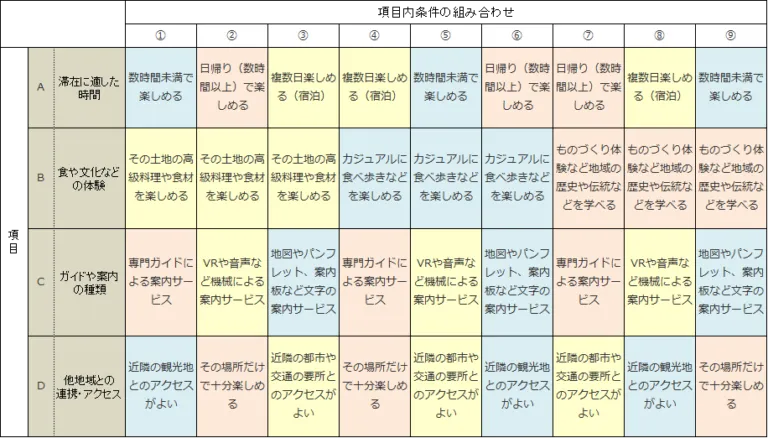
Here, based on the “settlements and townscapes with historic buildings” survey we conducted in June, we prepared combinations of three conditions for each of the following four items (1. Ideal length of stay, 2. Connectivity with other regions (access), 3. Types of guides and tours, 4. Experiences such as food and culture) to determine what travelers prioritize when deciding to visit, and collected responses (Table 1).When considering each individual “village or townscape with historic buildings,” the items deemed important vary depending on the type of buildings and location conditions; however, for this analysis, we selected the four categories listed above, as we believed they were relevant to many areas.
Furthermore, if we had attempted to have respondents evaluate every possible combination, the sheer number would have been overwhelming, causing survey respondents to cry out in despair. Therefore, we created combinations using an “orthogonal array” from experimental design methodology to obtain the minimum number of combinations necessary for analysis, resulting in a survey design with a limited number of combinations.
Table 1: Combinations Derived from the Orthogonal Array


Determining the Degree of Influence of Each Factor
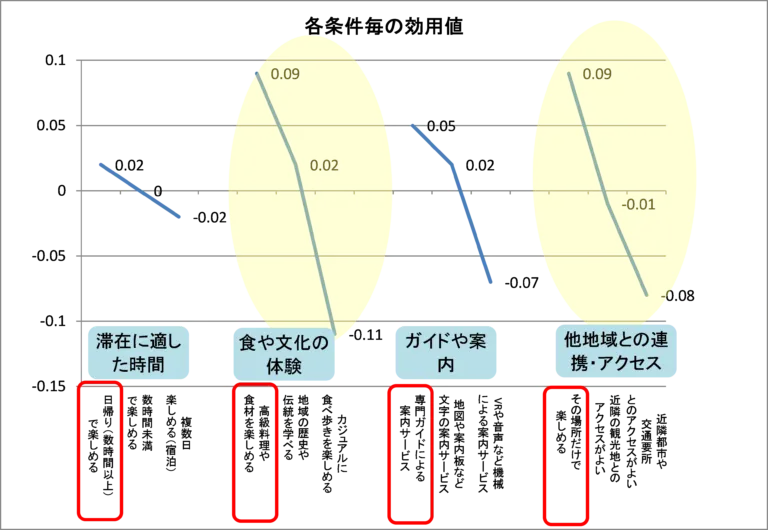
First, to determine how much each of the four items influences consumers, we calculated a measure of effect known as the “utility value” (Figure 1). Items with a large difference in utility values (steep slope) can be interpreted as having a greater impact on consumers. Consequently, we found that the differences for “culinary and cultural experiences” and “collaboration and access with other regions” were significant, indicating these are important factors. Let’s examine the details of one of these factors: “Food and Cultural Experiences.” When the condition is anything other than “being able to enjoy high-end cuisine and ingredients,” the utility value drops significantly. In other words, the condition of “being able to enjoy high-end cuisine and ingredients” is difficult to substitute and is considered an essential element for making people feel they “want to visit.” On the other hand, looking at “Suitable Length of Stay,” there is little difference between places that can be enjoyed in “less than a few hours” and those that can be enjoyed over “several days. ”This suggests that the difference in conditions between short and long visits has little impact on the degree of desire to visit.
Based on the above, we examined, item by item, which conditions are prioritized for enjoying visits to villages and townscapes featuring historical architecture. Regarding “culinary and cultural experiences,” we found that “being able to enjoy high-end cuisine and ingredients” was a key factor; for “connections with other regions and accessibility,” it was “being able to enjoy experiences unique to that location”; for “guides and tours,” it was “guided services provided by expert guides”; and for “suitable length of stay,” it was “being able to enjoy a day trip (lasting several hours or more)” (Figure 1).
Figure 1 Utility Values
Note differences based on attributes such as gender and age
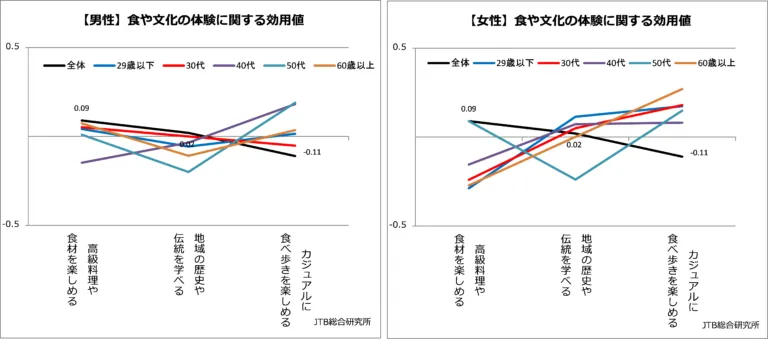
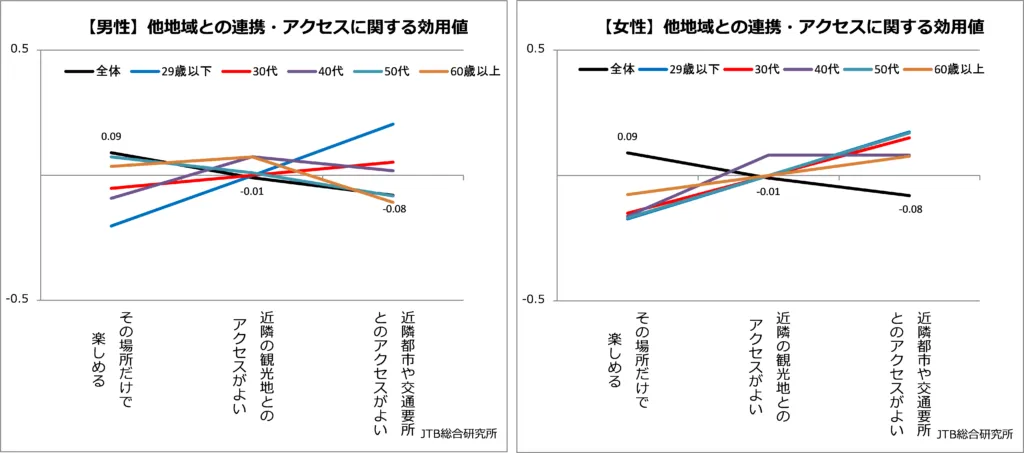
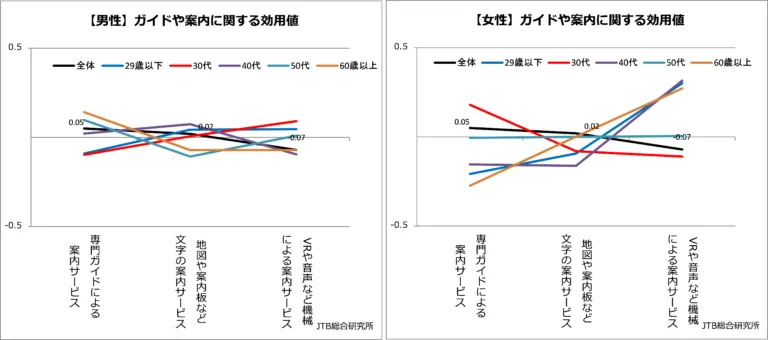
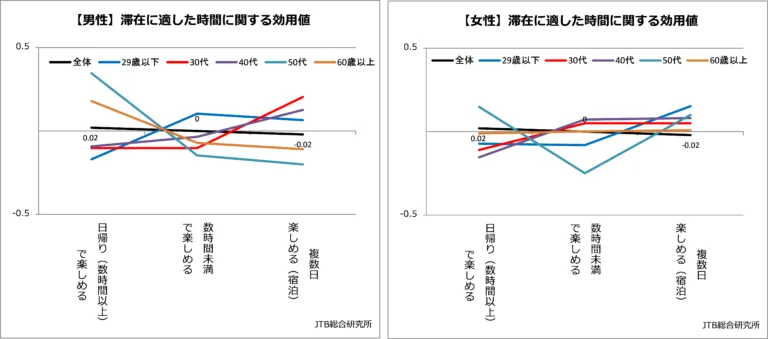
It is important to note that the utility values for each item vary significantly depending on attributes such as gender and age (Figure 2).
For example, regarding “culinary and cultural experiences,” as mentioned earlier, “being able to enjoy high-end cuisine and ingredients” had the greatest influence overall. However, when broken down by gender and age, while men aged 29 and under and men aged 60 and over placed importance on “being able to enjoy high-end cuisine and ingredients,” women and men in their 40s and 50s placed importance on “being able to casually enjoy eating while walking around.”
Regarding “connections with other regions and accessibility,” among both men and women, younger generations—those aged 29 and under and those in their 30s—prioritize “good access to neighboring cities and transportation hubs,” whereas those in their 40s and older place greater importance on “good access to nearby tourist destinations.”
Regarding "guides and information services," there is a significant gender difference: younger men tend to prefer "automated guidance services such as VR or audio," while older men tend to prefer "guidance services provided by professional guides." However, with the exception of women in their 30s, women of all ages—young and old alike—prefer "automated guidance services such as VR or audio."
Figure 2: Utility Values by Item, Gender, and Age (1–8)
Simulating the combination of measures that yields the greatest effect
So, how can we apply the results obtained so far to our strategies? The most significant feature of conjoint analysis is its ability to simulate optimal combinations and their effects based on utility values. Since utility values are calculated for each condition, we can calculate the overall effectiveness (total utility value) of the combination by summing up the maximum values for each condition as follows.
Overall, the combination yielding the greatest effect is as follows:
On the other hand, the combination with the smallest overall effect was as follows.
When broken down by demographic, the combination yielding the greatest effect for women in their 30s, for example, was as follows.
Since the overall utility value can be calculated for all combinations, even if the most effective combination is not feasible due to cost or other constraints, you can run several simulations using available options to evaluate feasibility based on budget and assess the impact on your target audience.
However, the results obtained will vary depending on the specific items and conditions used in the survey. Therefore, it is essential to thoroughly consider the selection of items and conditions in advance, taking into account regional characteristics and the target audience you wish to attract.
Conjoint analysis—and statistical analysis in general—is not a magic tool that solves everything. However, it plays a crucial role in marketing activities by transforming vague ideas that were previously only in our heads into objective numerical data, providing a common yardstick that facilitates discussion among stakeholders. Furthermore, to develop strategies and conduct analyses that can be applied in the field, it may actually be more important to take the opportunity to re-examine the features and key requirements of the products and services you offer, and to consider what is truly necessary—rather than simply looking at the data itself.
著者