The Role of Japanese DMOs
In November 2017, 41 candidate organizations were officially registered as Japanese-style DMOs. Two years after the Japanese-style DMO registration system was established in November 2015, DMOs are finally moving into a new phase. How will DMOs operate as new tourism destination management organizations going forward?
1. The First Batch of 41 Japanese-Style DMOs
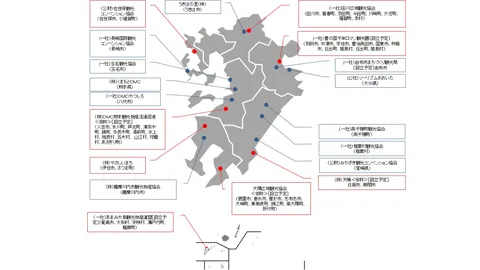
At the end of November 2017, 41 candidate Japanese-style DMOs were officially registered as Japanese-style DMOs. As a result, the total number of organizations registered under the Japanese-style DMO registration system now stands at 174, comprising 41 registered Japanese-style DMOs and 133 candidate Japanese-style DMOs (Figure 1).
Future trends for Japanese-style DMOs are expected to focus on both expanding the number of organizations registering as candidates to assume the roles and functions of a DMO, and enhancing quality by enabling candidate organizations to build a track record of activities with the aim of achieving full DMO registration.
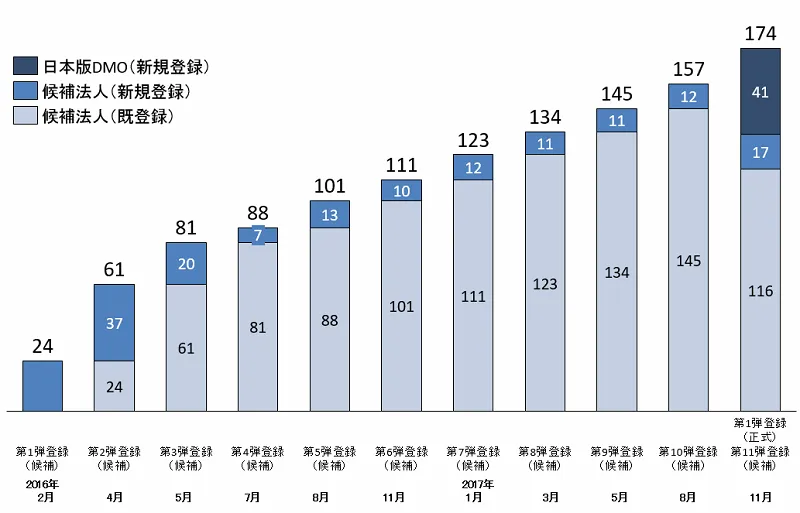
Japanese-Style DMO Registrations Source: Prepared by JTB Tourism Research & Consulting based on data from the Japan Tourism Agency
2. What Are the Key Points for Formal Registration?
Here, we would like to consider what factors are prioritized for a DMO to move beyond candidate status and become a fully registered DMO.
These are explicitly stated by the Japan Tourism Agency as the “Requirements for Japanese-Style DMO Registration” and the “Judgment Criteria Regarding Compliance with Japanese-Style DMO Registration Requirements” (Figure 2).
These requirements and criteria are exactly the same at the candidate application stage. However, while it is permissible for candidate organizations to include items in the registration requirements that are “planned for future implementation,” full compliance with all requirements and criteria is required for formal registration.
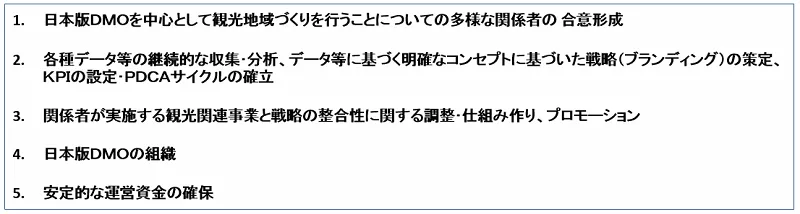
: Japan Tourism Agency Japanese DMO website
*More detailed criteria are outlined in the “Assessment Criteria for Compliance with Japanese DMO Registration Requirements.” Please refer to the Japan Tourism Agency website.
However, formal registration is not determined solely by whether the requirements and criteria are met. “Proven track record of the process”—that is, what concrete actions were actually taken to address these requirements and criteria—is also highly valued.
Let me introduce an example of a DMO (officially registered) that I was involved with.
This DMO has set goals such as increasing the number of overnight stays and the length of stays for both domestic and international visitors, and is implementing various initiatives targeting specific groups. Here are some examples.
- To monitor and review the progress of their strategy (PDCA cycle), they frequently hold meetings for discussion and decision-making—such as general assemblies, board meetings, and third-party meetings (expert panels)—led by a board of directors composed of diverse local stakeholders from sectors including lodging, shopping districts, forest management, fisheries, transportation, and finance.
- To achieve these goals, discussions are underway to review existing visitor attraction and promotional methods. There is a shift from traditional methods toward digital marketing, such as online platforms. Furthermore, a momentum is building within the region to actively pursue new initiatives, such as developing high-value-added experiential programs.
- The DMO is involved in nearly all local initiatives—including community development, tourism business development, visitor promotion, and the construction of new facilities—and is actively working to build consensus and foster understanding among diverse stakeholders.
These “process achievements” are documented in the “Activity Report” that the DMO submits to the Japan Tourism Agency once a year. Whether the DMO is diligently carrying out initiatives to effectively manage the region, along with the status of meeting registration requirements, is evaluated during the formal registration process.
3. How can DMOs secure stable funding?
Another key requirement for DMO operations is “the prospect of securing stable operating funds to enable the Japanese-style DMO to operate autonomously and continuously.”
Here, we examine the actual state of DMO revenue sources. Based on the plans for the formation and establishment of Japanese-style DMOs published on the Japan Tourism Agency’s website, we have compiled data on the 39 DMOs for which information is publicly available (Figure 3).
Among these 39 DMOs, as of FY 2017, 12 (31%) had a government funding ratio of less than 50%, while 27 (69%) had a ratio of 50% or more. This indicates that many DMOs rely on government funding as the foundation for their operations.
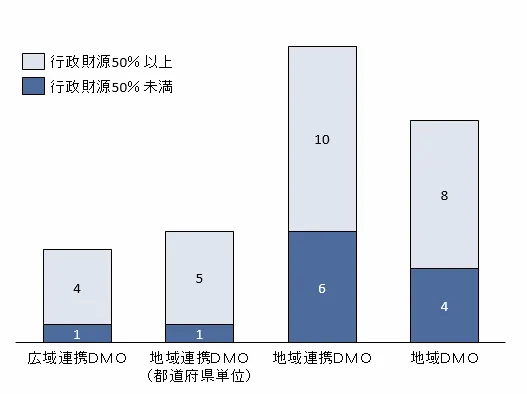
: Revenue Sources of Japanese-Style DMOs (FY2017 Results)
Source: Compiled by the author based on the Plan for the Formation and Establishment of Japanese-Style DMOs
However, this does not mean that this situation is unacceptable. It is important to note that even DMOs that rely on government budgets for their operations are not merely dependent on those budgets. This is because DMOs are exploring various strategies to secure stable funding sources based on their track records and the actual conditions of their regions.
Let us look at a few specific examples.
- Exploring the use of accommodation taxes and hot spring entrance fees as tourism revenue sources in collaboration with local governments (Osaka Convention & Tourism Bureau, Akan Tourism Association Town Development Promotion Organization, Gero Onsen Tourism Association, etc.)
- As the results of DMO initiatives (such as regional tourism efforts) have become deeply ingrained in the community, city governments and city councils are considering providing ongoing support (e.g., Akita Inu Tourism Association)
- The necessity of a DMO is explicitly stated in the government’s medium- to long-term vision, and a continuous budget is secured (San’in Inbound Organization, etc.)
- Discussions are underway to entrust the long-term operation of government-related facilities to DMOs (e.g., Kobe International Tourism and Convention Association [Public Interest Incorporated Foundation], Daisetsu Kamui Mintara DMO [General Incorporated Association], etc.).
As the Japan Tourism Agency has pointed out, it is important to note that “the primary role of a DMO is to enhance the overall benefits of the region and revitalize it by attracting tourists through regional management and marketing activities, not to generate revenue for the DMO itself.”
Thus, the operational model required of a DMO is not one of “self-sufficiency,” but rather one of “autonomous operation.”
4. The Next Step Is Not “Self-Reliance” but “Autonomy”
“Autonomy” is a difficult term, but Makoto Yuasa, a professor at Hosei University and well-known social activist, has stated the following (though Professor Yuasa does not use the term “autonomy” himself).
“An overly strong fantasy of ‘self-reliance’ obscures the reality that we are supported by various factors, making life difficult not only for ourselves but also for those around us. And does this not apply not only to individuals but also to the self-reliance of regions and nations?” (From NHK’s “Viewpoints and Issues: On ‘Self-Reliance,’” Thursday, December 10, 2015).
In line with the above, when considering “autonomy” for a DMO, rather than becoming fixated solely on “generating independent revenue,” should we not first clearly define the DMO’s role, take action to fulfill it, and firmly establish the necessity, role, and position of the DMO among diverse local stakeholders, including residents? There are examples where a deeper understanding and recognition of the DMO’s role and achievements by local authorities (particularly the administration and the assembly) has led to the securing of stable funding.
While aiming for financially independent operations is certainly important for a DMO to maintain a clear sense of purpose and vision—and to take the lead when necessary—it is also possible for a DMO to fulfill its role even within a framework where a portion of its funding comes from the government or other public sources. Isn’t it also important to consider “autonomous operations” in the context of continuously fulfilling the DMO’s fundamental role: “enhancing the overall benefits of the region and revitalizing it through tourism promotion via regional management and marketing activities”?