Post-COVID MICE Initiatives Led by the National Government, Local Governments, and Convention Bureaus: The Latest Trends in the MICE Industry

MICE events—such as international conferences—which would normally attract participants from overseas, are currently being held in hybrid formats, with some sessions taking place online and others open only to in-person attendees within the country. National and local governments, as well as convention bureaus, are undertaking various initiatives—such as preparing support measures for event organizers—to facilitate the resumption of global in-person MICE events once restrictions on inbound travel are lifted.
The number of new COVID-19 cases nationwide has been declining since the latter half of September and has remained in the triple digits since October 7 (as of October 13). On the other hand, with breakthrough infections being confirmed and concerns about a sixth wave, the outlook for the future remains uncertain.
Looking overseas, some countries have already begun easing entry restrictions for foreign visitors and have announced “roadmaps” outlining the process for lifting these restrictions in the future.
What steps must Japan take to ensure it does not lose its international competitiveness in the race to attract MICE events against these leading nations? The national government, local governments, and convention bureaus are not simply standing by idly. In this article, we will introduce measures and directions that have not been seen much in the past, while also considering the future of Japan’s international MICE industry.
1. Japanese MICE: Strongly Promoting Safety and Security
Currently, the national government and local authorities are working to expand measures and support programs to boost the revival of MICE. MICE organizers and operating companies should gather information on these measures and support programs, utilize available assistance to the fullest extent possible, and prepare for the new era of post-COVID MICE events. The initiatives of key organizations worth noting are summarized below.
(1) Japan National Tourism Organization (JNTO)
In January 2022, JNTO’s New York office plans to host a “Webinar on Hosting MICE Events in Japan” for meeting planners in Europe and the U.S. as part of PCMA’s educational program. With the world’s attention focused on Japan following the Tokyo Olympics and Paralympics, this is an ideal time to promote to global meeting planners how safely Japan is able to host MICE events.
Next, we will introduce support measures for exhibition organizers and operating companies within Japan.
(2) Ministry of Economy, Trade and Industry
Project to Promote the Advancement of the Exhibition and Event Industry ~ Subsidy Program for Small and Medium-Sized Enterprises ~ A subsidy is available to cover a portion of the costs required
to hold events (such as exhibitions) organized by small and medium-sized enterprises that incorporate initiatives leading to industry advancement and are adapted to the “new normal.” The subsidy amounts to a maximum of 2.5 million yen for in-person events and a maximum of 4 million yen for hybrid events combining in-person and online formats. The program’s official website states: “The aim is to secure opportunities for business negotiations and marketing for regional SMEs, while contributing to the revitalization of the local economy and the advancement of the exhibition and event industry as a whole.” Such support is a highly effective measure for trade shows, where the scale of participation is shrinking and organizers are expected to adapt to new values in the wake of the COVID-19 pandemic, as it provides the impetus to invest in necessary measures.
Although the application deadline for this FY has already passed, we hope the program will continue into the next FY and beyond. For trade shows attracting tens of thousands of visitors to “advance the exhibition industry,” it typically takes over a year to build the necessary systems. If the application, review, and selection process begins after the FY has changed, it will be too late to accommodate exhibitions scheduled within the current FY. We strongly urge the program to continue its operations and consider targeting exhibitions scheduled for the following FY starting next year.
Even during last year’s COVID-19 pandemic, industry associations formulated their own guidelines and continued to hold trade shows while adhering to a cap of 5,000 attendees, without causing any clusters. This is a remarkable achievement of Japan’s MICE industry that is unmatched overseas. The Tokyo Convention & Visitors Bureau focused on this point and launched a new subsidy program for trade shows.
(3) Tokyo Convention & Visitors Bureau
This is a grant for advertising targeting overseas visitors to trade shows held in Tokyo. While there is a condition that the advertising must “promote the precautions and measures being taken to ensure a safe and secure event,” if advertising is being conducted under current circumstances, “safe and secure event” would naturally be included, so this is not an issue at all.
The scope of eligible advertising placements is broad, including print ads in overseas trade show reports and industry publications, promotional ads on official websites of overseas trade shows, digital ads on official websites of overseas trade shows, and the creation of “Safe and Secure Trade Shows” PR pages on official websites of trade shows held in Tokyo. Eligible expenses include publication fees, design and production costs for ad copy, and translation costs required for multilingual support.
While trade shows continue to be held in Japan, many exhibitors remain hesitant to participate, and companies in struggling industries may even cancel their participation. When exhibition organizers see a decline in booth fee revenue, they consider cutting back on advertising and promotional expenses to keep the business viable. However, reducing public relations and advertising budgets could lead to a reduction in the scale of future exhibitions in the coming years. If annual advertising is discontinued, it may lead to speculation that “the event has been canceled this year,” potentially creating a vicious cycle where exhibiting companies do not allocate budgets for the following year, and visitors and buyers do not plan to visit Japan. If the trade show is to be held continuously, one should avoid casually discontinuing advertising .A particularly commendable aspect of this Tokyo Convention & Visitors Bureau initiative is that it extends subsidies to exhibitions scheduled for the following FY. As long as the advertising is placed within the current FY, the exhibition itself may take place in the next FY.
2. Decision Made to Host International Conferences in Japan That Are Drawing Attention from the MICE Industry
In October 2021, two major international conferences organized by the MICE industry will be held in Japan.
(1) UIA Asia Pacific Round Table
The Tokyo Convention & Visitors Bureau will co-host the “UIA Associations Round Table Asia-Pacific,” a conference for the Asia-Pacific region, with the UIA (Union of International Associations) for the first time on October 21–22. The UIA is also known for publishing the “UIA International Conference Statistics” annually, which details the number of international conferences held by country and city. This conference will be held in Tokyo in a hybrid format.
(2) ICCA (International Congress and Convention Association) General Assembly “Nagasaki Hub”
While this year’s ICCA General Assembly will be held in Cartagena, Colombia, hub venues have been established in five cities worldwide, and Nagasaki has been selected as one of them. The event will take place from October 25 to 27 at Dejima Messe Nagasaki, which is set to open shortly. According to the program, sessions will combine a global program with hub-specific programs, scheduled to align with each city’s local time. This approach may become an effective method for avoiding time zone issues in the future.
3. Active Trends in the Global MICE Industry
Meanwhile, overseas, there is a growing trend toward forming alliances to attract business. Led by the Thailand Convention and Exhibition Bureau (TCEB) and the Thailand Incentive and Convention Association (TICA), three organizations—the Taiwan External Trade Development Council (TAITRA), the Seoul Tourism Organization (STO), and the Malaysia Convention and Exhibition Bureau (MyCEB)—established the Asia Convention Alliance with the aim of fostering MICE growth in the post-COVID era, and held an online signing ceremony in September.
In a press release issued upon the alliance’s establishment, TCEB stated, “Through this alliance, we seek to promote mutual benefits among members, strengthen bilateral partnerships, and facilitate business development and knowledge exchange through joint projects. The ultimate goal is to revitalize the regional convention market by promoting more regional conventions and joint conventions held in each other’s countries, states, cities, and regions through a rotation system among members. To this end, each member will invite other organizations to join the alliance.”
It remains to be seen whether this move poses a “threat” to Japan’s MICE industry or whether cooperative relationships can be established and “collaboration” achieved in the future. In any case, it is likely necessary to keep a close eye on the future activities of this alliance.
4. The Activities of Convention Bureaus: Crucial in the Competition to Attract International Events
Due to the COVID-19 pandemic, convention bureaus have increased their presence.
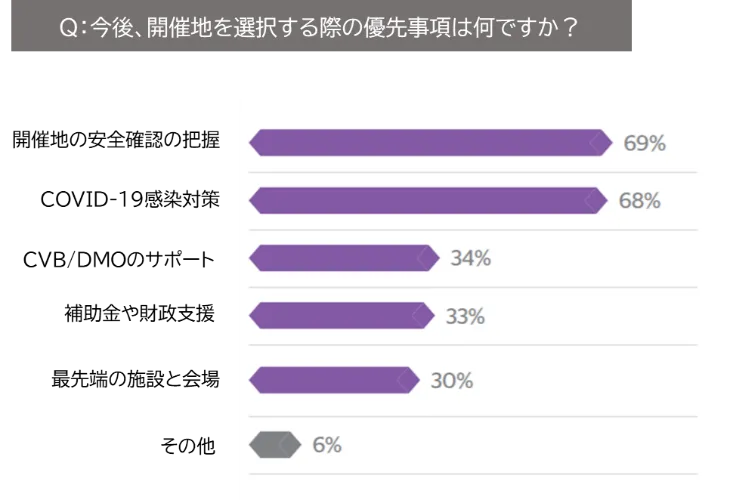
According to a PCMA survey, 34% of meeting planners responded that “support from convention bureaus and DMOs is important” when deciding on a future venue. For corporate meeting planners, the importance of a destination’s convention bureau is likely greater than ever before. With travel restricted by the pandemic and planners unable to visit destinations for site inspections, they are hesitant to choose high-risk venues. If a convention bureau is highly reliable and provides precise support, planners can develop plans based on the information received—even without a site visit—and present them to clients.
News recently broke that Tokyo, Osaka, and Kyoto swept the top three spots in a U.S. travel magazine’s “Ranking of the World’s Most Attractive Major Cities.” Given that Japan’s popularity is rising following the safe and successful hosting of the Tokyo Olympics and Paralympics, now is precisely the time for convention bureaus—as the representative organizations of their respective cities—to provide accurate information and promote Japan as a safe and secure destination for MICE events. We look forward to seeing even greater achievements from all convention bureaus.
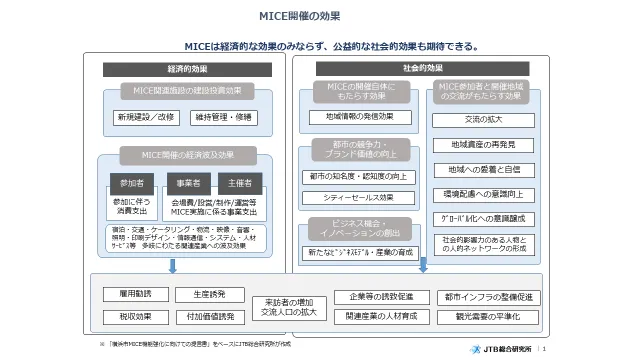
MICE participants are, after all, human beings, so ultimately, their decision to attend likely comes down to a personal feeling of “Do I want to go? Or don’t I?” Whether a destination is appealing to individuals is believed to have a significant impact on MICE participation rates. Moreover, as online participation becomes the standard in the future, we must employ every possible means to make people feel “I absolutely must go!” in order to get them to visit the host city in person. If a host city is popular and can attract a large number of participants, it holds an advantage in the international competition for hosting rights. Countries that view MICE as a strategy for economic development, and cities that incorporate it into their city branding strategies, fully understand the benefits that hosting MICE events brings and will enter the competition with every conceivable measure in place. To compete with such countries and cities, isn’t now the time for all of Japan to unite and promote Japan’s safety and security, thereby becoming the country and city of choice?
*If you would like to learn more about convention bureau activities related to this column, please join us for the 5th JTB Tourism Research & Consulting Travel Trend LIVE (online), scheduled for November 17: “The Renewed Importance of Convention Bureaus: MICE Attraction Leaders Discuss Post-COVID MICE.”
著者