The True Purpose of Hosting MICE Events: What We Should Reconsider in the Wake of the COVID-19 Pandemic
It appears that expectations for MICE to promote exchange have not waned even amid the COVID-19 pandemic. In this article, we will reexamine the importance of strategic planning for attracting MICE events, the significance of integrated resort (IR) development—as operator selection proceeds across various regions—and its relationship with MICE, as well as the evolving values surrounding MICE in the wake of the pandemic. Through this, we will reflect on the true significance of hosting MICE events.
As restrictions on in-person interactions persist amid the COVID-19 pandemic, we are receiving an increasing number of inquiries from local governments regarding the use of MICE to promote community engagement. In this column, we will reexamine the importance of strategic planning for attracting MICE events, the significance of Integrated Resort (IR) development—which is currently underway across the country—and its relationship to MICE, as well as the evolving values surrounding MICE in the wake of the pandemic. Through this, we will reflect on the true purpose of hosting MICE events.
1. Attracting MICE events tests a city’s comprehensive capabilities; a unique strategy integrated with industrial policy is essential
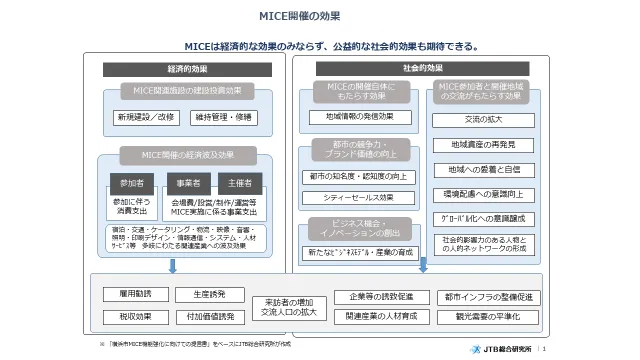
In Japan, where the population is aging and birthrates are declining, efforts to increase the resident population through measures such as birthrate support and immigration policies have proven difficult. Consequently, expanding the number of visitors—primarily through inbound tourism—has been prioritized. MICE has garnered attention as one means of achieving this goal. The significance of promoting MICE is often cited as “creating opportunities for business and innovation,” “generating economic benefits for the region,” and “enhancing the competitiveness of the nation and cities” (according to the Japan Tourism Agency website). However, hosting large-scale, international MICE events is believed to have a wide-ranging impact on society in many areas, not just economic ones.
(See Figure 1 below, “Effects of Hosting MICE Events.”)
However, while the social impact of MICE refers to the synergistic effects resulting from the long process of attracting and hosting events, as well as the outcomes of the events themselves, actually attracting or creating new MICE events is not an easy task. Attracting international MICE events involves fierce competition at the national level, and even for domestic MICE events, competition unfolds between local governments and cities.
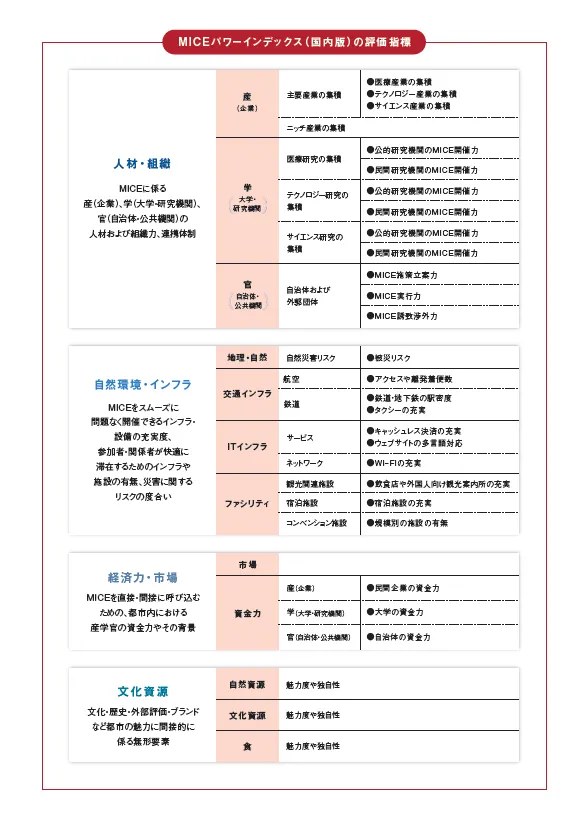
What factors are considered necessary for attracting and hosting MICE events? As evidenced by the annual ICCA statistics on the number of international conferences hosted by city, which consistently rank cities in G7 nations and China at the top, attracting MICE events requires the comprehensive strength of a nation or city. In compiling the “MICE City Power Index”—an objective indicator of a city’s comprehensive strength in the MICE sector—our institute has focused on evaluating the “strengths” necessary for attracting and hosting MICE events. These include People (human resources and organizational strength),Resources (infrastructure), and Capital (economic strength and market) as the “strengths” necessary for attracting and hosting MICE events. We have worked to evaluate these factors based on objective indicators across fields such as “urban social infrastructure,” “concentrations of industry and academic/research institutions,” and “natural environment and cultural resources” (see Figure 2 below, “Evaluation Indicators for the MICE Power Index (Domestic Version)”). For large-scale local governments, such as the national government and government-designated cities, attracting large-scale, international MICE events on a continuous and stable basis requires not only enhancing the city’s overall strength but also developing unique strategies that emphasize distinctiveness and competitive advantages relative to other cities.
On the other hand, for small and medium-sized municipalities to attract MICE events, it is important to formulate unique strategies utilizing MICE by objectively and accurately evaluating and analyzing their own regions, taking stock of their characteristics and resources (assets), and integrating these efforts with industrial, commercial, and tourism policies in line with the municipality’s long-term vision and direction.
2. MICE Promotion and IR (Integrated Resorts)
While IR has received less attention due to the devastating impact of the COVID-19 pandemic on inbound tourism to Japan, it is necessary to carefully explain the social objectives that IR was originally intended to achieve so that the public can better understand them. This is essential as a policy to address the challenges faced by the Japanese government, local governments, and the MICE industry itself.
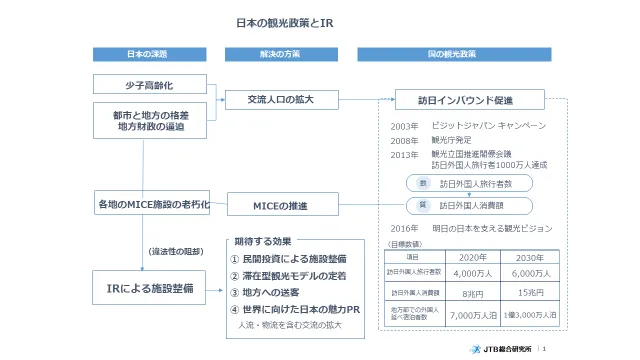
Currently, major challenges facing the national government and local municipalities include “a declining birthrate and aging population,” “disparities between urban and rural areas” and “strained local finances.” However, in the absence of effective solutions to increase the “resident population,” the approach of first increasing the “visitor population”—that is, initiatives to revitalize the nation and local regions centered on inbound tourism—has accelerated since the “Visit Japan Campaign” launched by the first Koizumi Cabinet in 2003.Until around 2015, increasing the number of international visitors—a “quantitative target”—was the overriding priority. However, due to issues such as overtourism, the “Tourism Vision to Support Japan’s Future,” formulated in 2016, added a “qualitative target”—the amount spent by international visitors—to the existing focus on visitor numbers. At the same time, attention began to shift toward the various benefits generated by hosting MICE events. This shift was substantiated by the Japan Tourism Agency’s “2018 MICE Economic Ripple Effect Calculation Project,” which found that the average per-person spending of international visitors coming to Japan for MICE purposes (¥337,000) was approximately twice that of visitors coming for leisure (¥154,000).(However, since airfare is included in the average expenditure for MICE visitors only when they use Japanese airlines, this figure should be viewed with some caution.)
On the other hand, looking at the MICE industry, many of the convention-centered MICE facilities currently located across the country were built in the 1980s. These facilities are becoming increasingly dilapidated, and it is undeniable that their competitiveness has declined relative to MICE facilities in Asian countries built this century. However, given the current financial situation of local governments, it is quite difficult to undertake new construction or rebuilding. To begin with, the management of MICE facilities—particularly those dedicated to sports and entertainment, which are primarily B2C—can achieve profitability not only through facility rental fees but also through broadcasting rights, merchandise sales, fan club operations, and various promotional initiatives utilizing content, making it entirely possible to turn a profit. Consequently, private-sector participation is expected. However, for large-scale convention facilities and exhibition halls that are primarily B2B, achieving profitability through operations alone is challenging, and recouping the costs of new construction or renovation—including land acquisition—is difficult. As a result, local governments have primarily shouldered this responsibility until now.
The Integrated Resorts (IRs) promoted by the government aim to ensure the profitability of core MICE facilities (conference centers and exhibition halls)—which are difficult to operate at a profit—by circulating revenue generated from casinos through private-sector investment. By operating various entertainment facilities, restaurants, shopping malls, and tourist attraction facilities as an integrated whole, they promote overnight tourism and the influx of travelers into surrounding areas. The construction of IRs is considered a policy aimed at strengthening the financial foundations of local municipalities in particular—not only through the promotion of MICE and regional revitalization driven by an expansion of visitor numbers centered on inbound tourism to Japan, but also through the promotion of employment and the development of industries driven by related demand, as well as through tax payments from IR operators (for details on IRs, please refer to our column dated September 11, 2018, titled “What Are the IRs Currently in the Spotlight?”).However, it is deeply regrettable that the original ideals and objectives of IRs are generally difficult for the public to grasp. This is largely due to concerns being emphasized regarding the negative aspects inherent to casinos themselves—such as deteriorating public safety, gambling addiction, and the potential for money laundering—as well as allegations of corruption involving certain politicians.
With the spread of COVID-19, the value of online meetings and events has been reevaluated, and it is believed that the scale and specifications required of MICE facilities have also changed. Furthermore, concerns regarding business models that are extremely dependent on inbound tourism have become a reality. Moving forward, various processes—including operator selection—will proceed in the municipalities that have expressed interest in IRs. I hope that, in addition to addressing the negative aspects of casinos themselves, these municipalities will overcome various concerns and successfully implement and operate IRs that live up to their original ideals and objectives.
3. MICE in the Post-COVID Era
The spread of COVID-19 has caused the MICE industry to face significant challenges. While MICE has traditionally been defined as “opportunities for face-to-face communication, such as conferences, incentive travel, exhibitions, and events,” for over a year now, these opportunities have been severely restricted, forcing a shift to online formats—a trend that continues today. In this environment, while the benefits of online conferences (seminars) and events have been recognized, challenges and issues have also become apparent in actual practice. This has led to a renewed appreciation of the importance of businesses within the broad MICE supply chain—particularly those that provide video and audio streaming services and those that build communication networks. Furthermore, from the perspective of conference (seminar) and event organizers, with a flood of various online MICE offerings on the market, viewers will not gather unless the purpose of the event is clear; if the content is lacking, it will quickly drive them away; and the barriers to charging for distributed content have become significantly higher. Going forward, as the COVID-19 pandemic begins to subside, we expect to see a rapid rise in demand for in-person communication opportunities—not only among MICE-related industries (operators) but also among MICE participants. However, as time passes, the value of holding in-person MICE events is likely to be re-examined. While “hybrid MICE,” which incorporates the benefits of both in-person and online formats, is expected to become the mainstream in the future, we believe we are entering an era where the question of “what exactly is being achieved by utilizing MICE as a means” will be scrutinized more rigorously.
4. Hosting MICE is not an end in itself, but a means to achieve the organizer’s strategic goals
The objectives of hosting MICE events vary by organizer. For example, when hosted by companies or event-based businesses, objectives may include business expansion, enhancing corporate value, and securing business revenue. For academic organizations, objectives may include sharing information and values and strengthening organizational cohesion. For national and local governments, objectives may include providing information and sharing values to promote public awareness and understanding of policy visions.
As shown above, while the objectives of MICE organizers vary, what they have in common is that “hosting MICE is not an end in itself; rather, MICE is a means to achieve strategic goals.” What is achieved through hosting MICE is what matters most, and I believe that, in the wake of the COVID-19 pandemic, we must reaffirm that it is paramount to implement MICE with a solid strategy and a clear vision of the goals to be achieved.