What Is IR, the Topic of Current Interest?
When most people hear the term "IR," they probably think of "investor relations." However, another type of "IR" has recently been making headlines in the news. This "IR" stands for "Integrated Resort," but what exactly does it entail? As someone involved in the MICE industry, I’ll explain the basics of IR.
On July 20 of this year, the Diet passed the “Act on the Development of Integrated Resort Areas” (hereinafter referred to as the “IR Development Act”). Around that time, the number of views for the term “IR” in the glossary on our website surged suddenly. While this made us keenly aware of the high level of public interest, we also sensed that many people might actually be unsure of what it means.
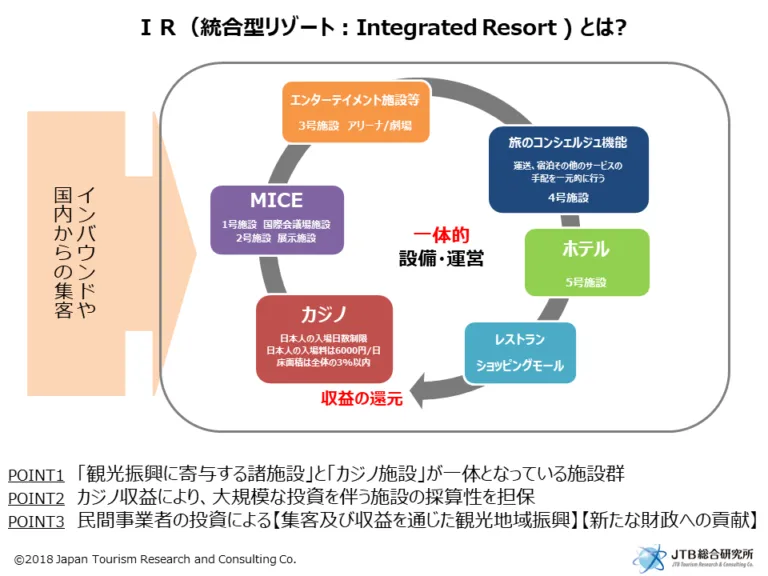
In Japan, IR is often equated with casinos, but officially, IR is defined as an “Integrated Resort,” referring to a complex of facilities comprising the facilities listed in Items 1 through 5 below, as well as casino facilities (Figure 1).IR is the collective term for this series of facilities designed to promote overnight tourism. The government’s goal is to use these facilities to attract and promote so-called MICE (Meetings, Incentives, Conventions, and Exhibitions) to Japan.
Type 1: International conference facilities that promote the attraction of international conferences and contribute to the smooth hosting thereof.
Type 2: Exhibition facilities that contribute to the smooth hosting of international-scale exhibitions, trade fairs, and other events. Type 3: Facilities that contribute to enhancing the appeal of tourism in Japan by holding
performances and other activities that utilize Japan’s traditions, culture, and arts.
Type 4: Facilities that contribute to the promotion of domestic tourism by appropriately providing information on the tourism appeal of various regions in Japan and, in conjunction with this, centrally arranging the transportation, lodging, and other services necessary for tourism travel to those regions.
Type 5: Accommodation facilities that meet the increasingly sophisticated and diverse needs of users.
(Type 6: In addition to those listed in the preceding items, facilities that contribute to promoting the visit and stay of domestic and international tourists.)
The purpose of the national government’s promotion of IRs as a public policy is stated at the beginning of Chapter 1, General Provisions, of the “Integrated Resort Development Act.” "By utilizing the revenue from sound casino operations managed under appropriate national oversight to promote the development of Integrated Resort Zones that leverage local ingenuity and private-sector vitality, the aim is to realize attractive, long-stay tourism with high international competitiveness, thereby contributing to the revitalization of regional economies and the improvement of public finances." It is expected that revenue generated from casinos will contribute to improving public finances at both the national and local levels in the form of "taxes," while also serving to provide financial support for facilities within the zone other than the casinos.
(Figure 1)
Overseas, Singapore’s “Marina Bay Sands”—which many of you are familiar with from TV commercials—is also an IR facility. While the general public likely associates it primarily with a hotel and a pool, the “Sands Expo and Convention Center”—a facility designed for MICE events—features an exhibition hall that can be divided into five sections across two floors, as well as over 200 meeting rooms and banquet halls spread across three floors, offering state-of-the-art facilities capable of flexibly accommodating various scales and purposes. When attracting MICE events to Japan, we must compete with such overseas facilities.
That said, simply building the infrastructure does not automatically attract users; particularly in the case of MICE, sales and promotional activities aimed at attracting international conferences and exhibitions are crucial. Furthermore, while the number of “Integrated Resort Zones” to be certified for the time being is capped at three, the regional strategies—not to mention MICE demand—differ between building IRs in major metropolitan areas and developing IR projects in regional areas. Consequently, the scale, specifications, and other requirements for MICE facilities will naturally vary.
While upholding the principles of the Japanese-style IR promoted by the national government, I believe it is essential to firmly establish a down-to-earth, step-by-step MICE strategy for the region, with a focus on attracting events.