What Is the "New Normal" in the MICE Sector?

What measures do organizers, event management companies, venues, and cities need to take when managing MICE events during the COVID-19 pandemic? We explore the future of the MICE industry as it moves toward a hybrid model combining online and in-person events.
1. Introduction
MICE is an acronym derived from the initial letters of “Meetings (corporate meetings), Incentive Travel (corporate incentive and training trips), Conventions (international conferences organized by international organizations, associations, and academic societies), and Exhibitions/Events (trade shows and other events).” It is gaining attention not only as a means of attracting large numbers of visitors to business events but also as a tool for regional industrial promotion. In anticipation of the Tokyo Olympic and Paralympic Games scheduled for July 2020, new hotels and convention centers were set to open in various regions, and preparations were underway to host corporate meetings, academic conferences, and trade shows. However, due to the spread of the novel coronavirus, gathering large numbers of people became impossible, leading to the cancellation of in-person MICE events.
On the other hand, spurred by the COVID-19 pandemic, digital conferences and digital trade shows utilizing online platforms have become commonplace worldwide. Online conferences and trade shows have proven to be opportunities to reach a wider audience and are expected to continue evolving. However, how should host cities—which have traditionally focused their efforts on attracting in-person MICE events—adapt to the “new normal” and continue to promote the value of MICE? Let us consider this issue.
2. The Growing Trend of Online MICE
Since the onset of the COVID-19 pandemic, various trade shows have begun to be held online. The current format appears to be dominated by the screening of promotional videos for products and services, combined with business negotiations conducted via video conferencing systems. With benefits such as reduced venue operating costs and the ability to archive events as digital data, online MICE is expected to evolve into an even more attractive option as 5G becomes widespread and content innovation progresses.
What are participants’ motivations for attending online trade shows, and how do they evaluate them? When I spoke with an organizer of an online trade show, I learned that participants’ objectives—such as gathering market intelligence, examining products, receiving explanations from exhibitors, and conducting business negotiations—were virtually identical to those at in-person events. While many felt that receiving explanations from exhibitors and conducting business negotiations could be adequately handled online, there was a common view that it is difficult to conduct online when it comes to gathering the latest general market information, experiencing products firsthand, or observing reactions—activities that allow participants to verify details according to their own interests. While gathering market information may seem achievable even in an online setting at first glance, the insights gained from face-to-face interactions in a physical setting—such as the perspectives of representatives—are often serendipitous and difficult to replicate online. With the rapid evolution of digital technology, it is becoming increasingly possible to cater to individual preferences and interests with greater precision. Going forward, online MICE events are also expected to evolve in terms of content, including the ability to inspect physical products, compare them with offerings from other companies, and gain new insights through serendipitous encounters.
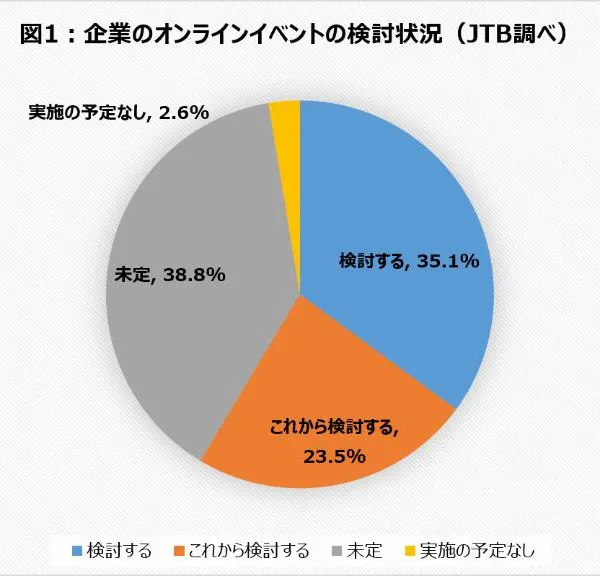
In June, JTB held an online seminar for companies regarding the hosting of online events and conducted a survey among participants on their “consideration status regarding hosting online events.” The results showed that over 50% of companies and organizations responded that they were “considering it” or “will consider it in the future” (Figure 1). It appears that for most companies, the adoption of online MICE is still very much in the “future.”

3. Measures for the “New Normal” in In-Person MICE
Regarding the “new normal” in the tourism sector, the Japan Tourism Agency has already announced “Travel Etiquette” and begun awareness campaigns; similarly, industry associations are formulating guidelines for MICE.
The key point is that, as long as events are held in person, safety and security measures are essential. The Japan Convention Management Association (JCMA), the largest MICE organization in Japan, formulated guidelines for holding MICE events to prevent the spread of COVID-19 in June 2020, summarizing safe and secure operational practices. When hosting MICE events, it is necessary to avoid the so-called “Three Cs” (closed spaces, crowded places, and close-contact settings) and to consider measures appropriate to the infection risk from before the event begins. The guidelines outline the risks of “contact transmission” and “droplet transmission” (Figure 2).
Figure 2: Risks of “contact transmission” and “droplet transmission”
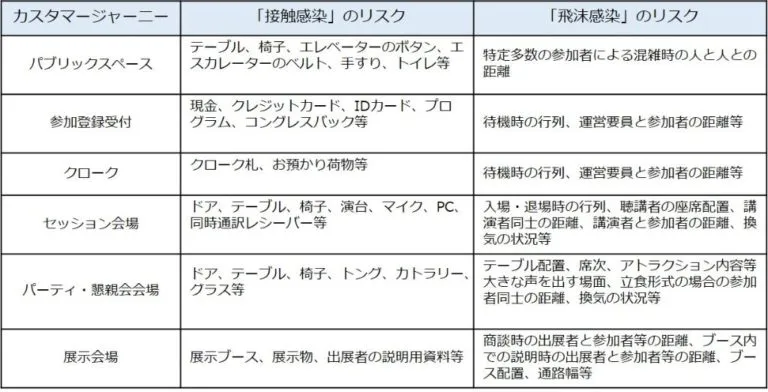
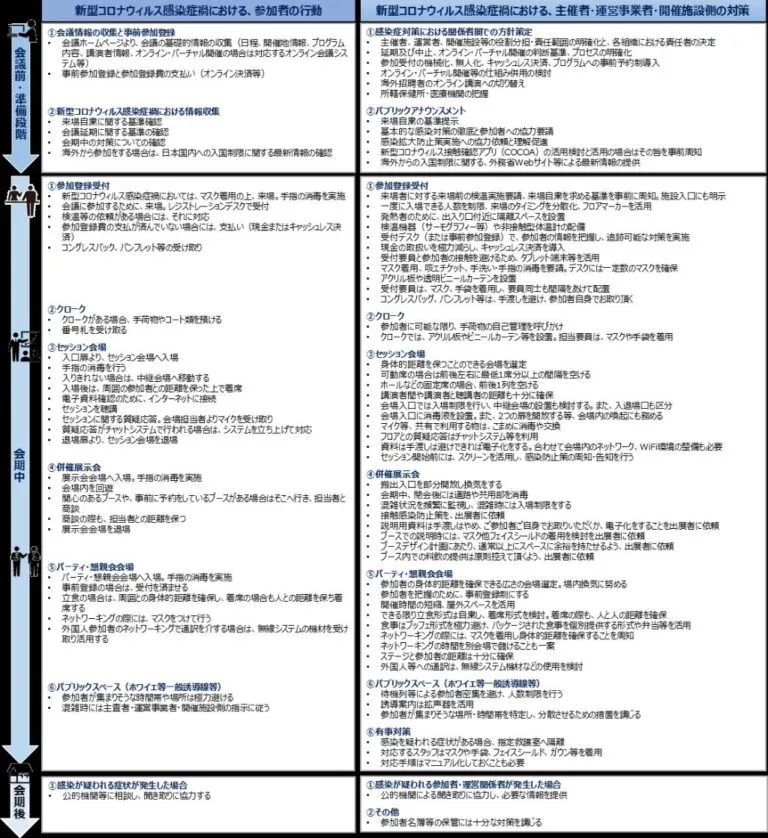
 Organizers, operators, and venue operators are required to identify the aforementioned risk factors in advance and, based on the participant’s customer journey during the “pre-event and preparation phase,” “during the event,” and “post-event” stages of the MICE process, consider measures to address these risks. However, since maintaining hygiene standards at the venue actually requires a significant amount of time and cost, the host city’s convention bureau must support organizers in ensuring safe and secure operations. While operational support measures—such as event subsidies, accommodation subsidies based on the number of participants, and the provision of shuttle buses and traditional performing arts for post-MICE activities—have been common as part of host city support initiatives, public health measures to ensure safe and secure events will now be given higher priority as part of these support measures.
Figure: Participant Behavior and Responses by Organizers, Operators, and Venue Owners During the COVID-19 Pandemic

4. Reaffirming the Significance of In-Person Events
The significance and purpose of holding MICE events in person will become more important than ever. Since the essence of MICE lies in the benefits derived from interaction resulting from “people gathering,” it is a prerequisite for organizers to ensure that prospective participants understand why it is essential to hold the event in person at that specific location—even before expecting the benefits unique to that location. In recent years, there has been a growing trend toward selecting host cities based on their connections to diverse factors such as local industries, research achievements, and cultural and tourism resources. By holding MICE events in fields related to a specific industry in regions where there is a concentration of that industry and accumulated expertise, participants can network with the local business community. For example, Kobe City, a global MICE city, actively attracts MICE events related to the medical industry, which the city has positioned as a strategic industry. At international conferences, medical companies based in Kobe exhibit their products and services. Simultaneously, technical tours of the city’s medical industry cluster are conducted to disseminate information to conference participants. Based on this information, company representatives often visit the sites at a later date, leading to many successful cases of attracting new businesses to the region. For the local business community, these events provide opportunities to access cutting-edge information, which can lead to innovation. Therefore, host cities must clearly communicate their unique strengths to MICE organizers and formulate regional MICE strategies, making this more important than ever.
As mentioned earlier, the “new normal” in the MICE sector will involve an increasing integration of online and in-person events. However, regardless of the format, MICE events are expected to continue playing a significant role as a driver of economic development—through business opportunities, innovation, research promotion, and regional revitalization. Moving forward, we look forward to working with host cities to develop concrete strategies and measures to realize these goals.
著者