We asked international students and graduates of tourism vocational schools: What aspects of their study abroad experience helped them find work in Japan?
With the number of foreign visitors to Japan on the rise, an increasing number of companies in the tourism industry—particularly the hospitality sector—are hiring international students and graduates as part-time or full-time employees to serve international guests. So, what did these students and graduates actually learn during their studies, what kind of experience did they gain through part-time work, and what do they believe was most helpful in their careers in Japan?
With the number of foreign visitors to Japan on the rise, an increasing number of companies in the tourism industry—particularly the lodging sector—are hiring international students and graduates as part-time or full-time employees to serve international guests.
According to a survey by the Japan Student Services Organization (JASSO), as of May 1, 2018, there were 298,980 international students in Japan, of whom 67,475 were studying at vocational schools, accounting for 22.6% of the total. By country, China ranked first, Vietnam second, and Nepal third, with students from Asia making up the majority.The reasons cited for so many Asian students choosing Japan as their study destination include relatively low tuition fees compared to Europe and the United States, a safe environment, and the fact that they are permitted to work up to 28 hours per week in part-time jobs (*).So, what did international students and graduates hired in Japan’s tourism and hospitality industries actually learn during their studies? What kind of part-time work experience did they gain, and what do they believe was most helpful for working in Japan? In this column, we will explore these questions based on a survey of international students and interviews with graduates from the JTB Group’s vocational school, “JTB Travel & Hotel College” (hereinafter “the College”).
(*) In order for international students to work part-time in Japan, they must apply for and obtain a “Permit for Activities Outside the Scope of Status of Residence,” after which they are permitted to work up to 28 hours per week. Additionally, working part-time in the adult entertainment industry (such as bars, clubs, and pachinko parlors) is prohibited. (Based on Article 19 of the Immigration Control Act (Permit for Activities Outside the Scope of Status of Residence))
1. Reasons for Choosing Japan as a Study Abroad Destination, as Revealed by a Survey of International Students at a Tourism Vocational School
The survey was conducted in June 2018 among 54 second-year international students at the college, and we received responses from 52 students (response rate: 96.3%). The breakdown by country/region is as follows: 32 from China, 8 from Vietnam, 5 from South Korea, 3 from Myanmar, and 1 each from Taiwan, Nepal, Indonesia, and Malaysia.
(1) The Purposes of Studying in Japan: “Learning,” “Working,” and “Living”
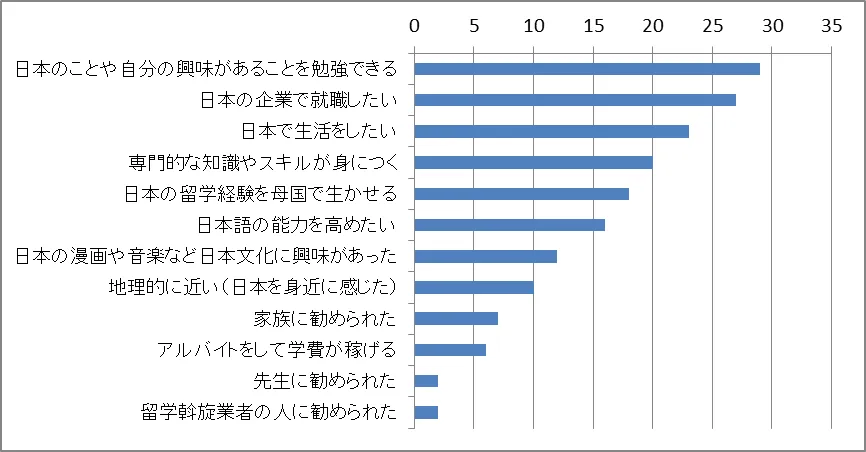
First, we asked them, “Why did they (the international students) come to Japan?” As shown in Figure 1, they decided to study in Japan for three main reasons: “to study” (learning about Japan or subjects of personal interest), “to work” (seeking employment at Japanese companies), and “to live” (wanting to live in Japan). Several students also mentioned that they developed a fascination with Japan through manga such as Doraemon and ONE PIECE.
[Figure 1] “Reasons for Deciding to Study in Japan”
(2) Reasons for Choosing Vocational Schools and Changes in Perceived Benefits
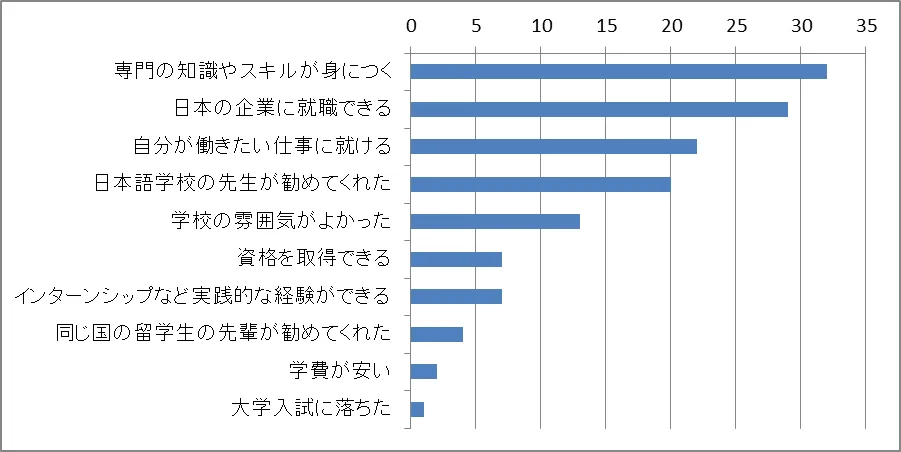
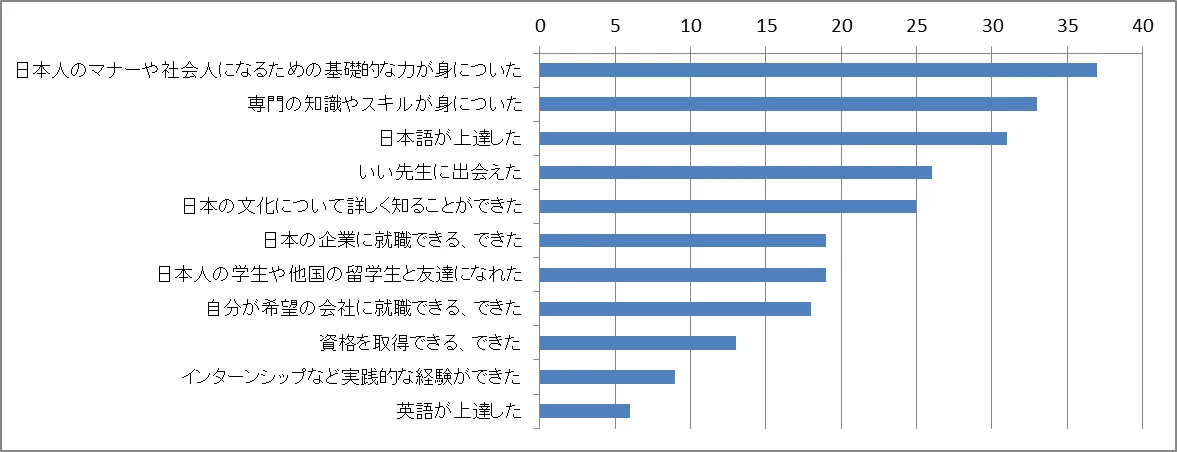
After spending one and a half to two years at a Japanese language school following their arrival in Japan, international students choose their career path by deciding whether to advance to a university or a vocational college. As shown in Figure 2, students at vocational colleges make their decisions with a focus on their personal growth and future employment prospects. However, as they study and go about their daily lives at vocational colleges, their evaluations of these institutions begin to shift. The responses regarding “what they were glad they chose this school for” as of June of their second year are shown in Figure 3.
With the exception of the second-ranked item, “I acquired specialized knowledge and skills,” the top-ranked item and items ranked third through fifth were not anticipated at the time of enrollment but were evaluated as “positive” after enrollment.
The top-ranked item, “I acquired Japanese manners and the basic skills needed to become a working professional,” includes aspects such as “not being late,” “keeping promises and following rules,” and “greeting others politely”—all of which the college repeatedly emphasizes in its instruction.For international students, being scolded or reprimanded by a teacher is certainly not a pleasant experience. Nevertheless, the fact that this item was rated as the most beneficial suggests it was useful for daily life and part-time work in Japan—for example, “I gained recognition from my part-time job manager” or “I understood the rules for taking out the trash.”
Regarding the third-ranked item, “My Japanese improved,” this is not merely about passing the Japanese Language Proficiency Test (JLPT) Levels 2 and 1 (N2 and N1). By learning Japanese for daily life, business, and customer service in industries like tourism, students reported that “conversations and communication with (Japanese) customers at my part-time job became smoother.” This suggests they strongly feel a connection between their studies and their work.
In other words, it can be said that international students highly value the “learning” that connects to “living” and “working” in Japan—such as Japanese manners and culture, as well as the correct Japanese language skills useful for part-time work.
The homeroom teacher spoke about the international students’ part-time jobs as follows: “We not only ensure that international students strictly adhere to the legal limit of 28 hours per week, but we also provide advice on the nature of their work. Since working at a convenience store mainly involves memorizing operations and does little to improve Japanese language skills, we recommend part-time jobs at family restaurants. Conversely, we also encourage international students who are not currently working part-time to gain experience in customer service through such jobs.”
The college provided advice on part-time work to help international students apply the Japanese they learned in school to the workplace, supporting them in connecting what they “learned” with “working.”
[Figure 2] “Reasons for Choosing This School”
[Figure 3] "What I’m glad about choosing this school"
2. From an Interview with Graduate (Former International Student) I
Next, based on an interview with I, a former international student (graduate) currently working at a Japanese company (specifically a hotel), we will consider what skills are necessary for working at a Japanese company.
Ms. I graduated from the college and was in her second year of employment at a hotel in Tokyo (at the time of the interview), where she is in charge of guest room and lobby services. Ms. I highly values her education at the college, stating, “I am able to do my best at my current workplace thanks to what I learned at the college.” The aspects of her education that Ms. I values are as follows.
(1) Mastering Japanese Rules and Etiquette—Connecting “Learning” to “Living” and “Working”
Mr. I described the Japanese rules and manners he learned during his time at vocational school as follows: “I was taught the importance of punctuality at college. Thanks to having developed this habit, I’m able to perform my current job properly. ‘When in Rome, do as the Romans do’—my homeroom teacher taught me this saying, and it’s something I still keep in mind today.Japan has its own rules, and the workplace has its own rules. When it comes to handling personal information, I understand that this is the rule of this workplace and work accordingly.” I also shared that it was only after entering the workforce that she understood the meaning of what she had learned in school: “After becoming a working adult, I truly realized the importance of ‘greetings.’ Greetings and smiles when arriving and leaving work are essential for working. I came to understand anew, after entering the workforce, the meaning behind repeatedly practicing greetings and smiles at school.”
(2) Learning “Correct” Japanese—Connecting What You’ve Learned to Daily Life and Work
Ms. I emphasized the word “correct,” stating, “At the college, rather than just becoming better at Japanese, I learned ‘correct’ Japanese.” The college’s Japanese classes thoroughly teach polite language and honorifics, such as “desu,” “masu,” and “hai.” Since working in the tourism or service industries requires satisfying customers, students are instructed to master “correct” Japanese rather than simply Japanese that gets the message across.
During her time at the vocational school, Ms. I changed the nature of her part-time jobs as her Japanese proficiency improved. She started by working in the kitchen at a restaurant, then moved to the dining room, and later switched from working the register at a convenience store to working the register at a supermarket. On weekends, she also worked at the front desk of a business hotel.By actually using the “correct” Japanese she learned at college in supermarkets and at the business hotel front desk, she gained confidence in communicating in Japanese. By putting the Japanese she “learned” at vocational school into practice through her part-time jobs, she successfully linked “learning” with “working.”
(3) The Importance of Classes and School Events for Learning About Japanese and Other Cultures
I highly values not only the teachers’ guidance but also school events like the cultural festival. “During my time at vocational school, I was able to meet people from various countries—including Vietnam, Russia, Myanmar, Taiwan, and Nepal—and the experience of speaking Japanese with everyone was truly wonderful. I especially remember being surprised to learn about countries I hadn’t known existed during the cultural festival and international exchange classes, where people from each country displayed local products, performed dances, and proudly showcased their cultures.”“Now that I work at a hotel, the exposure to various cultures I gained during my time at vocational school has been incredibly helpful.” Regarding Japanese culture, she explained that the opportunities the school provided to experience it firsthand have been beneficial in her hotel work: “Participating in Bon Odori festivals held near the school and experiencing Japanese culture firsthand has really come in handy when serving Japanese guests.”In Ms. I’s view, the most important thing when working at a Japanese company is adhering to Japanese rules and etiquette, as well as the specific rules of that company. That is why she believes that learning Japanese etiquette at vocational school and developing the habit of following school rules helped her adapt to working at a Japanese company. She also feels that by connecting what she “learned” at vocational school—such as proper Japanese—to her “daily life” and “work,” she is able to achieve a higher level of performance in both her job and her personal life.
3. Summary
Based on the survey of international students and graduates, the college places great importance on international students acquiring not only specialized knowledge and skills but also Japanese rules, manners, culture, and “proper” Japanese in order to secure employment and continue working at Japanese companies. We found that this has been helpful for international students and graduates working in Japan’s hospitality and tourism industries.
In April of this year (2019), a new status of residence called “Specified Skilled Worker” was introduced, and the first Accommodation Skills Assessment was held on April 14 for the hospitality industry. A total of 391 people took the exam at seven venues nationwide, with 280 passing, resulting in a pass rate of 71.6%.Going forward, isn’t it necessary to create opportunities for foreign nationals working under the “Specified Skilled Worker” status to not only “work” as “workers” but also to “live” in Japan as “residents,” by “learning” Japanese manners, culture, and “proper” Japanese?