Forecast of Trends in the Inbound Travel Market for 2026 (January–December)
This report was independently compiled based on official statistics and survey data from the Japan Tourism Agency and JNTO (Japan National Tourism Organization) regarding inbound tourism, economic forecasts from the IMF (International Monetary Fund), and booking trends within the JTB Group. (Our company is responsible for the research and analysis in this report.)
Key Findings
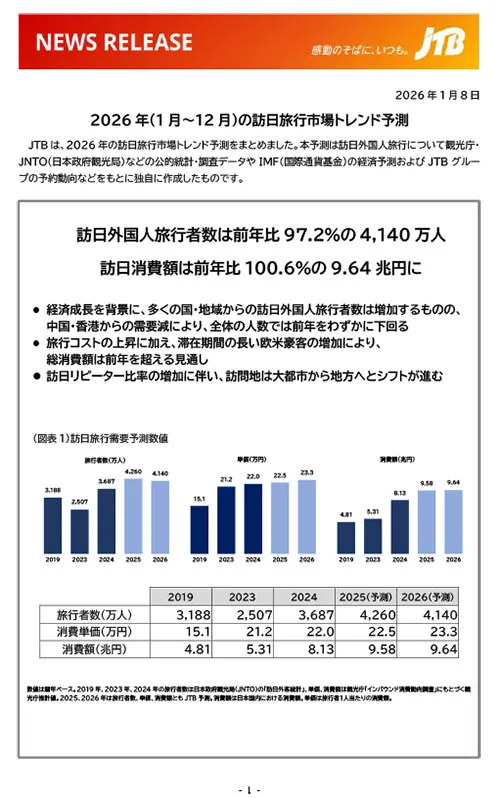
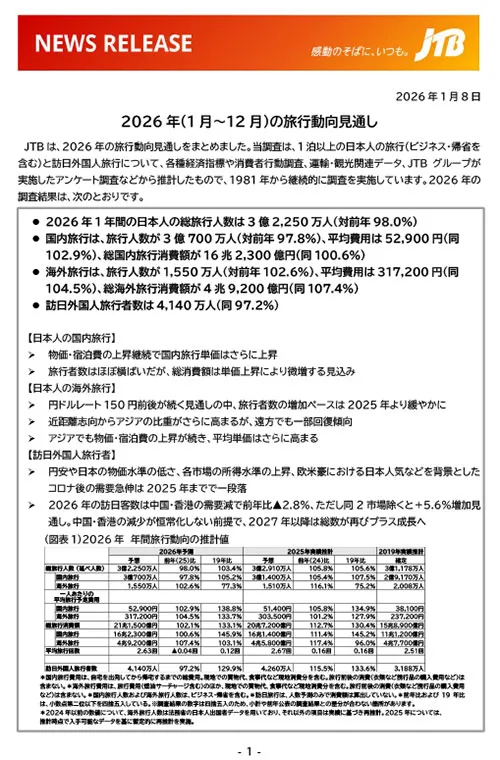
- The number of international visitors to Japan reached 41.4 million, or 97.2 percent of the previous year’s figure, while spending by international visitors totaled 9.64 trillion yen, or 100.6 percent of the previous year’s figure.
Against the backdrop of economic growth,while the number of international visitors to Japan from many countries and regions is increasing, the overall total is expected to fall slightly below the previous year’s level due to a decline in demand from China and Hong Kong. However, total spending is projected to exceed the previous year’s level due to rising travel costs and an increase in visitors from Europe, the U.S., and Australia, who tend to stay longer. As the proportion of repeat visitors to Japan rises, there is a continuing shift in travel destinations from major cities to regional areas.
Overview of the Inbound Travel Market to Japan
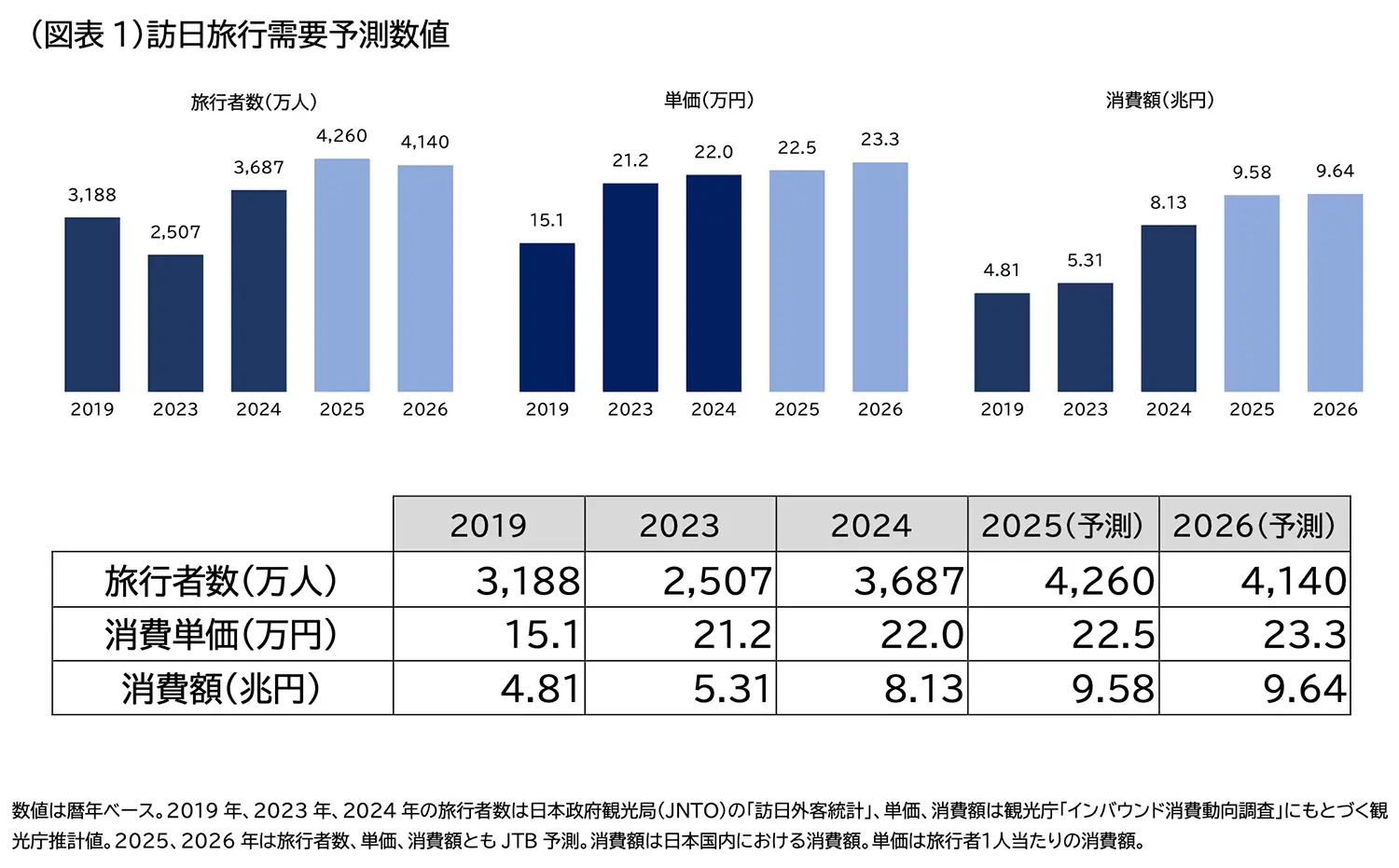
We forecast that in 2026, demand for travel to Japan will reach 41.4 million international visitors (97.2% of the previous year’s level) and 9.64 trillion yen in spending (100.6% of the previous year’s level) (Figure 1).While demand for travel to Japan has consistently posted double-digit growth rates during the post-pandemic recovery, the growth rate is expected to slow in 2026 as demand shifts to a phase driven primarily by organic growth accompanying economic expansion in various countries and regions. Furthermore, given the anticipated decline in demand from China and Hong Kong, the number of travelers is projected to fall below the previous year’s level.
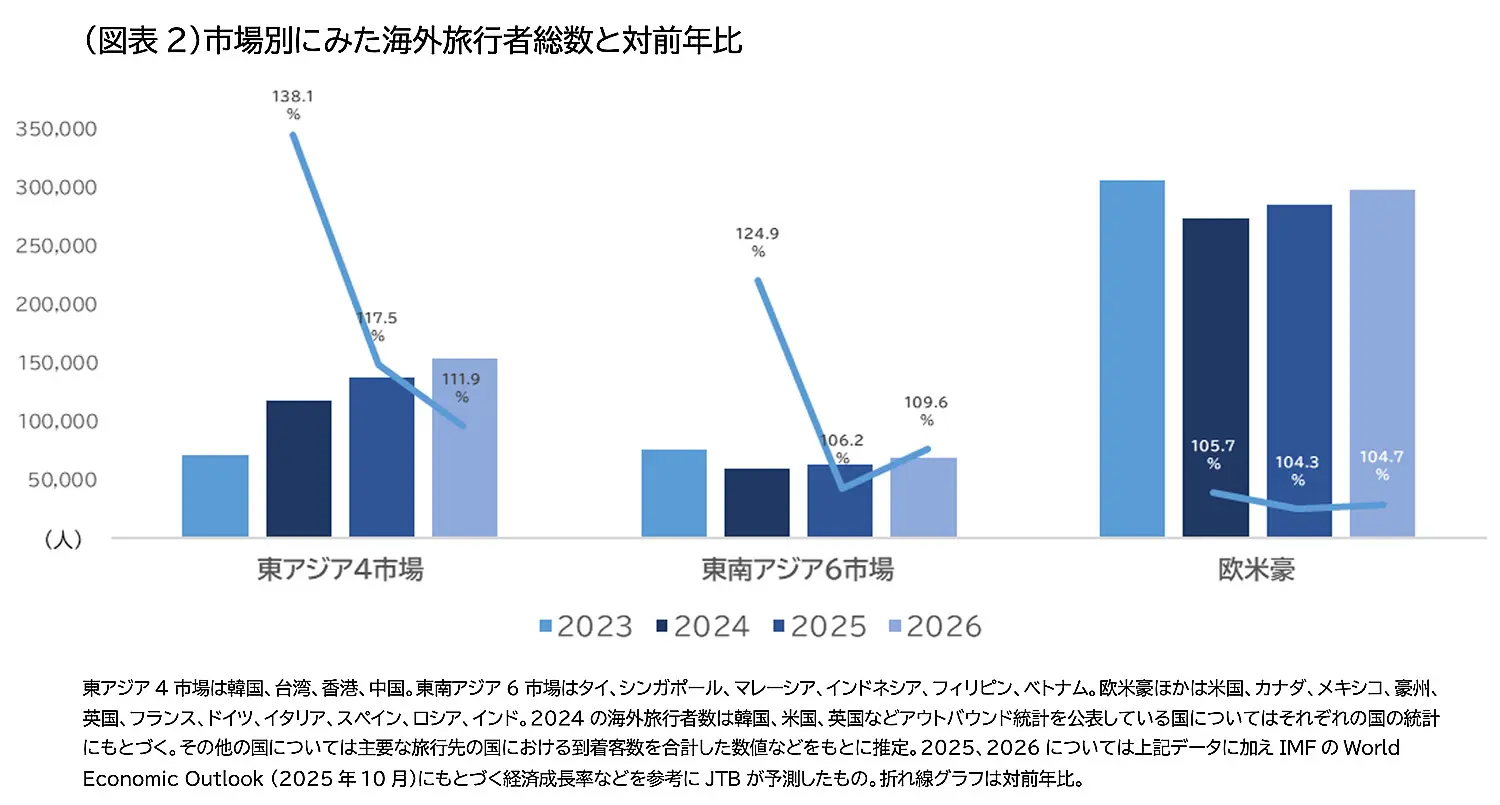
The significant surge in demand for travel to Japan from 2024 to 2025 was driven not only by the weak yen and low domestic prices in Japan but also by rising income levels in various countries and regions compared to pre-pandemic levels, as well as growing popularity of Japan, particularly in Europe, the United States, and Australia.The effect of these factors in boosting demand is expected to largely run its course by 2025, and we forecast that in 2026, the natural increase in demand for overseas travel driven by economic growth in various countries and regions will be the primary factor driving growth in the number of visitors (Figure 2).
A potential downside risk to demand is a decline in demand for travel to Japan from China and Hong Kong.In addition, a sharp rise in the yen exchange rate could also affect demand. In markets close to Japan, such as South Korea and Taiwan, a weak yen is one of the incentives for travel to Japan; if the yen were to appreciate, travelers might shift their destinations to relatively more affordable regions, such as Southeast Asia.
The average spending per foreign visitor to Japan is influenced not only by the yen exchange rate but also by domestic travel costs, such as lodging expenses, and income levels in each country and region.A comparison of per-person spending by expenditure category between 2024 and 2025 suggests that during periods of yen appreciation, travelers tend to curb their shopping, which is believed to have a negative impact on per-person spending. On the other hand, travel costs themselves—primarily accommodation expenses—are rising, acting as a factor that pushes up per-person spending.
For 2026, we assume that the average annual dollar-yen exchange rate (against the U.S. dollar) will remain largely unchanged from 2025, at around 150 yen per dollar. Under this assumption, we expect the upward pressure on per-person spending caused by rising domestic travel costs to continue, leading to a sustained increase in per-person spending.
Trends by Country and Region
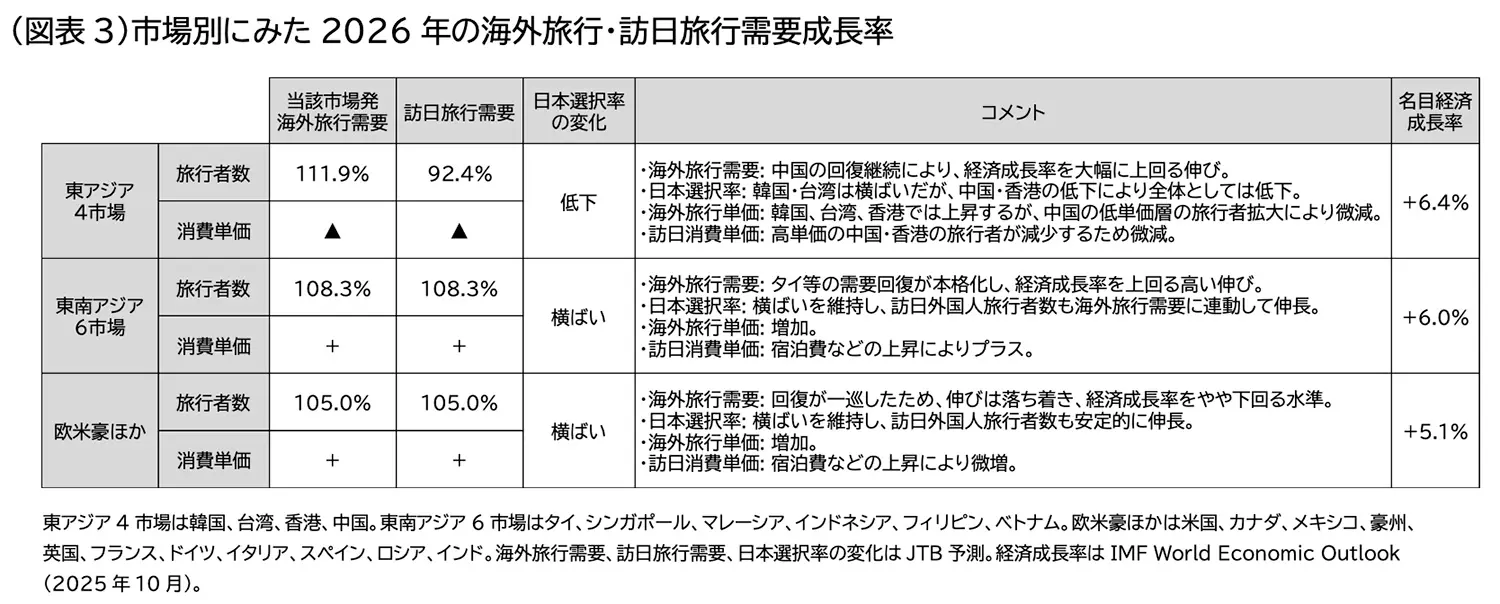
In 2026, the number of international visitors to Japan by origin is expected to grow at a rate comparable to the growth rates of outbound travel in each country and region, with the exception of the four East Asian markets, which will be affected by a decline in the number of travelers from China and Hong Kong.
Looking at the growth rates of international travelers by country and region in 2026, China is projected to have the highest growth rate, with an increase of 15.1 percent—significantly exceeding the nominal economic growth rate (in U.S. dollars) of around 6 percent.This is because the lifting of restrictions on outbound travel in China following the COVID-19 pandemic lagged behind that of other countries, meaning that the recovery to pre-pandemic demand levels will continue into 2026.
However, the number of travelers from China to Japan is expected to decline. Demand for outbound travel from China is anticipated to shift toward countries and regions other than Japan, such as Southeast Asia, leading to a significant increase in the number of travelers to those destinations.
For the six Southeast Asian markets, while economic growth rates are expected to be close to those of China, the growth rate for international travelers is projected to slow to 9.6%. This is because these markets include a mix of those, such as Singapore, where demand recovered quickly after the pandemic, and those, such as Thailand, where a full-scale recovery in demand is expected to take place in 2026.
For other countries and regions, such as Europe, the United States, and Australia, the growth rate of international visitors is expected to remain slightly below the economic growth rate. In regions like the United States and Europe, the post-pandemic recovery in demand for international travel has already run its course, and future growth in international visitor numbers is expected to largely converge with the economic growth rates of each region. (Figure 3)
Growing Presence of Travelers from Europe, the U.S., and Australia
In 2026, the presence of travelers from Europe, the U.S., and Australia is expected to increase further in major cities.According to statistics from the Japan Tourism Agency, the total number of overnight stays by travelers from Europe, the U.S., and Australia from January to September 2025 reached 29.95 million (an increase of 6.09 million compared to the same period the previous year), expanding to a scale comparable to that of South Korea, Taiwan, and Hong Kong (31.86 million), which traditionally accounted for a large volume of visitors.A key factor behind this trend is that the average length of stay for travelers from Europe, the U.S., and Australia is approximately twice that of travelers from Asia. Although the Asian market exceeds the European, U.S., and Australian market in terms of the number of travelers, the longer length of stay is driving up the total number of overnight stays and enhancing their presence.
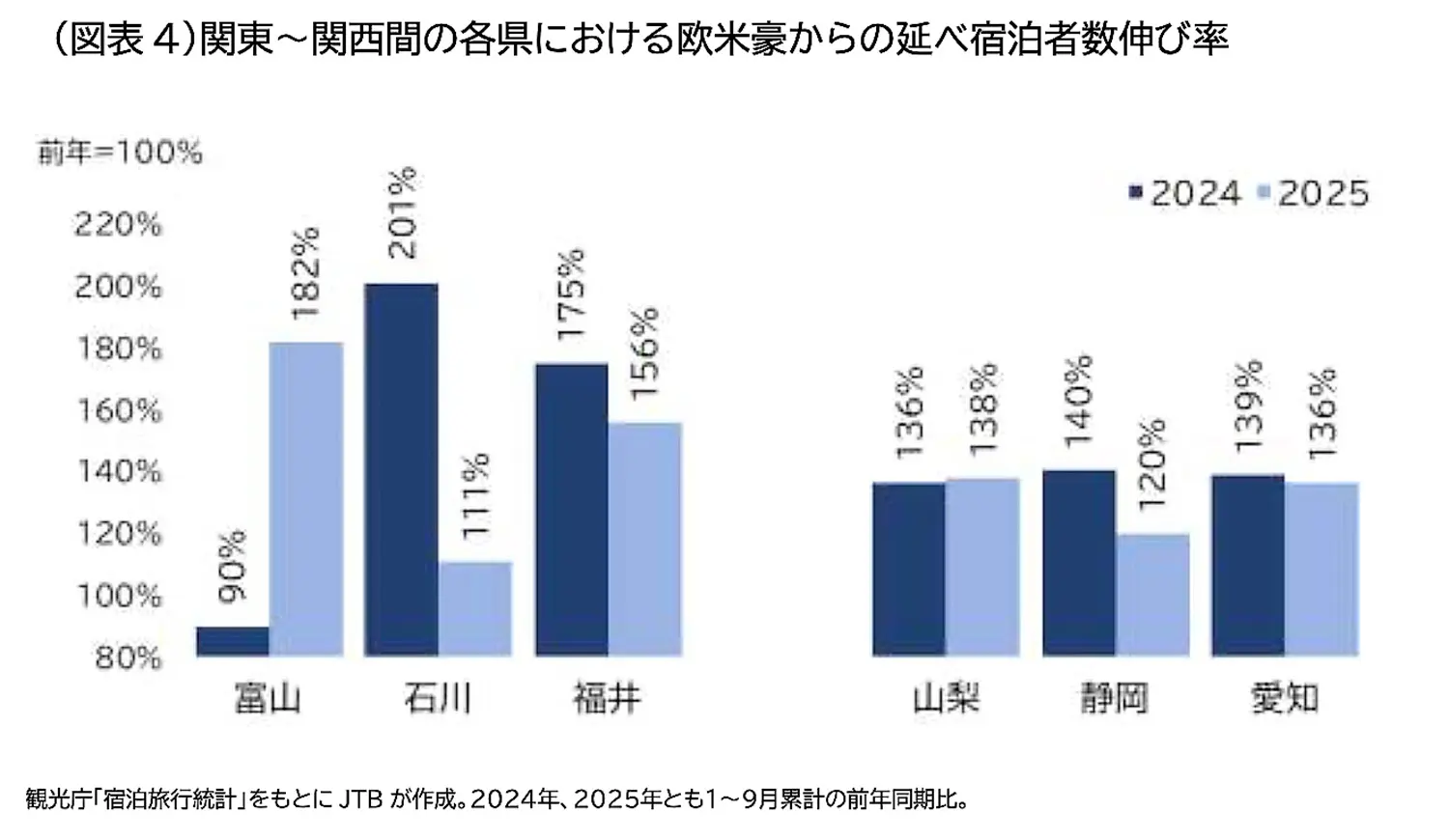
While travelers from Europe, the U.S., and Australia tend to concentrate in major metropolitan areas such as the Kanto and Kinki regions—more so than travelers from Asia—the number of total overnight stays has also increased significantly in the prefectures of the Hokuriku region. One contributing factor is the opening and extension of the Hokuriku Shinkansen, which has created a new travel route between Tokyo and the Kansai region.Since travelers from Europe, the United States, and Australia often enter Japan through Narita or Haneda Airports and a high proportion are first-time visitors to Japan, they tend to extend their trips to the Kansai region in addition to Tokyo.While the so-called “Golden Route”—traveling from Tokyo to Osaka via the Tokai region—was traditionally the mainstream route, there are signs that a portion of this traffic is shifting to routes via the Hokuriku region (Figure 4). In particular, Ishikawa and Kanazawa had already established a certain level of recognition and appeal as destinations second only to the Golden Route even before the extension of the Hokuriku Shinkansen.In addition to an abundance of tourist attractions—such as history, traditional culture, gardens, and castles—that align with the preferences of travelers from Europe, the U.S., and Australia, the region’s cultural experiences, such as kintsugi, are highly regarded, which also contributes to its popularity.On the other hand, while the absolute number of overnight stays in Fukui and Toyama remains limited, their growth rates are high. These trends can be attributed not only to the effects of the Hokuriku Shinkansen but also to the results of ongoing overseas promotional efforts by local governments and information campaigns supporting post-disaster reconstruction.
In terms of spending trends among travelers from Europe, the U.S., and Australia, there is a tendency for a high proportion of spending to be on in-trip expenses such as lodging and dining.Compared to pre-pandemic levels, shopping-related spending is also on the rise; in addition to increased purchases of duty-free items such as alcoholic beverages due to the weak yen, travelers from Europe, the U.S., and Australia tend to spend more on clothing and traditional crafts than travelers from Asia. Because travelers from Europe, the U.S., and Australia tend to stay longer, their per-person spending is higher, and they have a significant presence in terms of total spending.
The South Korean and Taiwanese Markets, Significantly Affected by Yen Exchange Rate Fluctuations
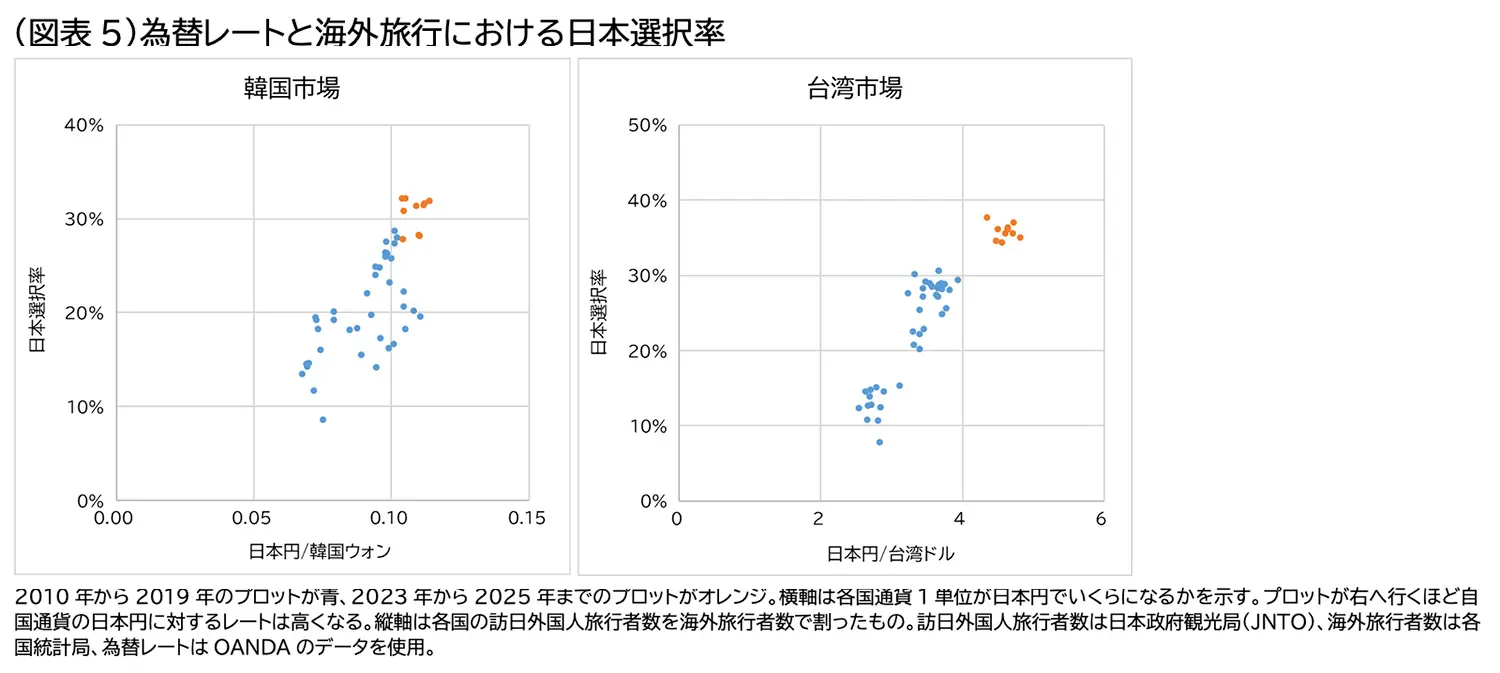
In South Korea and Taiwan, the proportion of travelers choosing Japan as an overseas destination has risen significantly since the pandemic (Figure 5). These markets, which are geographically close to Japan, are highly susceptible to exchange rate fluctuations; the high rate of choosing Japan can be attributed to the perception of value resulting from the weak yen.
While our projections for 2026 assume that the yen exchange rate will not fluctuate significantly, if the yen were to appreciate, travel destinations could shift from Japan to more affordable countries such as those in Southeast Asia, potentially leading to a decline in the number of international visitors to Japan.
Trends by Destination
Looking at demand for travel to Japan by destination from 2024 to 2025, there was a greater concentration of visitors in major cities such as Tokyo and Osaka compared to 2019.Factors contributing to this trend include an increase in the proportion of travelers from Europe, the United States, and Australia—whose accommodations tend to be concentrated in major cities—as well as the fact that even repeat visitors from Asia, who typically visit regional areas more frequently, showed a higher rate of visits to major cities during their first trip to Japan following the COVID-19 pandemic.Furthermore, delays in the resumption of direct international flights to regional airports in Japan also contributed to the concentration of demand in major cities.
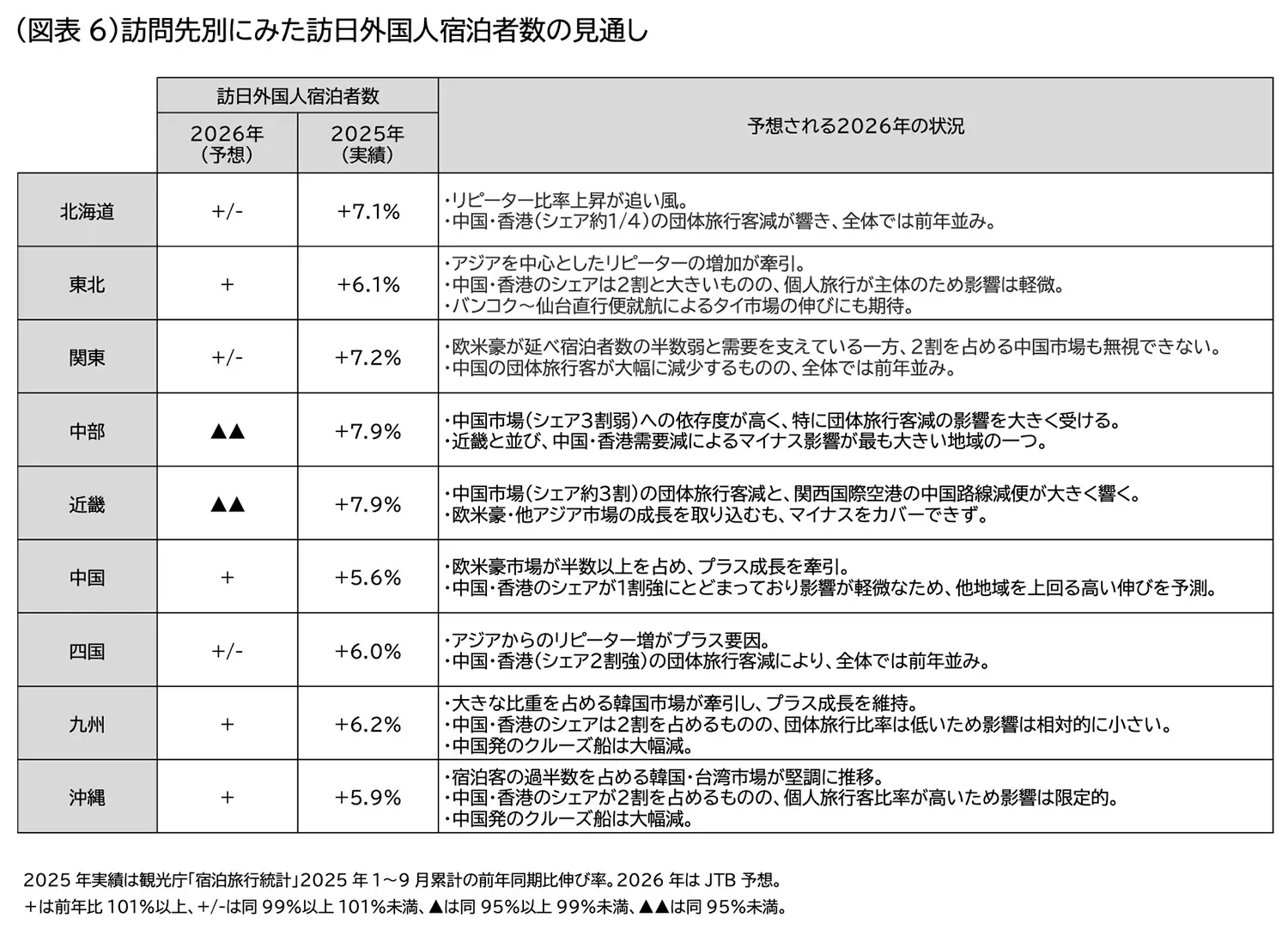
In 2026, while the number of foreign overnight visitors is expected to fall below the previous year’s level in some regions due to a decline in the number of travelers from China and Hong Kong, we predict that the proportion of visitors to regional areas will increase relative to major cities.A key factor behind this is that as the overall growth rate of international visitors to Japan slows, the proportion of repeat visitors—who tend to visit regional areas more frequently—is expected to rise.
Looking at the number of overnight stays by destination, an increase is expected in the Tohoku region, which has many frequent repeat visitors to Japan, and in the Chugoku region, where the proportion of travelers from Europe, the United States, and Australia is high. On the other hand, in regions such as Kinki and Chubu, where the proportion of group tourists from China is high, the number of overnight stays is projected to fall below the previous year’s level (Figure 6).
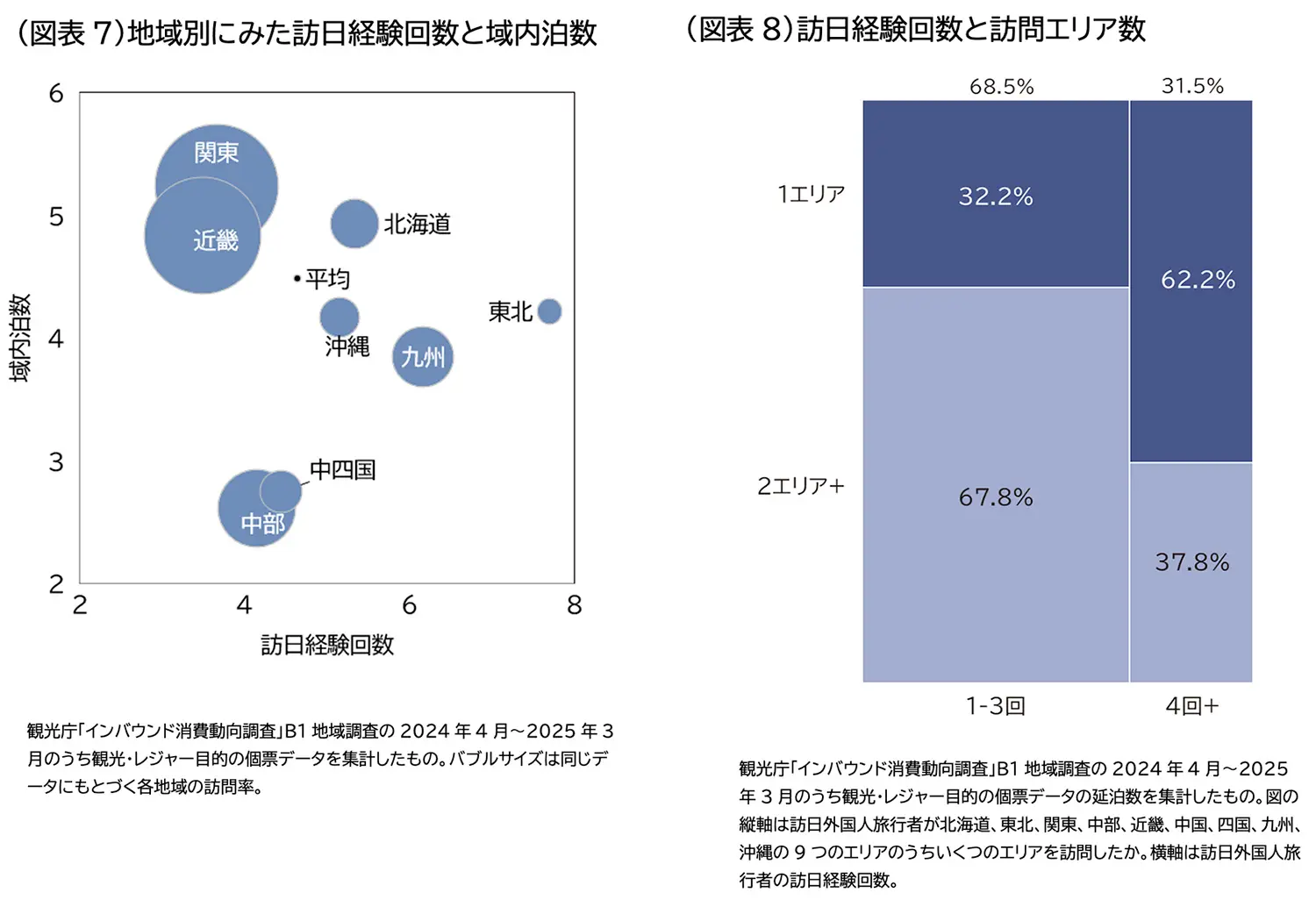
Furthermore, it is known that as the number of visits to Japan increases, so does the number of overnight stays in regional areas (Figure 7).Furthermore, since repeat visitors who have traveled to Japan four or more times tend to narrow their destinations down to a single region (Figure 8), it is expected that as the proportion of repeat visitors continues to rise, the travel patterns of international tourists will shift from major cities to regional areas, and their destinations will become increasingly focused.
JTB Group Booking Trends
On “JAPANiCAN.com,” an accommodation booking site for international visitors to Japan operated by JTB, the number of bookings from January through April 2026 showed steady growth compared to the same period last year: 161% for Taiwan, 138% for South Korea, and roughly flat for the United States.
The Chubu region is particularly popular among travelers from Taiwan, with Ishikawa, Mie, Nagano, and Aichi all recording growth of over 200% year-over-year. Osaka and Okinawa, where the network of direct flights has expanded, have also seen significant growth.Among travelers from South Korea, while demand for Hokkaido and Kyushu remains high, destinations such as Miyagi, Gunma, Nagano, Gifu, and Hyogo have also seen growth exceeding 200% year-over-year, indicating a growing diversification of travel destinations. This trend toward regional diversification is also evident among travelers from the U.S., with the Shikoku region performing particularly well at 240% year-over-year.On the other hand, due to the impact of Japan-China relations, the number of travelers from China has increased by only 50% year-on-year, while that from Hong Kong has risen by just 90%. In Hokkaido in particular, while group tours were temporarily affected, the region continues to enjoy high popularity as a destination for individual travelers, highlighting a notable difference in trends depending on the type of travel.
According to booking data from JTB Global Marketing & Travel (*), which specializes in inbound tourism to Japan, while interest in Japan remains high in the key European and North American markets, there are signs that travel demand growth will slow through 2026, as the rate of increase in travel costs in Japan is higher than in other countries.Furthermore, in these markets, vacation periods are shifting from a concentrated to a more dispersed pattern, suggesting that a desire to avoid crowds and concerns about summer heat are significantly influencing the choice of travel destinations and timing. Another notable trend is the growing interest in package tours, driven by a sense of security, ease of booking, and the desire for unique experiences.
*JTB Global Marketing & Travel offers themed tours in various regions across Japan, as well as a luxury brand (BOUTIQUE JTB) that specializes in providing high-value-added travel experiences for high-net-worth individuals.
In the corporate business segment for FY 2025, the Meetings & Events sector performed strongly, growing 240% compared to the previous FY, while international conferences grew 131% over the same period; a notable increase in demand related to the “Osaka-Kansai Expo” was also observed.Promotional businesses targeting inbound international travelers also showed strong growth, up 130% year-over-year.
In 2026, international sporting events such as the “2026 World Baseball Classic™” and the “20th Asian Games and Asian Para Games (Aichi/Nagoya)” will draw attention from countries around the world, particularly in Asia. Demand is expected to rise significantly due to the stays of not only athletes but also spectators and event staff.
To promote the “Inbound Tourism to Japan VISION 2030” across the entire group, the JTB Group has defined “six existing business areas” and “one new area (+1)” and aims to generate new customers in each of these areas.Led by the Inbound Tourism Co-creation Department, we are strengthening collaboration within the Group both domestically and internationally. By enhancing the regional responsiveness of our domestic sales offices and identifying the needs of inbound international travelers through Group companies such as North Star Travel Group and our overseas offices, we will contribute to the inbound tourism business from both the origin (overseas) and destination (Japan) perspectives.Regarding the “+1 New Area,” we will work to develop and invest in services and content that could become reasons for international visitors to come to Japan, and create new value through active co-creation with external partners.