Accepting Evacuees and Disaster Victims at Lodging Facilities During Disasters

In recent years, when large-scale disasters such as earthquakes occur, or when advance evacuation becomes necessary due to typhoons, heavy rain, or similar events, hotels and traditional Japanese inns (ryokan) have increasingly been used as places to accept evacuees and disaster victims. This article summarizes the systems and responses related to accepting evacuees and disaster victims at lodging facilities during disasters. It also explains the important role that lodging facilities play in supporting regional disaster preparedness, along with key points to consider when thinking about accepting evacuees.
Introduction
The 2026 Kumamoto Earthquake struck during the intense heat of midsummer. Power outages caused by the earthquake left evacuation shelters without air conditioning, and many disaster victims had no choice but to spend their evacuation life in cars with the air conditioner running. As harsh, prolonged heat wore on evacuees, the national government and Kumamoto Prefecture secured 2,200 guest rooms across 73 lodging facilities (*) and carried out "evacuation to hotels and inns (hotel-based evacuation)," aiming to ease the physical and mental burden on evacuees and help them stay in safety and comfort.
(Editor's note: This figure is current as of August 1, 2026, when this article was written.)
During disasters, lodging facilities contribute to their communities by accepting evacuees and disaster victims. At the same time, lodging operators sometimes face misunderstandings or uncertainty about accepting them — for example, under what circumstances and whom they should accept, how far they should go in providing services to the evacuees and disaster victims they take in, and whether they will be paid (accommodation fees).
This column was written to organize the systems and responses related to accepting evacuees and disaster victims at lodging facilities during disasters, in the hope of encouraging lodging operators to consider accepting them proactively when a disaster strikes.
How Lodging Facilities Respond by Disaster Phase
First, focusing on Japan, we have organized into a single table which types of people are accepted at each phase of a disaster, and how payment and accommodation fees are handled in each case.
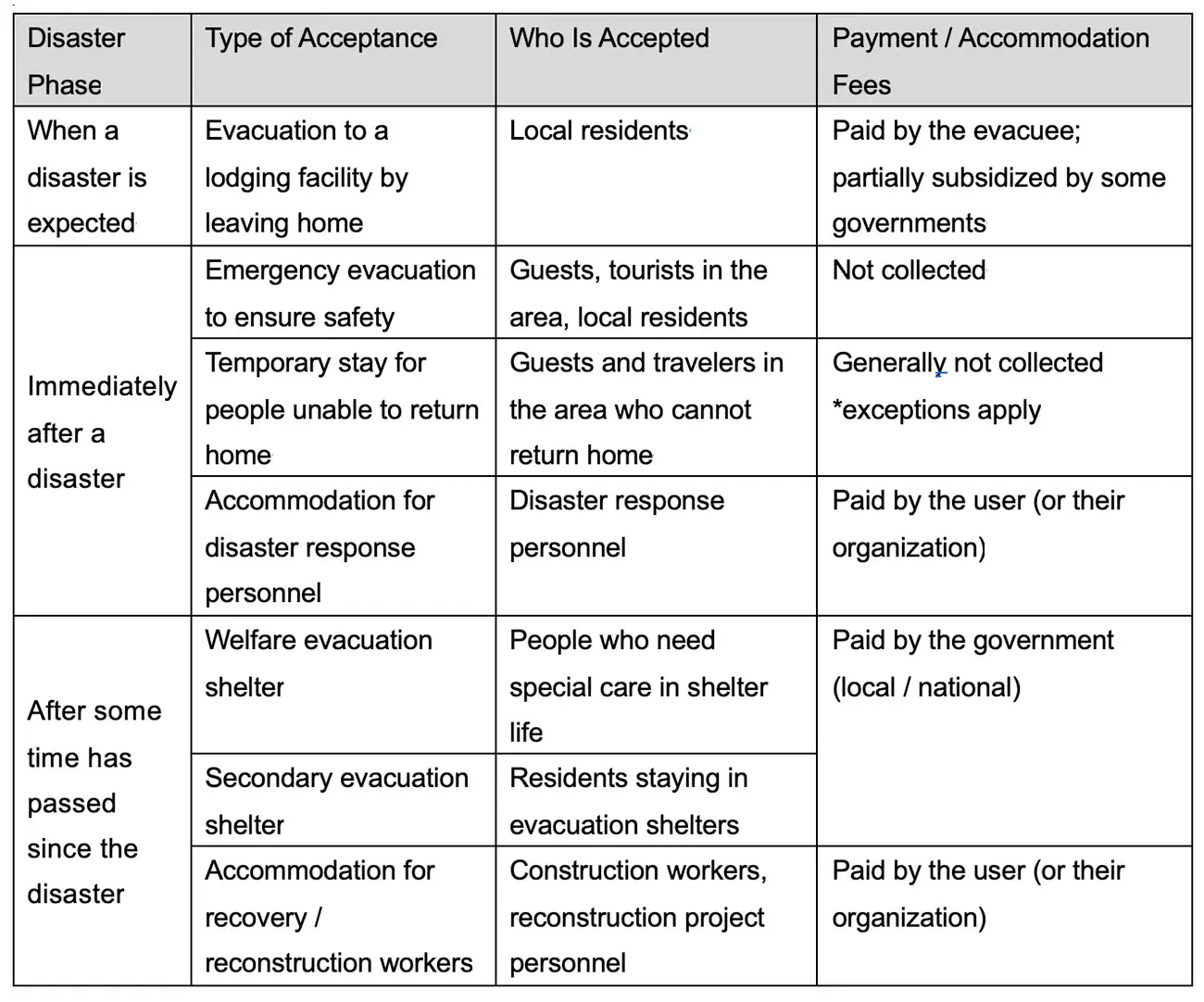
As this table shows, needs to accept various types of people arise at each phase. In each case, whether payment or accommodation fees can be collected — and who bears the cost — differs.
Below, we explain each type of acceptance in a little more detail.
1. Evacuating to a Lodging Facility When a Disaster Is Expected
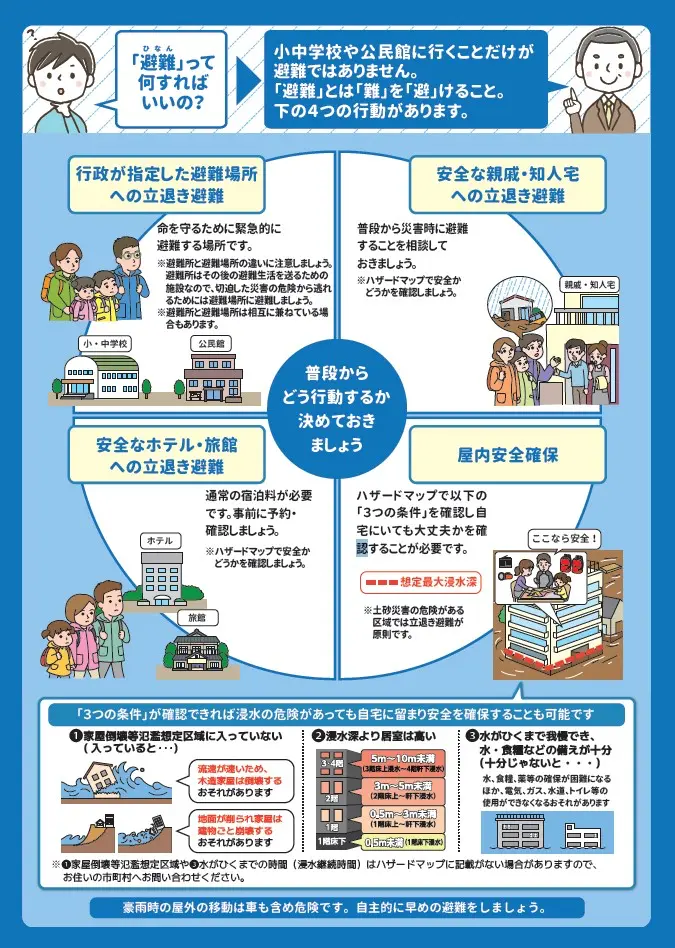
When a disaster such as a typhoon or heavy rain is expected, residents can evacuate to hotels and inns as safe places. The government also recommends "evacuating by leaving home for a safe hotel or inn" as one option for residents to evacuate in advance when a disaster is expected. As a rule, guests pay their own accommodation fees when evacuating to a lodging facility in advance, and they need to make reservations and confirm arrangements beforehand.
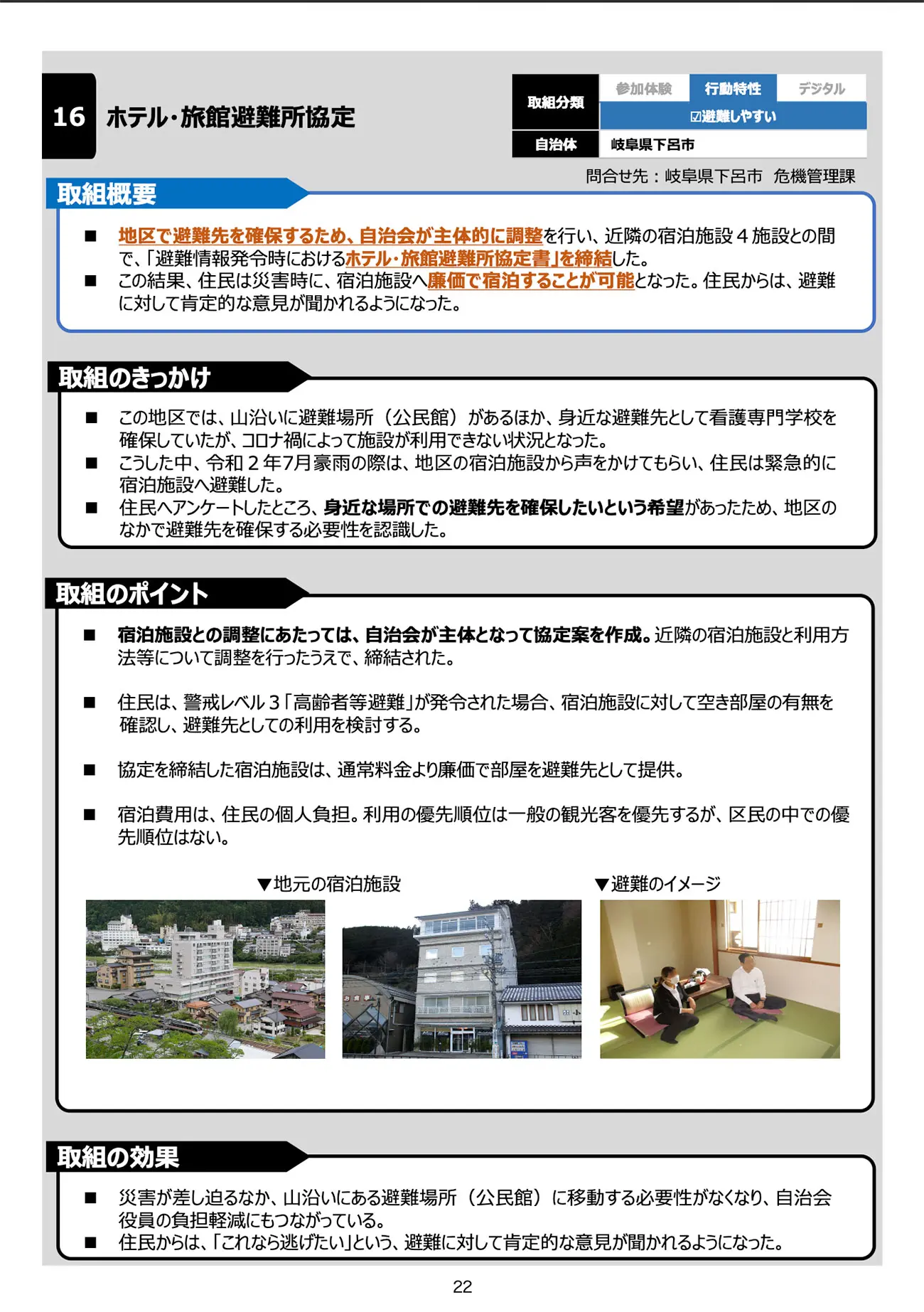
Some local governments have concluded agreements with lodging facilities to offer discounted accommodation fees to residents who evacuate in advance. In a case the author confirmed on-site, residents in Gero City, Gifu Prefecture can use vacant rooms at lodging facilities as evacuation destinations when Evacuation Warning Level 3 ("Evacuation of the Elderly and Others") is issued. The residents pay the accommodation costs themselves.
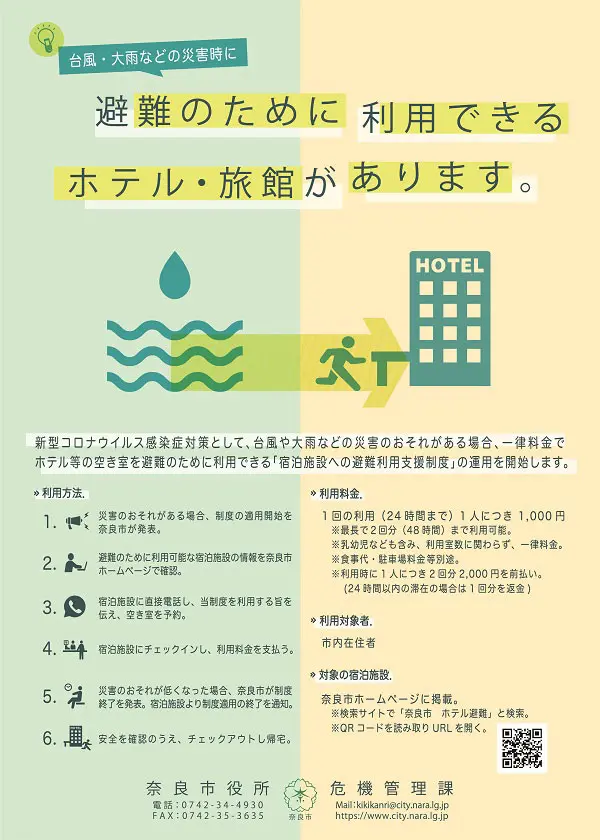
In addition, in Nara City, an evacuation support service allows residents living in the city who need to evacuate to a lodging facility to stay in guest rooms at hotels and inns within Nara City. Each resident pays 1,000 yen per use (within 24 hours), and Nara City pays 5,000 yen per person per use to the lodging facility as a commission.
This approach benefits both sides: residents gain peace of mind by evacuating to a lodging facility in advance, and the facility can offer rooms that would otherwise be cancellations to residents for a fee.
Even in areas without such agreements, evacuating to a lodging facility in advance when a disaster is expected has become common. Many businesses also arrange nearby accommodation for employees who would be unable to commute when public transportation is expected to be suspended due to a typhoon or similar event.
2. Emergency Evacuation When a Sudden Disaster Occurs
Emergency evacuation means moving to a safe place with the top priority of protecting one's life — for example, when an earthquake, fire, or terrorist attack occurs, or when a tsunami warning is issued. Whether to accept people who have evacuated in an emergency is left to the lodging operator's judgment. In practice, however, it would be difficult to refuse evacuees except when the safety of the facility cannot be confirmed. By deciding in advance "under what circumstances to accept emergency evacuees, and where within the facility to guide them," operators can respond promptly and without hesitation.
Once emergency evacuees have been accepted, they must be kept within the facility until the surrounding area is confirmed to be safe. While evacuees are staying in the facility, the operator provides food and drinking water to the extent possible and addresses evacuees' needs, such as keeping them warm and providing restroom access. Local residents who have evacuated to a lodging facility in an emergency should move to a designated evacuation shelter set up by the local government once they are able to travel.
There is no compensation for costs or payment of "accommodation fees" from the local government for accepting emergency evacuees. However, some municipalities subsidize the purchase of emergency food and supplies needed to accept evacuees for lodging facilities that have agreed in advance to accept emergency evacuees.
3. Temporary Stay for People Unable to Return Home
This refers to temporarily accepting the facility's own guests who can no longer travel or return home due to disaster-related transportation disruptions, as well as people stranded within the area who are unable to return home. It is the lodging operator's responsibility to let guests who cannot return home stay temporarily in the facility, but whether to accept other stranded people is left to the operator's judgment.
In tourist destinations that attract many visitors, public facilities alone have limited capacity to accept tourists who cannot return home. It is essential for lodging and tourism operators to cooperate in accepting these stranded people. When letting guests and others who cannot return home stay at a lodging facility, a question arises as to whether "accommodation fees" can be charged. If guests wish to "stay" or "extend their stay" in a guest room, accommodation fees can be charged according to the services that can be provided. On the other hand, if they stay temporarily in a lobby, banquet hall, or similar space, this cannot be regarded as providing accommodation services, so it would be difficult to collect accommodation fees under the accommodation terms and conditions. Based on this principle, considering how to handle fees in advance will help things go smoothly when the time comes.
4. Accommodation for Disaster Response Personnel
After a disaster occurs, demand from ordinary tourists drops to nearly zero. At the same time, disaster response personnel active in the affected area — including those in medical care, police, fire services, support staff dispatched by local governments, electric power and telecommunications companies, general contractors, and casualty insurance companies — gather in the affected area from across the country, causing accommodation demand to surge.
During the 2024 Noto Peninsula Earthquake, lodging facilities in Ishikawa Prefecture saw a wave of reservation cancellations. In the Noto region, which suffered heavy damage, almost all lodging facilities were affected, so accommodation could not be secured in Noto. As a result, many disaster response personnel stayed at hotels in Kanazawa City, and hotels there became fully booked. By actively accepting demand from disaster response personnel in place of the tourism demand that plummeted due to the disaster, lodging operators can achieve both regional contribution and revenue. It is advisable to coordinate with government authorities in advance and conclude an agreement on "accepting disaster response personnel for accommodation."
5. Welfare Evacuation Shelters
These are set up by municipalities as needed for people who have difficulty living in ordinary evacuation shelters. In addition to the elderly and people with disabilities, eligible individuals are defined as "pregnant and postpartum women, infants, people in poor health, and others who need some form of special consideration in shelter life because ordinary shelter life would be difficult for them; their family members may also be included." When public facilities designated as welfare evacuation shelters — such as elderly care facilities and nursery schools — are insufficient, lodging facilities may take on this role.
When a lodging facility is asked to cooperate in setting up a "welfare evacuation shelter," the local government makes an inquiry in advance. The facility can decide whether to accept based on its reservation status and room availability at that time. If acceptance is difficult, it is also possible to decline.
6. Secondary Evacuation Shelters
As evacuation life becomes prolonged, this refers to accepting evacuees who move from designated evacuation shelters to places with a better living environment — known as secondary evacuation. To help maintain evacuees' daily lives, government authorities decide to use hotels and inns as secondary evacuation shelters and ask lodging facilities to cooperate. As with cooperation in setting up welfare evacuation shelters, the lodging facility judges whether it can accept evacuees based on the situation at the time. A request from the government is strictly a request for cooperation, and if acceptance is difficult due to the facility's circumstances, it is possible to decline.
During the Noto Peninsula Earthquake, the evacuation shelters within the peninsula lacked capacity, and evacuation periods also grew long. As a result, "secondary evacuation" — moving evacuees to shelters using lodging facilities in other areas within and outside Ishikawa Prefecture — was carried out widely. A similar trend was seen during the Great East Japan Earthquake. The government is also actively promoting the use of shelters based on lodging facilities that accept disaster victims across regional boundaries. Lodging facilities are now expected to serve as vital infrastructure that supports communities during disasters.
7. Accommodation for Recovery and Reconstruction Workers
After a disaster, once recovery construction and reconstruction projects begin, accommodation demand increases, primarily from construction workers. These workers use lodging facilities as their place of daily life over a long period, from several weeks to several months. They do not need the lavish meals or attentive services offered to tourists, but facilities need to address needs specific to recovery and reconstruction workers, such as washing machines and drying areas for their dirty work clothes.
Management Decisions on Accepting Evacuees
At lodging facilities that accepted evacuees over the long term during disasters, the premises became a "place of daily life" — evacuees hung laundry and ate and drank in the rooms — and in some cases this left a lived-in feel or damage to the interior. As a result, problems such as a persistent household smell remained, and considerable cost and time were needed to repair the interior before resuming ordinary business. Some operators felt that, while they were able to contribute to society, they were forced to bear a heavy burden in terms of management. When deciding whether to accept evacuees over the long term, it is advisable to comprehensively weigh the risks and benefits from the following four perspectives.
1. Facility Safety (an Absolute Requirement)
The absolute requirement for deciding whether to accept evacuees is that the building remains safe even if aftershocks, landslides, or similar events occur. If there are safety concerns — such as cracks in the walls or the possibility that an adjacent steep slope may collapse — it is necessary to decide to decline.
2. Service Capacity
Check whether the facility can provide the minimum services required as an evacuation shelter or as lodging for recovery construction workers. Acceptance is difficult during power outages or water outages, and it is also necessary to judge whether staff can handle the response.
3. Impact on Resuming Ordinary Business (a Management Perspective)
When a facility accepts evacuees or construction workers, it becomes a "residence," and the impact on resuming ordinary business afterward is prolonged. For this reason, decisions should focus on the following points:
・Cleaning and repair costs: Whether the facility can accept the cost of cleaning and repairing the interior (wallpaper and so on) after evacuees or construction workers have lived there, as well as the risk that repairs may take several weeks.
・Difficulty in setting a period: Whether the facility can coordinate the acceptance period with the government and set a target date for resuming ordinary business.
・Risk of overlapping traffic flows: When accepting evacuees or construction workers while continuing ordinary business, whether the facility can account for the risk that overlapping traffic flows between ordinary guests and evacuees may lead to complaints from ordinary guests or damage to the facility's image.
4. Financial Benefits and Risks
After a disaster, when sales from ordinary guests drop sharply, how should the facility evaluate the usage fee of up to 10,000 yen per person per night (meals not included) provided under the Disaster Relief Act for accepting evacuees?
・Benefit: Securing a stable usage fee (for example, the equivalent of 40,000 yen in average daily rate (ADR) per room for a family of four) until ordinary tourist and business demand recovers is a major financial advantage.
・Comparison with risks: The balance between, on one hand, the opportunity loss from a delayed resumption of ordinary business and the repair costs after accepting evacuees, and on the other hand, the income from usage fees and the accommodation fees of construction workers.
Conclusion
As described above, during disasters, various needs to accept evacuees and to provide accommodation arise at each phase. There are no rules or obligations dictating how lodging operators must respond to these needs. How to respond — or whether to respond at all — is left to the business owners themselves as a management decision. What is clear is that responding to these needs requires making decisions in a short time amid the confusion of a disaster. To make sound decisions when the time comes — based not only on principles or emotional arguments but also on the balance between finances and the resumption of ordinary business — it is important to establish basic policies for disaster response in normal times, set them out clearly in a business continuity plan (BCP) or similar document, and share them within the organization. In an emergency, this allows operators to quickly decide and carry out concrete responses in line with those basic policies. Doing so should lead to enhancing the social value of lodging operators and to more reliable business continuity during disasters.
<Reference>
Revision of the "Operational Guidelines for the Disaster Relief Act"(P.59~P.60)
The rules for setting up and operating evacuation shelters using hotels, inns, and similar facilities are specified in detail in the Cabinet Office's "Operational Guidelines for the Disaster Relief Act." Last year, these guidelines were revised, clarifying that when evacuation life becomes prolonged or when designated evacuation shelters are insufficient, hotels, inns, and similar facilities can be used as evacuation shelters. The revision also made the service standards and costs for using hotels and inns as evacuation shelters clearer.
The principle of service provision is not to require everything normally offered as accommodation services, but to focus mainly on "providing a place" as an evacuation shelter. For this reason, the usage fee is, as a rule, set below the normal accommodation fee. It was raised from the pre-revision level of "7,000 yen including three meals" to a limit of up to 10,000 yen per person per night, tax included (meals not included). By responding to rising accommodation costs and easing the burden on those in the field, the revision has made it possible to accept evacuees more smoothly.
For accepting evacuees under the Disaster Relief Act, it was clearly stipulated that the level of service provided by lodging facilities is not equivalent to normal accommodation services, but should be "at a level appropriate for an evacuation shelter." This was established to ease the sense of unfairness between evacuees at designated evacuation shelters such as community centers and evacuees at shelters using lodging facilities, and also to reduce the burden on the facilities accepting evacuees.
As for meals, three meals a day are provided as a rule. However, when the facility's staff or equipment is insufficient and cooking on-site is difficult, meals may be provided from outside sources, such as boxed meals. Meals are to be kept within "a range that can reasonably be provided to everyone" by common social standards.
As for amenities and cleaning, only the minimum necessary for an evacuation shelter is sufficient. There is no need to provide all the usual guest amenities, such as offering a new toothbrush every day. As a rule, evacuees themselves handle simple cleaning of guest rooms and laying out their futons, and towel changes may be kept to a minimum. This significantly reduces the burden of cleaning and management. For bathing, offering the large communal bath during limited time slots is considered sufficient. In addition, accommodating pets is, as a rule, not required.
Through these provisions, it became clear that lodging facilities respond not at the level of normal "hospitality," but with the role of "providing a place for evacuation life," and their burden has been significantly reduced. With this greatly reduced burden, the environment has been prepared for lodging facilities to serve as a last resort, taking on part of regional disaster preparedness and shouldering disaster response.
著者