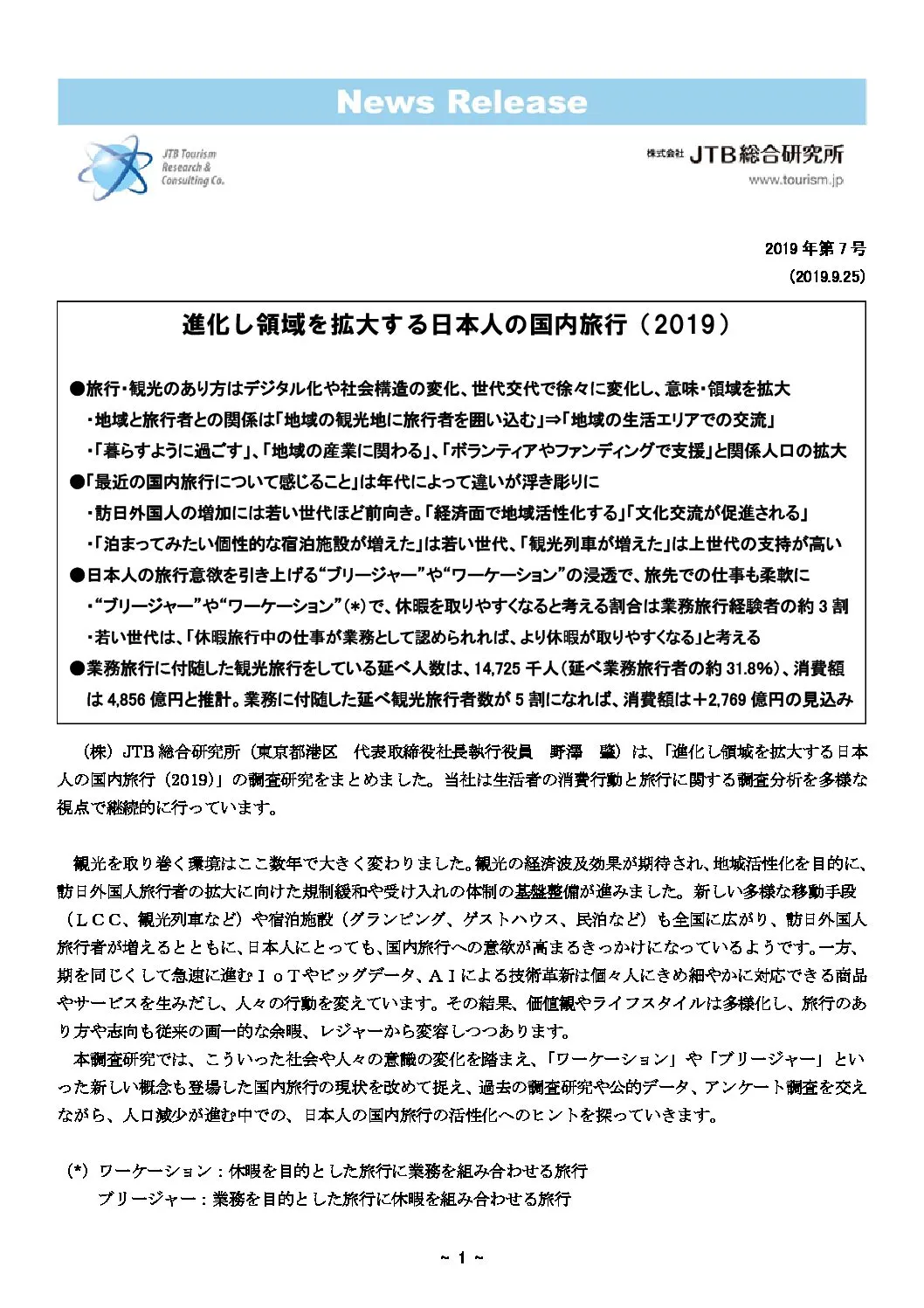
The Evolution and Expansion of Domestic Travel by Japanese People (2019)
The environment surrounding tourism has changed significantly in recent years. With expectations for the economic ripple effects of tourism and the goal of regional revitalization, efforts have progressed to deregulate and improve infrastructure to accommodate an increasing number of foreign visitors to Japan. New and diverse modes of transportation (such as low-cost carriers and sightseeing trains) and lodging options (such as glamping, guesthouses, and private lodging) have spread nationwide. As the number of foreign visitors to Japan increases, this appears to be sparking greater interest in domestic travel among Japanese people as well. At the same time, rapid technological innovations driven by IoT, big data, and AI are creating products and services capable of providing highly personalized experiences, thereby changing people’s behaviors. As a result, values and lifestyles have diversified, and attitudes toward travel are shifting away from the traditional, uniform models of leisure and recreation.
In this research study, taking these societal and attitudinal shifts into account, we re-examine the current state of domestic travel—which has seen the emergence of new concepts such as “workation” and “bleisure”—and, drawing on past research, public data, and survey results, explore ways to revitalize domestic travel among Japanese people amid a declining population.
(*) Workation: Travel that combines business with vacation purposes
Bleisure: Travel that combines vacation with business purposes
Key Findings
- The nature of travel and tourism is gradually changing due to digitalization, shifts in social structures, and generational change, expanding in both scope and significance.The relationship between local communities and travelers has shifted from "attracting travelers to local tourist destinations" to "interaction within local residential areas"
Expanding the "relationship population" through "living like a local," "getting involved in local industries," and "providing support through volunteering and crowdfunding" - "Perceptions of recent domestic travel" reveal differences by age groupYounger generations are more positive about the increase in foreign visitors to Japan. "It will revitalize local economies" and "It will promote cultural exchange"
Younger generations are more likely to agree that "there are more unique accommodations I’d like to stay at," while older generations are more likely to agree that "there are more sightseeing trains." - With the growing popularity of "bleisure" and "workation," which are boosting Japanese people's desire to travel, working while on vacation has become more flexible.About 30% of those with business travel experience believe that “bleisure” and “workation” (*) make it easier to take time off.
Younger generations believe that “if work done during a vacation is recognized as part of their job duties, it will be easier for them to take time off.” - The total number of tourists on sightseeing trips associated with business travel is estimated at 14.725 million (approximately 31.8% of all business travelers), with total spending estimated at 485.6 billion yen. If the number of sightseeing travelers associated with business travel were to reach 50%, total spending is projected to increase by 276.9 billion yen.
JTB Research Institute Co., Ltd. (Minato-ku, Tokyo; Hajime Nozawa, President and CEO) has compiled the findings of its research study titled “The Evolution and Expansion of Domestic Travel by Japanese Citizens (2019).” The company continuously conducts surveys and analyses of consumer behavior and travel from diverse perspectives.
The environment surrounding tourism has changed significantly in recent years. With expectations for the economic ripple effects of tourism and the goal of revitalizing regional economies, deregulation and infrastructure development aimed at increasing the number of foreign visitors to Japan have progressed. New and diverse modes of transportation (such as low-cost carriers and sightseeing trains) and lodging facilities (such as glamping, guesthouses, and private lodging) have spread nationwide. As the number of foreign visitors to Japan increases, this seems to be serving as a catalyst for Japanese people to become more enthusiastic about domestic travel. At the same time, rapid technological innovations driven by IoT, big data, and AI have given rise to products and services capable of providing highly personalized experiences, thereby changing people’s behaviors. As a result, values and lifestyles have diversified, and attitudes toward travel are shifting away from the conventional, uniform approach to leisure and recreation.
In this research study, taking into account these changes in society and public consciousness, we re-examine the current state of domestic travel—which has seen the emergence of new concepts such as “workation” and “bleisure”—and, drawing on past research, public data, and survey results, explore ways to revitalize domestic travel among Japanese people amid a declining population.
(*) Workation: Travel that combines business with vacation. Bleisure: Travel that combines vacation with business.