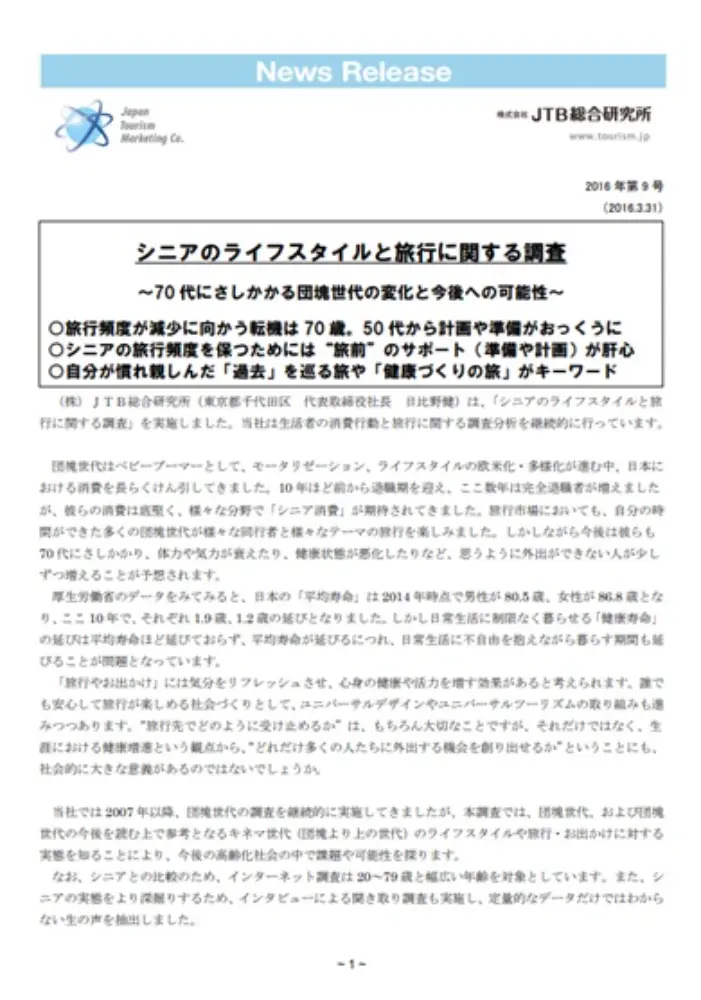
Survey on Senior Lifestyles and Travel: Changes Among the Baby Boomer Generation as They Enter Their 70s and Future Prospects
Key Findings
- The turning point when travel frequency begins to decline is age 70. Starting in their 50s, people start to find planning and preparation a chore.
- To help seniors maintain their travel frequency, support before the trip—such as preparation and planning—is essential.
- The keywords are "journeys through the past" and "health-focused journeys"
As the "baby boomers" generation, the post-war baby boomers have long driven consumption in Japan amid the spread of motorization and the Westernization and diversification of lifestyles. They began reaching retirement age about a decade ago, and while the number of fully retired individuals has increased in recent years, their spending remains robust, and "senior consumption" has been viewed as a promising sector across various fields.In the travel market as well, many members of the baby boomer generation, now with more free time, have enjoyed trips with various travel companions and on a variety of themes. However, as they approach their 70s, it is expected that the number of people who cannot travel as they wish—due to declining physical strength and energy, or deteriorating health—will gradually increase.
According to data from the Ministry of Health, Labour and Welfare, Japan’s “life expectancy” as of 2014 was 80.5 years for men and 86.8 years for women, representing increases of 1.9 years and 1.2 years, respectively, over the past decade.However, the increase in “healthy life expectancy”—the length of time one can live without restrictions in daily life—has not kept pace with the rise in average life expectancy. As average life expectancy increases, the period during which people must live with limitations in their daily lives is also lengthening, which has become a significant issue.
"Travel and outings" are believed to have the effect of refreshing one’s mood and enhancing physical and mental health and vitality. Initiatives in universal design and universal tourism are also progressing as part of efforts to create a society where anyone can enjoy travel with peace of mind.While “how people are received at their travel destinations” is certainly important, there is also significant social value in “how many opportunities we can create for people to go out,” from the perspective of promoting lifelong health.
Our company has been conducting ongoing surveys of the baby boomer generation since 2007. In this survey, we explore the challenges and possibilities within our aging society by examining the lifestyles and actual travel and outing habits of the baby boomer generation, as well as the “Kinema generation” (the generation older than the baby boomers), whose insights are valuable for understanding the future of the baby boomers.
To facilitate comparison with seniors, the online survey covered a wide age range from 20 to 79 years old. Additionally, to gain a deeper understanding of seniors’ actual circumstances, we conducted in-depth interviews to capture authentic voices that cannot be fully captured by quantitative data alone.