Turning Japan Heritage into a True Legacy: The True Value of Regions That Shines Precisely Because It Isn’t Categorized by Resources

In June 2020, a total of 21 new sites were designated as Japan Heritage sites, bringing the total number to 104. Five years ago, the Agency for Cultural Affairs launched the Japan Heritage initiative with the goal of reaching 100 sites as a milestone; therefore, the number of designations will not be increased further for the time being, and the initiative will move on to the next phase starting next year.
“From the preservation to the utilization of cultural properties.” It has only been in the last five or six years that cultural policy has begun to emphasize this theme. Indeed, this coincides with the start of the “Japan Heritage” designation program. Although the term “utilization of cultural properties” had been in use for some time, many traditional approaches to “utilization” positioned these properties primarily as museums or visitor facilities, placing greater emphasis on “making them accessible to the public and disseminating their value” rather than on economic benefits. In light of recent policies by the Agency for Cultural Affairs, it is clear that the focus has shifted from the conventional “display and public access” model to “utilization as a resource that generates economic value.”
・Market Positioning of Japan Heritage
Japan Heritage was established in 2015 with the aim of promoting tourism and related activities. It is a domestic framework within Japan, with evaluation criteria that differ significantly from those of “World Heritage.” Regions designated as Japan Heritage are eligible to utilize subsidies and other financial support for three years to strengthen their reception infrastructure and other measures. Consequently, they have promoted the development of tourism-focused facilities and the expansion of experiential content, and there are cases where tourist numbers have increased following Japan Heritage designation.
According to the “Survey on Awareness of Japan Heritage and Travel” conducted in 2018 by Futuradition WAO (a general incorporated association) which conducts research and manages Japan Heritage, less than 30% of respondents said they were “aware” of Japan Heritage, and only 12.6% reported having actually visited a designated site. It must be acknowledged that the brand value of “Japan Heritage” has not yet become widely recognized as a true “value.” On the other hand, over 80% of respondents expressed interest, indicating a position of “I’m not sure exactly what it is, but I’m somewhat interested.”
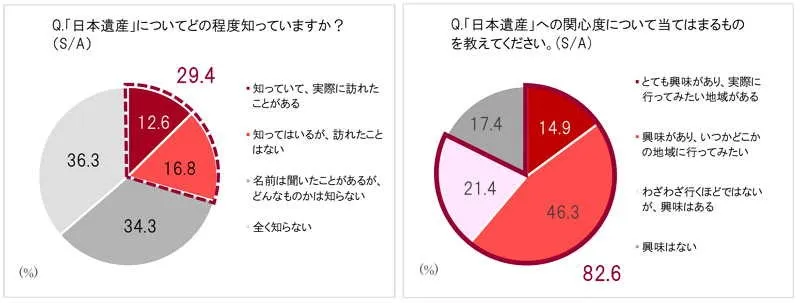
Regarding the perceived value of Japan Heritage, responses such as “It allows me to rediscover the beauty of Japan and my pride as a Japanese person” (41.6%) and “It strengthens my desire to cherish my local community and hometown” (30.4%) indicate that Japan Heritage has the potential to contribute not only to its value as a travel destination or attraction but also to the pride and identity formation of local residents.
・Challenges and Case Studies for Attracting Tourists
Progress on regional revitalization plans utilizing Japan Heritage sites is regularly evaluated by a follow-up committee composed of experts. As of March 2018, approximately 70% (39 out of 54) of the sites certified at that time were noted as having “some challenges in the progress of their initiatives.” Overall trends indicate that challenges are observed in areas such as “private-sector collaboration,” “shortage of personnel,” “information dissemination,” and “systems and mechanisms for sustaining initiatives.”
With all 104 sites now designated, the Japan Heritage sites certified in the first FY have reached the end of their planned implementation period, so it is expected that another comprehensive evaluation will be conducted in the near future. In fact, in October 2020, Minister of Education, Culture, Sports, Science and Technology Hagiuda explicitly stated, “For areas lacking attractive initiatives, we will consider replacements,” indicating that a strict evaluation will be conducted to determine whether the plans approved at the time of designation have been properly executed or have fallen by the wayside.
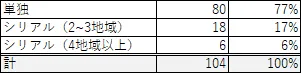
In reality, it must be acknowledged that there are significant disparities in the level of local enthusiasm regarding the use of Japan Heritage sites for tourism. Of the 104 Japan Heritage sites, serial-type sites (where the narrative spans multiple municipalities) account for 23%, or roughly one-quarter. However, in such cases, it is often difficult to coordinate differences in enthusiasm among multiple municipalities or allocate budgets proportionally, making it challenging to achieve swift and comprehensive development and promotion across the entire area.
Breakdown of Japan Heritage Locations
In regions lacking traditional famous tourist destinations, many are pinning their hopes for regional tourism promotion on Japan Heritage sites, and there are cases where they are actively advancing these initiatives in tangible ways. In Utsunomiya City, Tochigi Prefecture (designated in 2018), which boasts a heritage site featuring Oya Stone, a logo usable across various initiatives was created within FY 2018.Not only does the city hope to attract visitors to the “Oya Stone Museum”—the core attraction—but tours of active Oya Stone quarries have also begun. Additionally, several dining and leisure facilities have opened near the parking lot serving as a regional hub, as well as around the starting points for experiences such as tours of the underground lake. Furthermore, efforts are proceeding at a rapid pace to relocate the former public hall—a building constructed of Oya Stone—to this hub and utilize it as a landmark structure.


featuring an underground experience center, a café, and a coworking space
The “Kamenose-Tatsuta Old Road” in Misato Town, Nara Prefecture, and Kashiwara City, Osaka Prefecture—designated in 2020, the final year of the program—is a resource located in an area that, unlike Oya, has not traditionally promoted itself as a “tourist destination.” Consequently, development efforts are starting almost from scratch. By the end of FY 2023, we plan to establish a system capable of disseminating a certain level of information via our website, and we will proceed in stages to enhance the information available, develop facilities that help convey the site’s value on-site, and expand experiential content. Furthermore, to strongly integrate “Japan Heritage Tourism” with “Infrastructure Tourism,” we have established a close collaborative framework with the Yamato River Office. The Yamato River Office is responding to visitor needs by increasing the number of scheduled dates for its “Adult Field Trips,” a program it had been running even before the designation. Additionally, within the Meiji-era tunnel, the office is exploring the development of paid special content that goes beyond simple free facility tours.
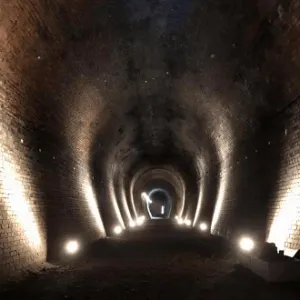
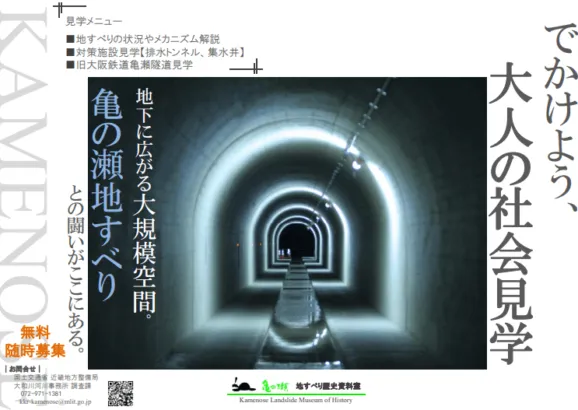
Although these two regions are completely different in terms of their types of tourist attractions, they share two common characteristics: internal cross-departmental coordination and clear division of responsibilities within the government office, as well as close collaboration with external organizations and companies to ensure a unified approach. Utsunomiya City has a cross-thematic department called the “Oya Promotion Office” dedicated to promoting the Oya area. Since this office is solely responsible for initiatives related to tourism, visitor attraction, infrastructure development, and commerce and industry, it is able to implement projects with a sense of urgency.
On the other hand, Misato Town and Kashiwara City operate as a “serial” partnership between two regions. While such arrangements typically require time for consensus-building and cost-sharing adjustments—often leading to delays—these municipalities maintain close coordination within their own administrations between departments responsible for cultural property preservation and commerce and industry. They also engage in meticulous coordination with river management offices and tourism-related facilities. Furthermore, to ensure consistent development and promotion across multiple initiatives, they have brought in external advisors to draft long-term plans for self-sufficiency. By effectively assigning roles to stakeholders both within and outside the region for plan implementation, they are striving to optimize operational and cost efficiency.
・How to Enjoy the “Eclectic Authenticity” Unique to Japan Heritage
A broad overview of Japan Heritage stories reveals that themes related to “Industry and Crafts,” “Food and Primary Industries,” “Indigenous Beliefs and Local Culture,” “Modern Heritage,” and “Roads and Trade” stand out. In particular, there are over 20 stories falling under “Industry and Crafts,” and just under 20 related to “Indigenous Beliefs and Local Culture. ”Japan Heritage differs fundamentally from the traditional approach to cultural property designation—which aims to preserve cultural assets—in that it constructs narratives by combining a region’s tangible and intangible cultural assets to convey their appeal. It can be said that the most significant characteristic of Japan Heritage is that the genre of the heritage is not fixed, unlike “Natural Monuments,” “Historic Sites,” or “Important Groups of Traditional Buildings.” This offers the major advantage of breaking away from the previous limitation of explaining regional resources solely by “genre. ”Furthermore, by incorporating undesignated cultural properties into the narrative, it is possible to shine a light on resources that have not previously been in the spotlight. It is a system that allows for a more accurate and engaging presentation of regional characteristics that could not be conveyed simply by listing designated cultural properties.
On the other hand, however, this complexity and richness of individuality also make it difficult for the market to grasp exactly “what Japan Heritage is. ”Compared to traditional cultural heritage, which was like a showcase displaying outstanding items by genre, a story that connects resources from various genres—including those not designated as cultural properties—is more like a festival space where floats, stages, and various food stalls line the grounds of temples and shrines to form a single world. For consumers accustomed to conventional cultural heritage tourism, this is unfamiliar, and they are not accustomed to intuitively recognizing its value.
To help people visualize this value as a concrete experiential value and understand the story as a cohesive worldview, the region’s “ability to curate materials” and “ability to stage” become extremely important in determining how to link this to the tourism experience. By appealing through storytelling, we can transcend the framework of “cultural property introduction”—which has often been limited to presenting isolated points of history, local products, geology, and ecosystems—and create new regional branding. This can serve as a valuable opportunity to refresh the region’s image and appeal, and as a catalyst for expanding the pool of potential visitors. We hope that those who visit will enjoy exploring the “chaotic reality” that hasn’t been neatly organized, through the lens of Japan Heritage. Within these seemingly complex stories, visitors will discover the living breath of local livelihoods and customs that connect to the present day, gaining a deeper understanding of the region that goes beyond mere historical tourism.
・To Utilize Japan Heritage in the Region
The ultimate goal of preserving and utilizing cultural properties through Japan Heritage is not simply to “attract visitors. ”The true goal is to create a virtuous cycle: tourism brings foreign currency to the region, increases related employment, raises awareness of the value of local resources, and leads to more people participating in conservation efforts and more fans from outside the region—thereby fostering a growing sentiment that “this must be preserved and passed on.” Through this process, a mechanism for “protecting precious local assets” becomes embedded in the local economy and begins to operate independently. Attracting tourists is merely a stepping stone toward that end.
Although the current framework of the project is structured to prioritize infrastructure development aimed at attracting tourists, the methods for achieving this ultimate goal are not limited to tourism. Personally, I hope that by fostering creators involved in the manufacturing industry, refining crafts and local products, and reinterpreting food culture in ways suited to modern life, we can align our heritage with contemporary lifestyles. This, in turn, will lead to the growth of new commercial ventures and the creation of new cultures.
I hope that the Japan Heritage designation will serve as a catalyst for new stories—ones that have not yet been “labeled”—to be naturally integrated into and woven into modern industry and the economy. Is this not the future that Japan Heritage should be aiming for?
著者