Japanese Yokai Go Global: The Value of Folklore as Seen in the Amabie Craze

"Amabie" (historical spelling: Amabie), a mythical creature said to ward off epidemics, is currently enjoying a quiet resurgence in popularity. On April 9, the Ministry of Health, Labour and Welfare posted an illustration of Amabie on its official Twitter account, using it as an awareness-raising image to help prevent the spread of the novel coronavirus. The two previous Amabie booms, during the Edo and Meiji periods, were typical “merchandise booms” that could occur in any era—where images were sold to address people’s fears of epidemics. However, this time, the situation seems different. The phenomenon is...
1. The Amabie Craze and the Origins of the “Amabie Challenge”
(1) Characteristics of the Amabie Boom
On February 27, 2020, inspired by the idea to “borrow the power of Amabie, said to ward off epidemics” and “draw Amabie illustrations together as a measure against the coronavirus,” a specialty shop selling yokai hanging scrolls posted an explanation and illustration of Amabie—a creature virtually unknown to the general public outside of yokai fans—on Twitter. Many Twitter users who agreed with this idea began creating various works—including illustrations, comics, videos, stuffed animals, and figurines—and posting photos of them one after another, using hashtags such as “Amabie Challenge” and “Amabie Festival.”
This movement spread across the seas, and by mid-March, international internet users began posting their own “Amabie creations” on Twitter and Instagram, accompanied by messages such as “Wish for the end of the epidemic” and “Wishing everyone safety.”
(2) Social Memory Through Amabie’s “Form”
Amabie (historical spelling: Amabie) is a half-human, half-fish yokai from Japanese folklore. It is said to have emerged from the sea in a radiant form and declared, “For the next six years starting from this year, there will be bountiful harvests across the land, but epidemics will also spread. Show the people a picture of me as soon as possible.”It is an extremely rare yokai (supernatural being) that appeared only once, in the third year of the Kōka era (1846) during the late Edo period, in Higo Province (present-day Kumamoto Prefecture). This story was featured in a kawaraban (woodblock-printed leaflet) with illustrations and spread as far as Edo. True to the prophecy, the instruction to “show people a picture of my likeness via the kawaraban” was carried out promptly.
While there is only one known example of documentation regarding Amabie, there are slightly more materials related to “Amabiko” (Tenhiko/Tenhiko), which is considered a similar type of yokai. They share common traits such as emerging from the sea, predicting bountiful harvests and epidemics, warding off disasters through paintings of their likeness, and standing upright on three or more legs.
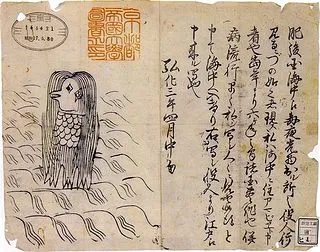
There have been two previous Amabie and Amabiko booms.
About 10 years after the first appearance, during the cholera (Kore-ra) epidemic of Ansei 5 (1858), a printed leaflet depicting a “three-legged monster resembling a monkey” (presumed to be Amabiko) was sold throughout the streets of Edo as a charm to ward off cholera.Furthermore, more than 20 years later, in Meiji 15 (1882), records show that “statues of three-legged monkeys” were sold as “charms to ward off cholera” at picture book shops (stores selling entertainment books and ukiyo-e) in Tokyo, suggesting that Amabie had become established as a social memory that was naturally recalled during epidemics.
However, from the mid-Meiji period, when newspapers became widely circulated, until 2020, Amabie was not sought after by society.In an era when social units were smaller than they are today, there were traditions and memories corresponding to the size of each community. Knowledge and memories were passed down through oral accounts and illustrations, becoming deeply ingrained in people as tangible social memories. I speculate that this was because the advent of “newspapers”—a mass medium brought about by modernization—expanded the scale of society. As homogenized information began to circulate independently of local communities, the need for individuals to preserve living “traditions” on their own diminished.
2. Information Dissemination Through the “Amabie Challenge”
(1) Awareness of Amabie
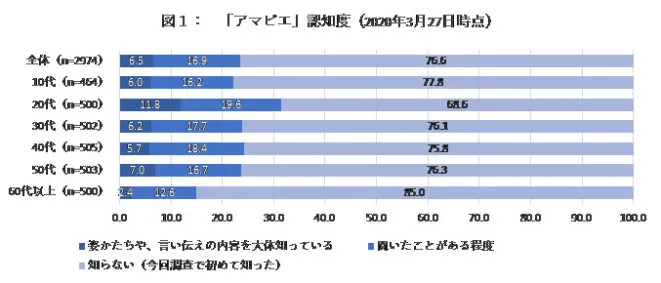
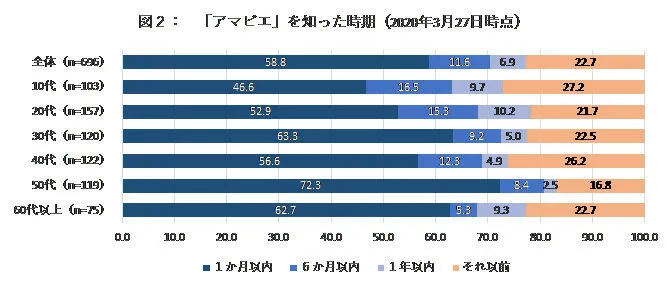
As mentioned earlier, Amabie has only a single historical record and is an extremely “rare” type of yokai or supernatural creature; consequently, its social recognition is extremely low.One month after the initial Twitter post that sparked this boom, only 6.5% of people said they “knew the details of the legend,” and the total percentage of those who had “heard of it” was 23.4% (Figure 1). Furthermore, nearly 60% of those who were aware of Amabie responded that they had “learned about it within the past month,” indicating that information originating from the “Amabie Challenge” on social media served as the catalyst (Figure 2).
(2) The Spread of Amabie-Related Information and Activities
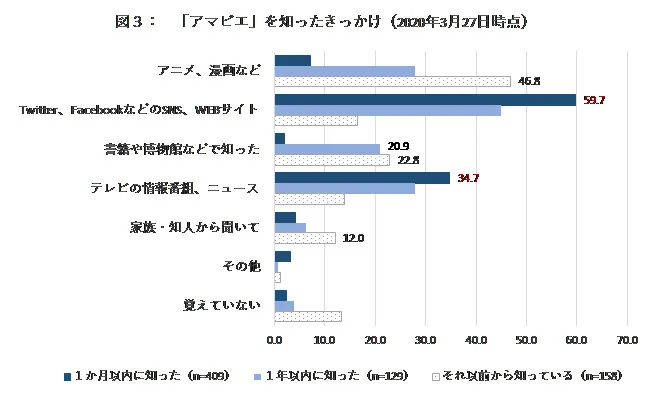
In recent years, it has become common practice for mass media outlets such as television and newspapers to utilize social media in search of “stories.”In this case as well, various media outlets focused on Amabie—which had been spread by individual social media users—and covered it as the latest news and trend. According to the survey, among those who “learned about Amabie within the past month,” approximately 60% became aware of it through “social media and websites,” while “TV information programs and news” followed closely at 34.7% (Figure 3).
Various businesses responded to this movement; Tower Records, for example, published Amabie works submitted by creators on its official web gallery. Subsequently, as various companies and individual creators successively developed a wide range of products—including T-shirts, accessories, and traditional Japanese sweets—the quiet trend that had originated among a segment of consumers active on social media spread rapidly throughout the general public.
3. The Emergence of a "Desire to Contribute" Amid Uncertainty
(1) Modern trends are driven by a desire to “contribute” rather than simply “benefit”
The Amabie and Amabiko booms during the Edo and Meiji periods arose as a response to the anxiety ordinary people felt about epidemics, with images of Amabiko being sold as “merchandise” based on folk traditions. Regardless of the factors involved, it was simply a “boom in products (necessary for that era)” that could have occurred in any era. In comparison, it is clear that the current “Amabie Challenge” presents a different picture.
Immediately after the 2011 Great East Japan Earthquake, consumer behavior characterized by “self-restraint” and “refraining from travel” was prominent.As consumers nationwide sympathized with and sent their thoughts to the disaster-stricken areas, consumption and recreational activities temporarily stagnated even in regions outside the affected zones. During the 2016 Kumamoto Earthquake, the sentiment of “Let’s buy to support the region” became widespread. Lines formed before opening hours atアンテナショップ (regional product shops) for disaster-stricken areas located in major metropolitan areas, and numerous “products with donations included” were released.
In the current global health crisis, there is no clear distinction between disaster-stricken areas and other regions. Furthermore, this unknown threat does not occur in a single instant but persists while the situation changes day by day. Consequently, this unstable state—where there is no clear solution—is likely to continue for a long time. I believe that within this social environment, a growing consumer consciousness—the feeling that “I am not an outsider” and “even when there is no clear solution, I want to contribute in some way”—led to the emergence of the Amabie Challenge.
(2) The Role of Social Media in an Unstable Social Climate
During a crisis, social media can sometimes be the source of misinformation and rumors. On the other hand, it can also serve as a platform for ordinary people without significant funds or influence to contribute to society.
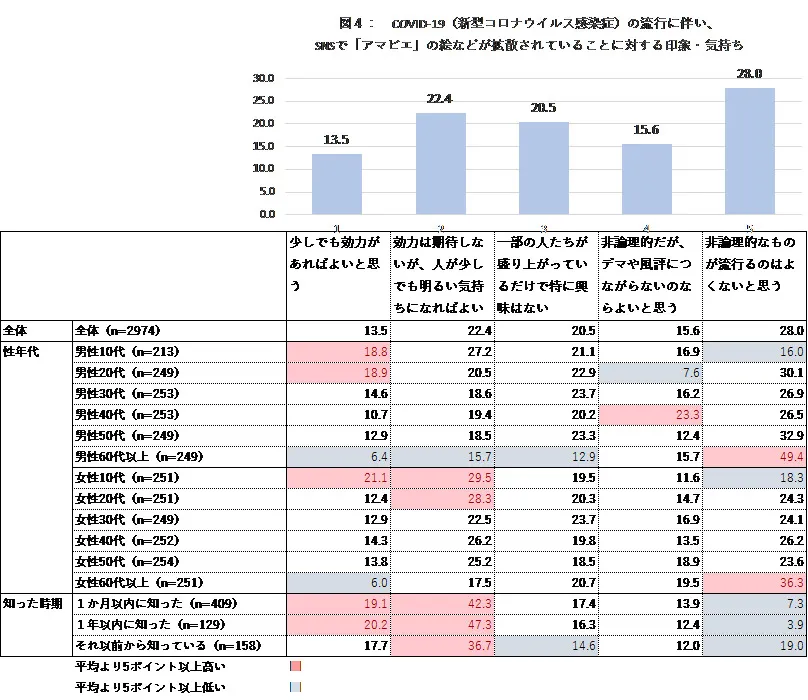
Regarding this movement, the proportion of people who view it favorably—saying, “I hope it has at least some effect” or “I don’t expect it to be effective, but I hope it makes people feel a little brighter”—is high among younger generations in their teens and twenties (Figure 4).It is interesting that young people, including Generation Z (born between 1996 and 2012)—who are said to be particularly receptive to “quality,” “individuality and diversity,” and “authenticity”—are finding value in and supporting this historical and indigenous folklore.
Because information on social media is disseminated verbatim via “retweets,” it is difficult for third parties to edit it. By strictly adhering to Amabie’s “physical characteristics rules” and “purpose of dissemination” when sharing content, the digital native generation ensured that the character’s appearance did not take on a life of its own, and that its raison d’être and purpose of dissemination were conveyed without distortion.While recognizing that the Amabie legend does not offer any practical benefits, it is no exaggeration to say that a generation that views locally rooted “legends” not as fantasy but as “some form of reality” has propelled this rare Japanese yokai (supernatural creature), previously known only to a core group of enthusiasts, into a global phenomenon.
4. “Folklore” is not merely “information” but possesses narrative quality
(1) The Value of “Folklore”
So, what exactly is “folklore,” and what is its value?Every corner of Japan is a treasure trove of local folklore, including history, myths, and yokai. Manga and anime featuring yokai regularly become bestsellers, and the “Great Yokai Exhibition” held at the Edo-Tokyo Museum in 2016 was a massive hit, attracting over 200,000 visitors in just 50 days. In Japan, regardless of whether people believe in their existence, yokai are widely recognized as commonplace and enjoy broad support across all demographics.
Yōkai and other supernatural phenomena do not exist merely to convey the message that “they were or are here”; rather, they make their presence felt when society needs them. Japanese and regional folklore, passed down orally rather than through commercial creations, gains greater credibility and breathes new life into the present day.
From 2004 to 2006, the Fire and Disaster Management Agency of the Ministry of Internal Affairs and Communications compiled disaster-related folklore preserved in various regions and published the information on its website.The information is posted with the aim of raising disaster prevention awareness among local residents by documenting the disaster-related folklore passed down in their communities. Since kappa are often associated with flooding, folklore about them is found nationwide; similarly, the belief that sounds from swollen rivers are “the voices of yokai” likely served the purpose of keeping people away from the river and monitoring its movements.In addition to traditions meant to protect the community, there are also many traditions designed to help individuals cope with personal crises. For example, the “Hidaru-gami” is considered a spirit that induces hunger in humans and is a type of “Yukoi-gami” or “gaki-tsuki” (a spirit that possesses one with hunger). If you encounter this spirit, your body suddenly becomes heavy and you are unable to walk.This is what is known as “hanger.” The tradition that states, “When crossing the mountains, one should carry rice balls in advance to offer to Hidaru-gami in case one encounters him,” can be seen as a concrete countermeasure against unexpected hunger-induced collapse. The fact that carrying extra rice balls can save one’s life makes “Hidaru-gami” a tangible presence and enhances the credibility of the legend.
(2) How Legends Are Passed Down in the Region
Many regions attempt to link yokai and folklore to tourism promotion. Notable examples include Kappa-buchi in Tono and the Zashiki-warashi of Iwate Prefecture, while Yamashiro Town in western Tokushima Prefecture boasts over 160 yokai-related legends, including the “Crying Grandfather.”In the United States, where historical resources are scarce, there is a concept of town revitalization called “cryptotourism” (sometimes translated as “monster tourism”), which uses UFOs, unidentified creatures (UMAs), and urban legends as motifs. Although this concept garnered some attention in Japan during the 2010s, it has not taken root.I believe a major factor is the significant difference in how “urban legends” in the U.S. and “folklore” in Japan are perceived by consumers—specifically, whether they are recognized as “real and intrinsically valuable”—which likely made it incompatible with American-style business practices.
It is certainly true that folklore and the yokai that appear in it possess a certain charm as characters—they are seen as “lovable” and “familiar.” However, this character appeal accounts for only half of the appeal of folklore and yokai.There are reasons why these folklore tales inevitably emerged from the social conditions, geographical environments, and local lifestyles of past eras; why they were visualized through a uniquely Japanese sensibility to take on the tangible form of “yōkai”; and why people genuinely sought them out. It is only when all these elements come together—as seen in the recent Amabie boom—that folklore truly demonstrates its “real value.”
Incidentally, an Amabie keychain I received from a friend has been hanging in my kitchen for over 10 years now.
While we rarely encounter yokai or supernatural phenomena, their existence undoubtedly enriches our society and daily lives just a little bit. I am delighted that the sensibility passed down by the Japanese people has crossed the seas and been understood by the world, and I hope this will serve as an opportunity to reevaluate the resource value of local folklore.
"Survey on Amabie" Overview
Survey Method: Online questionnaire Survey Participants: Men and women aged 15–79 residing in Japan (2,974 respondents total) Survey Period: March 26 (Thu) – 29 (Sun), 2020 *Survey Cooperation: Bulk Co., Ltd.
著者