The Role of Public Cultural Facilities in Bringing Together Local Residents’ Passion for Their “Favorite Things”
The region is home to public cultural facilities—such as cultural halls and art museums—that serve as hubs for cultural promotion. The way these facilities are operated has evolved alongside changes in the roles expected of them and their place within the community. This article examines the future of public cultural facilities in the post-COVID era.
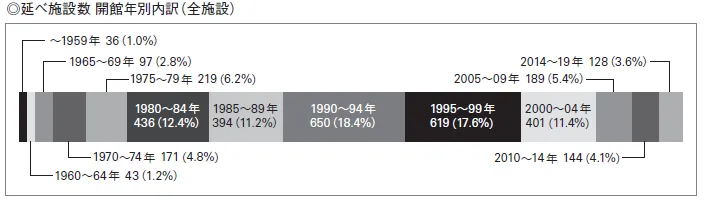
Many public cultural facilities in Japan were built in the 1980s and 1990s, and discussions are currently underway regarding their renovation or reconstruction due to aging infrastructure. In terms of management, a 2003 amendment to the law allowed private operators to manage these facilities in order to meet the diversifying needs of residents. Furthermore, in recent years, driven by expectations for the promotion of culture in local communities, these facilities are no longer expected to serve merely as standalone hubs for cultural promotion, but rather to engage in organic collaboration with related fields. With usage rates declining significantly due to the COVID-19 pandemic, what should the future of public cultural facilities look like?
1. The Environment Surrounding Public Cultural Facilities
(1) Facility Distribution and Progressing Deterioration
Public cultural facilities refer to “public facilities” as defined by the Local Autonomy Act, specifically “halls,” “art museums,” “rehearsal spaces and creative workshops,” and “multi-purpose complexes” that include these, where activities such as music, theater, and fine arts are conducted.
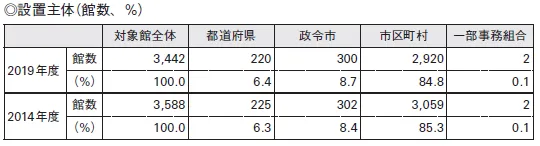
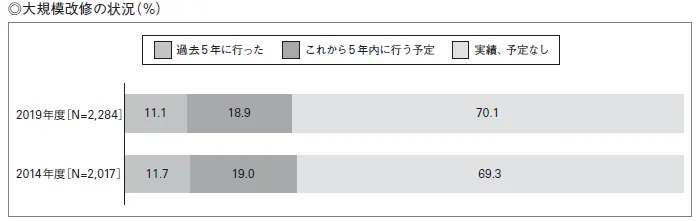
As of 2019, there were 3,442 public cultural facilities nationwide. Many of these were constructed between the 1980s and 1990s, and as they approach the end of their design life (47 years for steel-framed reinforced concrete structures), discussions are underway in various regions regarding large-scale renovations to extend their service life or complete rebuilding.
(2) Operational Status of Public Cultural Facilities and the Trend Toward Privatization
In 2003, the introduction of the Designated Manager System through a partial amendment to the Local Autonomy Act made it possible for private-sector operators to manage public facilities. The rationale behind the introduction of the Designated Manager System included the effectiveness of broadly utilizing the expertise of private-sector operators to efficiently address the diversifying needs of residents.
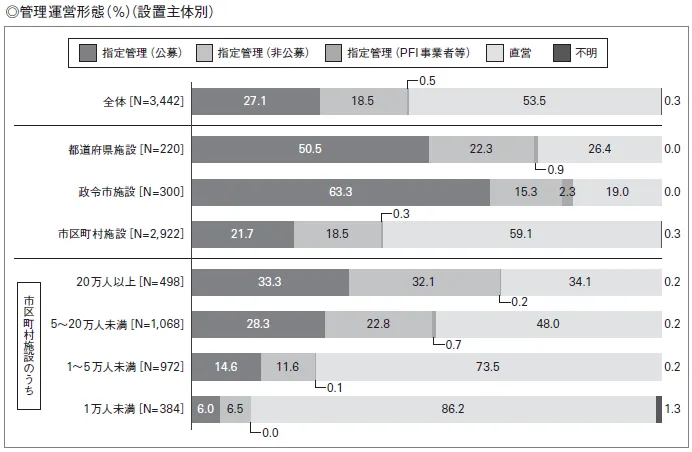
Since then, the proportion of facilities operated under this system has gradually increased. As of 2019, 1,589 facilities (46.2% of the total) were operated by designated managers, accounting for approximately half of the total, while 1,843 facilities (53.5%) were directly managed by local governments. In FY 2014, 1,526 facilities (42.5%) were operated by designated managers, while 2,035 (56.7%) were directly managed by local governments. Over the past five years, the number of facilities operated by designated managers increased by 63 (a 4.1% increase), while the number of directly managed facilities decreased by 192 (a 9.4% decrease).
Designated managers selected through open recruitment are typically private-sector entities, while those selected without open recruitment are often foundations funded by local governments. By local government level, 50.5% (111 facilities) of prefectural facilities and 63.3% (190 facilities) of government-designated city facilities are managed by designated managers selected through open recruitment, a higher proportion compared to the 21.7% (633 facilities) of municipal facilities. Among municipal facilities, the proportion of those managed by designated operators selected through open recruitment tends to be higher in larger municipalities: 33.3% (166 facilities) in municipalities with populations of 200,000 or more, 28.3% (302 facilities) in those with populations between 50,000 and 200,000, 14.6% (142 facilities) in those with populations between 10,000 and 50,000, and 6.0% (23 facilities) in those with populations under 10,000.This is thought to be because larger municipalities tend to have larger facilities, which increases operational flexibility and profitability, making it easier to realize the economic benefits of having private operators manage and operate them.
2. Challenges in Facility Management and Examples of Initiatives
(1) Local Residents’ Engagement with Public Cultural Facilities
Public cultural facilities are often used as venues for local “special occasions” such as cultural festivals and coming-of-age ceremonies, and it can be said that the majority of local residents have visited them at least once. However, few residents visit multiple times a month, and in most cases, these facilities are used only by a limited number of people.
To accurately grasp the actual usage of public cultural facilities by local residents, it is necessary to conduct a survey targeting the entire local population; however, it is rare for local governments to carry out such surveys. Therefore, the standard method for estimating the proportion of local residents using these facilities is to make projections based on the lists of registered user groups maintained by each facility. Estimates derived from this method show that the number of people listed in these user group registries accounts for approximately 5–10% of the total local population at many public cultural facilities. This represents a low proportion when considering that these facilities are intended to serve the entire local community.
To ensure the survival and self-sustaining operation of public cultural facilities, it is necessary to address the current situation where usage scenarios and users are limited. It is essential to consider expanding the range of uses and strengthening information dissemination so that public cultural facilities become more accessible to local residents.
(2) Growing Expectations for Cultural Promotion in the Region
As we transition to a global society and with population decline in rural areas anticipated, the preservation of national and regional cultures, as well as the industrial linkages and economic revitalization driven by culture, are being prioritized. Consequently, expectations for “cultural promotion” as a means to address regional and social challenges are rising.
In an era when there were few facilities available to provide cultural experiences to local residents, public cultural facilities played a primary role as venues for offering such opportunities as part of regional cultural promotion. Meanwhile, over the past 15 years, community-based and city-wide art festivals have flourished, and there has been an increase in initiatives that integrate “art” and “local traditional culture” into events.
The Basic Act on Culture and the Arts, enacted in 2017, explicitly states that in promoting policies related to culture and the arts, “care must be taken to ensure organic collaboration with related fields.” Specific fields cited include “tourism, urban development, international exchange, welfare, education, industry, and others.” As a result, the scope of cultural policy has expanded significantly, and the range of settings where culture connects with societal challenges is growing. Today, the hubs for cultural promotion are no longer limited to public cultural facilities as they once were, but have expanded to various spaces such as street corners, public squares, and vacant lots.
(3) Case Study: Collaboration between “Kisera Kawanishi Plaza” and “Kawanishi Otodomari”
As an example of a case responding to the trends and changes described above, we present the collaboration between "Kawashima Kiseru Plaza," a public cultural facility in Kawanishi City, Hyogo Prefecture, and "Kawashima Oto-Akari."
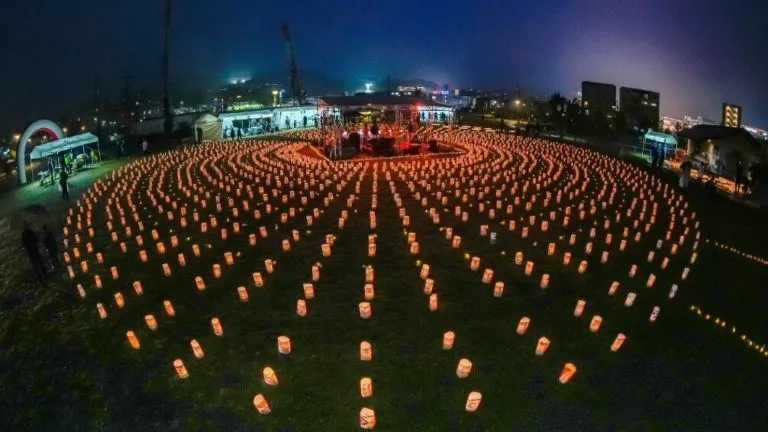
One method for implementing public works projects is the PFI (Private Finance Initiative), which utilizes private capital, management capabilities, and technical expertise (know-how) to comprehensively handle the design, construction, renovation, renewal, maintenance, and operation of public facilities. As part of Kawanishi City’s PFI projects, “Kisera Kawanishi Plaza” has been operated by JTB Communication Design Co., Ltd., a JTB Group company, for a 20-year term beginning in 2018.Since the facility began operations, it has collaborated with the organizers of “Kawanishi Otodari,” a music event held every November at the adjacent Kishera Kawanishi Seseragi Park.
"Kawanishi Otodomari" has been organized since 2011 primarily by the Kawanishi City citizens’ group "The Town is a Carnival!! Project" (commonly known as "Machipro"). Currently, it is a music event planned and operated by the "Kawanishi Otodomari Executive Committee," which was formed from this group. Activities are carried out using Kiseru Kawanishi Plaza as one of their bases, including pre-event publicity and planning meetings, even outside of the event day itself. By sharing time and creating a shared space together—involving organizers, staff, performers, vendors, and attendees alike—the event helps participants rediscover the city’s charm and deepens their affection and interest in it. Attendance grew from 1,500 people in FY 2011 to 8,000 in FY 2019, and “Kawanishi Otodomari” is now becoming the “face” of Kawanishi City.
In 2020, the event was held online with Kishera Kawanishi Seseragi Park as the main venue (photo by KOHEY)
3. The Role of Public Cultural Facilities in the Community During the With/After-Corona Era
(1) Changes in Their Role within the Community
As many public cultural facilities built in the 1980s and 1990s are nearing the end of their statutory useful lives, the impact of the COVID-19 pandemic has also extended to these facilities. When comparing the utilization rates of the 31 facilities managed and operated by JTB Communication Design as the designated manager between April–September 2019 (pre-pandemic) and the same period in 2020, there was a significant year-on-year decline of 27.5%. With the impact of the pandemic compounding changes in social structure, it can be said that the role of public cultural facilities in local communities requires major transformation, whether viewed from a short-term or long-term perspective.
With the introduction of the designated management system, managers are now required to balance cost reduction with the creation of social value—a responsibility that was already expected of them prior to the system’s implementation. However, cultural promotion initiatives often face challenges in demonstrating their value and effectiveness from a purely monetary perspective. In many cases, the selection and review of designated managers takes place every three to five years, but the reality is that pricing criteria (such as low-cost operations and the generation of efficient operating revenue) account for a large proportion of the scoring. For local governments, as the fiscal burden of an aging society with a declining birthrate increases year by year, we can glimpse the difficult reality that they are forced to prioritize cost reduction over creating social value through cultural promotion.
(2) A venue for activities that bring together local residents’ passion for “what they love”
Until a few years ago, I myself was involved in project development and operational management for designated management projects of public cultural facilities, including PFI (Private Finance Initiative) projects that integrate construction and operation, such as the aforementioned Kishira Kawanishi Plaza. Through my experience in various settings, I have come to realize the power of the “chain of proactive activities” among local residents engaged in cultural promotion.
There are many local residents in the community who are engaged in “passions”—activities that go beyond mere hobbies cultivated over many years. Those involved in facility management can convey the activities and intentions of such residents to other residents, or provide opportunities for non-participants to mingle with them, fostering empathy and shared understanding. When public cultural facilities serve as hubs where residents who are not active participants can understand, empathize with, and support those who are, cultural activities are born within the facilities, disseminated outward, and ultimately drive the entire community forward. In this process, as public cultural facilities become places that bring together residents’ passion for the “things they love,” people will come to use the facilities with a sense of attachment, thereby deepening their own affection for their local community.
4. For Cultural Promotion and the Community in the Future
Given the unresolved financial difficulties faced by local governments due to population decline, it is anticipated that there will be an increase in cases where private operators manage and operate public cultural facilities. Additionally, for relatively small-scale facilities, it is expected that local residents—who were once merely users—will increasingly take the lead in their operation. The closure or consolidation of facilities themselves (such as joint establishment with neighboring municipalities or integration with other functions like education and welfare) will likely become commonplace. It is also possible that facilities established by private operators who have relocated to rural areas during the “with/after-COVID” era, or by local residents themselves, may be granted new functions as public cultural facilities. Initiatives for cultural promotion that take the “entire town” as their base—actively utilizing various local spaces such as street corners, squares, and vacant lots rather than managing specific facilities—will likely attract even more attention than before.
Given that the trend toward cost reduction in local governments and the push to promote private-sector involvement are expected to continue, methods for securing operating funds are also likely to change. We will likely see increased adoption of the concession model, where the operator sets facility usage fees, as well as crowdfunding, where funds are raised directly from beneficiaries on a project-by-project basis.
Simply serving as an “event venue” or “cultural classroom” is not enough to make a facility a place that brings people together. Public cultural facilities are places where every individual community member can express their “passions,” share them with others, and find a sense of connection. Even in the “with/after-COVID” era, when significant changes are anticipated in management and operations as well as in the facilities themselves, these spaces are expected to function as places where the passions of local residents are brought together and where activities that deepen their attachment to their own town take place.