Survey on Changes in Daily Life and Mental Well-being, and Attitudes Toward Travel, Amid the Spread of COVID-19 (August 2021)
More than a year and a half has passed since the novel coronavirus disease (COVID-19; hereinafter “COVID-19”) became a global pandemic. Since February 2020, when the spread of the infection began, our company has conducted regular surveys to track people’s psychology and behavior—which have fluctuated in response to infection rates and the issuance of states of emergency—as well as travel spending.This report marks the ninth in the series and the first in four months since the previous (unpublished) survey. During this period, a third state of emergency was declared for four prefectures at the end of April, and vaccination began for the elderly.At the time of the survey in late July, a state of emergency was in effect in Tokyo and Okinawa Prefecture, while “Priority Measures to Prevent the Spread of Infection” were in place in Osaka, Kanagawa, Chiba, and Saitama Prefectures.
We continue to conduct research on consumers’ values, behaviors, and travel habits in today’s rapidly changing society from a variety of perspectives.
Key Findings
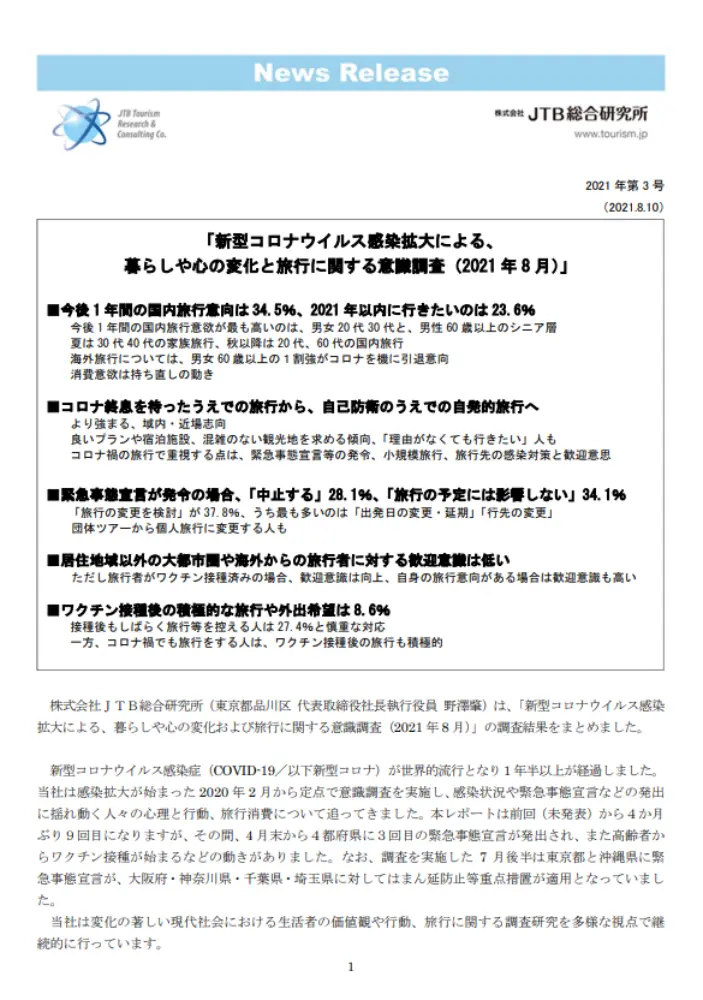
- 34.5% of respondents plan to travel domestically in the next year, and 23.6% want to do so by the end of 2021The groups most eager to travel domestically over the next year are men and women in their 20s and 30s, as well as men aged 60 and older
Family travel by those in their 30s and 40s is expected in the summer, while domestic travel by those in their 20s and 60s is expected from autumn onward.
Regarding overseas travel, slightly more than 10% of men and women aged 60 and older intend to stop traveling due to the pandemic.
Consumer sentiment is showing signs of recovery. - From waiting for the pandemic to end before traveling to traveling voluntarily while taking precautionsGrowing Preference for Local and Nearby Destinations
A trend toward seeking attractive itineraries, accommodations, and less crowded tourist spots, as well as people who “just want to go, even without a specific reason”
Key considerations for travel during the COVID-19 pandemic include the issuance of state of emergency declarations, small-scale trips, and the destination’s infection control measures and willingness to welcome visitors - If a state of emergency is declared, 28.1% would "cancel their plans," while 34.1% said it "would not affect their travel plans."37.8% are "considering changing their travel plans," with the most common changes being "changing or postponing the departure date" and "changing the destination"
Some people are also switching from group tours to independent travel - There is little enthusiasm for welcoming travelers from other metropolitan areas or from overseasHowever, if travelers are vaccinated, the level of welcome increases; if they have plans to travel, the level of welcome is also high.
- 8.6% of people expressed a desire to travel or go out actively after receiving the vaccine27.4% of people are taking a cautious approach, refraining from travel and other activities for a while after vaccination.
On the other hand, those who travel even during the pandemic are also eager to travel after vaccination.
JTB Research Institute Co., Ltd. (Shinagawa-ku, Tokyo; President and CEO Hajime Nozawa) has compiled the results of its “Survey on Changes in Daily Life and Mental Well-being, and Attitudes Toward Travel Due to the Spread of COVID-19 (August 2021).”
More than a year and a half has passed since the novel coronavirus disease (COVID-19; hereinafter “COVID-19”) became a global pandemic. Since February 2020, when the spread of the infection began, our company has conducted regular surveys to track people’s psychology, behavior, and travel spending as they fluctuated in response to infection trends and the issuance of states of emergency. This report marks the ninth in the series, coming four months after the previous (unpublished) edition. During this period, a third state of emergency was declared for four prefectures starting in late April, and vaccination began for the elderly. At the time of the survey in late July, a state of emergency was in effect for Tokyo and Okinawa Prefecture, while "Priority Measures to Prevent the Spread of Infection" were in place for Osaka, Kanagawa, Chiba, and Saitama Prefectures.
We continue to conduct research on consumers’ values, behaviors, and travel habits in today’s rapidly changing society from a variety of perspectives.