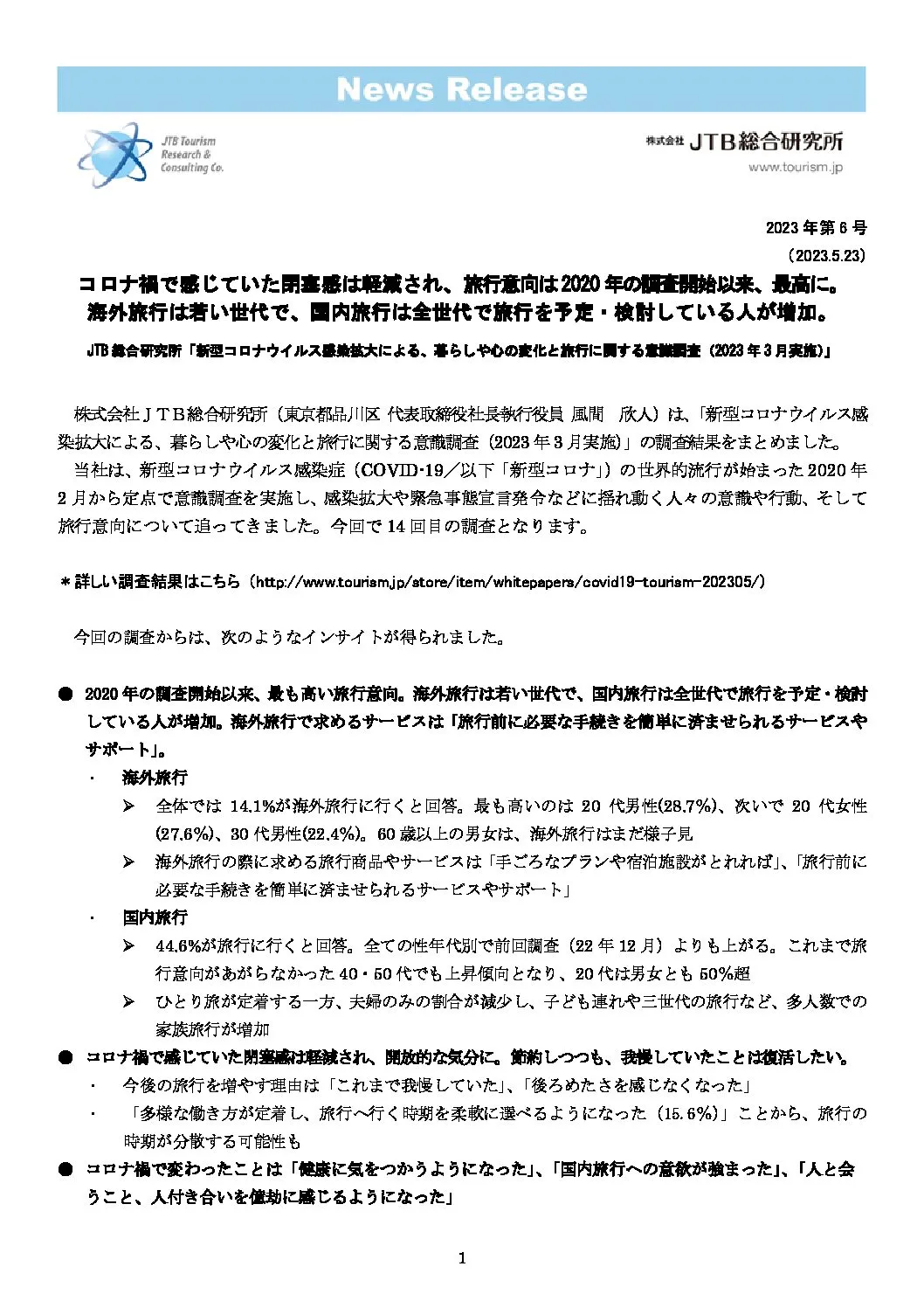
"Survey on Changes in Daily Life and Mental Well-being, and Attitudes Toward Travel Amid the Spread of COVID-19 (Conducted in March 2023)" The sense of stagnation felt during the COVID-19 pandemic has eased, and the intention to travel has reached its highest level since the survey began in 2020. The number of people planning or considering travel is increasing among younger generations for overseas travel and across all age groups for domestic travel.
PDFダウンロード
公開日
JTB Tourism Research & Consulting Co., Ltd. (Shinagawa-ku, Tokyo; President and CEO: Yoshito Kazama) has compiled the results of its “Survey on Changes in Daily Life and Mental Well-being, and Attitudes Toward Travel Amid the Spread of COVID-19 (May 2023).”
Since February 2020, when the global pandemic of COVID-19 began, the company has conducted regular surveys to track shifts in public sentiment and behavior—including travel intentions—amidst the fluctuating situation caused by the spread of the virus and the issuance of states of emergency. This marks the 14th such survey.
Key Findings
- Travel intentions are at their highest level since the survey began in 2020. The number of people planning or considering overseas travel is increasing among younger generations, while the number planning or considering domestic travel is rising across all age groups. When it comes to overseas travel, the services people are seeking are “services and support that make it easy to complete necessary procedures before departure.”Overseas Travel
・Overall, 14.1% of respondents said they would travel overseas. The highest percentage was among men in their 20s (28.7%), followed by women in their 20s (27.6%) and men in their 30s (22.4%). Men and women aged 60 and older are still taking a wait-and-see approach to overseas travel
・When traveling abroad, respondents seek “affordable plans and accommodations” and “services and support that simplify necessary pre-trip procedures.”
Domestic Travel
・44.6% said they would travel domestically. This figure is higher than in the previous survey (December 2022) across all gender and age groups. Intentions to travel are also on the rise among those in their 40s and 50s, a group where travel intentions had previously not increased, while over 50% of both men and women in their 20s plan to travel.
・While solo travel has become established, the proportion of couples traveling alone has decreased, and family trips involving multiple people—such as those with children or three-generation trips—have increased. - The sense of stagnation I felt during the pandemic has eased, and I now feel more open and free. While I still want to be frugal, I’m eager to resume the activities I’ve been putting off.The reasons for traveling more in the future include "having held back until now" and "no longer feeling guilty."
Given that "diverse work styles have become established, allowing people to choose when to travel more flexibly (15.6%)," it is also possible that travel will be spread out over a wider period. - Changes brought about by the COVID-19 pandemic include "paying more attention to health," "a stronger desire to travel domestically," and "feeling reluctant to meet people or socialize."
JTB Research Institute Co., Ltd. (Shinagawa-ku, Tokyo; President and CEO: Yoshito Kazama) has compiled the results of its “Survey on Changes in Daily Life and Mental Well-being, and Attitudes Toward Travel Due to the Spread of COVID-19 (May 2023).”
Since February 2020, when the global pandemic of COVID-19 began, the company has conducted regular surveys to track shifts in public sentiment, behavior, and travel intentions amid fluctuations caused by events such as the declaration of states of emergency due to the spread of the virus. This marks the 14th such survey.
For more detailed survey results, please download the full report here.