Survey on Travel Trends Among Chinese Tourists by Region (Coastal vs. Inland)
What Is Japan’s True Appeal After the ‘Spending Spree’?
PDFダウンロード
公開日
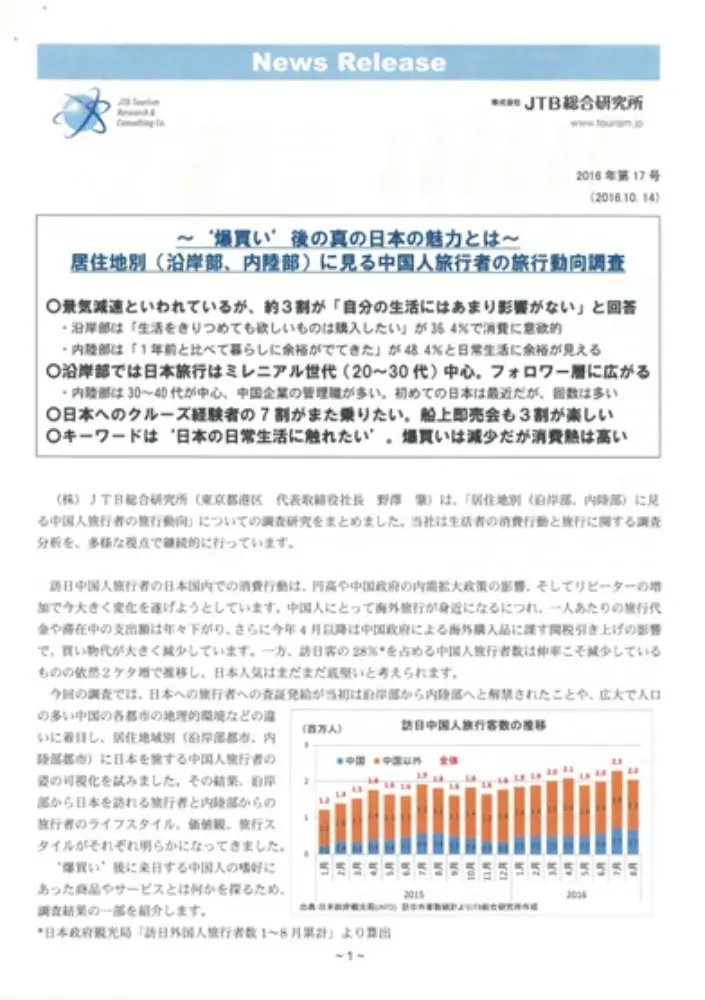
JTB Tourism Research & Consulting Co., Ltd. (Minato-ku, Tokyo; President and CEO: Hajime Nozawa) has compiled a research study titled “Travel Trends of Chinese Tourists by Region (Coastal vs. Inland).” The company continuously conducts surveys and analyses of consumer behavior and travel from diverse perspectives.
The consumption behavior of Chinese tourists visiting Japan is currently undergoing significant changes due to the strong yen, the Chinese government’s policies to expand domestic demand, and the increase in repeat visitors. As overseas travel becomes more accessible to Chinese citizens, per-person travel costs and spending during stays have been decreasing year by year. Furthermore, since April of this year, spending on shopping has declined significantly due to the Chinese government’s increase in tariffs on goods purchased abroad. On the other hand, although the growth rate of Chinese tourists—who account for 28% (*) of all visitors to Japan—has slowed, the number continues to grow at a double-digit rate, suggesting that Japan’s popularity remains solid.
In this survey, we focused on the fact that visa issuance for travelers to Japan was initially expanded from coastal to inland regions, as well as the differences in the geographical environments of China’s vast and densely populated cities. We attempted to visualize the profiles of Chinese travelers visiting Japan by region of residence (coastal cities and inland cities).As a result, the distinct lifestyles, values, and travel styles of travelers visiting Japan from coastal regions and those from inland regions have become apparent.
To explore the types of products and services that align with the preferences of Chinese visitors coming to Japan after the "spending spree" phase, we present a portion of the survey results below.
*Calculated based on the Japan National Tourism Organization’s “Cumulative Number of Inbound Foreign Visitors, January–August”
Key Findings
- Although there is talk of an economic slowdown, about 30% of respondents said it “hasn’t really affected their lives.”
- In coastal areas, travel within Japan is primarily driven by millennials (those in their 20s and 30s). This trend is spreading among social media followers.
- Seventy percent of people who have taken a cruise to Japan would like to go again. Thirty percent also found the onboard sales events enjoyable.
- The key phrase is “I want to experience everyday life in Japan.” While “spending sprees” have declined, consumer enthusiasm remains high.