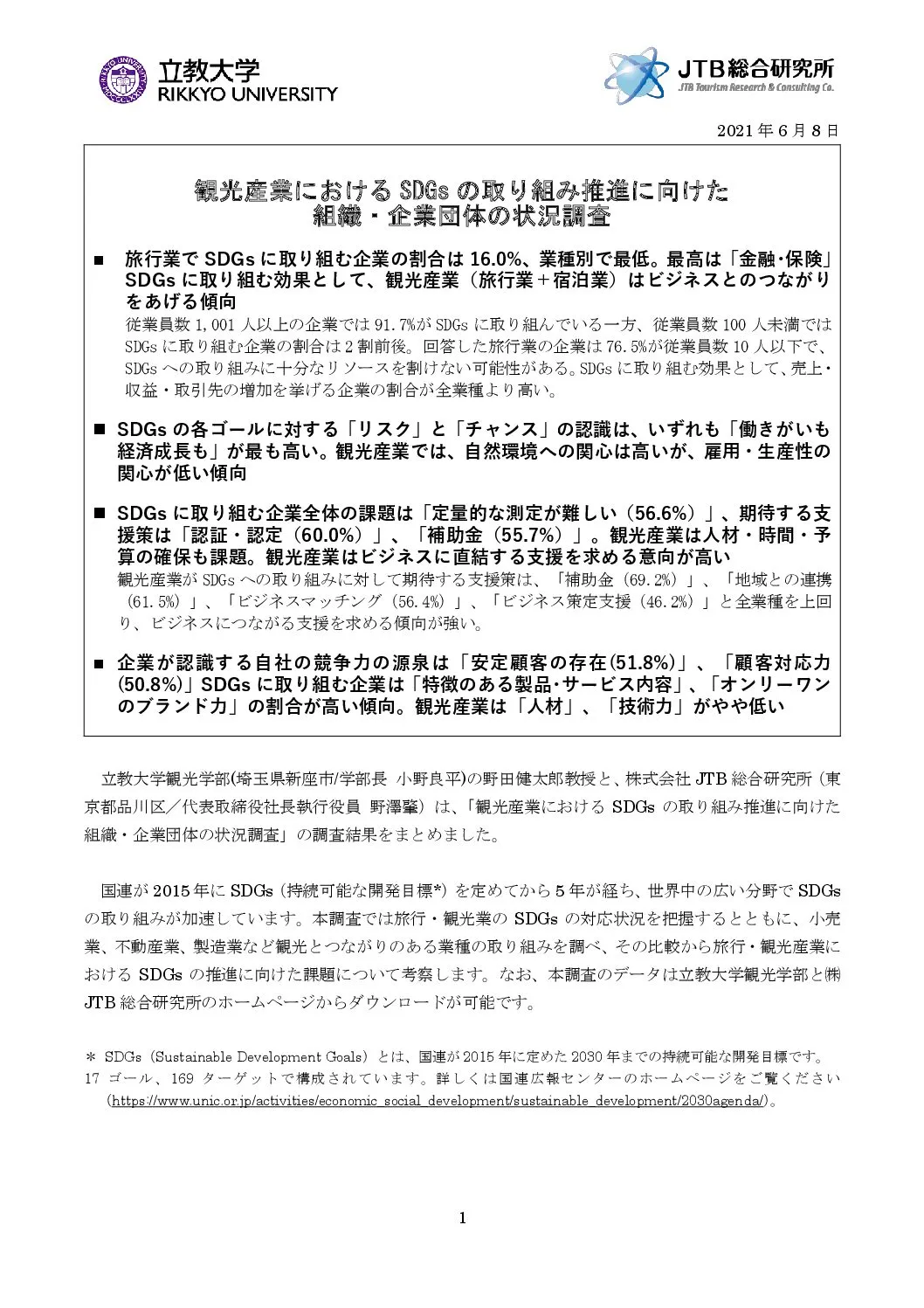
Survey on the Status of Organizations and Business Groups Promoting SDG Initiatives in the Tourism Industry
Key Findings
- The percentage of companies in the travel industry addressing the SDGs is 16.0%, the lowest among all sectors. The highest percentage is in the "Finance and Insurance" sector. Regarding the benefits of addressing the SDGs, the tourism industry (travel and accommodation sectors) tends to cite strengthened business connections.While 91.7% of companies with 1,001 or more employees are engaged in SDG initiatives, the proportion of companies with fewer than 100 employees doing so is around 20%. Among the travel industry companies that responded, 76.5% have 10 or fewer employees, suggesting they may not be able to allocate sufficient resources to SDG initiatives.The percentage of companies citing increased sales, profits, and business partners as benefits of SDG initiatives is higher than the average across all industries.
- When it comes to perceptions of "risks" and "opportunities" related to each SDG, "Decent Work and Economic Growth" ranks highest in both categories. In the tourism industry, while there is a high level of concern for the natural environment, there tends to be less concern for employment and productivity.The support measures the tourism industry expects regarding SDG initiatives are “grants (69.2%),” “collaboration with local communities (61.5%),” “business matching (56.4%),”and "business planning support (46.2%)"—all of which exceed the rates for all other industries, indicating a strong preference for support that leads to business opportunities.
- The primary challenge faced by companies working toward the SDGs is that “quantitative measurement is difficult” (56.6%), while the support measures they most desire are “certification and accreditation” (60.0%) and “grants” (55.7%). In the tourism industry, securing human resources, time, and budget also poses challenges. Companies in the tourism industry have a strong preference for support measures that directly benefit their business operations.
- Companies identify "a stable customer base (51.8%)" and "customer service capabilities (50.8%)" as the primary sources of their competitive strength. Companies engaged in SDG initiatives tend to place a higher emphasis on "distinctive products and services" and "unique brand strength." In the tourism industry, the percentages for "human resources" and "technical capabilities" are slightly lower.
Five years have passed since the United Nations established the SDGs (Sustainable Development Goals*) in 2015, and efforts to address the SDGs are gaining momentum across a wide range of sectors worldwide.This survey aims to assess the status of SDG implementation in the travel and tourism industry, while also examining initiatives in sectors related to tourism—such as retail, real estate, and manufacturing—and, through comparison, to explore challenges in promoting the SDGs within the travel and tourism industry.The data from this survey can be downloaded from the websites of the Faculty of Tourism Studies at Rikkyo University and JTB Tourism Research & Consulting Co., Ltd.
* The SDGs (Sustainable Development Goals) are a set of goals for sustainable development established by the United Nations in 2015 to be achieved by 2030.
They consist of 17 goals and 169 targets. For more details, please visit the United Nations Information Centre website.