Survey on Consumers’ Awareness of the SDGs and Travel (December 2022) — A Comparison of Germany, Australia, Thailand, and Japan
The SDGs (Sustainable Development Goals) are international goals aimed at creating a sustainable and better world by 2030. Consisting of 17 goals and 169 targets, they pledge to “leave no one behind” on Earth. To explore how travelers and local communities should build relationships regarding the sustainability of tourism, we conducted a survey in 2021 on awareness and behavior related to the SDGs in both daily life and while traveling. This is our second survey, and in November 2022, we released the “Domestic Edition” covering the general Japanese public and travelers. This article summarizes a comparison between Japanese travelers and travelers from Germany, Thailand, and Australia.
Key Findings
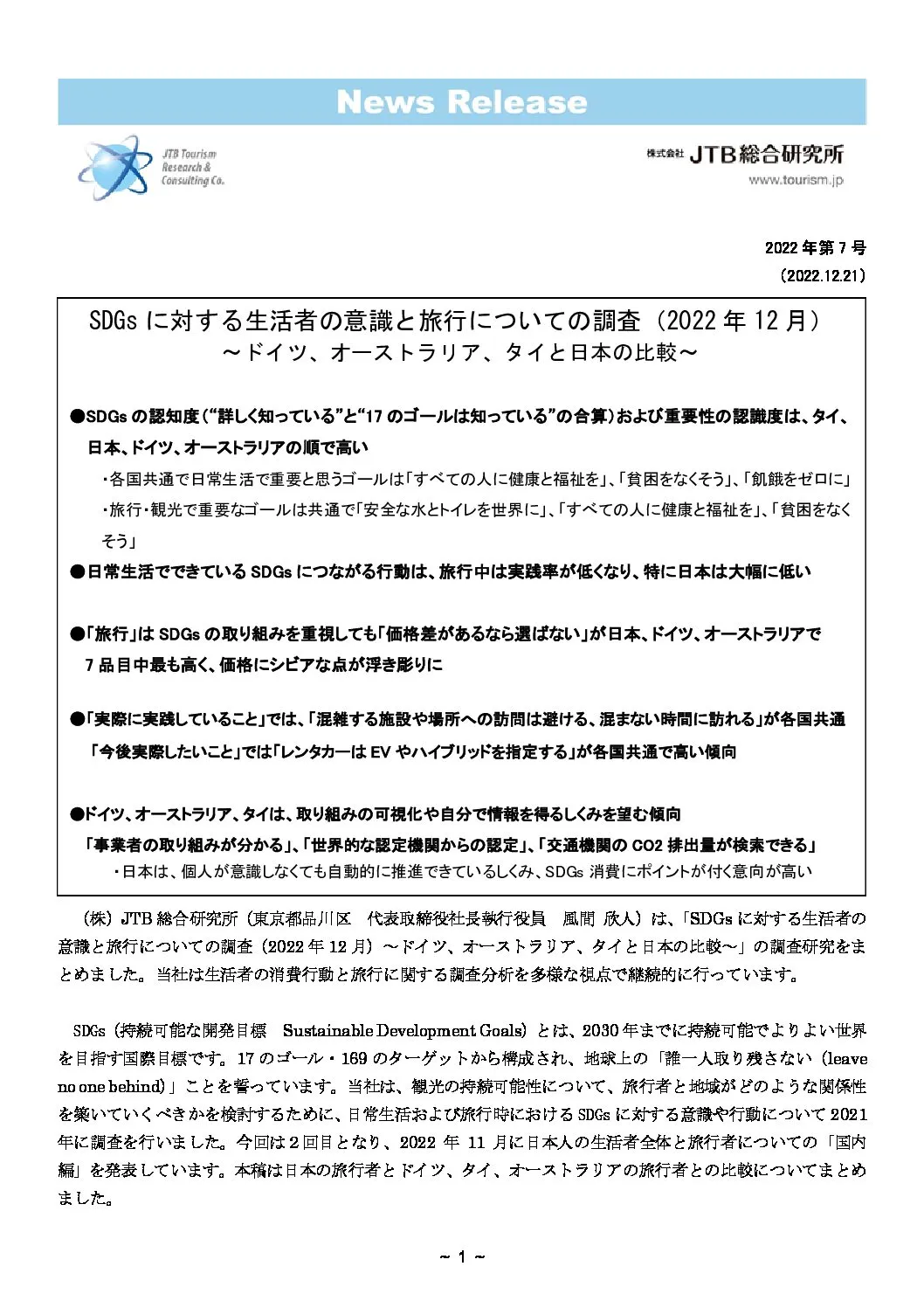
- Awareness of the SDGs (combining those who “know the details” and those who “are familiar with the 17 goals”) and recognition of their importance are highest in Thailand, followed by Japan, Germany, and AustraliaGoals that all countries consider important for daily life include “Good Health and Well-being,” “No Poverty,” and “Zero Hunger.”
Goals that all countries consider important for travel and tourism include “Clean Water and Sanitation,” “Good Health and Well-being,” and “No Poverty.” - While people are able to take actions related to the SDGs in their daily lives, the rate at which they do so drops when traveling, and is particularly low in JapanJapan has a system that automatically promotes sustainable consumption without individuals having to be conscious of it, and there is strong support for a program that awards points for SDG-aligned purchases.
- Even when prioritizing SDG initiatives, the response “I wouldn’t choose it if there’s a price difference” was the highest among the seven categories in Japan, Germany, and Australia, highlighting their sensitivity to price.
- In the "Current Practices" section, "Avoiding visits to crowded facilities and locations, and visiting during off-peak hours" was a common response across
all countries. In the "Future Plans" section, "Specifying electric or hybrid vehicles when renting a car" was a common response with a high percentage across all countries. - Germany, Australia, and Thailand tend to prefer mechanisms that make initiatives
transparent and allow people to access information on their own: "being able to see what operators are doing," "certification from global certification bodies," and "being able to look up CO2 emissions from public transportation."
JTB Research Institute Co., Ltd. (Shinagawa-ku, Tokyo; President and CEO: Yoshito Kazama) has compiled the findings of its research study titled “Survey on Consumer Awareness of the SDGs and Travel (December 2022): A Comparison of Germany, Australia, Thailand, and Japan.” The company continuously conducts surveys and analyses of consumer behavior and travel from diverse perspectives.
The SDGs (Sustainable Development Goals) are international goals aimed at creating a sustainable and better world by 2030. Comprising 17 goals and 169 targets, they pledge to “leave no one behind” on Earth. In 2021, we conducted a survey on awareness and behavior regarding the SDGs in both daily life and while traveling to examine how travelers and local communities should build relationships in the context of sustainable tourism. This is the second installment of the series; in November 2022, we released the “Domestic Edition” covering the general Japanese public and travelers. This report summarizes a comparison between Japanese travelers and travelers from Germany, Thailand, and Australia.