The Lives and Lifestyles of "Today's Seniors" and "New Seniors" — A Joint Survey by the Nikkei New Senior Life Design Research Group and JTB Tourism Research & Consulting
Joint Survey by the Nikkei New Senior Life Design Research Group and the JTB Research Institute
In addition to the Nikkei New Senior Life Design Research Group and the JTB Tourism Research & Consulting, this survey was conducted with the participation of member companies of the Research Group—Daiwa House Industry Co., Ltd., Denso Corporation, Cleanup Co., Ltd., and Fujitsu Research Institute, Ltd.—allowing us to incorporate specialized expertise from their respective fields.
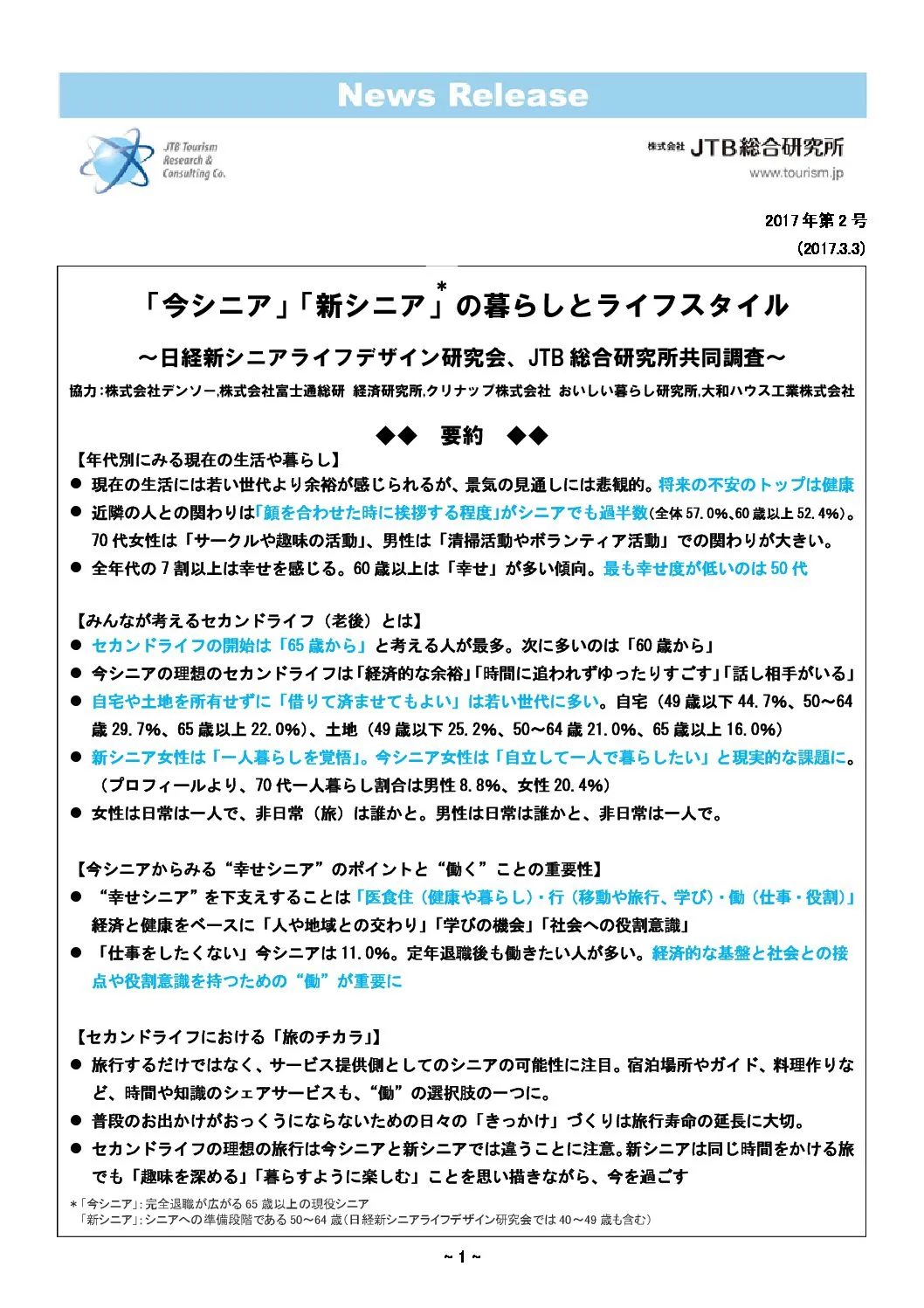
Key Findings
- Current Lifestyles by Age GroupWhile seniors seem to have more financial leeway than younger generations in their current lives, they are pessimistic about the economic outlook. Their top concern for the future is health.
Even among seniors, a majority (57.0% overall; 52.4% for those 60 and older) describe their interactions with neighbors as “just exchanging greetings when we see each other.”Women in their 70s tend to engage primarily through “clubs and hobby activities,” while men do so through “cleanup activities and volunteer work.”
More than 70% of people across all age groups feel happy. Those aged 60 and older tend to report higher levels of happiness. The lowest level of happiness is found among those in their 50s. - What People Think About Their Second Life (Retirement)Most people believe that a "second life" begins "at age 65." The next most common response is "at age 60."
For today's seniors, the ideal second life involves "financial security," "living at a leisurely pace without being rushed," and "having someone to talk to."
The view that "it's fine to just rent" rather than owning a home or land is more common among younger generations.Home ownership (44.7% for those aged 49 and under, 29.7% for those aged 50–64, 22.0% for those aged 65 and over); land ownership (25.2% for those aged 49 and under, 21.0% for those aged 50–64, 16.0% for those aged 65 and over)
New senior women"prepared to live alone." Today’s senior women face the practical challenge of wanting to "live independently on their own." (According to profiles, the percentage of people living alone in their 70s is 8.8% for men and 20.4% for women.)
Women tend to spend their daily lives alone but enjoy special occasions (such as travel) with someone. Men tend to spend their daily lives with someone but enjoy special occasions alone. - Key Points for a "Happy Senior Life" from the Perspective of Today's Seniors, and the Importance of "Working"Supporting “Happy Seniors” hinges on the “Health, Living, Travel, and Work” economy—grounded in health and well-being—and encompasses “interaction with people and communities,” “learning opportunities,” and “a sense of social purpose.”
Currently, 11.0% of seniors say they “don’t want to work.” Many people want to continue working even after retirement. “Work” is crucial for providing a financial foundation and fostering connections with society and a sense of purpose. - "The Power of Travel" in Second LifeRather than just traveling, we’re focusing on the potential of seniors as service providers. Sharing services—such as providing lodging, guiding tours, or cooking—have become another option for staying active.
Creating daily “triggers” to prevent routine outings from becoming a chore is key to extending one’s “travel lifespan.”
Note that the ideal travel experience for “new seniors” differs from that of current seniors. Even when spending the same amount of time traveling, new seniors envision “deepening their hobbies” and “enjoying life as if they were living there” as they go about their daily lives.
Second Life Begins at Age 65: Exactly 60 years ago, in 1956 (Showa 31), people aged 65 and older were defined as the elderly. At that time, life expectancy was 65 years. It is clear that over the past 60 years, the major challenge has been living a life unlike anything experienced before. Much has changed in those 60 years. Today’s 65-year-olds are completely different from those of 60 years ago. Standing at the threshold of their “second life,” they are faced with the question of how to live the remaining 20 or 30 years of their lives. We believe this survey has succeeded in capturing some of these attitudes to a certain extent.
What the survey revealed is that “today’s seniors,” with the next 20 or 30 years of life in mind, hold a grim outlook on the future economy. They cut back where they can but are willing to spend on things they deem worthwhile. They also think about enjoying life, firmly protecting what needs to be protected, and never missing an opportunity when it’s time to take the offensive—they are “solid seniors” who resemble the ideal strategy of a soccer match. Furthermore, the survey highlighted that people in their 50s—who are the future “seniors”—are, conversely, a generation facing many challenges and anxieties.
The term “New Seniors” refers to those aged 40 and up. This concept was born from the idea that, given the challenges faced by those in their 50s, it is necessary to start preparing in one’s 40s—essentially building a runway—in order to fully embrace a second chapter of life at age 60 or 65.
The key themes are: Medicine (health), Food and Shelter (lifestyle), Travel (mobility, travel, and learning), and Work (employment and roles). Among these, the keyword “Work” has come to the forefront this year, which is being called the “first year of work-style reform. ”Financial considerations are unavoidable when it comes to living a long life, and it is clear that an increasing number of people are viewing “work” in diverse ways as a purpose for living.
With the baby boomer generation entering their 70s this year, companies must fundamentally change their marketing strategies and traditional approaches. We hope the results of this survey will help companies address these challenges head-on and seize new business opportunities.
(Nikkei New Senior Life Design Research Group)
*“Current Seniors”: Active seniors aged 65 and older, as full retirement becomes more widespread. “New Seniors”: Those aged 50–64 who are in the preparatory stage for senior life (the Nikkei New Senior Life Design Research Group also includes those aged 40–49).