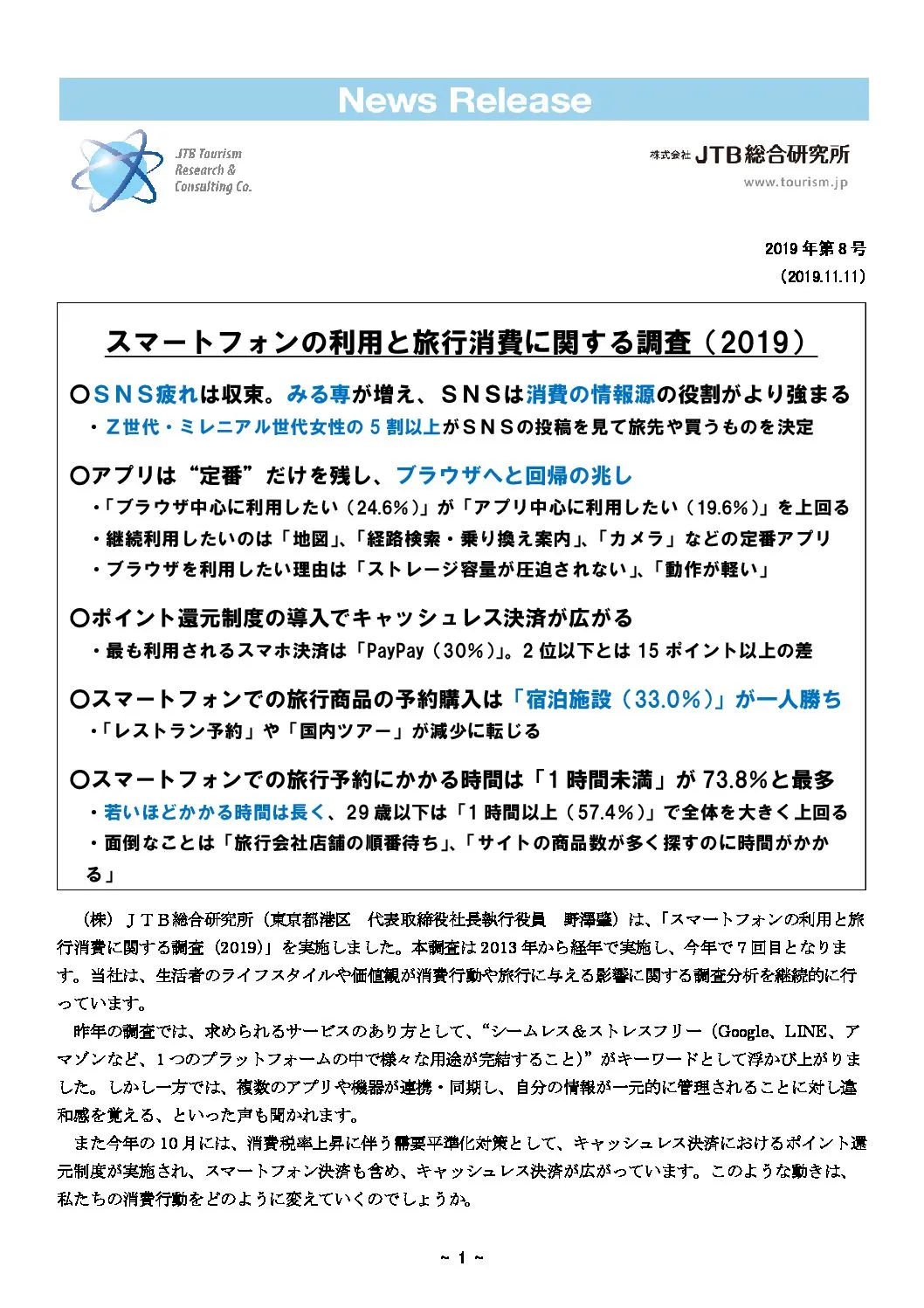
Survey on Smartphone Use and Travel Expenditures (2019)
In last year’s survey, “seamless and stress-free” (the ability to complete various tasks within a single platform, such as Google, LINE, or Amazon) emerged as a key concept regarding the desired nature of services. However, on the other hand, some respondents expressed discomfort with the idea of multiple apps and devices linking and syncing, resulting in their personal information being managed centrally.
Furthermore, in October of this year, a point-rebate system for cashless payments was implemented as a measure to level out demand following the consumption tax hike, and cashless payments—including smartphone payments—are becoming increasingly widespread. How will these trends change our consumption habits?
This survey aims to identify signs of future changes in daily life and travel behavior by continuously examining actual smartphone usage patterns and public attitudes.
Key Findings
- Social media fatigue is subsiding. As the number of passive users increases, social media is playing an increasingly prominent role as a source of information.More than half of Gen Z and Millennial women decide where to travel and what to buy based on social media posts
- Apps are showing signs of a return to the browser, retaining only the "must-haves""I want to use the browser primarily (24.6%)" outnumbered "I want to use apps primarily (19.6%)"
The apps users want to continue using are staples such as "Maps," "Route Search & Transit Directions," and "Camera"
Reasons for wanting to use a browser include "it doesn't take up storage space" and "it runs smoothly" - The introduction of a points-back program is driving the growth of cashless payments"PayPay" is the most widely used mobile payment service, with a lead of more than 15 percentage points over the second-place service.
- When it comes to booking and purchasing travel products on smartphones, "accommodations (33.0%)" are the clear leader"Restaurant reservations" and "domestic tours" have begun to decline
- The largest percentage (73.8%) of respondents said it takes "less than an hour" to book a trip on a smartphoneThe younger the person, the longer it takes; 57.4% of those aged 29 and under reported taking "more than an hour," significantly exceeding the overall average.
The most troublesome aspects were "waiting in line at travel agency branches" and "having to spend a lot of time searching through the large number of products on the website."
JTB Research Institute Co., Ltd. (Minato-ku, Tokyo; President and CEO Hajime Nozawa) conducted the “Survey on Smartphone Usage and Travel Spending (2019).” This survey has been conducted annually since 2013, making this the seventh edition. The company continuously conducts research and analysis on the impact of consumers’ lifestyles and values on their spending behavior and travel habits.
In last year’s survey, “seamless and stress-free” (the ability to complete various tasks within a single platform, such as Google, LINE, or Amazon) emerged as a key concept for the desired nature of services. However, on the other hand, some respondents expressed discomfort with the idea of multiple apps and devices linking and synchronizing to centrally manage their personal information.
Furthermore, in October of this year, a point-rebate system for cashless payments was implemented as a measure to offset the impact of the consumption tax hike, leading to the widespread adoption of cashless payments, including smartphone payments. How will these trends change our consumption behavior?
This survey aims to capture signs of future changes in daily life and travel behavior by continuously examining actual smartphone usage patterns and public attitudes.