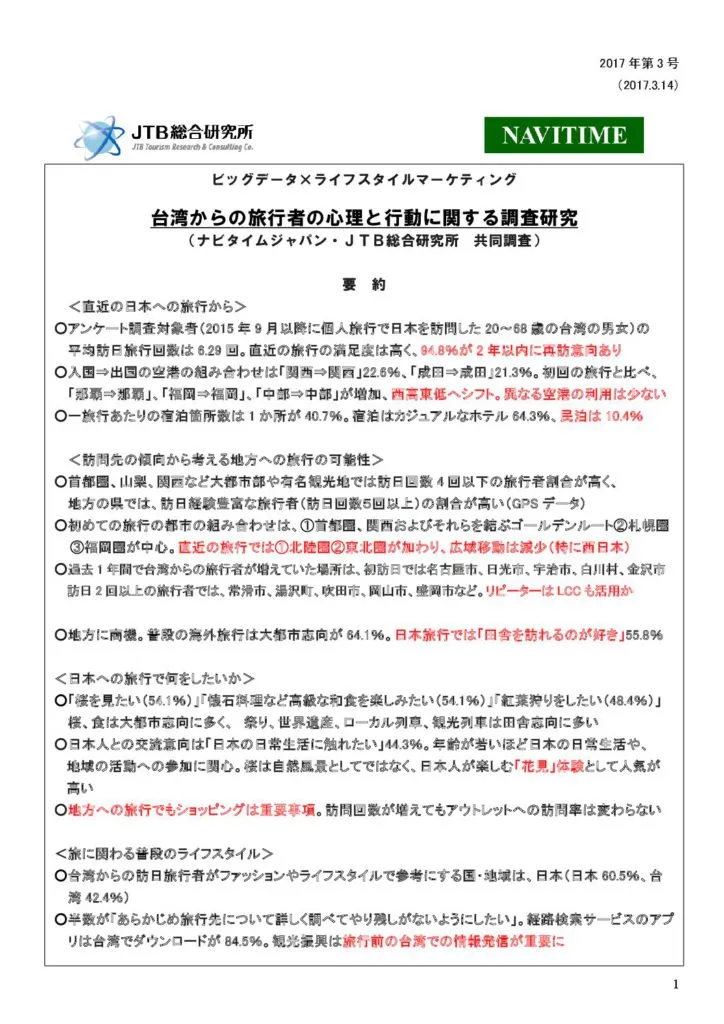
A Survey on the Psychology and Behavior of Travelers from Taiwan: Big Data × Lifestyle Marketing (Joint Survey by Navitime Japan and JTB Tourism Research & Consulting)
Big Data × Lifestyle Marketing (Joint Survey by Navitime Japan and JTB Research Institute)
PDFダウンロード
公開日
JTB Tourism Research & Consulting Co., Ltd. (Minato-ku, Tokyo; President and CEO: Hajime Nozawa) and Navitime Japan Co., Ltd. (Minato-ku, Tokyo; President and CEO: Keisuke Onishi) have conducted a joint study titled “Research on the Psychology and Behavior of Travelers from Taiwan.”
As foreign travelers to Japan gain more travel experience, they tend to increasingly opt for FIT (independent travel, where travelers research, book, and purchase airfare and accommodations themselves to fit their budget and itinerary) or package tours that combine airfare and accommodations while allowing for independent travel.
Regarding travelers from Taiwan to Japan, the number exceeded 1 million in 2004, meaning that many people have been traveling to Japan since an earlier period than the rapidly increasing numbers from China and Southeast Asian countries in recent years. In 2015, with a population of approximately 23 million, the total number of outbound travelers reached 13.18 million, of which 3.68 million traveled to Japan (according to the Directorate General of Budget, Accounting and Statistics, Executive Yuan of Taiwan, and the Japan National Tourism Organization).The majority of these travelers are repeat visitors and independent travelers, and their travel patterns are considered to be highly diverse. Where exactly do they go in Japan, and what do they do there? What values and preferences underlie their behavior? Furthermore, can Japan continue to be a destination with high potential? It is expected that as travelers from other Asian countries gain more travel experience, independent travel will increase. To predict these changes and determine how to best utilize Japan’s tourism resources, it seems meaningful to understand what travelers from Taiwan are thinking and what kind of trips they are taking.
On the other hand, the movements of individual travelers cannot be captured in detail through surveys alone. It is difficult to grasp behaviors unrelated to the traveler’s intentions or self-awareness, and with an incalculable number of tourist destinations, it is challenging to elicit every minute detail of travelers’ movements along specific routes or within specific areas. In recent years, advancements in big data analytics have made it possible to track consumers’ specific behaviors using GPS (location data), POS (point-of-sale) data, and social media data, and their future application is highly anticipated. However, tourism is heavily influenced by travelers’ sensibilities and moods; relying solely on big data risks focusing only on superficial phenomena, making it difficult to see the context behind their actions—such as “why they took that action” or “what kind of experiential value they were seeking.” This can lead to a tendency to focus solely on function-centric improvements or replicate temporary success stories from other regions, preventing a deeper exploration of fundamental strategies. To address this challenge, through joint research with Navitime Japan Co., Ltd., we conducted an analysis combining GPS data with survey results to visualize the behavior of travelers from Taiwan, including their locations during their stay, their intentions to visit specific tourist attractions, and travel trends. Here is a summary of some of the findings.
Key Findings
- From my most recent trip to JapanThe average number of visits to Japan among survey respondents (Taiwanese men and women aged 20–68 who visited Japan on individual trips since September 2015) was 6.29. Satisfaction with their most recent trip was high, with 94.8% intending to return within the next two years.
The most common airport combinations for entry and exit were “Kansai → Kansai” (22.6%) and “Narita → Narita” (21.3%).Compared to their first trip, the use of “Naha to Naha,” “Fukuoka to Fukuoka,” and “Chubu to Chubu” routes has increased, shifting the trend toward higher usage in the west and lower in the east. The use of different airports is low.
For 40.7% of travelers, they stayed at only one accommodation per trip. Accommodations consisted of casual hotels (64.3%) and private lodging (10.4%). - The Potential for Travel to Regional Areas Based on Trends in DestinationsIn major metropolitan areas and popular tourist destinations such as the Tokyo metropolitan area, Yamanashi, and the Kansai region, the proportion of travelers who have visited Japan four times or fewer is high, whereas in regional prefectures, the proportion of travelers with extensive experience visiting Japan (five or more visits) is high (GPS data).
The primary destination combinations for first-time travelers are: (1) the Tokyo Metropolitan Area, the Kansai region, and the Golden Route connecting them; (2) the Sapporo area; and (3) the Fukuoka area. In recent trips, the Hokuriku region and the Tohoku region have been added, while long-distance travel has decreased (particularly in Western Japan).
Destinations that saw an increase in travelers from Taiwan over the past year included, for first-time visitors: Nagoya, Nikko, Uji, Shirakawa-go, and Kanazawa; and for travelers visiting Japan two or more times: Tokoname, Yuzawa, Suita, Okayama, and Morioka.Do repeat visitors also use LCCs?
Business opportunities in regional areas. 64.1% of travelers prefer major cities for their usual overseas trips. For trips to Japan, 55.8% say they “enjoy visiting the countryside.” - What do you want to do on your trip to Japan?"Want to see cherry blossoms (54.1%)", "Want to enjoy high-end Japanese cuisine such as kaiseki (54.1%)", "Want to see autumn foliage (48.4%)". Cherry blossoms and cuisine are more popular among those interested in big cities, while festivals, World Heritage sites, local trains, and sightseeing trains are more popular among those interested in the countryside.
Regarding interaction with Japanese people, 44.3% expressed a desire to “experience everyday life in Japan.” The younger the age group, the greater the interest in participating in everyday life and local community activities. Cherry blossoms are popular not merely as a natural landscape, but as the “hanami” experience enjoyed by the Japanese.
Shopping remains a key priority even for trips to regional areas. The rate of visits to outlet malls remains unchanged even as the total number of visits increases. - A Travel-Oriented LifestyleCountries and regions that visitors from Taiwan look to for fashion and lifestyle inspiration include Japan (Japan: 60.5%, Taiwan: 42.4%)
Half of respondents said they “want to research their destination in detail beforehand to ensure they don’t miss anything.” Route-planning apps have a download rate of 84.5% in Taiwan. For tourism promotion, disseminating information in Taiwan prior to travel is crucial.