Announcement of "Travel Trends for the Year-End and New Year Holidays (December 23, 2024 – January 3, 2025)"
PDFダウンロード
公開日
JTB has compiled a forecast of travel trends for “people taking a trip of one night or more during the year-end and New Year period (December 23 to January 3).”
This report is based on various economic indicators, industry trends, developments among transportation companies, accommodation booking status, and various opinion surveys, and has been compiled continuously since 1969. (Our company is responsible for the research and analysis for this report.)
Key Findings
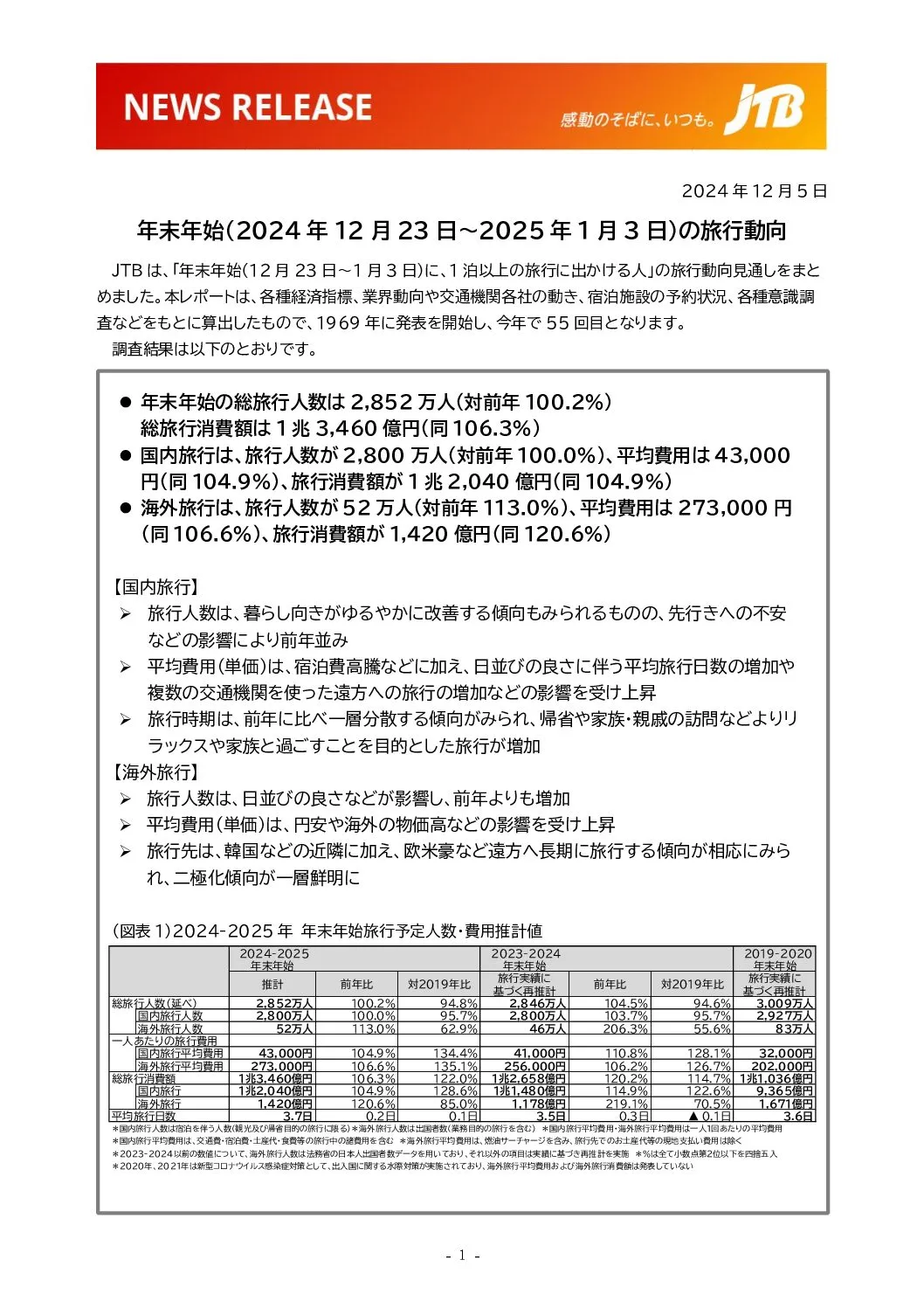
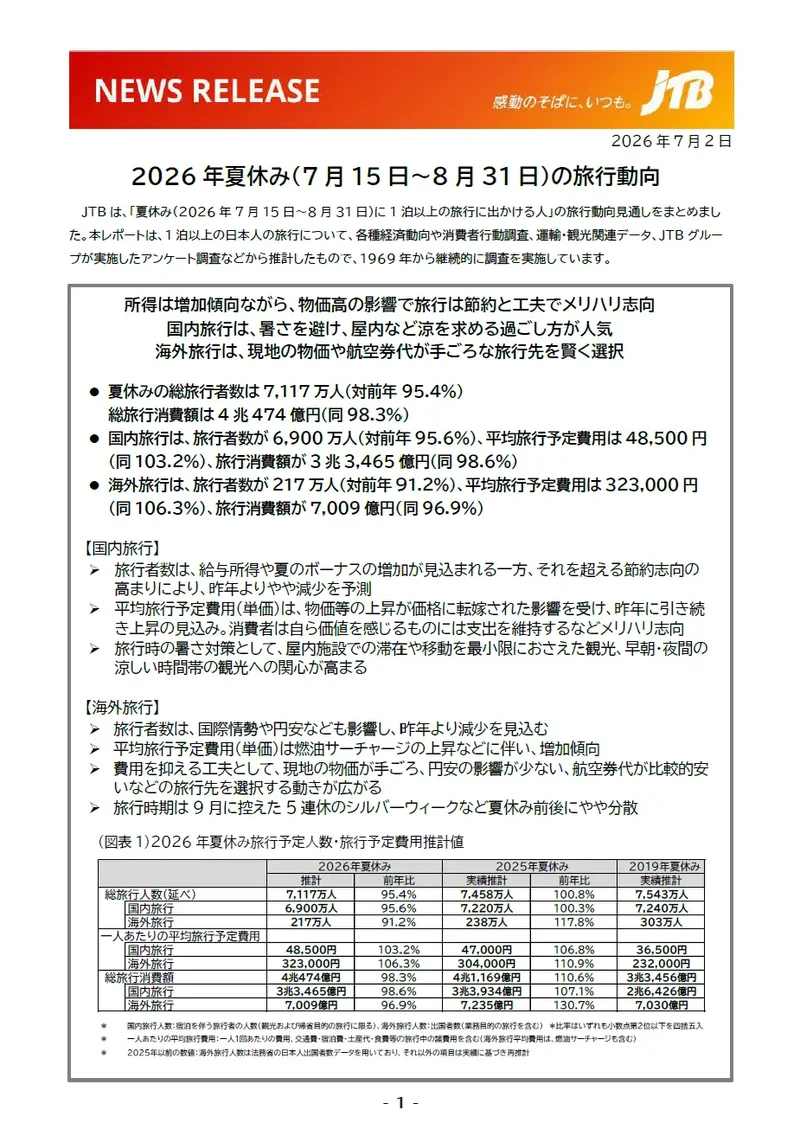
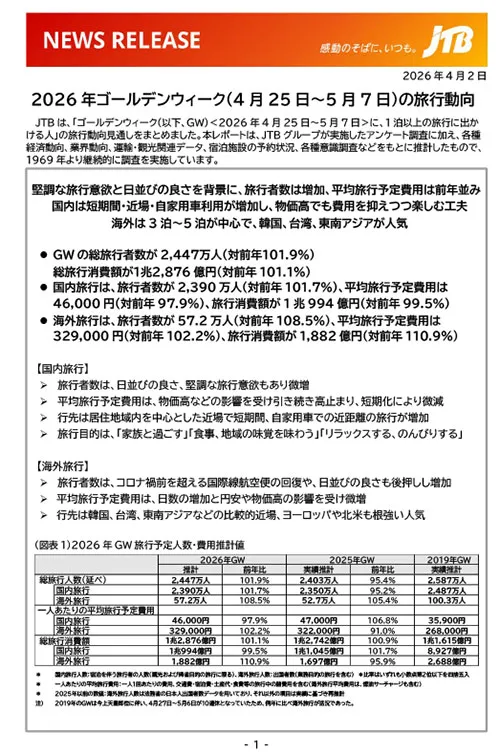
- Travel Trends Forecast for "People Planning a Trip of One Night or More During the Year-End and New Year Holidays (December 23–January 3)"The total number of travelers during the year-end and New Year holidays was 28.52 million (100.2% of the previous year), and total travel spending was 1.346 trillion yen (106.3% of the previous year).
For domestic travel, the number of travelers was 28 million (100.0% of the previous year), the average expenditure was 43,000 yen (104.9% of the previous year), and total travel spending was 1.204 trillion yen (104.9% of the previous year).
For overseas travel, the number of travelers was 520,000 (113.0% of the previous year), the average expenditure was 273,000 yen (106.6% of the previous year), and total travel expenditure was 142.0 billion yen (120.6% of the previous year) - Domestic travelAlthough there are signs of a gradual improvement in living standards, the number of travelers remained roughly the same as the previous year due to factors such as uncertainty about the future.
Average spending (per person) rose due to soaring accommodation costs, as well as an increase in the average number of travel days driven by favorable calendar dates and a rise in long-distance travel involving multiple modes of transportation.
Travel dates showed a greater tendency to be spread out compared to the previous year, with an increase in trips aimed at relaxation and spending time with family, rather than returning to one’s hometown or visiting family and relatives - Travel AbroadThe number of travelers increased compared to the previous year, influenced by favorable calendar dates, among other factors.
Average spending (per person) rose due to factors such as the weak yen and high prices abroad.
In terms of travel destinations, while nearby countries like South Korea remained popular, there was a noticeable trend toward longer-term trips to distant regions such as Europe, the United States, and Australia, making the polarization in travel trends even more pronounced.