"Survey on What People Seek in Travel" ~ What Does "Escapism" Mean in Travel? ~
JTB Tourism Research & Consulting Co., Ltd. (Shinagawa-ku, Tokyo; President and CEO: Yoshito Kazama) has compiled a "Survey on What People Seek in Travel" based on a combination of questionnaire and interview research.
Key Findings
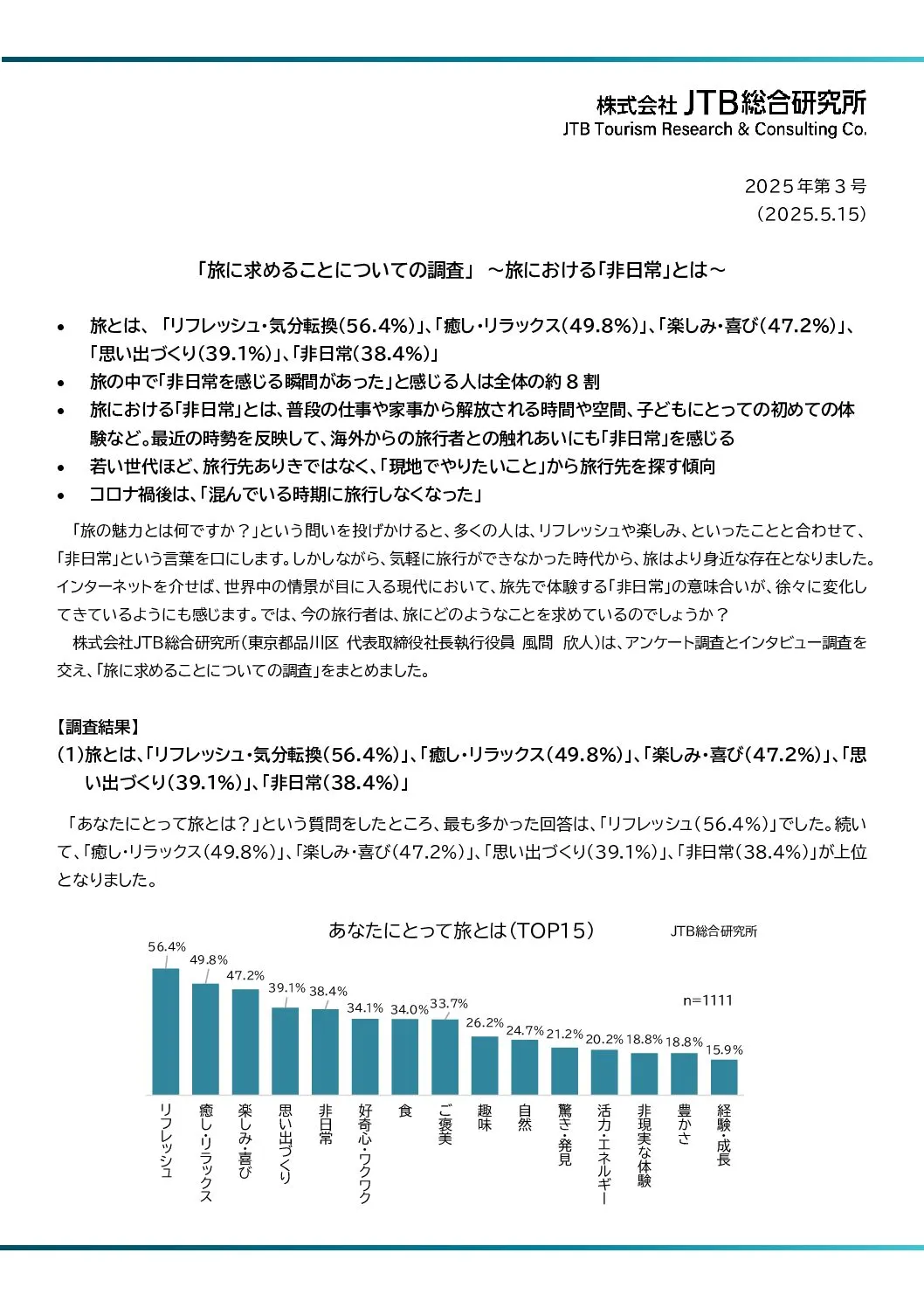
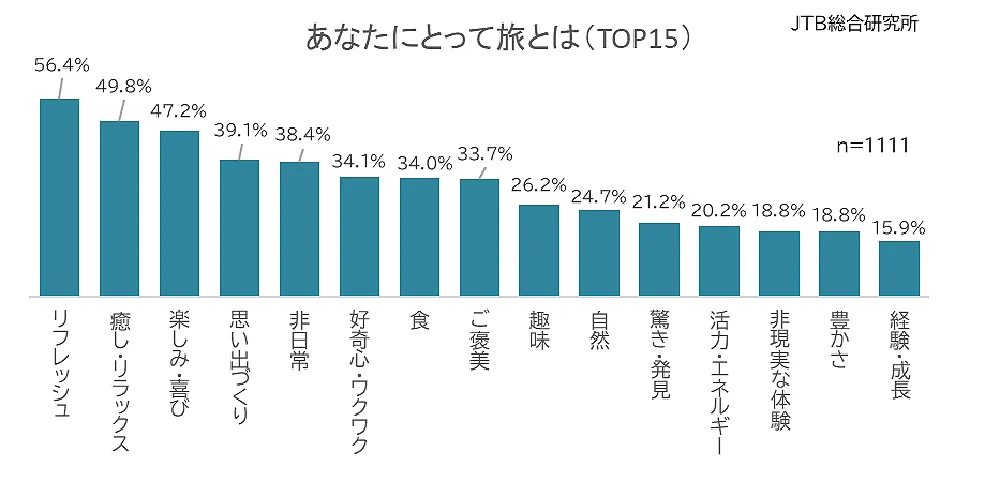
- People travel for the following reasons: "to refresh and clear their minds (56.4%)," "to find healing and relaxation (49.8%)," "for fun and enjoyment (47.2%)," "to create memories (39.1%)," and "to experience something out of the ordinary (38.4%)."
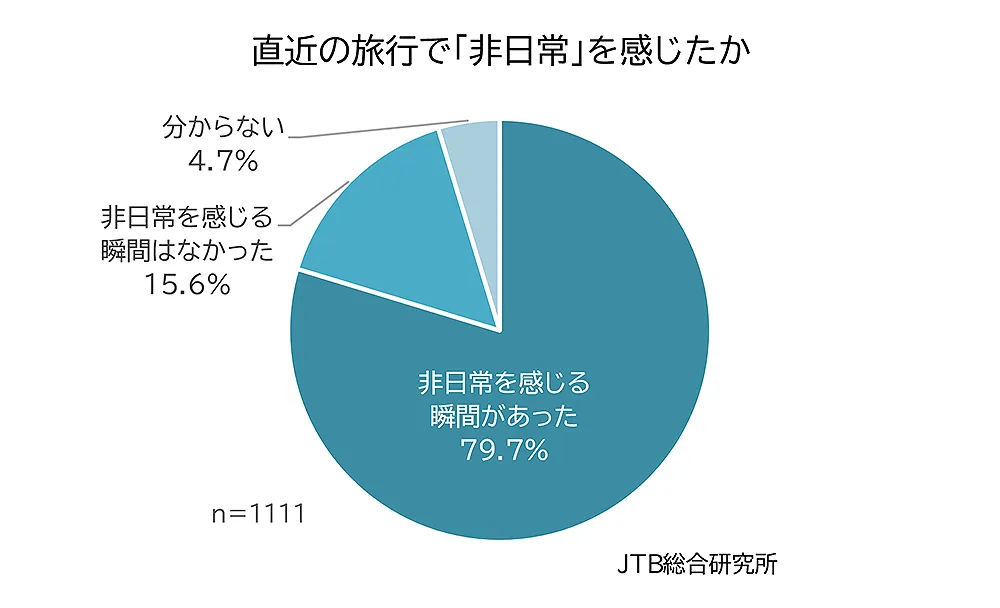
- About 80% of people say they experienced moments during their travels when they felt a sense of escape from the everyday
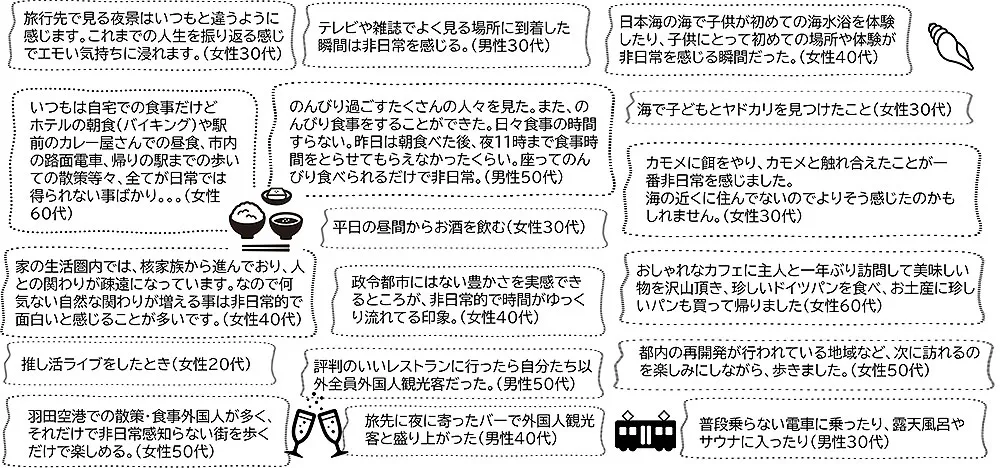
- When it comes to travel, the "escape from the everyday" refers to time and space spent free from daily work and household chores, as well as new experiences for children. Reflecting current trends, interacting with international travelers also offers a sense of this "escape from the everyday."
- The younger the generation, the more they tend to choose their travel destinations based on what they want to do there, rather than the destination itself
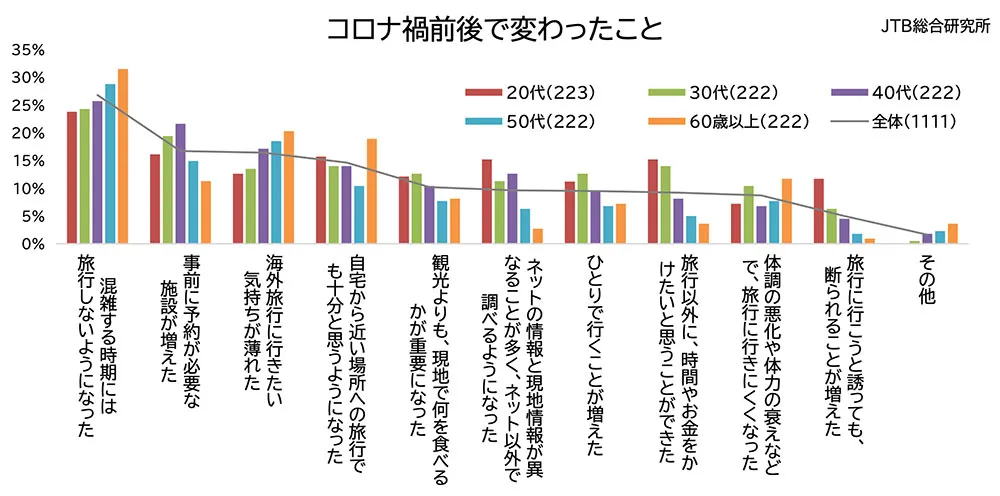
- Since the COVID-19 pandemic, I’ve stopped traveling during busy periods.
People travel for the following reasons: "to refresh and clear their minds (56.4%)," "to find healing and relaxation (49.8%)," "for fun and enjoyment (47.2%)," "to create memories (39.1%)," and "to experience something out of the ordinary (38.4%)."
When asked, “What does travel mean to you?” the most common response was “refreshment” (56.4%).This was followed by “healing and relaxation (49.8%),” “fun and joy (47.2%),” “creating memories (39.1%),” and “escaping the everyday (38.4%),” which rounded out the top responses.
About 80% of people say they experienced moments during their travels when they felt a sense of escape from the everyday
In addition to factors related to one’s state of mind—such as “refreshment” and “relaxation”—“escapism” ranked highly among what people seek from travel. When asked whether they had experienced a sense of “escapism” during their most recent trip, approximately 80% of respondents said they had “had moments when they felt a sense of escapism.”
When it comes to travel, the "escape from the everyday" refers to time and space spent free from daily work and household chores, as well as new experiences for children. Reflecting current trends, people also find this sense of "escape from the everyday" in interactions with international travelers.
So, specifically, what kind of experiences does the term “escape from the everyday” refer to when it comes to travel?
In this survey, to gain a deeper understanding of travelers’ specific interests, we went beyond the questionnaire and conducted online chat-style interviews to gather detailed information about each individual’s travel experiences.
Looking at specific responses, many men cited “work” and many women cited “housework”—they felt a sense of the “extraordinary” in the moment they were freed from their daily busyness. For those traveling with children, many reported feeling this sense of the “extraordinary” when sharing “first-time experiences” with their children.Even familiar sights found in everyday life—such as night views, cafes, cityscapes, and train stations—seem to have a distinct charm when experienced at a travel destination. Furthermore, reflecting the recent increase in foreign visitors to Japan, some respondents mentioned feeling a sense of the “extraordinary” through interactions with international travelers.
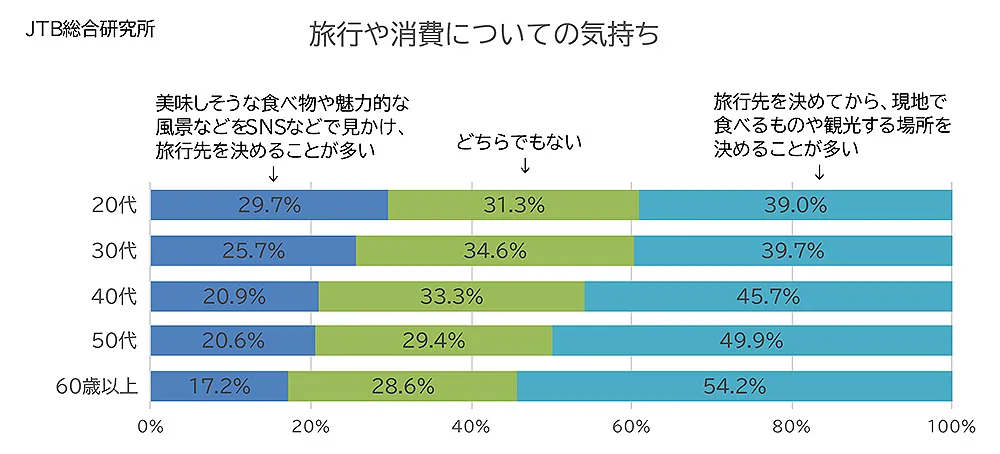
The younger the generation, the more likely they are to choose a travel destination based on what they want to do there
Changes in attitudes toward travel are also influencing the decision-making process for choosing a destination. When asked which of the following best describes their travel planning process—"I often decide on a destination after seeing delicious-looking food or attractive scenery on social media" or "I often decide what to eat and where to sightsee once I’ve chosen a destination"—Overall, while the majority of respondents said they “usually decide what to eat and where to go sightseeing after choosing a destination,” there was a clear trend showing that the younger the generation, the higher the percentage of respondents who said they “often decide on a destination after seeing appetizing food or attractive scenery on social media.”It appears that, particularly for younger people, “what to do” is becoming more important than “where to go.”
Since the COVID-19 pandemic, I’ve stopped traveling during peak seasons.
In addition, the long-standing travel restrictions imposed due to the COVID-19 pandemic have changed people’s attitudes and behaviors toward travel.When asked what had changed before and after the pandemic, the most common response was “I no longer travel during peak seasons (26.8%),” followed by “More facilities now require advance reservations (16.7%)” and “My desire to travel abroad has diminished (16.4%).”In particular, the response rates for “I no longer travel during peak seasons” and “My desire to travel abroad has diminished” increase as respondents get older.
On the other hand, among those in their 20s, there was a tendency for higher response rates for “Online information often differs from local information, so I started researching outside of the internet,” “I found things other than travel that I wanted to spend my time and money on,” and “I’ve been turned down more often when inviting people to travel.”
Summary
The "escape from the everyday" in travel refers to the time and space we have when we are freed from work and household chores. Even things that are all around us in daily life take on a different charm when we’re traveling
The results of our interview survey revealed that the sense of the “extraordinary” in travel comes from being freed from the time and space dominated by daily life—such as work and household chores—and immersing oneself in a relaxed pace of life, as well as through casual, natural interactions with people.Specifically, when it comes to experiencing the “extraordinary,” things we encounter in our daily lives—such as cafes, night views, and train stations—seem to feel fresh and new when seen while traveling.
A survey conducted last year on “What Attracts People While Traveling” revealed that people are often drawn to “local cafes and coffee shops” and “retro buildings and stores,” and end up visiting them. This suggests that visiting such places may stem from a desire to experience that “sense of the extraordinary.”
The younger the generation, the more they prioritize “what to do” over “where to go”
The shift from text-based information to images and videos, driven primarily by social media, appears to be influencing how people choose their travel destinations. According to the results of this survey, the younger the generation, the higher the percentage of respondents who said they “often decide on a travel destination after seeing delicious-looking food or attractive scenery on social media.”
According to the findings of the “Survey on Smartphone Use and Travel Expenditures (2024),” while keyword searches remain the mainstream method for finding information, the proportion of users relying on “map apps” and “video searches” has increased.This trend is likely driven by an increase in behaviors such as checking the location of images or videos that catch one’s interest on a map, or searching for videos from the outset to find something specific to do.
The tendency to avoid crowds persists even after the pandemic subsided
The prolonged COVID-19 pandemic has brought about changes in attitudes toward travel and travel behavior. Although the pandemic has subsided and opportunities to go to the office rather than work remotely have increased, we still hear comments such as, “It’s hard to ride a crowded train.” It seems that quite a few people do not want to give up the comfort of avoiding crowded spaces and enjoying relaxed time and space.