A Study on Travel to Japan by South Korean Tourists: Clarifying Characteristics Through Comparison with Australia and Indonesia
Highlighting key differences through comparisons with Australia and Indonesia
PDFダウンロード
公開日
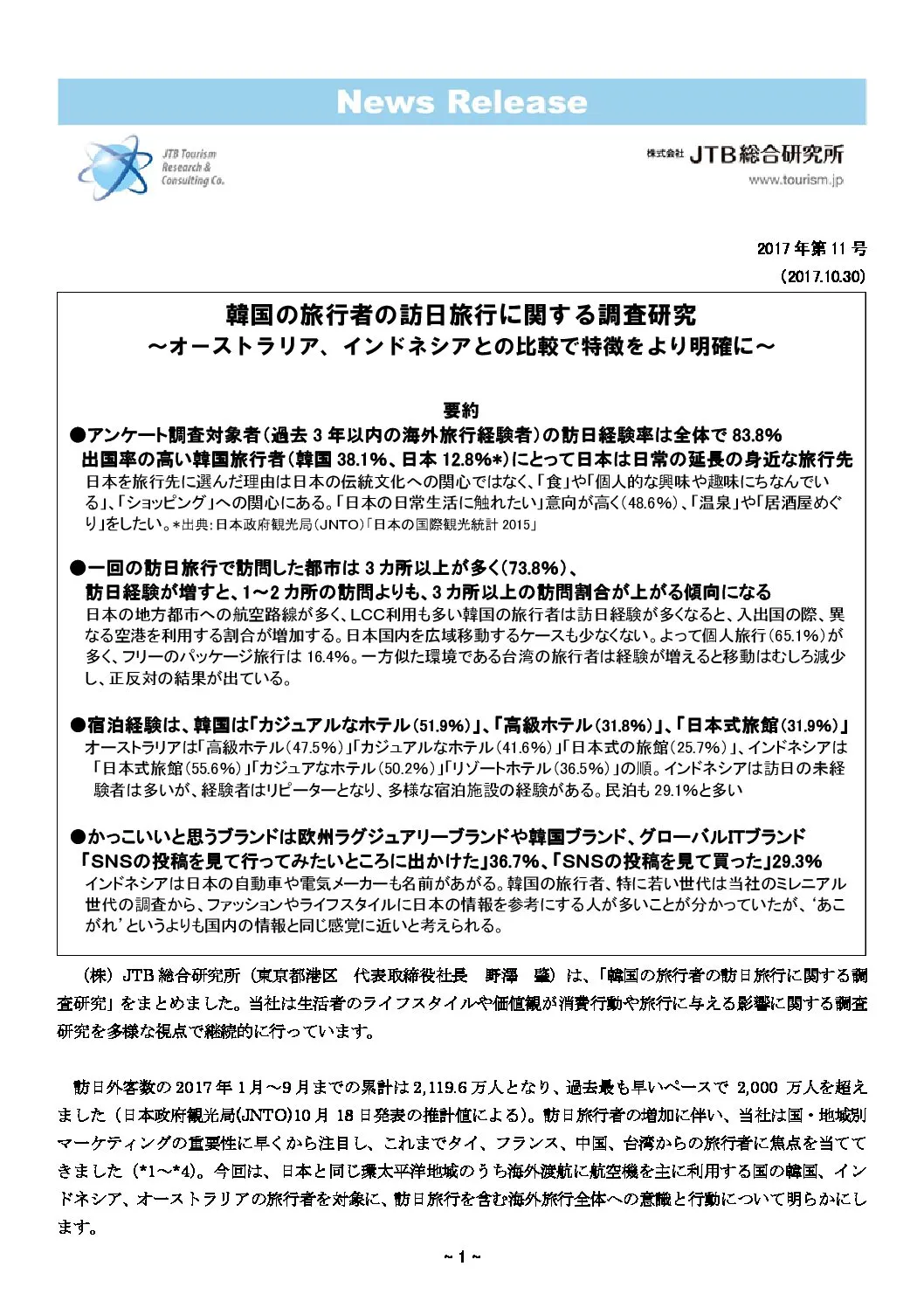
JTB Tourism Research & Consulting Co., Ltd. (Minato-ku, Tokyo; President and CEO: Hajime Nozawa) has compiled a “Survey and Research on Travel to Japan by South Korean Tourists.” The company continuously conducts surveys and research from diverse perspectives on how consumers’ lifestyles and values influence their consumption behavior and travel.
The cumulative number of international visitors to Japan from January to September 2017 reached 21.196 million, surpassing the 20-million mark at the fastest pace on record (based on estimates released by the Japan National Tourism Organization (JNTO) on October 18).In response to the increase in inbound travelers, we recognized the importance of country- and region-specific marketing early on and have focused our efforts on travelers from Thailand, France, China, and Taiwan (*1–*4).In this report, we examine the attitudes and behaviors regarding overseas travel—including travel to Japan—among travelers from South Korea, Indonesia, and Australia, all of which are located in the same Pacific Rim region as Japan and rely primarily on air travel for international trips.
In an effort to make the findings easier to understand, this survey used the same questions for all three countries to enable direct comparison; however, this report will focus primarily on travelers from South Korea.
South Korea is the second-largest source of inbound travelers to Japan after China. However, it has traditionally not received much attention because it has long had a large number of independent travelers and relatively low per-person spending. However, the number of travelers to Japan has increased significantly in recent years, and per-person travel expenditure for July–September of this year rose by 10.0% compared to the same period last year (Japan Tourism Agency, “Survey on Consumption Trends of Inbound Foreign Visitors,” released October 18). We therefore consider South Korea to hold an important position in the Japanese travel market, particularly for gauging future trends among travelers from other Asian countries.
Key Findings
- Among survey respondents (those who have traveled abroad within the past three years), 83.8% have visited Japan. For South Korean travelers, who have a high rate of outbound travel (38.1% to South Korea, 12.8% to Japan*), Japan is a familiar destination that feels like an extension of their daily lives.The reason for choosing Japan as a travel destination is not an interest in traditional Japanese culture, but rather an interest in “food,” “personal interests and hobbies,” and “shopping.” There is a strong desire to “experience everyday life in Japan” (48.6%), and many wish to visit “hot springs” and “tour izakaya bars.”
*Source: Japan National Tourism Organization (JNTO), “International Tourism Statistics for Japan 2015”
Most travelers (73.8%) visit three or more cities during a single trip to Japan, and as the number of visits increases, the proportion of travelers visiting three or more cities tends to rise compared to those visiting only one or two.South Korean travelers, who frequently use low-cost carriers (LCCs) on flights to regional cities in Japan, are more likely to use different airports for arrival and departure as they gain more experience visiting Japan.It is also not uncommon for them to travel extensively within Japan. Consequently, independent travel accounts for 65.1%, while free-and-easy package tours account for 16.4%. In contrast, travelers from Taiwan—a region with a similar environment—tend to travel less frequently as their experience with Japan increases, yielding results that are the exact opposite.- In terms of accommodation experiences in South Korea, the breakdown is as follows: "casual hotels (51.9%)," "luxury hotels (31.8%)," and "Japanese-style ryokan (31.9%)."In Australia, the top choices were “luxury hotels (47.5%)”, “casual hotels (41.6%)”, and “Japanese-style ryokan (25.7%)”; in Indonesia, it was “Japanese-style ryokan (55.6%)”"casual hotels (50.2%)" and "resort hotels (36.5%)". While many Indonesians have never visited Japan, those who have tend to become repeat visitors and have experienced a variety of accommodations. The use of private lodging is also high at 29.1%.
- Brands they find appealing include European luxury brands, Korean brands, and global IT brands
. 36.7% said they “visited a place they saw on social media,” while 29.3% said they “bought something they saw on social media.”Japanese automakers and electronics manufacturers are also frequently mentioned in Indonesia. Based on our survey of millennials, we found that many South Korean travelers—especially younger generations—look to Japan for fashion and lifestyle inspiration; however, this seems to stem more from a sense of familiarity with domestic trends than from any particular “admiration.”
*1 “Travel and Lifestyle of Thais” (September 15, 2015)
*2 “Survey on the Lifestyle and Travel Habits of French People Interested in Traveling to Japan” (March 28, 2016)
*3 “Survey on Travel Trends Among Chinese Tourists by Region (Coastal vs. Inland)”(October 14, 2016)
*4 “Research on the Psychology and Behavior of Travelers from Taiwan” (March 14, 2017)