Tourism Statistics 2020 Special Edition: Travel Forecast for 2020
Regarding travel and tourism in 2020, JTB released its “2020 Travel Trends Forecast” at the end of last year. Based on that report, we will highlight notable trends that point toward the future, with a focus on travelers.
The Japanese Travel Market in 2020
- With the Olympics on the horizon, will 2020 mark the dawn of the workation era?
- The shift toward independent travel is accelerating. Package tours are being used selectively
- "Generation Z," supported by a robust job market, and the "Bubble Generation," who are beginning to have more free time, are driving overseas travel
The Inbound Tourism Market in Japan in 2020
- With rising global environmental awareness, we have entered an era where businesses “won’t be chosen” without SDG initiatives
- The inbound market is shifting from quantity to quality. The importance of “experiences” is increasing
Outlook for the 2020 Travel Market (Estimates)

Latest Tourism Statistics
1. Japanese Consumption and Travel in 2020
The global economy is slowing down due to factors such as the U.S.-China trade friction and the deterioration of the situation in the Middle East. The Japanese economy is no exception, and consumption in 2020 is expected to be generally subdued, partly due to the impact of the consumption tax hike. However, looking at trends following the 2014 tax hike, a gradual recovery began after about a year. Furthermore, considering the psychological boost associated with the Tokyo 2020 Games and the economic impact of inbound foreign tourists, a recovery is expected in the second half of the year.
Will 2020, an Olympic year, mark the dawn of the workation era?
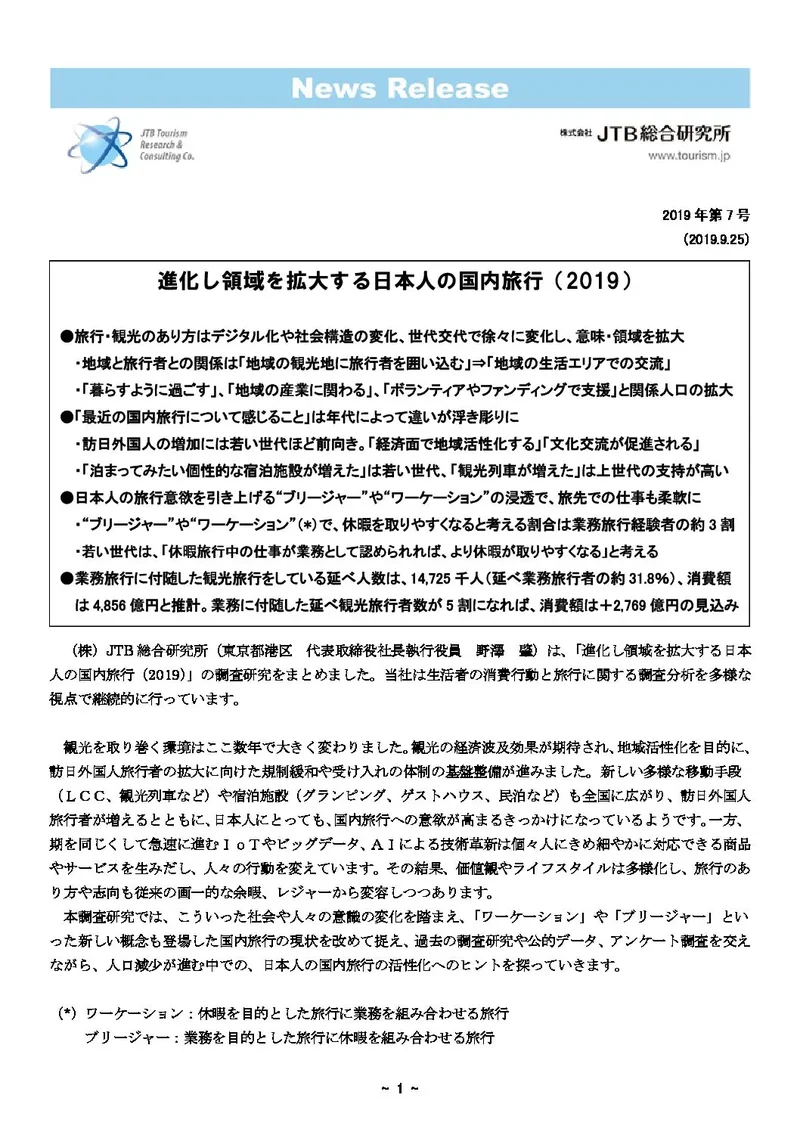
The government designated July 24, the date of the Tokyo 2020 Olympic Opening Ceremony, as “Telework Day” and has been promoting a national campaign for work-style reform since 2017. In 2019, approximately 680,000 people from 2,887 companies and organizations nationwide participated, not just in the Tokyo metropolitan area. As 2020 is finally the year of the Games, nomadic work (a location-independent work style) is expected to spread in earnest. According to our survey results, among those who had taken a business trip within the past year, 31.5% believed that if “workation” (working while on vacation) and “bleisure” (combining business travel with leisure) became more common, it would be easier to take vacations. In particular, younger generations (Millennials and Gen Z) were positive about “workation.” Additionally, the percentage of people in both generations who generally wanted to work in a location-independent manner tended to be high.
On the corporate side, there is a growing trend toward establishing environments that support flexible work styles, with the aim of promoting the government’s “relational population” initiative (involvement with local communities in forms distinct from permanent residency or tourism) and improving employee productivity and work-life balance. As nomadic work becomes more common, work styles that extend beyond Japan’s borders will also expand. To foster innovation and enhance global competitiveness, efforts to support and promote flexible work arrangements for employees—including side jobs—are likely to intensify.
The day may soon come when the boundaries between “living” and “traveling,” and between “work” and “leisure,” disappear.
The shift toward independent travel is becoming increasingly pronounced. Package tours are being used selectively
The shift toward independent travel is progressing not only for domestic trips but also for overseas travel. According to a long-term survey on travel conducted by JTB, the proportion of FIT (independent travel) has been increasing year by year, reaching 75.8% for domestic travel and 47.5% for overseas travel in 2018 (83.6% and 62.5%, respectively, when including dynamic packages).On the other hand, "skeleton tours" (package tours that only include accommodation and transportation, with the rest left to the traveler’s discretion) have seen a significant decline. JAL and ANA have announced plans to transition their package tour fares for travel agencies to dynamic pricing by spring 2020. As a result, it will become more difficult to create in-store tour products with fixed prices for a set period, and their market presence is expected to diminish. For consumers, daily price fluctuations may also lead to confusion when selecting products. Furthermore, with the rise in smartphone purchases, many people now prefer to buy accommodation and transportation separately to avoid the hassle of searching and entering information during the booking process. Going forward, the key will likely be how to enhance the transparency of products and prices and convey this information clearly to consumers.
On the other hand, looking at the survey results mentioned earlier, while guided tours account for a relatively small share of the total market (4.5% for domestic travel and 12.7% for overseas travel), this level has remained consistent over the past four to five years. For example, for destinations where travelers are “visiting for the first time,” “find it difficult to get around on their own,” or “have places that can only be visited via a tour,” the preference for package tours remains strong, and it is expected that travelers will continue to choose different options depending on their destination.
"Generation Z," supported by a robust employment environment, and the "Bubble Generation," who are beginning to have more free time, are driving overseas travel
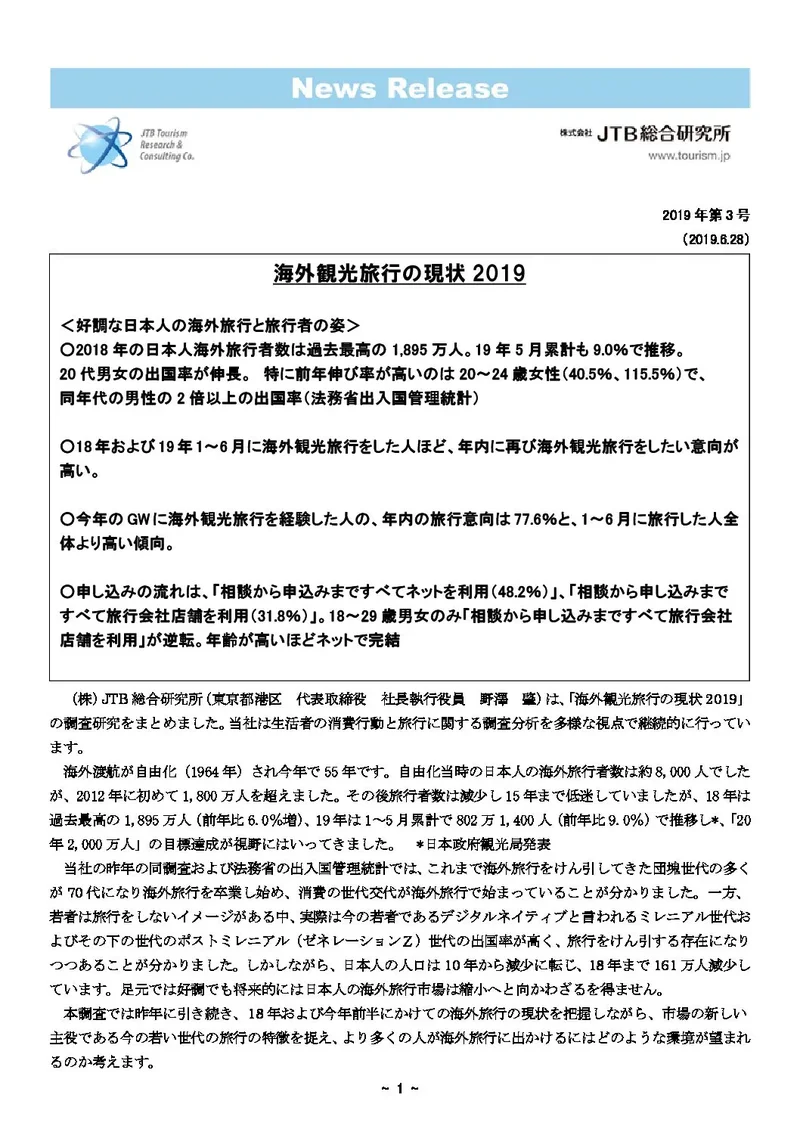
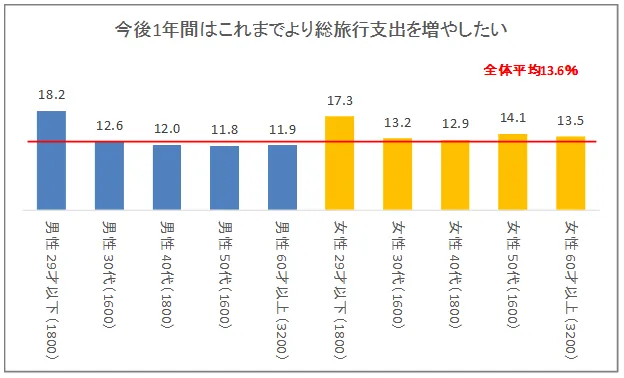
Overseas travel is expected to increase in 2020 as well. According to a survey conducted by JTB in November 2019, the percentage of respondents who stated they “wish to increase their total travel spending over the next year compared to before” exceeded the overall average among men and women in their 20s and women in their 50s. Although the economy is slowing down, the employment environment remains robust due to labor shortages, and winter bonuses at major companies in 2019 reached a record high (according to a Keidanren announcement).Young people tend to reflect improvements in the employment environment and income increases in their spending. In particular, Generation Z—those in their early 20s—is a generation with a global perspective in today’s interconnected world, and they are expected to continue driving overseas travel in 2020.
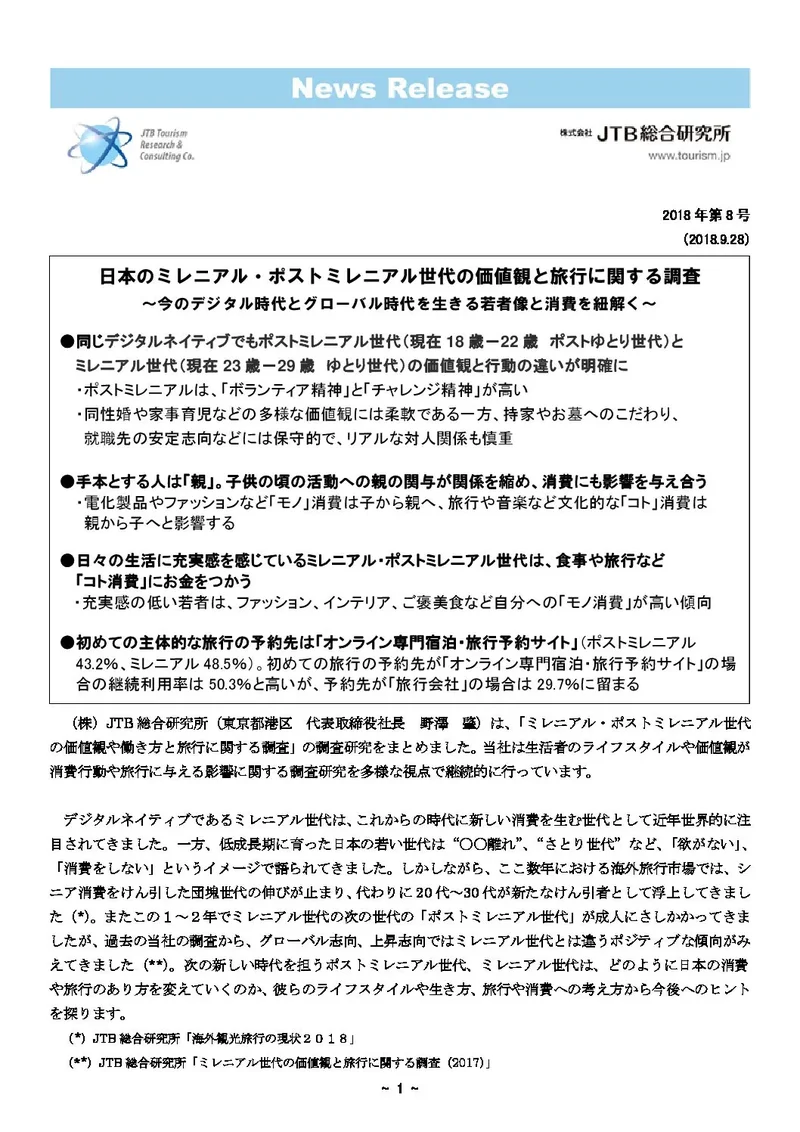
Additionally, women in their 50s, who have extensive consumption experiences with both goods and experiences dating back to the bubble era, have finished raising their children and are beginning to have more time for themselves. It is believed that their desire to travel overseas is also increasing. Since this generation has a strong interest in European culture as a model for fashion and lifestyle, and harbors a desire to do things a little differently from others—such as staying at nice accommodations while traveling—there may be changes in their choice of travel destinations and their behavior while abroad.
2. The Inbound Tourism Market in 2020
With rising global environmental awareness, we have entered an era where destinations “will not be chosen” without initiatives toward the SDGs
The Sustainable Development Goals (SDGs) were adopted at the 2015 UN Summit, and countries around the world have begun initiatives addressing sustainable consumption and production, climate change, and other issues. In Asia as well, regulations on plastic waste have progressed, starting with China’s 2017 ban on imported plastic waste. Furthermore, a movement to reduce the use of airplanes—which have a high environmental impact—and switch to trains and other modes of transportation is spreading, particularly in Nordic countries such as Sweden. It is symbolic that “flying shame” won the Buzzword of the Year award in Sweden in 2018.
Changes are also evident in B2B relationships. Compliance with sustainability certifications and standards has become a prerequisite for business, and in response, an increasing number of companies are declaring their commitment to strengthening environmental initiatives. Furthermore, because tourism is a broad-based industry, it is expected to contribute to all of the goals set forth by the SDGs.
According to a 2019 survey on “sustainable travel” conducted by Booking.com, while 72% of global travelers responded that “to protect the Earth for future generations, people need to take action now and make sustainable choices,” only 40% of Japanese respondents agreed, highlighting a lack of environmental awareness. If we fail to recognize this domestic reality and instead become complacent, without making sincere efforts toward sustainability from a global perspective, there is a real possibility that Japan could, before we know it, become a “destination that global travelers no longer choose.”
The inbound market is shifting from quantity to quality. The importance of “experiences” is growing
In its “Program for Realizing the Tourism Vision 2019,” the Japan Tourism Agency has set forth the goal of “developing new regional tourism content.” It aims to provide attractive content by utilizing national parks and cultural properties, thereby promoting the attraction of foreign tourists to regional areas and expanding their spending.
Our survey results indicate that affluent visitors to Japan and repeat visitors who come multiple times tend to have a strong interest in visiting regional areas and a high desire to experience Japan’s nature and culture through “experiences.”
One “experience” worth highlighting is adventure tourism. Adventure tourism is based on three pillars—“activities,” “nature,” and “cross-cultural experiences”—and aims to promote sustainable regional development and revitalize local economies. While the global travel market has an average annual growth rate of 3–5%, adventure tourism has maintained a growth rate of around 20% annually since 2012, and its economic scale in the United States is said to have reached approximately $680 billion. In Japan, local “experiential” tours are often viewed as simply a way to “fill spare time during a trip,” but overseas, there are many high-priced “experiential” tours where the experience itself is the primary purpose of the trip. In the future, there will likely be a growing demand for authentic, experiential local tours in Japan as well.
With the increase in international visitors to Japan, issues of overtourism are emerging in various regions. In connection with the aforementioned sustainability initiatives, the focus is likely to shift from merely “quantity” (number of travelers) to ensuring “quality,” such as increasing the average spending per visitor.