Tourism Statistics 2019 Special Edition: Travel Forecast for 2019
At the end of last year, JTB released its “2019 Travel Trends Forecast.” Based on that report, we will highlight notable trends centered on travelers that point toward the future.
Key Trends in the 2019 Travel and Tourism Market
- Japanese Travel Remains Steady. A Slow but Prolonged Economic Recovery Has Kept Consumer Sentiment Firm
- Young people are the driving force. The Japanese outbound travel market is growing, albeit slightly
- A generational shift in consumption begins with overseas travel. The baby boomer generation is stepping aside
- The Inbound Tourism Market Is Expanding. This year is drawing global attention as it marks the Rugby World Cup 2019™ in Japan, the Imperial Enthronement Ceremony, the G20 Summit, and the one-year countdown to the Tokyo 2020 Olympic and Paralympic Games
- Qualitative changes in the inbound cruise market
Outlook for the 2019 Travel Market (Estimates)

Latest Tourism Statistics
1. Japanese Consumer Spending and Travel Intentions
Prolonged Economic Recovery Keeps Travel Spending Firm
At the end of last year, the Cabinet Office’s Economic Trends Survey Committee announced that Japan’s economic expansion, which began in December 2012, has continued for an extended period, surpassing the “Izanagi Boom” of the high-growth era to become the second-longest post-war economic expansion. While this may not be strongly felt in daily life, consumption sentiment—including travel—appears to be solid, as evidenced by last year’s record-high number of Japanese travelers abroad and expectations that this year’s figures will exceed those of last year.
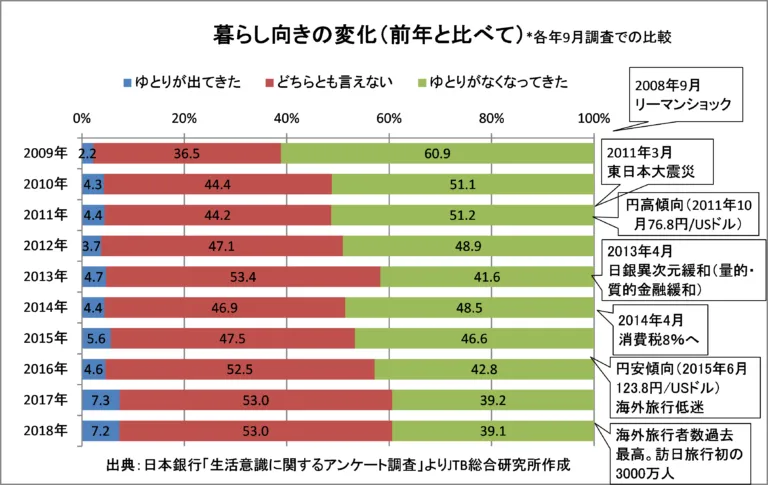
Looking at the long-term trends in changes in living standards compared to the previous year, as shown in the Bank of Japan’s “Survey on Public Perceptions of Living Conditions,” while the consumption tax hike in April 2014 had an impact, the percentage of respondents who felt they had “more financial leeway” has been on an upward trend since 2013—when the Bank of Japan’s unprecedented monetary easing began—while the percentage of those who felt they had “less financial leeway” has been declining (Figure 1).
(Figure 1) Changes in Japanese Living Standards and Travel
The Overseas Travel Market, Expected to Grow Despite Population Decline, and the Generational Shift Underway
Overseas travel, which had been sluggish, began to pick up in 2016, with the recovery starting particularly with graduation trips in the spring of that year. This can be attributed to an improved employment environment, higher employment rates, and rising wages, especially among younger workers. Due in part to the prolonged economic recovery, the rate of outbound travel among people in their 20s (especially those in their early 20s) has improved significantly over the past two to three years compared to other generations. Today’s young people are the Millennial generation—digital natives. They travel differently from the young people of previous generations. While the economic climate plays a role, the fact that their parents belong to the “Bubble Generation,” which reveled in consumerism, also has a major influence.
Although Japan’s population has been declining since 2010, the number of outbound travelers has increased, raising expectations for market expansion. However, the outbound travel rate among the senior generation has barely grown. Many members of the baby boomer generation, who have driven personal consumption, are now approaching their 70s, and an increasing number are retiring from overseas travel. A generational shift in consumption is becoming apparent. The next generation of seniors is a group that enjoyed leisure spending during their youth in an economy characterized by steady growth. With an increasing number having experienced overseas business trips or assignments, their behaviors and values differ from those of the baby boomers. The key will likely be whether providers of goods and services can adapt to the changing preferences resulting from this generational shift in consumption (Table 1).
(Table 1) Trends in Outbound Travel Rates by Gender and Age

While the scale of the economic recovery has not been particularly large, the fact that it has been sustained over a long period appears to have contributed to an improvement in consumer sentiment. Although a consumption tax hike is scheduled for October of this year, its impact on travel within the year is expected to be minimal.
2. Trends in the Inbound Tourism Market in 2019
In 2018, the number of international visitors to Japan saw growth slow slightly from July onward due to the impact of typhoons and earthquakes; however, the cumulative total through December 18 reached the 30-million mark for the first time (JNTO).The inbound tourism market is expected to continue expanding in 2019. Particularly promising are European countries such as Italy and Spain—which performed well last year—as well as Australia, Vietnam, Thailand, and the Philippines in Southeast Asia. 2019 is likely to be a year that attracts global attention, featuring the Rugby World Cup 2019™ in Japan, the Imperial Enthronement Ceremony, the G20 Summit, and the one-year countdown to the Tokyo Olympics.
Signs of Qualitative Changes in the Inbound Cruise Market
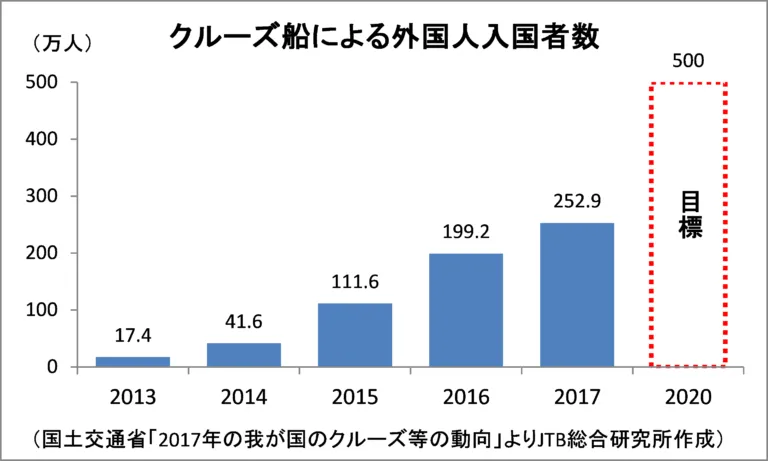
While the overall inbound cruise market to Japan is growing steadily, qualitative changes are occurring within it.
The market for cruises to Japan from China, which accounts for the largest volume, saw a rise in popularity starting around 2013 as large casual cruise ships became more common, making it easier to enjoy family vacations and other leisure trips. Furthermore, the market expanded rapidly in 2015 due to the effective elimination of visa requirements for cruise travel to Japan. However, over the past year or so, alongside the economic slowdown in China, intensifying price competition has led to a shakeout in the market. We are seeing cruise lines withdrawing from the Chinese market and shifting some of their ships to routes in Southeast Asia and Europe. As a result, while port calls in Kyushu—which receives a large volume of cruises from China—declined slightly in the first half of 2018, port calls in the Kanto and Chubu regions are expanding.
Regarding cruise passengers visiting Japan from Europe and the United States, the “fly-and-cruise” style—where travelers arrive in Japan by plane and then tour the country on small luxury ships carrying around 200 to 300 passengers—is gaining popularity. This has led to an increase in calls at relatively small ports such as Karatsu, and the image of cruises as events that bring thousands of visitors at once appears to be changing.
Assumptions for the 2019 Travel Market Forecast (Estimates)
- Average spending on overseas travel includes travel expenses (including fuel surcharges and airport taxes) as well as local expenditures such as shopping and meals. It does not include spending before or after the trip (such as the cost of purchasing clothing and other carry-on items).
- Average spending on domestic travel refers to the total cost from departure from home until return. It includes local spending such as shopping and meals. It does not include spending before or after the trip (such as the cost of purchasing clothing and other personal items).
- For foreign visitors to Japan, only the number of visitors is projected; spending figures are not calculated.
- The estimated number of outbound travelers for 2018 is a revision of the estimate made at the end of last year, based on the actual number of arrivals and departures announced by the Ministry of Justice.