The Current State of the "Travel Business Administrator Examination" ~ The Expanding Pool of Test Takers and the Tourism Industry's Expectations for Qualified Professionals ~
Last September, the “Regional Travel Business Handling Manager Examination” was administered for the first time. This is a new qualification within the Travel Business Handling Manager certification system, and 400 people nationwide took the exam in FY 2023.Previously, the Travel Business Handling Manager Examination offered two categories: the "Domestic Travel Business Handling Manager" (hereinafter "Domestic"), who can handle only domestic travel, and the "Comprehensive Travel Business Handling Manager" (hereinafter "Comprehensive"), who can handle both domestic and international travel. However, in recent years, there has been a growing trend of individuals obtaining qualifications to provide destination-based tourism plans through activities such as DMOs. This new category was established with the aim of broadening access for those wishing to obtain the qualification. This article examines the current status and challenges of the Travel Business Manager Examination in light of trends in regional tourism.
1. What is the newly established "Regional Travel Business Manager Examination"?
The "Regional Travel Business Manager" certification was introduced in 2013 with the aim of promoting the regional travel business sector. Regional travel businesses refer to enterprises that plan and sell experiential and interactive travel products that leverage local tourism resources and attractions. Previously, to register a regional travel business, one was required to hold either a General or Domestic Travel Business Manager qualification; however, the "Regional Travel Business Manager" qualification—which requires fewer exam subjects—is now also accepted, effectively lowering the barrier to entry for establishing a regional travel business.
The registration categories for travel agencies and similar businesses differ depending on the scope of travel they handle, as shown in the table below.
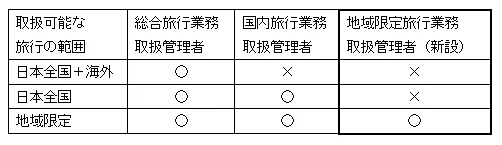
The examination subjects for the “Regional Travel Business Manager” consist of three subjects—laws and regulations, terms and conditions, and domestic travel practices—which are the same as for the “Domestic” qualification. However, questions regarding air transport terms and conditions, usage fees, and domestic geography have been excluded from the scope of the exam. Consequently, there has been a trend toward expanding eligibility to include transportation operators such as railway, airline, bus, and shipping companies, as well as tourism associations, tourism promotion corporations, and NPOs—entities that had not previously been major holders of the Travel Business Handling Manager qualification.
2. Travel Business Handling Manager Examination Results
1) Exam Takers and Pass Rates
For FY 2018, the "Domestic" category had 14,327 examinees and 5,674 passers, with a pass rate of 39.6%; the "Comprehensive" category had 9,306 examinees and 2,547 passers, with a pass rate of 27.1%.(The pass rates for the FY 2017 exam were 38.6% for “Domestic” and 23.4% for “Comprehensive.”) Although the organizing body has not released the number of examinees for the newly established “Regional” category, based on the list of successful candidates, approximately 400 people took the exam, and 58 passed. Possible reasons for the low number of examinees include the fact that the exam was held at only two venues—Tokyo and Osaka—and that the period between the announcement and the application deadline was short.
2) Occupational Classification of Examinees
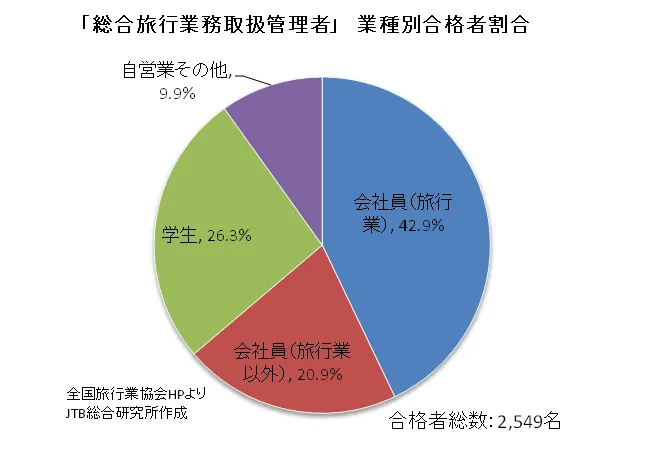
Looking at the breakdown of successful candidates by occupation for the “Domestic” and “Comprehensive” categories, the “Comprehensive” category shows that travel industry professionals accounted for the largest share at 42.9%. In contrast, while travel industry professionals made up only 11.4% of all applicants for the “Domestic” category, the combined total of those in the transportation, accommodation, tourism, and other corporate sectors reached 28.9%.Furthermore, looking at trends in the number of “Domestic” examinees, the number of workers outside the travel industry has been increasing year by year. The reason for the growing number of examinees and successful candidates from sectors other than the travel industry is the deregulation of registration for Type 3 travel agencies, aimed at promoting destination-based travel.
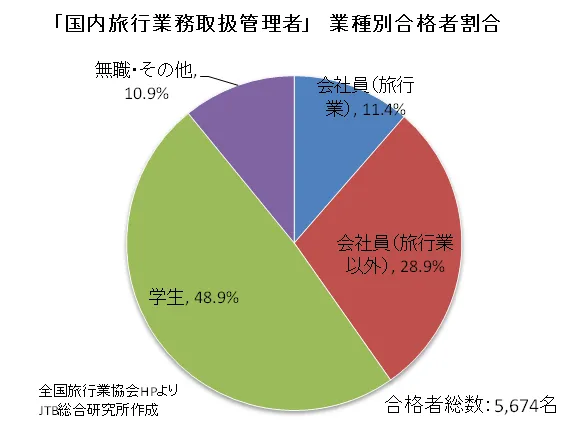
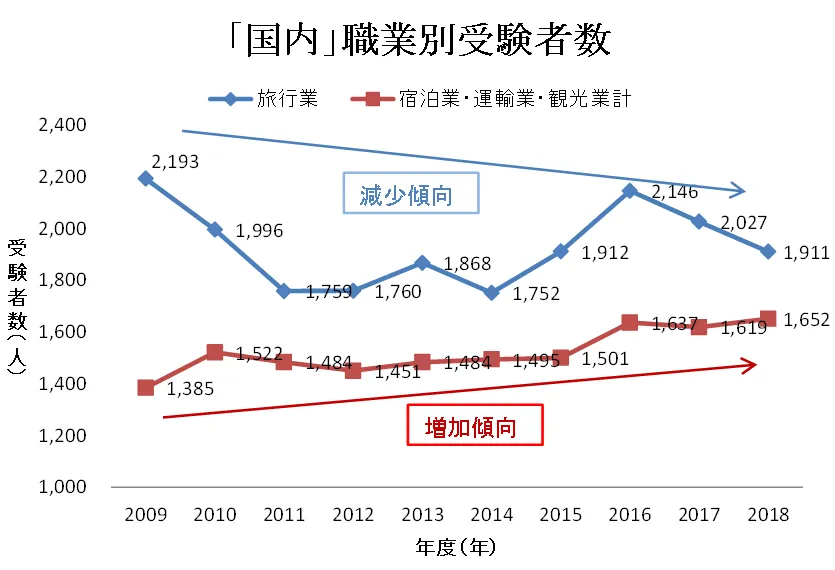
Tourism associations and tourism promotion corporations wish to obtain travel agency registration to enable the planning and sale of destination-based travel products; railway operators intend to station handling managers at many stations to plan tours originating locally; and bus operators similarly aim to station staff at their respective sales offices. Furthermore, accommodation providers are increasingly developing destination-based products, such as day trips departing from hotels. It seems likely that the view is spreading that individuals holding the "Domestic" license, who possess a broad range of knowledge, are necessary to attract and retain tourists and expand business operations. Additionally, students, who account for 48.9% of the total, are likely influenced by the fact that successful candidates hold an advantage not only in the travel industry but across various sectors during their job searches. It can be said that changes in the tourism environment are reflected in the composition of successful candidates for the Travel Business Handling Manager exam.
As for why the proportion of candidates from professions other than the travel industry and students is lower among "Comprehensive" exam passers compared to "Domestic" passers, industry changes such as the decline in the number of travel agency branches due to the rapid growth of OTAs (Online Travel Agents), as well as a decrease in the number of examinees caused by low pass rates (specifically, while the pass rate for those taking all subjects in FY 2018 was 11.0%, a recovery from the 8.8% in the previous FY 2017, an increasing number of students are avoiding taking the exam altogether due to its difficulty).
3. Future Challenges and Outlook
Recently, we have received many requests such as, “We want our staff to take the national exam to revitalize the town through destination-based tourism, so please send an instructor,” or from young people working in agriculture who say, “I want to obtain this qualification and start my own business to promote the region’s appeal where I live,” and from students at local schools who have obtained the national qualification and “secured employment as new graduates at the regional tourism promotion corporation.” We sense that the previous mindset of “I don’t need a qualification because I don’t work for a travel agency” is becoming less common.
While the “Travel Business Handling Manager” qualification was previously viewed primarily as a credential for travel agency employees, as its adoption spreads among a wide range of businesses in the tourism sector, its benefits are expected to extend beyond the creation and sale of travel products to various other areas. As regions seek to revitalize their local economies through tourism promotion, the role of certified professionals—who possess a solid foundation in the Travel Agency Act, standard travel agency terms and conditions, and domestic business practices—in managing and supervising operations to provide appropriate products (destination-based tourism plans) is becoming increasingly important.
Regarding administration, there were comments that it was difficult to take the exam in the first FY because there were only two test centers nationwide. If the goal is to genuinely increase the number of “region-specific” passers, shouldn’t we aim to expand exam opportunities by establishing at least nine test centers nationwide—similar to the “domestic” exam—and, if possible, setting up test centers in every prefecture? With the rapid growth of inbound tourism and major events such as the 2019 World Sports Championships and Tokyo 2020 on the horizon, the opportunities and venues requiring personnel to support the tourism industry are increasing. Consequently, we expect that the scope of work for “Travel Business Handling Managers” will expand beyond existing travel agencies.