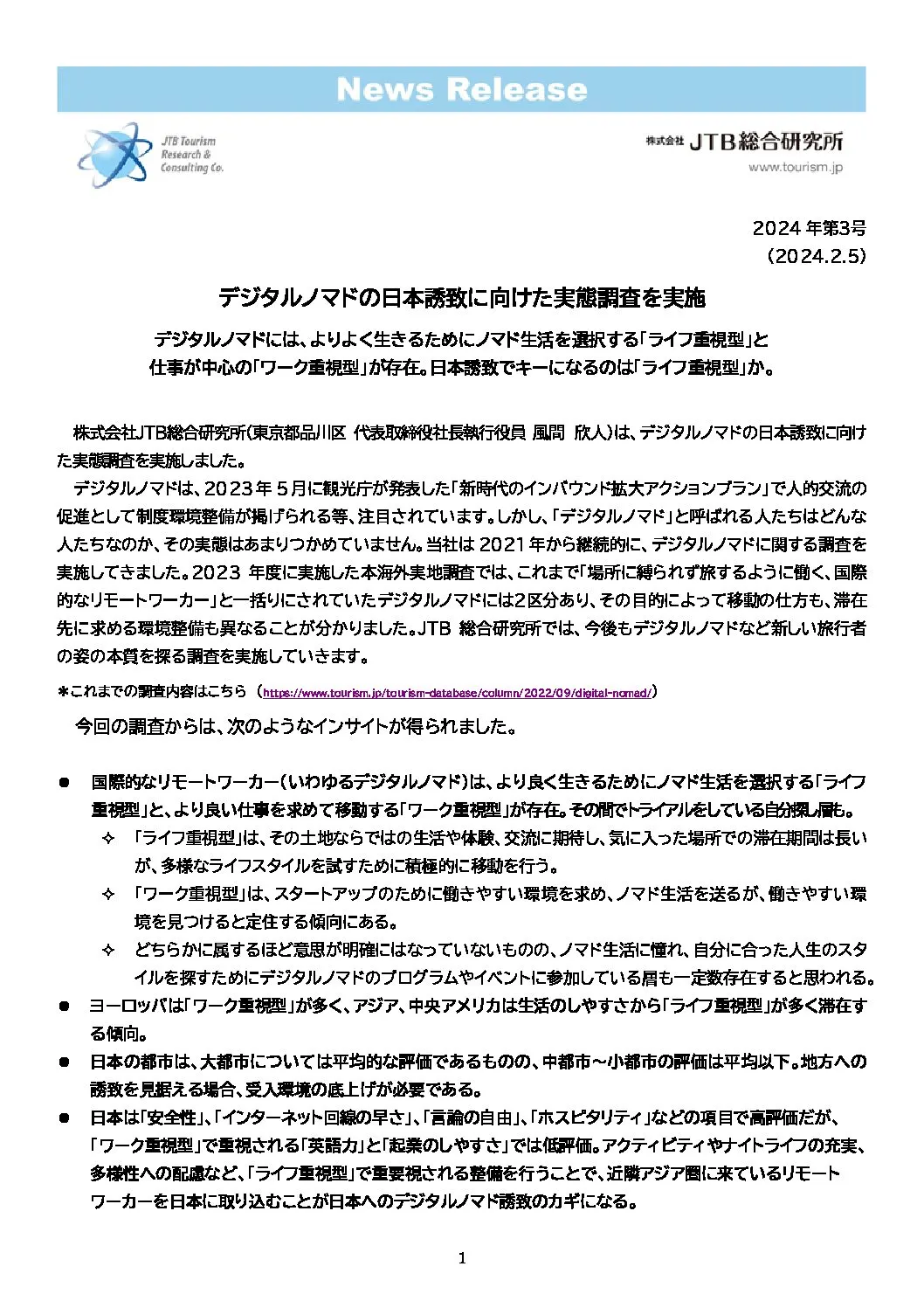
Survey Conducted to Attract Digital Nomads to Japan ~ Digital nomads fall into two categories: "life-oriented" individuals who choose a nomadic lifestyle to live better, and "work-oriented" individuals for whom work is the priority. The "life-oriented" group may be the key to attracting them to Japan ~
Digital nomads have been garnering attention, as evidenced by the Japan Tourism Agency’s “Action Plan for Expanding Inbound Tourism in a New Era,” released in May 2023, which identified the development of institutional frameworks as a key measure to promote people-to-people exchanges. However, little is known about the actual characteristics of the people referred to as “digital nomads. ”Our company has been conducting surveys on digital nomads on an ongoing basis since 2021.Through this overseas field survey conducted in FY 2023, we discovered that digital nomads—previously grouped together as “international remote workers who work while traveling, unbound by location”—can be divided into two distinct categories. We found that their travel patterns and the environmental requirements they seek at their destinations differ depending on their objectives. JTB Tourism Research & Consulting will continue to conduct surveys to explore the true nature of new types of travelers, such as digital nomads.
Key Findings
- Among international remote workers (so-called digital nomads), there are two main types: "life-oriented" individuals who choose a nomadic lifestyle to improve their quality of life, and "work-oriented" individuals who move in search of better job opportunities. There is also a group of people in between who are experimenting with this lifestyle as they search for their identity."Life-oriented" individuals look forward to the unique lifestyle, experiences, and interactions that a particular region offers; while they tend to stay longer in places they like, they actively move around to try out diverse lifestyles.
"Work-focused" digital nomads seek an environment conducive to working on startups and lead a nomadic lifestyle, but tend to settle down once they find a suitable work environment.
While their intentions may not be as clearly defined as those in either of the other two categories, there appears to be a significant number of people who are drawn to the nomadic lifestyle and participate in digital nomad programs and events to find a life style that suits them. - Europe tends to attract more "work-oriented" people, while Asia and Central America tend to attract more "life-oriented" people due to their livability.
- While Japan’s major cities receive average ratings, medium-sized and small cities score below average. With a view to attracting businesses to regional areas, it is necessary to improve the overall quality of the business environment.
- Japan receives high marks in categories such as "safety," "internet speed," "freedom of speech," and "hospitality," but scores low in "English proficiency" and "ease of starting a business"—factors prioritized by "work-focused" digital nomads.The key to attracting digital nomads to Japan lies in developing the infrastructure valued by "life-oriented" workers—such as a rich selection of activities and nightlife, and a commitment to diversity—to draw remote workers currently based in neighboring Asian countries to Japan.
JTB Research Institute Co., Ltd. (Shinagawa-ku, Tokyo; President and CEO: Yoshito Kazama) has conducted a survey to assess the current situation regarding efforts to attract digital nomads to Japan.
Digital nomads have been garnering attention, as evidenced by the Japan Tourism Agency’s “Action Plan for Expanding Inbound Tourism in the New Era,” released in May 2023, which identified the development of institutional frameworks to promote people-to-people exchanges. However, little is known about the actual characteristics of those referred to as “digital nomads.” Our company has been conducting surveys on digital nomads on an ongoing basis since 2021.Through this overseas field survey conducted in fiscal year 2023, we discovered that digital nomads—previously grouped together as “international remote workers who work while traveling without being tied to a specific location”—can be divided into two distinct categories. We found that their travel patterns and the environmental requirements they seek at their destinations differ depending on their objectives. JTB Research Institute will continue to conduct surveys to explore the essence of new types of travelers, such as digital nomads.