A Journey Where People Connect, Transcending the Physical and Distance [Part 2]

This series explores the "line" between the everyday and the extraordinary in the lives of travelers, examining different perspectives on travel. For the fifth installment, we return to the topic of "OriHime," the telepresence robot developed by Orii Laboratory Inc. In today’s rapidly evolving technological society, what role does travel play, and what does its future hold?
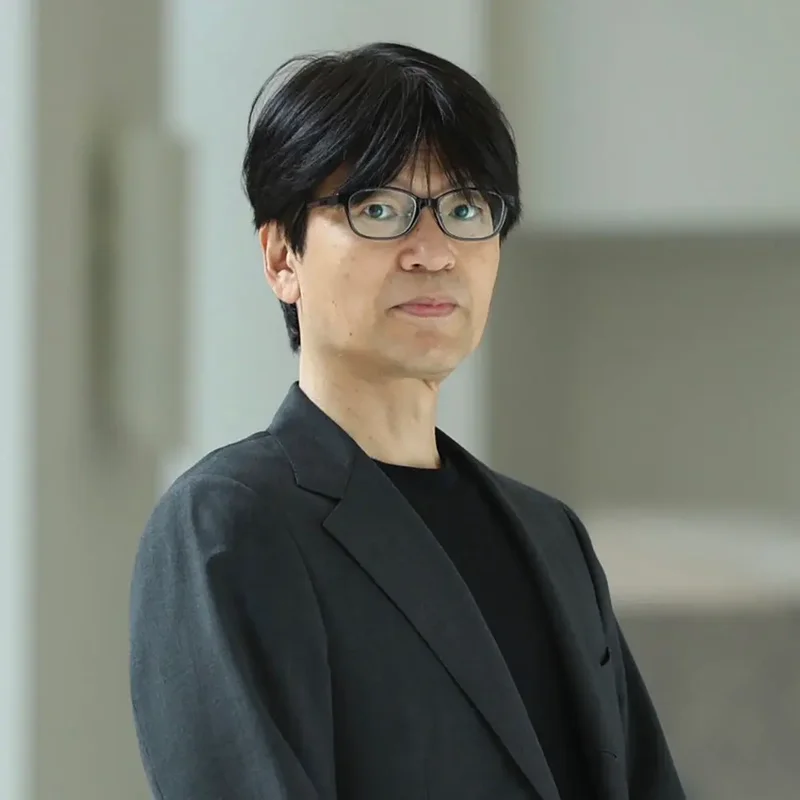
Born in Nara Prefecture. He did not attend school from fifth grade through ninth grade. While in high school, he invented a new mechanism for electric wheelchairs, winning the Minister of Education, Culture, Sports, Science and Technology Award at the Japan Science & Engineering Challenge (JSEC) and representing Japan at the Intel International Science and Engineering Fair (Intel ISEF), where he received the Grand Award (3rd place).After graduating from Waseda University, he pursued research and development of avatar robots aimed at alleviating loneliness using a unique approach, and established Orii Laboratory Inc. in 2012. In 2021, he received the Good Design Grand Award 2021, the highest honor bestowed by the Good Design Awards.
Advances in technology have profoundly transformed our lives and are reshaping the way we travel. Orii Yoshifuji, the developer of the telepresence robot “OriHime,” has made it his mission to “alleviate human loneliness” based on his own experiences and the voices of the people he has met, and he continues to conduct research and development with this goal in mind.His work extends beyond providing technical support to those struggling with loneliness for various reasons; it also fosters human encounters, emotional connections, and the creation of communities. Through Orii’s perspective, we explore the new possibilities for travel brought about by technology and the future of travel as a means to deepen human connections.
What Role Can Travel Play in "Eliminating Loneliness"?
In Part 1, we introduced the avatar robot OriHime and the pilots working at the Avatar Robot Café DAWN ver.β (hereinafter Café DAWN). They connect with society by overcoming physical limitations and the barriers of distance, meeting a variety of people, and opening up new possibilities for interaction.
In this second part, we spoke with Orii Yoshifuji, the developer of OriHime and a man whose mission is to “eliminate human loneliness,” about human connections and the potential of travel.
Even if it’s inefficient, people want to go out and meet others in person
Author: You have consistently pursued the mission of “eliminating human loneliness.” What potential do you see in travel?
Mr.Orii: I believe travel has the potential to alleviate loneliness. First, “movement,” “dialogue,” and “role” are crucial for “alleviating loneliness.” My hypothesis is that loneliness can be alleviated by removing the obstacles that hinder these elements.
I used to be a shut-in myself, so I’ve always wondered, “Why do people go out?” To get to school or work, we eat breakfast, take a shower, pick out clothes, and get ready in front of the mirror. Assuming a one-hour commute each way, we spend roughly three hours a day just on travel.I think it used to be difficult to live without leaving the house, but now that remote work has become widespread and more things can be done online, we are also using OriHime to support people who have difficulty getting around. In other words, even though we’ve entered an era where it’s possible to live without moving around, people don’t stop doing so. Many people are willing to invest that time just to meet others in person and connect with society.It may not be rational, but I believe there is that much value in “going out.”
Author: What exactly is the value of “going out”?
Mr.Orii: I spent my childhood barely speaking to anyone, and I overcame that by trying various methods. People who have similarly emerged from loneliness—though their situations and methods vary—all say one thing in common: “I am who I am today because that person was there for me at that time.”
At technical college, I was researching “friend robots,” hoping that artificial intelligence might offer healing. But when I emerged from my reclusive life, I realized that “I was shaped by my encounters with others,” and that “people are healed not by AI that adapts to them, but by talking to others and meeting friends who are a good fit.” So I stopped that research.
Having failed many times in my attempts to change myself, I believe that neither people nor I change easily. However, I have experienced firsthand time and again how meeting someone, listening to their stories, or doing something together—such encounters with others—can influence one’s life and serve as a turning point.
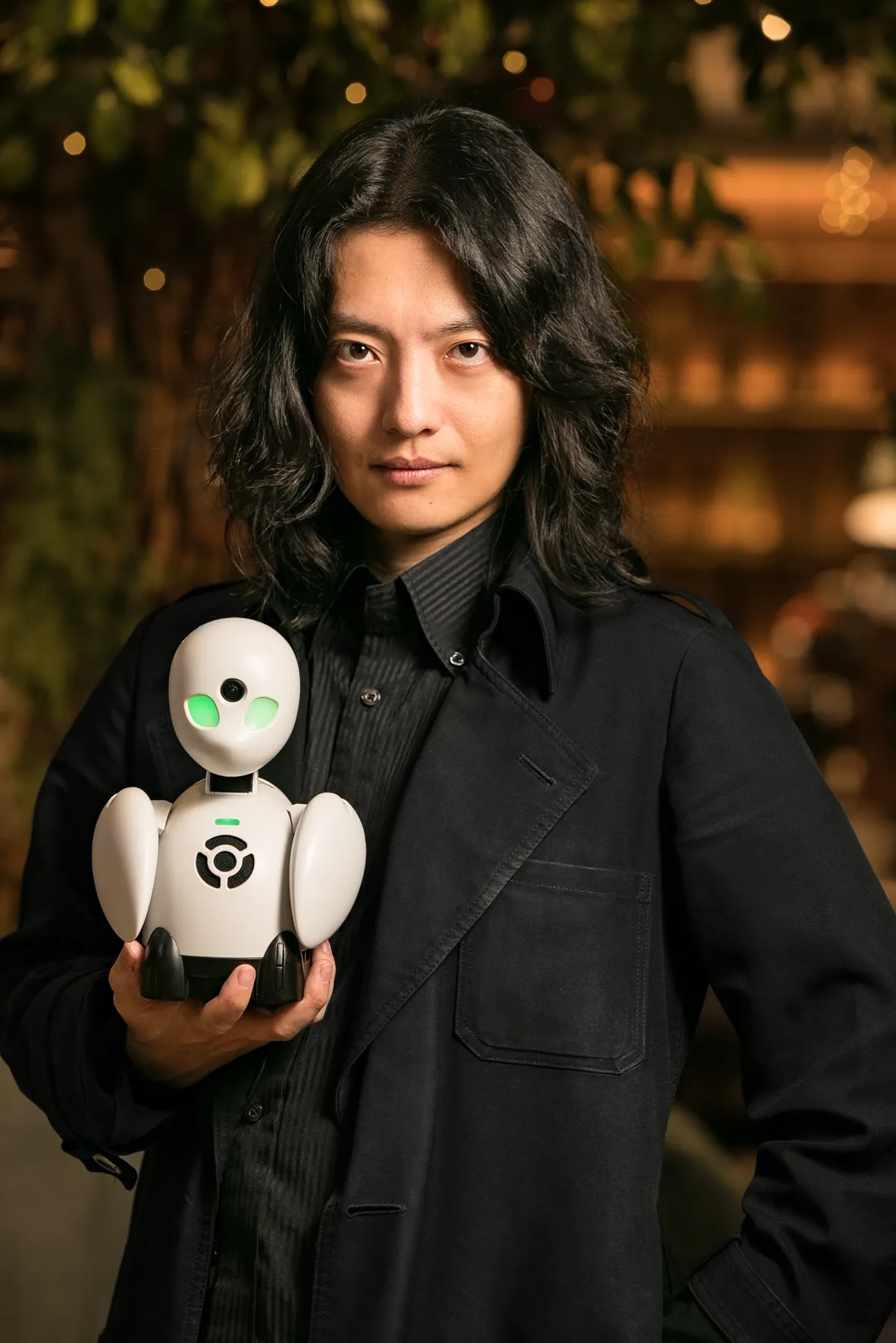
there together” through OriHime (Photo courtesy of Orii Laboratory Inc.)
The greatest handicap of being unable to move is “the lack of encounters and discoveries in life.”
Author: So, in other words, “going out” is important in order to “meet people.”
Mr.Orii: I started taking an interest in other people around the age of 20. As I listened to the life stories of others, I realized that each person’s background was shaped by their family environment and hardships, and I found it fascinating that they held values and perspectives on life that were completely different from my own. Additionally, in my case, I have many opportunities to interact with people with disabilities, and I feel that many of them, in particular, spend a lot of time reflecting on life. While worrying about things like, “Why did I get this illness?” or “Am I a burden because I can’t live without someone else’s help?”, they’re also thinking about “what they should do to live their lives,” and I often learn a lot from them.
In particular, my bedridden best friend and secretary, Yuta Banda, who passed away in 2017, once said, “The greatest handicap of being unable to move is that there are no encounters or discoveries in life. ”There are countless inconveniences associated with being bedridden—not being able to move even within one’s own home, not being able to look out the window, or not being able to open the refrigerator. But for Banada, who spent 20 years from the age of four largely bedridden in hospitals, unable to attend school and with almost no close friends, the greatest handicap of all was “the lack of encounters and discoveries.”
Author: I hear you’ve also given lectures together with Mr. Bandai about his “20 years as a bedridden patient.”
Mr.Orii: Without those conversations, I would never have learned about those perspectives on life or gained those insights. While we can’t walk a different path in life, I believe that listening to stories of lives we don’t know can greatly expand our sensibilities and values.
Based on those experiences, I began to focus intensely on realism with OriHime, wondering if I could somehow create the sensation of “being there myself.” Of course, I’ve always liked VR and the metaverse, and I think those approaches are possible too. But I named it OriHime based on the desire to create the sensation of “being there in real time, in a real place, in reality,” and the wish to “be able to meet the people I want to see, even when we’re in different places.” The concept I first envisioned during my university days has led to where we are today.
Author: As Mr. Bandai mentioned, when freedom of movement is restricted, opportunities to meet people decrease. On the other hand, even people who can move around freely sometimes feel lonely. What do you think is necessary to create opportunities for connection?
Mr.Orii: A state of loneliness might simply mean you haven’t met someone you click with yet. However, it’s hard to meet people without a specific reason, isn’t it? For example, if you commute on trains in Tokyo every day alongside hundreds of people, you’d think it wouldn’t be unusual to make friends among them, but the reality is different. In other words, how you meet people is what matters.
I was interested in the conditions under which that kind of “conversation where we share our views on life” arises. I had a hypothesis that creating situations where questions arise naturally—like the kind of communication that happens while traveling—could lead to meaningful connections. That hypothesis is becoming a conviction through the current state of Café DAWN.
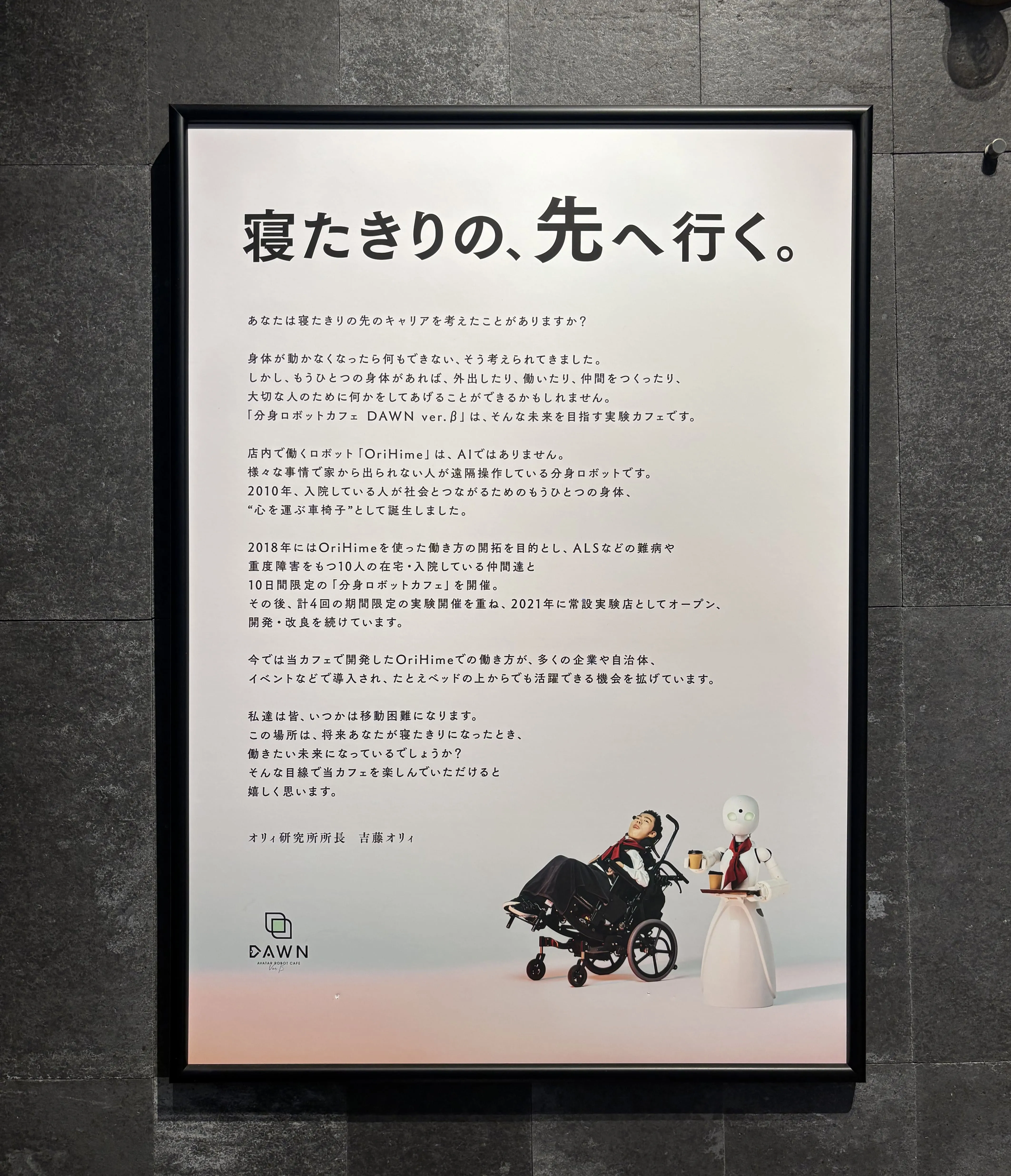
A New Initiative: Walking with Avatar Robots
In my conversation with Mr. Orii, he suggested the potential of travel as a means to “alleviate human loneliness.” Furthermore, the Orii Institute is not limited to Café DAWN; it is exploring the possibility of a new experience: walking through the city with an OriHime robot perched on one’s shoulder.
Taking OriHime out on the town
I had the opportunity to walk through the city with OriHime perched on my shoulder. While we interact face-to-face at Café DAWN, OriHime on my shoulder felt like a partner walking alongside me from the same perspective—a completely new experience.
Even though I, who move around Tokyo every day as a matter of course, and the pilot—who doesn’t usually walk freely or has never visited that place—are walking the same path and seeing the scenery from the same perspective, our feelings, observations, and interests differ.As we conversed—asking things like, “What kind of wind is blowing right now? What’s the temperature like?” or “I thought I heard a bird singing just now; was there something there?”—my attention turned to things that had become too ordinary for me. While walking with a real person also brings discoveries, I felt that interacting with a pilot generated even more insights, precisely because of the significant difference in our backgrounds.
We’ve begun testing whether this experience can be developed into a guided tour. In a typical guided tour, the guide leads the visitors, shares prepared information, and serves as a guide. However, with the shoulder-mounted OriHime, while it can provide information, the visitors are the ones actually walking, and the guide cannot control whether they take detours or not.
Furthermore, walking with OriHime on your shoulder tends to spark casual conversations with strangers due to its presence. Neighbors who initially wondered, “What’s that?” now greet me, and children run up to me. When I tried it myself, I was surrounded by foreign children on vacation and approached by a passing woman who smiled and struck up a conversation.
“Unlike inside Café DAWN, there are many serendipitous and unexpected elements outside. It’s a collaborative effort to create a journey while enjoying those moments. By thinking together, sharing insights, and filling in the gaps, each journey becomes completely different depending on the customer. It’s different from a typical guided tour, but I hope people will find that unique and interesting,” the pilot told me.
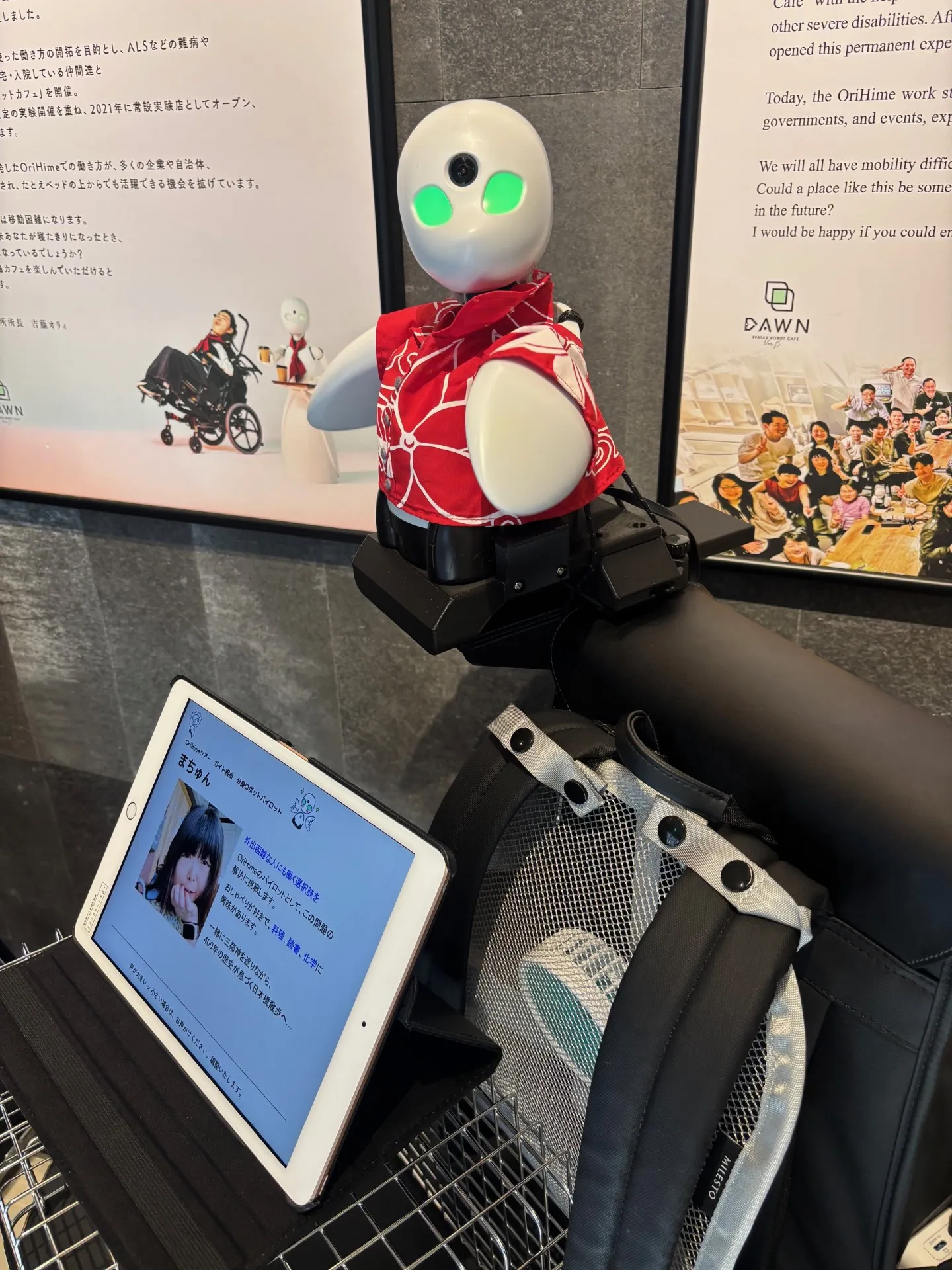
The specially designed backpack for walking together, refined through numerous iterations (Photo by the author)
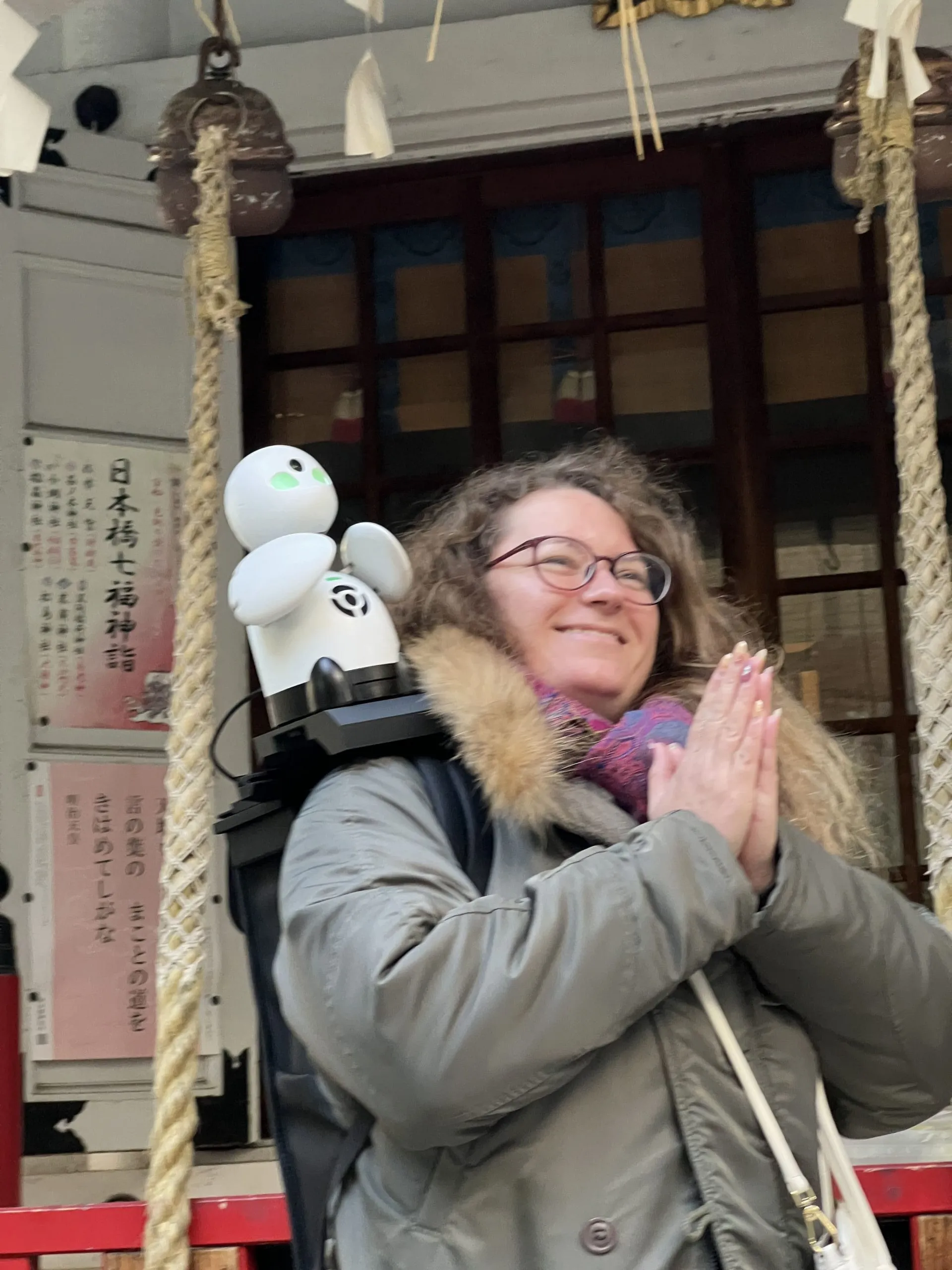
the backpack rests on (Photo courtesy of Orii Laboratory Co., Ltd.)
Technology is changing both people’s common sense and the landscape of society
The idea for the shoulder-mounted OriHime predates Café DAWN. Initially, there were negative reactions, with some saying, “No one would do something so embarrassing,” but now, with the spread of AI and robots, lifestyle changes due to the COVID-19 pandemic, and the increase in foreign tourists, it has become more widely accepted as society evolves. Indeed, just as it has become commonplace to see people walking through the streets using smartphones and wireless earbuds, talking to themselves as if in a monologue, technology is changing both our common sense and the landscape of society.
The Shoulder-Ride OriHime also holds potential as a proxy experience that “takes people who cannot go out into the world.” For example, a bedridden child could participate as a “pilot,” not only joining school trips or field trips they had given up on, but also experiencing the casual daily lives of elementary school students their own age. Such a “life-exchange experience” might be an intriguing form of travel in the future.
Essentially, it involves people who would rarely encounter each other in daily life traveling together. This is not a one-way relationship; rather, it can become an opportunity for mutual insight and introspection by sharing each other’s backgrounds, perspectives, and sensibilities. Unlike traditional “travel to a destination,” this is an experience that enriches life by meeting people through travel and exchanging perspectives and values. I sensed the potential for travel to evolve more than ever before into an activity aimed at fostering emotional connection.
On “Travel” Evolved by Technology and Its Meaning in the Modern World
OriHime embodies the “essence of travel”—creating opportunities for people to meet by overcoming physical limitations and the barriers of distance. Moreover, it provides not only travelers but also people who have felt lonely—such as the pilots working at Café DAWN—with new connections and roles.
Mr. Orii aspires to create a form of travel that allows everyone to continue building new discoveries, encounters, and connections with special places and people throughout their lives. Furthermore, in an aging and increasingly diverse society, he believes that for people to live without feeling lonely, it is essential to have a role where they are needed by others and receive gratitude in the form of a “thank you.” “With ‘mobility’ as our core, we want to use technology to address social issues such as labor shortages in the tourism industry while further advancing efforts to alleviate loneliness,” he said.
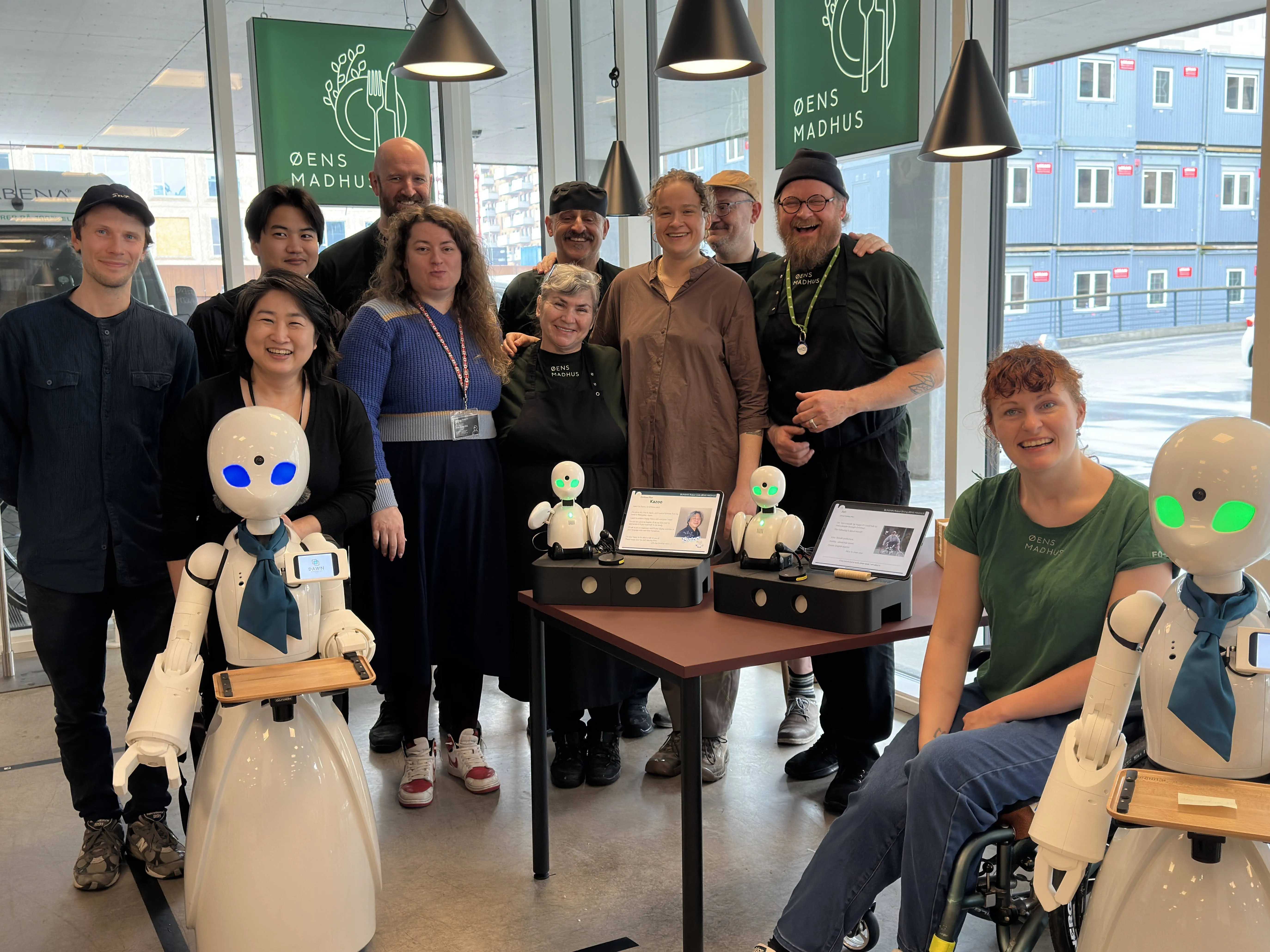
This spring, a limited-time avatar robot café opened in Denmark (Dates: April 2–September 30, 2025).Even when mobility is difficult, the pilots use OriHime to interact with many local people while sharing the feeling of “working in the same workplace” with colleagues over 8,000 km away. OriHime’s challenge to overcome distance, barriers, and conventional wisdom continues.
People who would never have met are connecting, exchanging their backgrounds and perspectives, and gaining new insights. And their lives are becoming richer. This is the essence of “travel,” and tourism can be said to be what creates value and jobs beyond that. While encounters and interactions may change form through technology, they will remain deeply etched in our hearts and continue to influence our lives moving forward.
A Word from the Observer of “Lines”
A person’s values and outlook on life are fundamentally shaped by encounters in daily life—whether through the place where they grew up, school, work, hobbies, or other points of connection—and the accumulation of these experiences. In today’s so-called information society, the world may appear to be expanding at first glance, but the information we encounter daily is streamlined and personalized, which may actually be narrowing our perspective. We also hear about topics such as filter bubbles*1 and the echo chamber phenomenon*2. Travel has long been regarded not only as a contributor to economic growth but also as a means to broaden one’s horizons and deepen mutual understanding of cultures and values. Perhaps this is why modern travel is increasingly expected to play a role in overcoming the drawbacks of the information society and allowing people to engage with diverse values across borders.
著者