
“Tourism × Community Development”: Toward Creating Communities Where Residents and Visitors Intermingle (Roundtable Discussion)
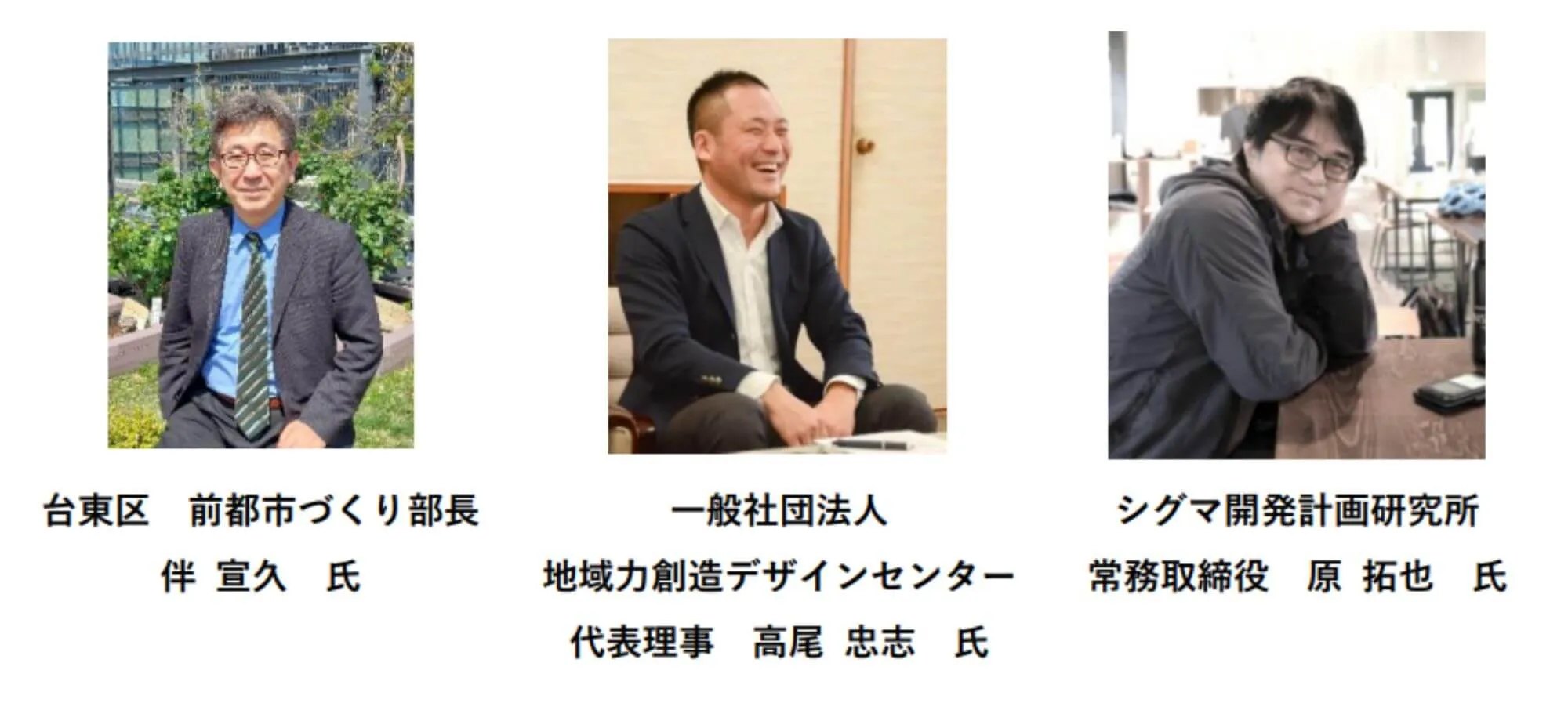
In this new era, where the value of local communities is being rediscovered and the lines between residents and visitors are blurring, how should urban development proceed? We spoke with Mr. Nobuhisa Ban, former Director of Urban Development for Taito Ward; Mr. Tadashi Takao, Representative Director of the Regional Strength Creation Design Center (General Incorporated Association); and Mr. Takuya Hara, Managing Director of Sigma Development Planning Institute, to hear about their initiatives and perspectives from the viewpoints of local government, academia, and development consulting, respectively.
With the spread of social media and the diversification of values, people have begun visiting towns that were not traditionally considered “tourist destinations.” At the same time, however, as the local population declines, the number of people “managing the community” is shrinking, making it increasingly difficult to divide the region into distinct “tourist areas” and “residential areas.”
As local values are rediscovered amid global trends and “micro-tourism” is advocated during the COVID-19 pandemic, how should urban development proceed in this new era? We heard about the initiatives and visions for the future from representatives of local governments, academics, and consultants who support regional management.
*This article is based on a panel discussion held during an online seminar conducted by JTB Tourism Research & Consulting on August 11, 2021.
1. Recent Trends in Urban Development
—Projects Promoted with a Focus on “Creating” and “Using” by Multiple Stakeholders—
[Kono]
In the past, urban development was carried out by major general contractors, and this trend continues even today in metropolitan areas. On the other hand, in so-called traditional downtown areas, residential neighborhoods, and regional cities, encouraging resident participation in urban development has become a standard practice, and there is a growing demand for urban development that ensures a comfortable environment for both residents and visitors. What are the key points of urban development in recent years and for the future?
[Hara]
In the “Kamagaya Station East Exit Project” in Kamagaya City, Chiba Prefecture, the NPO KAO no Kai was established to carry out building development. The NPO receives commissions from residents and the local government to manage and operate tenant spaces, generating regular income. This can be cited as an example of a compact, sustainable initiative that addresses funding and other operational needs for the town. In the redevelopment project for the Nayabashi East District in Nagoya City, we established community spaces for residents, warehouses, freight elevators, and rent-free back-office facilities, creating a system where owner organizations, neighborhood associations, and community groups can economically support one another. The key to area management lies in the interconnection of three elements: creating spaces, establishing rules, and building systems. I feel that it has become much easier in recent years to proceed with these initiatives through discussions with the local community.
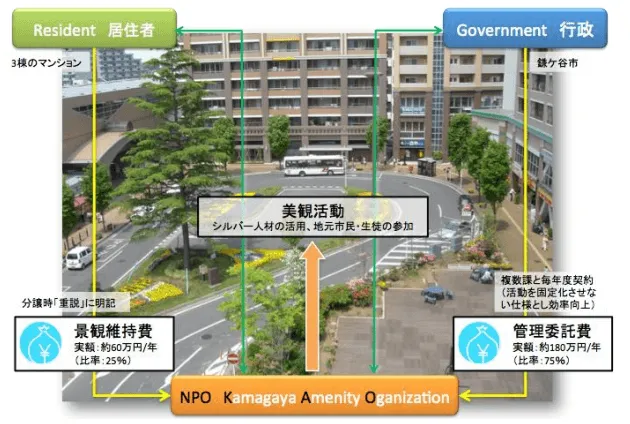
Source: Provided by Mr. Hara
[Ban]
Taito Ward is divided into seven districts with distinct characteristics, with 20% residential and 80% commercial areas. A survey of ward residents revealed that a certain proportion of residents view the increase in tourists unfavorably. Given this situation, Taito Ward’s Urban Master Plan aims to create a vibrant community while balancing residential and tourism needs. Most recently, in the area surrounding Ueno Station, measures were implemented to address issues caused by tourist buses, such as noise. These included parking solutions through the introduction of dedicated parking lots and a reservation system, as well as adjustments to pedestrian flow, such as converting crosswalks into roundabouts. It is crucial to make physical improvements to ensure that the increase in tourists does not become a burden on the local community and does not impose inconvenience on the tourists themselves.
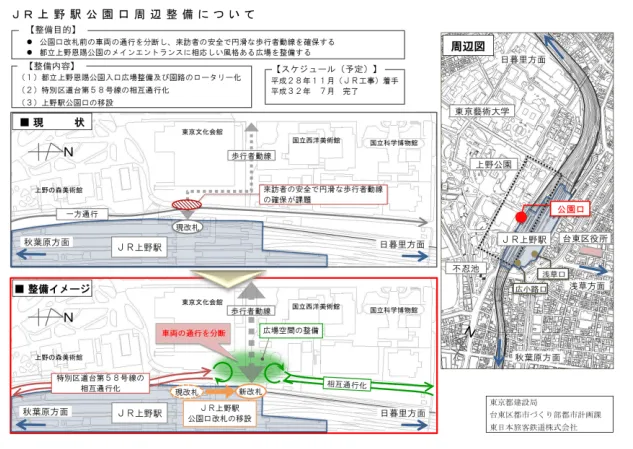
Source: Provided by Mr. Ban
[Takao]
A town or space consists of hardware, an OS (system), and software built on top of that. Simply updating the software alone won’t work; we are taking on the challenge of industrializing community interaction while simultaneously improving the hardware and systems—such as deregulation.
Public works projects have traditionally been carried out with the goal of “building,” but values have shifted in recent years. We are now able to discuss “use” and “build” as an integrated whole, creating while considering how the space will be used.
I am a core member of the project to develop the area around Nagasaki Station, and from the design stage onward, we have been proceeding by listening to the opinions of residents and the business community regarding how they would like to use the station once it is completed. Public works involve various stakeholders. Whether updating the physical infrastructure or establishing the systems that will operate it once completed, it is becoming increasingly important for all stakeholders to share a common vision for the area’s future and to move forward in a collaborative manner.
2. The Urban Development Process
—Expanding the Circle of Activity Starting from a Place That Serves as a “Base” for Residents—
[Kono]
A major role of the government is to continuously communicate the vision we have created and to establish the mechanisms for the town’s operation. To build a sustainable town that aims to “balance daily life, the economy, and community interaction,” we must envision what kind of society will exist in the future—how many years from now—and consider how to get residents and businesses to resonate with that vision. What are the key perspectives in that process?
[Ban]
Regarding the Ueno District urban development vision, we sought to share a common image of Ueno’s future using the phrase: “Ueno: A stage where forest culture and urban vibrancy come together—The essence of the world, the essence of Tokyo.” Currently, the profiles of stakeholders and visitors in the “forest” centered around Ueno Park and the “town” centered around Ameyoko are separate. However, our goal for the future is for these two groups to merge, thereby expanding the arena for everyone’s activities.To facilitate a shared, intuitive understanding of this vision, we collaborated with JTB Tourism Research & Consulting to create illustrative renderings depicting the future of the area surrounding Ueno Station. It is crucial to be able to share a vision of the town’s future through a single image.
We are no longer in an era where the government takes the lead in physical infrastructure development; instead, our primary role is to support the local community. We provide financial assistance and dispatch consultants to local organizations. The draft vision for the town was proposed to the ward by the local community, and the final vision was formulated following discussions within a planning committee comprising academics, national government representatives, the Tokyo Metropolitan Government, and railway companies. Even after its formulation, we continuously strive to share and embed the vision through activities such as lectures by committee members for local organizations.
Currently, based on this vision, we are implementing improvements to transform the area near the Tokyo University of the Arts into a public space centered on art, called “Art Cross.” We are also in discussions regarding landscape improvements to strengthen pedestrian routes from the area surrounding the university toward Uguisudani Station.
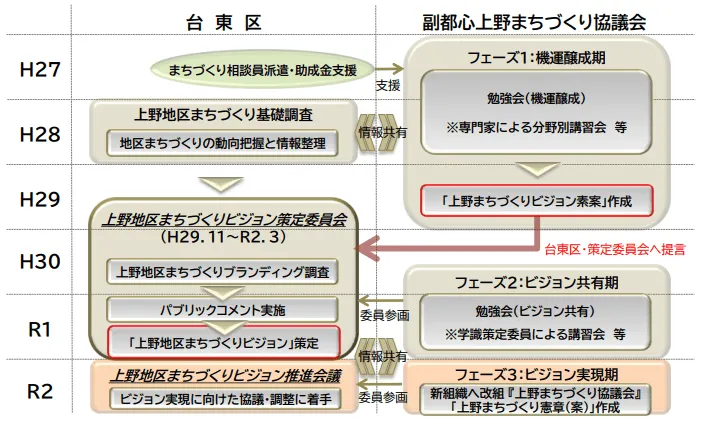
Materials on the Formulation of the Ueno District Community Development Vision: Provided by Mr. Ban
[Kono]
How are the various entities and stakeholders involved in recent
urban development initiatives increasing in number?
[Hara]
There is no manual or standard approach to involving people, but it is important to create spaces and opportunities where people can become comrades-in-arms and share moving experiences.
In Kawasaki, we are supporting urban development around Kashimada Station. Rather than starting with the construction of large-scale facilities intended to be the core of attracting visitors, we began by establishing a small café to serve as a community hub for the area. By holding various exchange events at this hub, people began to gather. As the circle of people grew and relationships developed where everyone felt comfortable talking to one another, ideas began to emerge. As numerous small initiatives to bring these ideas to life gain momentum, government interest grows, and support begins to flow in. Even if the potential for a redevelopment project is identified as one option for advancing community development, redevelopment is a means, not an end. I believe the correct way to use redevelopment is for local stakeholders to utilize it as a tool to create the functions and spaces they desire.
In the early stages, it is essential to foster creativity and a sense of local identity. If individuals can find a direction within the government’s overarching plans that allows them to enjoy the process, they can contribute to the overall direction. In discussions during the early stages of town planning, core members must possess strong passion and adhere to the rules and beliefs that define the town’s development, but for those newly involved, it is necessary to maintain a sense of freedom to join or leave, as well as an appreciation for the unplanned and unfinished nature of the process.
In Kawasaki City, they created a conceptual map of a fictional city incorporating resident feedback gathered through repeated workshops. Using this map, they have organized various events ranging from adult discussions to coloring activities for children. Through these activities, people from young children to adults have begun to discover their own visions for the city, leading to a situation where discussions about town planning can take place loosely and naturally in social settings.
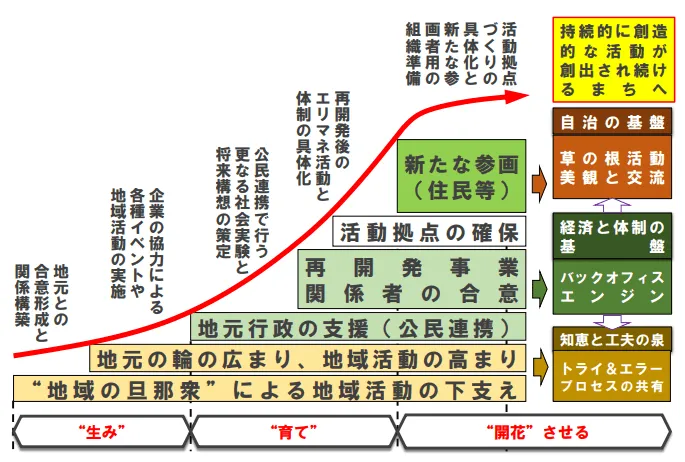
local value. Source: Provided by Mr. Hara
[Takao]
We are at a point where we must shift the definition of tourism from simply counting how many people we attract to the area to providing experiences—that is, to human interaction. If we redefine tourism as interaction, the very dynamic between residents and tourists will change. I believe the standard approach to creating a new community will be a cumulative process: small changes within the area, as Mr. Hara described, lead to shifts in how everyone in the community perceives things, and the influx of visitors through these interactions adds to that process.
On the other hand, administrative plans are also essential for updating the “hardware” and “operating system.” I believe it is crucial for community development to build a system that connects the grand vision formulated collaboratively by the government and the community with the organic events unfolding on the ground.
I believe that if a team of coordinators—each with their own areas of expertise, much like those who have supported Taito Ward’s vision-building—is at the heart of a community, that community will undergo significant transformation. When it comes to building a community, there are likely several stages or layers, such as the core team members and those who take action on the ground.
3. Shaping the Face of the Town
—A town’s identity is shaped by people’s daily lives and how the town is “used”—
[Kono]
As towns across the country face fierce competition to increase their resident and visitor populations, establishing a town’s uniqueness is becoming increasingly important. How should we express a region’s individuality through the town itself?
[Takao]
The issue of originality is always difficult. For example, when it comes to train stations, every region wants to make them the face of the area and give them a unique character.
Currently, Nagasaki City is advancing various development projects as part of its “once-in-a-century urban renewal” initiative, with New Nagasaki Station—scheduled for partial opening in the fall of 2022 as part of the West Kyushu Shinkansen—at its core. In today’s world, where harmony with the surrounding landscape, cost, and convenience are prioritized, there are very few cases where we can create a building with a strong individual character. Therefore, rather than expressing the essence of Nagasaki through the station’s spatial design, we decided to create a “vessel” where diverse local people could engage in activities according to the time of day and season. This pragmatic approach—aiming to make the station as user-friendly as possible to embody the spirit of Nagasaki—became a turning point in our discussions.
Rather than having the station itself represent the region, the discussion led to a focus on the station’s role in harmonizing with the surrounding landscape and serving as a vantage point—specifically, how the scenery of the entire city appears when passengers step off the train—as this is considered crucial for expressing the “essence of Nagasaki City.”
Furthermore, we view the nightscape as an initiative that aligns with the region’s unique character. Every single light in the nightscape is turned on by people, and people can choose where to shine that light. By building consensus within the community on where to direct the light—specifically on the areas we want people to see—it becomes content that the community can share. In Nagasaki City, we reviewed our lighting plans, and when we changed the lighting of the famous tourist spot, Megane Bridge, the people who were most delighted were the residents who see that view every day. Especially in tourist areas, the daytime scenery that residents and tourists see every day differs due to the differences in their respective spheres of activity. However, when it comes to the nightscape, tourists and residents stand side by side, looking at the same thing. It is important to create spaces, opportunities, and situations within the city where residents and tourists can mingle. I feel that the very fact of people gathering and mingling in certain places creates the city’s unique landscape.
[Ban]
In Taito Ward, we aim to develop a distinct identity for each of the seven districts. Here, I’d like to introduce the case of the Yanaka district, where residential and tourist activities coexist.
The Yanaka district retains many old buildings. There are numerous examples of Tokyo University of the Arts graduates settling in the area; they rent old apartments and operate traditional Japanese houses that serve as venues for community interaction, art events, and cafes. While there are no large-scale lodging facilities, an “Albergo Diffuso” (a decentralized hotel model integrated with the local community) has been established, based on the premise of renovating old buildings and utilizing nearby shops and public bathhouses. It is not the physical landscape of rows of old Japanese houses that defines the town’s character; rather, it is the accumulation of initiatives led by the local residents themselves—utilizing these distinctive local assets—that shapes Yanaka’s image as an “old yet progressive town” and an “old yet vibrant town.”
[Hara]
Previously, when we conducted a survey of foreign visitors to Japan as part of a Taito Ward project, many of those from Europe who had visited Japan two or more times responded that they wanted to experience the daily life of the local community. I believe that learning, experiencing, and feeling what the locals love and cherish is the most moving experience of all. In town planning as well, even without particularly famous temples or shrines, the foundation lies in the desire to cherish the public spaces within the town and to see visitors enjoy them.
When I once visited Hida Takayama, I saw an elderly woman arranging flowers in a single-stem vase on the eaves of her home. From her gestures, I sensed her love for the town and a sense of refinement, and that shaped my impression of Hida Takayama as a town.
The “face of a town” is its “impression,” and that impression is shaped by the “people of the town.”
I often use the phrase, “That sense of happiness becomes attached to the land.” I believe visitors can feel that sense of happiness attached to the land. It is the repetition of everyday, ordinary moments that creates value.
4. Conclusion
—Incorporating Visitors into the Townscape—
It was extremely impressive that a group of town-planning experts specializing in “hardware”—such as architecture, civil engineering, urban planning, and urban engineering—did not focus on how to design, maintain, and pass down sustainable infrastructure, but instead declared, “A town is its people.” This reveals the very essence of modern town planning.
A city is a living organism. The activities of its residents and visitors transform the daily landscape into something different every day, and that landscape becomes the city’s face, shaping its unique image. What expresses the “character of a traditional downtown” might be the voices of shopkeepers calling out to customers; what defines the “character of Shibuya” might be the dynamic, experimental initiatives at MIYASHITA PARK and the young people who gather there in response; and what defines the “character of a rural area” might be the changing state of the fields with the seasons, the sights and smells of farm work, and local festivals.
When visitors look at a town, can they imagine themselves blending into its landscape? Can they be inspired to want to become part of it? The goal is not to have visitors merely “consume” the town, but to make them part of the town’s landscape, so that the scenery—with visitors integrated into it—becomes the town’s face in its entirety.
著者













