
Changes in Airline Ticket Sales and Technological Innovation: Insights Gained Through "Hackathons," the Gateway for IT Professionals

In late May 2016, an event called The IATA NDC Hackathon 2016 was held in Berlin, Germany. A hackathon is a portmanteau of “hack” and “marathon,” and it is a research event where young system developers take the lead in showcasing their skills. In this article, we will examine how this hackathon addresses business efficiency and service improvement, with a focus on “technological advancements.”
"Hackathons": A Launchpad for Young IT Professionals
In late May 2016, an event titled “The IATA NDC Hackathon 2016” was held in Berlin, Germany. A hackathon is a portmanteau of “hack” and “marathon,” and it is a research event where young system developers take center stage to compete and showcase their skills.
This time, the theme was “business travel arrangements,” and the winners were selected on the final day of the three-day event. Along with a cash prize, the winners were also awarded the opportunity to present their work to hundreds of corporate buyers at international aviation industry conferences held in Geneva, Switzerland, and Dubai. In other words, this event also serves as an incubation ground for the aviation distribution business.
What is the significance of an aviation industry association hosting such an event? To understand this, we must first examine the background.
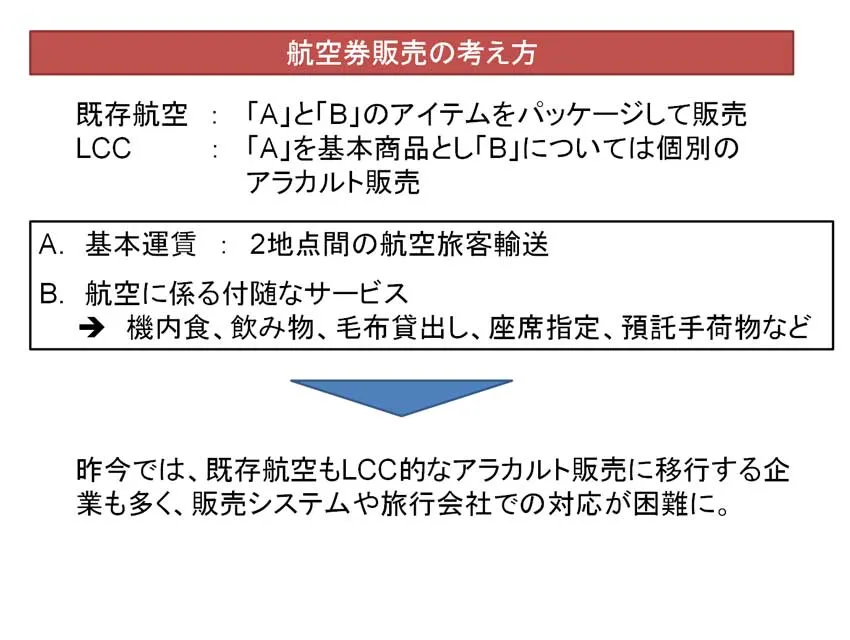
In traditional airline ticket sales, purchasing a single ticket has traditionally included not only “air transportation between two points” but also ancillary services such as “in-flight meals,” “beverages,” “checked baggage,” and “seat selection. ”However, low-cost carriers (LCCs), which have emerged in recent years, use the basic fare for transportation between two points and implement an à la carte sales model where other ancillary services are sold separately as needed. As this rational approach has been accepted and established by consumers, the need for à la carte sales has also grown among traditional airlines.
Until now, package sales through travel agencies have been the mainstream method for selling airline tickets. Since it was sufficient to sell a single ticket for each individual flight segment, the communication standards for sales and distribution had an extremely simple structure. Consequently, implementing à la carte sales proved difficult using the existing communication formats connecting airlines and travel agencies, making the resolution of this issue an urgent priority.
In light of this situation, IATA announced a next-generation sales and distribution communication standard: NDC.
A New Communication Standard to Address Changes in Airline Ticket Sales: NDC
NDC stands for New Distribution Capability. It is a communication standard that, in addition to traditional functions such as flight reservations, ticketing, and payment processing, supports the individual sale of various other aviation-related services, as well as the sale of products outside the aviation sector. IATA explains the significance of NDC as follows:
- A system that is significantly easier to use and more powerful for business travel coordinators.
- Enables cross-selling of products and down-selling (through searches for lower-cost fares).
- Detailed responses to individual needs.
- It is a standard that enables the development of systems to compare all fares across all airlines and present the best available tickets, aiming for a user experience similar to shopping on "amazon.com."
To summarize, NDC is a standard that brings companies closer to their customers and enhances usability, while also supporting operational streamlining for travel agencies and corporate clients.
Development Challenges at the Hackathon and Their Background
This hackathon event is hosted by IATA (International Air Transport Association), an industry association comprising airlines from around the world. The purpose of this event is to develop more user-friendly systems for the business travel sector using the NDC API developed and released by IATA.
While existing IT companies, primarily major GDS providers, have historically developed and operated air ticket distribution systems, this hackathon was organized to target emerging IT companies (and their engineers) with expertise in the internet sector, with the aim of further promoting their entry into the aviation business.
Participants are given development challenges across two categories—"Business Travel" and "Travel Data"—and are asked to select from a total of five challenges (development themes). (See figure below)
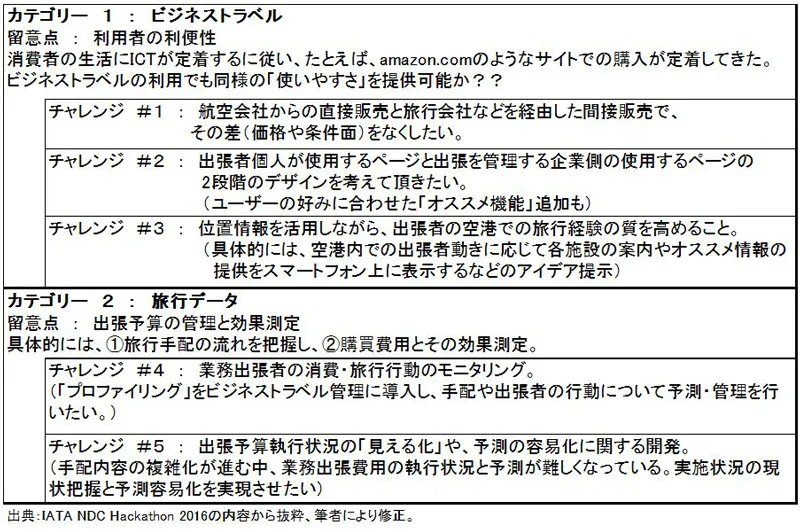
These development challenges clearly aim to improve convenience and usability for business travel users, as well as to enhance operational efficiency for corporate travel managers and business service providers.
If this development becomes a reality, it is highly likely to lead directly to the streamlining of product distribution by service providers such as airlines (including reduced sales costs and increased opportunities for direct sales). While this is “good news” for airlines and client companies that conduct business travel, it also carries the risk that intermediaries—such as travel agencies supporting business travel operations—may lose their business significance.
The Main Battleground for Airline Product Distribution Shifts to the Technology Sector
For airlines, the efficient distribution of diversifying products and cost reduction are pressing issues. The shift from indirect to direct sales leads to reduced sales costs, the maintenance and enhancement of passenger (consumer) loyalty, and operational stability. System development aimed at analyzing consumer behavior and effectively implementing promotional activities is becoming increasingly important.
With the advancement of the information society and the widespread adoption of mobile devices such as smartphones, consumers have come to demand "convenience," "ease of use," and "immediacy."
Furthermore, travel companies are increasingly adopting technology-driven business strategies. Major OTAs such as Expedia and Priceline are actively pursuing mergers and acquisitions (M&A), integrating the proprietary technologies of acquired companies while simultaneously enhancing the functionality of their own websites.
(Note: Expedia has acquired Orbitz and Travelocity (airline ticket sales), Trivago (travel metasearch engine), Wotif (Australia’s largest OTA), and HomeAway (a major vacation rental platform). Priceline has acquired Booking.com and Agoda.com (major accommodation booking platforms), Kayak (a major travel metasearch engine), and OpenTable (a major restaurant reservation platform).)
Aware of these trends among online travel companies, travel firms are also beginning to engage in M&A with technology companies. (Note: TUI, Europe’s largest travel group, acquired a 15.4% stake in Peakwork, a German software company that provides services to airlines and travel companies.)
As more consumers embrace the Amazon-style seamless shopping experience as part of their daily lives, airlines seeking to reduce distribution costs, increase sales opportunities, and build closer relationships with end users, along with travel companies operating in business and leisure travel, are likely to focus on these “technological advancements” as a core strategy to improve operational efficiency and enhance customer service.
著者













