
Inbound Japan 2016 [Tourism Revitalization Session] (July 22)

From July 20 to 22, "Inbound Japan 2016," organized by Nikkei BP, was held at Tokyo Big Sight. The event featured exhibitors from a wide range of sectors, including companies specializing in inbound tourism promotion and marketing, multilingual and language services, ICT, and Halal-related organizations and businesses, alongside numerous seminars. Among these, a seminar titled “Tourism Revitalization Session” featured a keynote speech and a panel discussion. Below is a summary of the session.
[Keynote Speech]
Mayuko Kono, Senior Consultant, Tourism Crisis Management Research Office, JTB Tourism Research & Consulting, Inc.
1. Why is Tourism Crisis Management Necessary?
The tourism industry has a structure that is vulnerable to crises, and once a crisis occurs, normal transportation, communications, and human resources become unavailable
Supporting tourists’ actions “after their lives and safety have been secured” leads to the sustainable development of “safe and secure tourist destinations”
Making appropriate preparations during normal times enables effective response when the time comes. What cannot be done in normal times cannot be done when a crisis occurs
Case Study 1: Indonesia’s “Tsunami Ready”: A private company working to advance tourism crisis management in hotels
Case Study 2: Iceland Volcanic Eruption (Case Study):A case where vulnerabilities were exposed due to a lack of response plans regarding the impact on air travel and hotel guests in Europe
Case Study 3: Bangkok Hospital Phuket during the Sumatra Earthquake: The impact of sincere and humanitarian responses to tourists in organizational decision-making on destination reputation, and continuous operational improvements based on crisis experience
2. Growing Interest in Tourism Crisis Management
Impact on the Tourism Market Following Major Earthquakes
Explain the characteristics of each case using the trends in tourist numbers following the Noto Peninsula Offshore Earthquake and the Niigata Chuetsu Offshore Earthquake, as well as the Great East Japan Earthquake. When damage is caused solely by an earthquake, it takes approximately six months to one year for demand to recover. In particular, it takes time for demand from foreign markets to recover
Internationally, there is a growing trend toward prioritizing “disaster preparedness” at travel destinations
The certification system by SAFE HOTELS (a private Swedish company). It grants certification to hotel groups that meet certain standards. Since these initiatives began in Europe, efforts to promote global standards in the Asian region are still in their infancy
3. Tourism Recovery = Marketing Tourist Destinations During Disasters (Based on the Kumamoto Earthquake)
Even in tourist destinations such as Unzen and Hitoyoshi, which suffered almost no direct damage from the Kumamoto Earthquake, cancellations began pouring in the very next day. Cancellations by school trip students were particularly notable (reputational damage).
Situation Overseas
South Korea: With regular transportation services suspended one after another following the earthquake, Koreans—who are not accustomed to earthquakes—reacted sensitively. Taiwan: CI
suspended flights between Kaohsiung and Kumamoto. Thailand: The impact was minimal, and there were few cancellations.
When it comes to recovery efforts and information dissemination, reading the “tide” is crucial. The “tide” to launch aggressive promotions is when “the number of new reservations exceeds the number of cancellations at accommodation facilities.”
[Panel Discussion]
≪Panelists≫
Koichiro Tsuruta, President and CEO, Tsuruta Hotel (Hotel New Tsuruta)
Professor, Faculty of Crisis Management, Nihon University: Mr. Mitsuru Fukuda
Senior Consultant, Tourism Crisis Management Research Laboratory, JTB Tourism Research & Consulting Co., Ltd.: Mayuko Kono
Moderator: Mr Takaaki Kuroda, Producer, Construction Bureau, Nikkei BP Summary of Panelists’ Remarks
Mr. Mitsuru Fukuda
・Referring to public relations during disasters, using reputational damage during disasters as an example. Public relations refers to a strategic communication process for building mutually beneficial relationships between an organization and the public surrounding it.
・For tourism crisis management, both “crisis communication” (communication when a disaster occurs) and “risk communication” (communication to prevent disasters) are necessary; however, for countering reputational damage in particular, information dissemination and risk communication during normal times are crucial
Koichiro Tsuruta
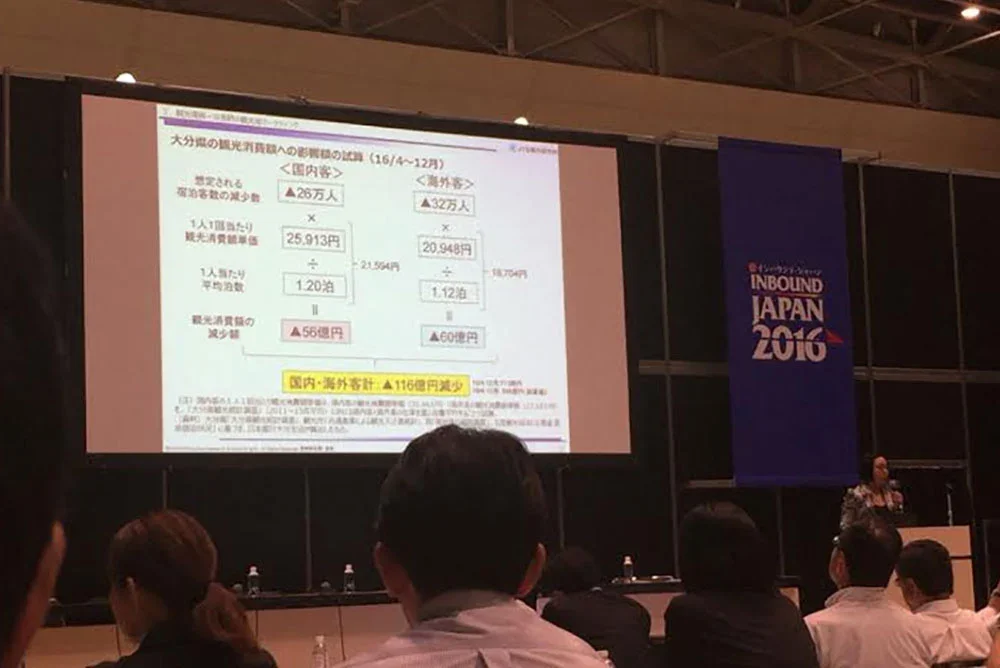
・Regarding the impact of the Kumamoto Earthquake on the lodging market and the status of recovery: Tourist numbers have decreased by 20% across Kyushu as a whole. In Oita Prefecture, the decline is 30–40%. While Fukuoka Prefecture is seeing an increase due to reconstruction demand, Nagasaki and Kagoshima Prefectures have seen a 20% decline due to reputational damage. In particular, areas such as Yufuin, Unzen, and Ibusuki have experienced a drop of more than 50%.
・During disasters, conveying accurate information is crucial, and social media has become the most effective tool for this purpose. Immediately after the Kumamoto Earthquake, a public-private project team was formed. Social media proved to be the most useful tool in the project team’s activities. Using platforms like Facebook, the mayor personally shared meeting minutes (disclosing decisions) and other information
・To revive tourism, it is effective to consider the order and channels of information dissemination based on target audiences. The recovery of tourists proceeds in the following order: online, individual travelers, and overseas group tourists. It is essential to determine the appropriate timing for each market and promote communication and promotion accordingly
・Even with the same media, how consumers perceive it varies depending on the situation. Even people who are typically skeptical of the media often wait for and trust media information during a disaster. Therefore, it is crucial to determine “who” will disseminate “what kind of information” in each specific situation.
著者













