
Infectious Disease Control × Evacuation Center Management—A Case Study from the Response to Typhoon No. 10 in 2020—

Typhoon No. 10, which formed on September 1, 2020, was expected to pass through the Daito Islands and the Amami region of Okinawa Prefecture from the 6th to the 7th and make landfall in the Kyushu region while still at “Special Warning” intensity. Combined with the impact of Typhoon No. 9, which had arrived shortly before, authorities announced the need for sufficient preparatory measures in advance.Ultimately, however, because Typhoon No. 9—which had moved northward through the East China Sea the previous week—had followed a similar path, the seawater was churned up and the sea surface temperature dropped, causing the typhoon to develop less than initially predicted.
Given the frequent flood damage across the country in recent years, it seems that calls for preemptive evacuation in response to this typhoon were made quite proactively; however, what is particularly noteworthy is that evacuation center operations this time had to be conducted while taking COVID-19 countermeasures into account.
Based on interviews with staff members involved in managing evacuation shelters in Nagasaki Prefecture, we have summarized the preparations and on-site conditions regarding evacuation shelter operations in light of COVID-19 countermeasures as follows.
Evacuation Shelter Conditions
- Evacuees were predominantly women, and the proportion of elderly people was high.
- September 6: Evacuees began arriving around 5:00 p.m.
- By noon on September 7, nearly all evacuees had returned home
COVID-19 Countermeasures
- Health checks (temperature checks, questionnaires, etc.) are conducted upon
arrival. *While temperature checks are often the only measure taken, it would be even better if staff could ask about symptoms such as shortness of breath (respiratory distress) or severe fatigue (malaise). - Strict enforcement of mask-wearing and hand sanitization
- To prevent crowding, lay out mats in designated waiting areas in advance to maintain spacing and assign fixed spots
- Open windows as much as possible to ensure good ventilation
Challenges
[Regarding the General Operation of Evacuation Centers]
- Lack of Operational
Guidelines There are no guidelines for shelter operations, so decisions are made on a case-by-case basis by staff and evacuees. While differences between shelters are inevitable, minimum standards are necessary. - Air Conditioning
: The air conditioning system at local community centers operates on a pay-per-use basis (100 yen per hour). Based on on-site judgment, staff were forced to pay for the air conditioning out of their own pockets. - Lack of Communication with Local Communities: When
using facilities owned by neighborhood associations as “sub-evacuation centers,” advance notification was required; however, the department responsible for opening evacuation centers failed to notify the relevant parties, leading to issues such as not having the keys.
[Regarding COVID-19 Countermeasures]
- Lack of Operational Guidelines: Problems arose, such as crowds concentrating
at popular evacuation centers due to their location or environmental factors (e.g., the age of the building). - Lack of Supplies
: At “sub-evacuation centers,” which are rarely opened, routine operational management was lacking; as a result, disinfection supplies were not provided, and in some cases, staff had to rely on their own personal items (brought from home). - Burden on Evacuation Shelter Staff To avoid
overcrowding, authorities dispersed evacuees across a large number of shelters rather than accommodating large numbers in a single facility. Consequently, more staff were needed than ever before, leading to personnel shortages; at some shelters, staff were unable to work in two shifts and ended up working for more than 24 hours straight.
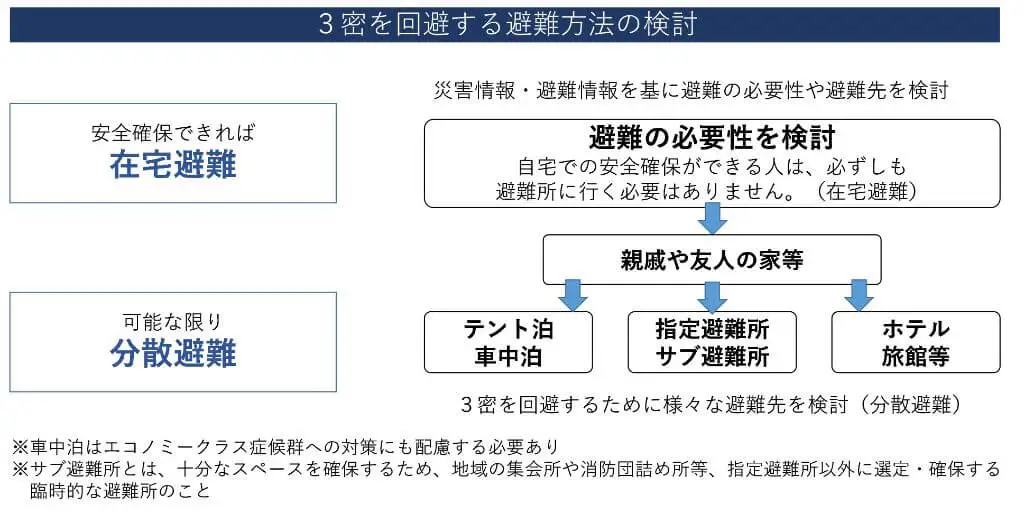
Evacuation shelters are spaces where people gather, congregate in close proximity, and stay for extended periods, making them prone to becoming airtight. Since there has been no legal requirement to address “airtight” conditions until now, there are many cases where it is unclear “how many minutes it takes to ventilate the space.”Since the Building Management Act specifies a carbon dioxide concentration limit (1,000 ppm or less) as the criterion for a “sealed” environment, it is also effective to determine in advance how many people staying for approximately how many hours could result in such conditions.
Furthermore, depending on the disaster situation, people may have to stay for two or more consecutive days. During that time, because there are many shared spaces and facilities—such as restrooms and water fountains—the risk of contact transmission is high.
Furthermore, when planning to disperse people across numerous evacuation shelters as a measure against infectious diseases, as seen in the case of this year’s Typhoon No. 10, we face challenges such as a shortage of operational staff and insufficient supplies.
There are three key points for addressing these challenges.
The first is the recommendation for “distributed evacuation” mentioned above. Individuals should make the decision to seek refuge at “appropriate alternative locations to public evacuation shelters”—such as their own homes, the homes of relatives or friends, or their workplaces—to prevent a rush of people to evacuation shelters.In particular, for day-trippers who have not yet secured lodging, it is desirable to ensure thorough advance announcements so that they can be guided to evacuate to large tourist facilities or lodging facilities in safe locations (including arrangements for overnight stays)—rather than to designated evacuation shelters where they would mix with residents—in order to thoroughly identify their pre- and post-trip lodging arrangements and facilitate their prompt return home.
Next, as a self-reliance measure, people should “add infection prevention supplies to their existing emergency kits.”The number of people arriving at evacuation shelters is unpredictable. Even if multiple shelters are designated, the number of people visiting them may vary. Consequently, if a shelter is forced to accommodate more people than anticipated, or if evacuees end up staying longer than expected, the infection control supplies prepared in advance by the shelter operators may run out.It is also important to include hygiene supplies that individuals can prepare on their own—such as thermometers, masks, disinfectant, sanitizing wipes, disposable vinyl gloves, and plastic wrap—in your evacuation kit in advance.
Finally, “mutual aid.” Given that the number of evacuation shelters is expected to increase in the future to avoid overcrowding, local volunteer disaster prevention organizations and municipalities must collaborate to establish agreements and rules defining their respective roles in advance. Creating a system that does not rely solely on government officials will ensure smooth preparations for the opening and operation of numerous evacuation shelters, leading to a swift and comprehensive response.
著者













